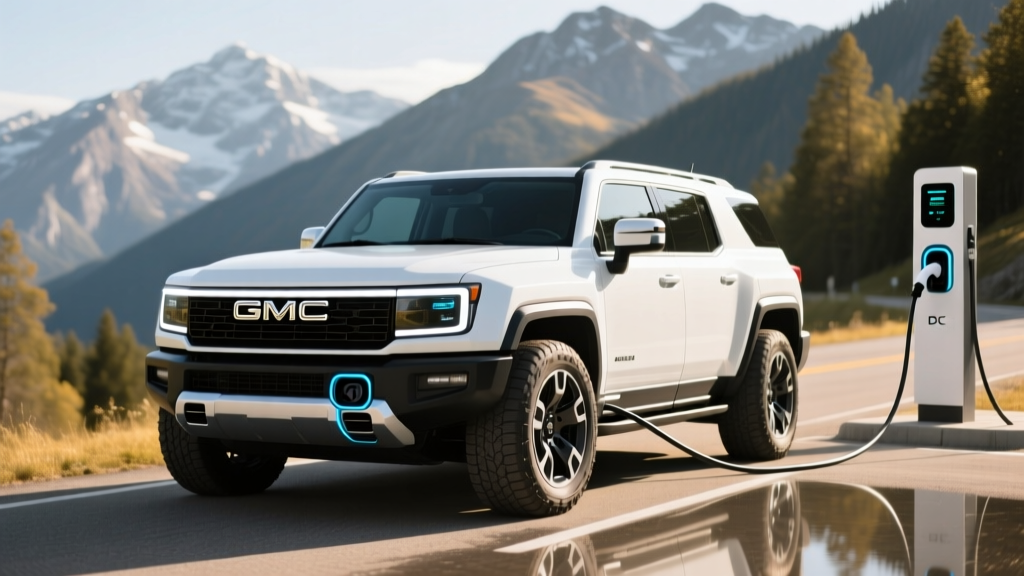
The Verdict: A 9,000-Pound Electric Statement
The 2024 GMC Hummer EV SUV is less a family hauler and more an engineering showcase wrapped in a 10,000-pound-GVWR fortress. Built on GM's Ultium platform with a 24-module double-stacked battery and up to 830 horsepower via the Watts to Freedom launch mode, it exists in a category of one. If you need to tow 7,500 pounds, ford 26 inches of water, and extract the attention of every parking lot you enter — all on electrons — there is literally no substitute. But at a starting MSRP north of $98,000 and with real-world highway range closer to 250 miles than the EPA sticker suggests, the Hummer EV SUV demands buyers who want the spectacle and accept the compromises.
Spec Sheet: 2024 GMC Hummer EV SUV by the Numbers
| Specification | 2X Trim | 3X Trim |
|---|---|---|
| EPA Range | 314 miles | 314 miles |
| Battery (usable) | ~212 kWh (NMC, 24 modules, double-stack) | ~212 kWh (NMC, 24 modules, double-stack) |
| Drivetrain | Dual-motor AWD | Tri-motor AWD |
| Horsepower | 625 hp | 830 hp (Watts to Freedom) |
| 0–60 mph | ~3.5 sec | ~3.0 sec (WTF mode) |
| Max DC Fast Charge | 350 kW (peak) | 350 kW (peak) |
| 10–80% DCFC Time | ~34 minutes | ~34 minutes |
| Level 2 Home Charge | 11.5 kW / ~16 mi/hr | 11.5 kW / ~16 mi/hr |
| MPGe (combined) | 47 MPGe | 47 MPGe |
| Efficiency | ~72 kWh/100 mi | ~72 kWh/100 mi |
| Towing Capacity | 7,500 lbs | 7,500 lbs |
| Cargo Volume (rear seats up) | 35.9 cu ft | 35.9 cu ft |
| Cargo Volume (seats folded) | 81.8 cu ft | 81.8 cu ft |
| Base MSRP | $98,845 | $106,295 |
| Battery Warranty | 8 yr / 100,000 mi | 8 yr / 100,000 mi |
Source: GMC official specs and EPA fueleconomy.gov.
Range and Efficiency: EPA Sticker vs. Real World
Real-World Expectation: ~240–270 miles at sustained highway speeds (70–80 mph); ~200–230 miles in cold weather (below 30°F) with cabin heating; up to 300+ miles in mild city/suburban driving with regen.
The 2024 Hummer EV SUV's 314-mile EPA figure is impressive for a vehicle that weighs over 9,000 pounds, but physics is undefeated. The Hummer's brick-like aerodynamic profile (Cd is not published but is estimated above 0.40) and massive frontal area mean highway efficiency drops sharply above 65 mph. In EPA testing, the combined cycle yields 47 MPGe, which translates to roughly 72 kWh consumed per 100 miles — about three times what a Tesla Model Y uses for the same distance.
For daily commuting under 50 miles round-trip, the Hummer EV SUV's battery is massively overbuilt, which ironically means you'll rarely need to charge daily. But on road trips, plan for stops every 220–250 miles in warm weather and every 180–210 miles in winter. The enormous 212 kWh usable battery (GM has not published an official usable figure; this is derived from module count and cell capacity) takes a long time to fill, making charge-stop duration a real trip-planning factor.
Charging: 350 kW Peaks, But the Curve Tells the Story
| Charging Level | Power (kW) | Speed (miles of range added) | Time (10–80%) |
|---|---|---|---|
| Level 1 (120V, 12A) | ~1.4 kW | ~2 mi/hr | N/A (multi-day) |
| Level 2 (240V, 48A) | 11.5 kW | ~16 mi/hr | ~18–20 hours (full) |
| DC Fast Charge (peak) | 350 kW | ~100 mi in ~12 min (peak) | ~34 minutes |
The 350 kW peak DC fast-charge capability requires a 800-volt-capable CCS station (such as Electrify America's 350 kW stalls or Tesla Superchargers with the GM-approved NACS adapter, available starting 2025 model year). However, the Hummer's massive battery means sustained charge rates matter more than peak rates. The charge curve holds above 200 kW through roughly 40% state of charge, then tapers significantly. The 10–80% time of approximately 34 minutes is competitive given the battery size, but the absolute energy transferred (~150 kWh) is enormous.
Home charging on a 48-amp Level 2 circuit adds about 16 miles of range per hour, meaning a full recharge from 10% takes roughly 18–20 hours. Most owners will charge nightly from 30–40% and rarely see a full charge — which is fine for battery longevity. A 200-amp electrical panel is typically sufficient, but the Hummer's appetite makes a dedicated 60-amp circuit (for 48A continuous draw) strongly recommended. Budget $800–$2,000 for professional Level 2 installation depending on panel proximity and local permitting.
Performance: 830 Horsepower in a 9,000-Pound Package
The 3X trim's tri-motor setup (one front, two rear) produces 830 horsepower and an estimated 1,200 lb-ft of torque in Watts to Freedom (WTF) launch mode. GMC quotes 0–60 mph in approximately 3.0 seconds — a number that defies the Hummer's mass and feels surreal when experienced in person. The 2X trim's dual-motor configuration delivers 625 hp and a 3.5-second 0–60, which is still sports-car territory.
Performance isn't just straight-line. The available four-wheel steering (standard on 3X) gives the Hummer EV SUV a turning circle tighter than many compact SUVs, and the CrabWalk diagonal-drive mode allows the rear wheels to steer up to 10 degrees in the same direction as the fronts, letting the vehicle move diagonally — useful on tight trails, mostly a party trick in parking lots. Air suspension with Extract Mode raises the ride height by nearly 6 inches for off-road obstacles, yielding 15.9 inches of ground clearance at maximum.
The trade-off: at 9,046 pounds curb weight (3X), the Hummer EV SUV chews through tires (expect 25,000–35,000 miles on the 35-inch Goodyear Wranglers), demands premium brake-pad attention despite heavy regen braking, and will not be mistaken for a canyon carver. It rides comfortably and quietly on the highway, but body roll is noticeable in corners.
Interior, Cargo, and Tech: Big Screen, Big Cabin, Some Quirks
The Hummer EV SUV seats five across two rows with generous space. Front legroom is 42.5 inches; rear legroom is 38.9 inches. Cargo volume is 35.9 cubic feet behind the second row and 81.8 cubic feet with seats folded — competitive with a mid-size SUV but less than you might expect given the vehicle's exterior footprint, due to the double-stacked battery consuming floor height.
A modest front trunk (frunk) adds weather-sealed storage, though it's smaller than the Rivian R1S frunk due to the front motor and power electronics occupying space.
The infotainment system runs on a 13.4-inch touchscreen with Google Built-In (Maps, Assistant, Play Store), wireless Apple CarPlay and Android Auto, and a 12.3-inch driver display. The available UltraVision camera system provides up to 18 camera views, including underbody cameras for off-road navigation — genuinely useful on trails, excessive on pavement.
Driver assistance comes via GM's Super Cruise on the 3X trim (and available on 2X with the Technology Package). Super Cruise is an SAE Level 2 hands-free driving system on pre-mapped divided highways. The driver must remain attentive — an infrared camera monitors eye gaze — and the system disengages on unmapped roads, construction zones, and inclement weather. It is not autonomous driving; it is a highly capable highway assist that reduces fatigue on long trips.
Pricing, Trims, and Federal Tax Credit Eligibility
| Trim | Base MSRP | Destination | As-Tested (typical) | §30D Credit Eligible? |
|---|---|---|---|---|
| 2X | $98,845 | $1,995 | $100,840–$112,000 | No (exceeds SUV MSRP cap) |
| 3X | $106,295 | $1,995 | $108,290–$125,000+ | No (exceeds SUV MSRP cap) |
- MSRP Cap: The §30D credit caps eligible SUVs at $80,000 MSRP. The Hummer EV SUV starts at $98,845 — well above the limit.
- Buyer Income Cap: Even if the price qualified, buyers must fall under $150,000 (single) / $300,000 (joint) AGI.
- Battery Sourcing: Critical minerals and battery component sourcing requirements must be met; GM's Ultium batteries use a mix of domestic and imported cells.
- Point-of-Sale Transfer: Available for eligible vehicles starting 2024, but irrelevant here due to the MSRP cap.
Source: IRS §30D guidance. Consult a tax professional for your specific situation.
No federal purchase incentive applies. Some states offer additional rebates or HOV-lane access for EVs regardless of price — check your local DMV or energy office. For buyers in this price bracket, the absence of the $7,500 credit is unlikely a deal-breaker, but it does widen the cost gap versus competitors like the Rivian R1S (which also exceeds the cap on most trims) or the Tesla Model X (similarly ineligible on higher trims).
Warranty and Long-Term Ownership Costs
GMC covers the Hummer EV SUV's battery and drive unit powertrain components for 8 years or 100,000 miles (whichever comes first), with a capacity retention threshold of 70% — consistent with GM's EV warranty across the Ultium lineup. The bumper-to-bumper warranty is 3 years / 36,000 miles, which is average for the segment.
Ownership costs to budget for beyond the purchase price:
- Tires: 35-inch Goodyear Wrangler Territory MTs run $400–$500 each; expect replacement every 25,000–35,000 miles given the weight.
- Insurance: Average annual premium is $3,200–$4,500 depending on state, age, and driving record — significantly above average due to repair costs and vehicle value.
- Charging cost: At the national average residential rate of $0.16/kWh, a full home charge costs roughly $34 and yields ~250 real-world miles, or about $0.14/mile. DC fast charging at $0.40–$0.50/kWh pushes that to $0.35–$0.45/mile on road trips.
- Depreciation: Early data suggests the Hummer EV SUV holds value better than average luxury EVs due to limited supply and enthusiast demand, but long-term depreciation for a six-figure EV remains uncertain.
Who Should Buy the 2024 GMC Hummer EV SUV?
- You need genuine off-road capability (4WD, locking diffs, 15.9" ground clearance) with zero tailpipe emissions.
- You tow a boat, camper, or horse trailer (7,500-lb capacity) and want electric torque for the job.
- You want a conversation-starter that no other EV on the road can match in presence.
- Your daily commute is short and you have reliable home Level 2 charging.
- Efficiency and range-per-dollar are priorities (a Tesla Model X or Rivian R1S delivers similar utility with better MPGe).
- You need three-row seating for six or seven passengers (the Hummer is strictly two-row/five-passenger).
- You road-trip frequently in cold climates where range drops to ~200 miles and charging stops add up.
- You want the $7,500 federal tax credit to offset purchase cost.
Pros and Cons
- 830 hp tri-motor performance defies its mass
- Genuine off-road hardware (locking diffs, Extract Mode, CrabWalk)
- 314-mile EPA range is strong for a 9,000-lb vehicle
- 350 kW DC fast-charge capability
- Super Cruise hands-free highway driving (3X)
- 7,500-lb towing capacity
- Unique — nothing else looks or drives like it
- Starts at $98,845; no federal tax credit eligibility
- Efficiency of ~72 kWh/100 mi makes charging expensive on the road
- Real-world highway range ~240–270 miles; less in cold weather
- Two-row, five-passenger seating only (no third row)
- Extreme weight accelerates tire wear
- Cargo space modest relative to exterior size
- Charging a 212 kWh battery takes time — 34 min for 10–80% is best case
Frequently Asked Questions
What is the real-world range of the 2024 GMC Hummer EV SUV?
The EPA rates it at 314 miles, but real-world highway driving at 70–80 mph yields approximately 240–270 miles. In cold weather (below 30°F), expect 200–230 miles. City driving with regenerative braking can approach the EPA figure.
How fast does the Hummer EV SUV charge at home and on the road?
On a 48-amp Level 2 home charger (11.5 kW), it adds about 16 miles of range per hour, with a full charge taking 18–20 hours. On a 350 kW DC fast charger, it can add 100 miles in about 12 minutes at peak rate, with a 10–80% charge taking approximately 34 minutes.
Does the 2024 GMC Hummer EV SUV qualify for the $7,500 federal EV tax credit?
No. The IRS §30D credit caps eligible SUVs at an $80,000 MSRP. The Hummer EV SUV starts at $98,845, making it ineligible regardless of buyer income or battery sourcing. Consult IRS guidance or a tax professional for details.
Is the Hummer EV SUV worth buying vs. the Rivian R1S or Tesla Model X?
The Rivian R1S (starting ~$79,900) offers three-row seating, strong off-road capability, and better efficiency, though its range is lower on most trims. The Tesla Model X (~$79,990) delivers superior efficiency, access to the Supercharger network natively, and falcon-wing doors, but lacks serious off-road hardware. The Hummer EV SUV wins on sheer presence, towing, and off-road extremes, but costs significantly more and seats only five.
What is the biggest drawback of owning a Hummer EV SUV?
Efficiency and charging time. At ~72 kWh/100 miles, it consumes energy at three times the rate of a crossover EV, making DC fast-charging road trips expensive ($0.35–$0.45/mile at commercial rates) and requiring longer stops due to the massive battery. Combined with cold-weather range loss, road-trip planning requires more discipline than in lighter, more aerodynamic EVs.
Does Super Cruise make the Hummer EV SUV self-driving?
No. Super Cruise is an SAE Level 2 driver-assistance system. It provides hands-free steering, acceleration, and braking on pre-mapped divided highways, but the driver must remain attentive and ready to take over at any time. The vehicle monitors eye gaze and will issue warnings and disengage if the driver is not paying attention.