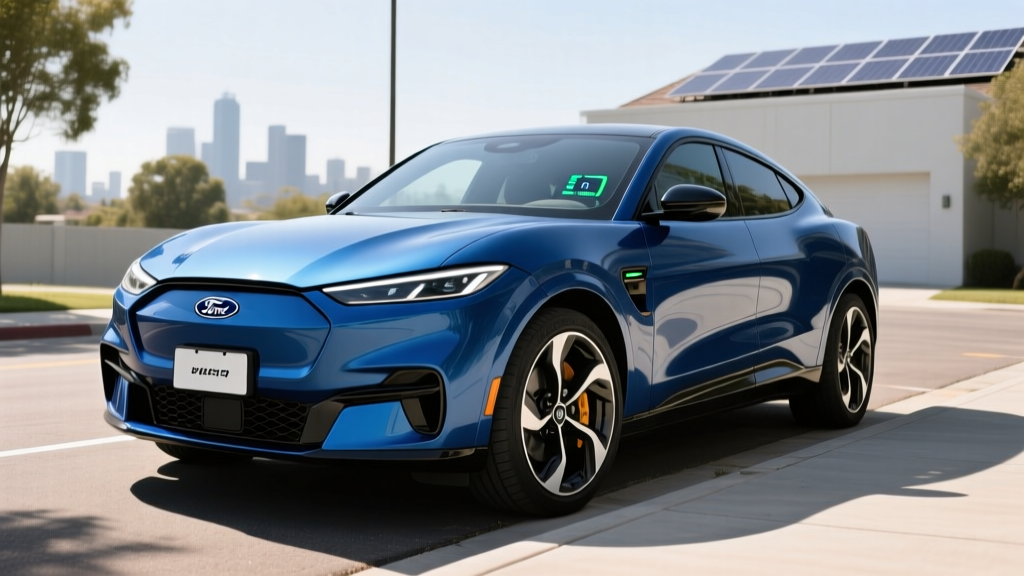
The 2024 Ford Mustang Mach-E occupies a critical space in the electric crossover market: it's one of the few EVs that pairs a recognizable performance nameplate with practical daily usability, and it undercuts the Tesla Model Y on price while offering a more conventional crossover driving experience. After extensive time with multiple trims — from the base Select to the GT Performance Edition — here's what the numbers actually tell prospective buyers about range, charging, cost, and whether the Mach-E earns its Mustang badge.
Range, Efficiency, and the Real-World Reality Check
The Mach-E's range varies significantly depending on battery pack, drivetrain, and trim. Ford offers two battery options for 2024: a Standard Range pack (70 kWh usable) and an Extended Range pack (91 kWh usable). Both use NMC (nickel manganese cobalt) lithium-ion chemistry, which prioritizes energy density over the longer cycle life of LFP packs found in some competitors.
The Extended Range RWD California Route 1 achieves an EPA-estimated 320 miles. In real-world highway driving at 70-75 mph, expect approximately 260-280 miles before needing to charge. In cold weather (below 30°F), range drops further — plan for roughly 220-240 miles on the Extended RWD. The AWD Extended Range (GT and Premium trims) is EPA-rated at 290-305 miles; expect ~240-260 miles highway and ~200-220 miles in winter conditions. The Standard Range AWD is EPA-rated at 230 miles; real-world highway use yields ~185-200 miles.
| Trim / Configuration | Battery (kWh usable) | EPA Range (mi) | Combined MPGe | kWh/100 mi |
|---|---|---|---|---|
| Select RWD (Std Range) | 70 | 250 | 101 | 33 |
| Select AWD (Std Range) | 70 | 230 | 93 | 36 |
| Premium RWD (Ext Range) | 91 | 310 | 101 | 33 |
| Premium eAWD (Ext Range) | 91 | 290 | 94 | 36 |
| California Route 1 RWD (Ext Range) | 91 | 320 | 103 | 32 |
| GT eAWD (Ext Range) | 91 | 290 | 86 | 39 |
| GT Perf. Edition eAWD | 91 | 280 | 84 | 40 |
Source: EPA fueleconomy.gov
The efficiency numbers (kWh/100 mi) reveal why the GT trims sacrifice range: the dual-motor performance setup and stickier summer tires increase rolling resistance and energy consumption. If range is your priority, the California Route 1 RWD is the efficiency sweet spot.
Charging Speed: DC Fast Charging and Home Level 2
Charging is where the Mach-E shows both its strengths and its limitations relative to the fastest-charging competitors. Here's the full breakdown:
| Charging Level | Max Rate | Speed (mi/hr or time) | Notes |
|---|---|---|---|
| Level 1 (120V household) | ~1.4 kW | ~3-5 mi/hr | Emergency/trickle only; 70+ hrs for full charge |
| Level 2 (240V, 48A) | 10.5 kW | ~28-33 mi/hr | Full charge in ~9-10 hrs (Ext Range); Ford Mobile Power Cord included |
| DC Fast Charge (Std Range) | 115 kW peak | 10-80% in ~38 min | CCS connector; tapers significantly above 80% |
| DC Fast Charge (Ext Range) | 150 kW peak | 10-80% in ~35 min | Sustains ~130-140 kW through mid-SoC; curve tapers hard past 80% |
Charging curve reality: The 150 kW peak on Extended Range models is achievable at roughly 20-40% state of charge (SoC) on a compatible 150+ kW DC fast charger. From 40-60%, speeds typically hold around 120-135 kW. Above 80% SoC, charging slows dramatically to protect battery health — expect 50 kW or less, which is why Ford and most EV experts recommend charging to 80% on road trips rather than waiting for a full charge. The Standard Range pack's 115 kW peak is noticeably slower, adding roughly 10 minutes to a 10-80% session versus the Extended Range.
For home charging, the Mach-E's onboard charger accepts up to 10.5 kW (48 amps at 240V). This is competitive but not class-leading — the Hyundai Ioniq 5 accepts 10.9 kW, while the Tesla Model Y accepts 11.5 kW on a Wall Connector. A typical overnight charge from 20% to 100% on the Extended Range pack takes roughly 9-10 hours on a properly installed Level 2 home station. The Ford Mobile Power Cord (included) can deliver up to 30 amps on a 240V NEMA 14-50 outlet, yielding about 6.6 kW — adequate for most daily needs but slower for large replenishments.
Performance: 0-60, Horsepower, and Drivetrain Options
The Mustang name isn't just branding — the GT trims genuinely deliver sports-car acceleration. Here's the performance matrix:
| Trim | Horsepower | Torque (lb-ft) | 0-60 mph | Drivetrain |
|---|---|---|---|---|
| Select (RWD) | 266 hp | 317 | ~6.3 sec | RWD (single motor) |
| Select / Premium (eAWD) | 346 hp | 428 | ~5.1 sec | eAWD (dual motor) |
| GT | 480 hp | 600 | ~3.8 sec | eAWD (dual motor) |
| GT Performance Edition | 480 hp | 634 | ~3.5 sec | eAWD (dual motor) |
The GT Performance Edition's 3.5-second 0-60 time puts it in genuine sports-car territory — comparable to a Porsche Cayenne Coupe or BMW X5 M in straight-line acceleration, at a fraction of the price. The standard eAWD models' 5.1-second 0-60 is brisk for a family crossover and more than adequate for highway merging and passing.
One practical note: the Mach-E is not rated for towing in most configurations. Ford lists a maximum towing capacity of 1,500 lbs for the GT with the optional towing package — far below the Tesla Model Y's 3,500-lb rating. If towing is a priority, look elsewhere.
Pricing, Trims, and Federal Tax Credit Eligibility
The 2024 Mach-E lineup spans five trims. Ford reduced prices for the 2024 model year to improve competitiveness, and several trims qualify for the federal EV tax credit under IRS §30D rules.
| Trim | Base MSRP | Est. As-Tested | §30D Credit Eligible? |
|---|---|---|---|
| Select RWD | $39,995 | $42,500 | Up to $7,500* |
| Select eAWD | $42,995 | $45,500 | Up to $7,500* |
| Premium RWD (Ext Range) | $48,995 | $52,000 | Up to $7,500* |
| Premium eAWD (Ext Range) | $51,995 | $55,000 | Up to $7,500* |
| California Route 1 RWD | $46,995 | $48,500 | Up to $7,500* |
| GT eAWD | $59,995 | $64,000 | Up to $7,500* |
| GT Perf. Edition | $64,995 | $68,000 | Up to $7,500* |
*Destination charge (~$1,495) additional. As-tested prices reflect common option packages.
- MSRP Cap: SUVs/crossovers must be under $80,000 — all Mach-E trims qualify.
- Buyer Income Cap: Modified AGI must not exceed $150,000 (single), $225,000 (head of household), or $300,000 (joint filing).
- Battery Sourcing: The full $7,500 requires meeting both critical minerals ($3,750) and battery component ($3,750) thresholds. The Mach-E is assembled in Cuautitlán, Mexico, and Ford has worked to shift battery component sourcing to comply. Verify current eligibility at fueleconomy.gov before purchasing.
- Point-of-Sale Transfer: As of 2024, buyers can transfer the credit to the dealer at purchase, reducing the purchase price directly rather than waiting for a tax refund.
- Important: Credit eligibility can change mid-year based on Treasury guidance. Confirm with your dealer and a tax professional. See IRS.gov §30D for current rules.
Interior Space, Cargo, and Daily Practicality
The Mach-E's cabin is one of its strongest selling points relative to the Model Y. The interior materials, fit and finish, and noise isolation feel a tier above Tesla's minimalist approach.
| Measurement | Mach-E | Model Y (comparison) |
|---|---|---|
| Cargo behind rear seats | 29.7 cu ft | 30.2 cu ft |
| Cargo (rear seats folded) | 59.7 cu ft | 72.0 cu ft |
| Front trunk (frunk) | 4.7 cu ft | 4.1 cu ft |
| Front legroom | 43.3 in | 41.8 in |
| Rear legroom | 38.1 in | 41.6 in |
| Passenger volume | 104.5 cu ft | 106.0 cu ft |
The Mach-E wins on front-seat comfort and legroom but concedes cargo space with seats folded to the Model Y. The frunk is drainable and useful for wet items or charging cables. Rear-seat headroom is adequate for adults up to about 6'2", though the sloping roofline cuts into space for taller passengers.
Tech, Driver Assistance, and Standout Features
The Mach-E centers its tech experience around a massive 15.5-inch portrait touchscreen running Ford's SYNC 4A system. The interface is responsive, supports wireless Apple CarPlay and Android Auto, and includes an integrated physical volume knob at the bottom — a practical choice that Tesla owners often wish they had.
Ford BlueCruise (SAE Level 2): Available on Premium and GT trims (and optional on Select), BlueCruise enables hands-free driving on over 130,000 miles of pre-mapped divided highways. A driver-facing camera monitors your attention. This is not self-driving — it is an SAE Level 2 driver-assist system, meaning you must remain alert and ready to take over at any moment. In testing, BlueCruise performs well on interstate highways but disengages on unmapped roads, construction zones, and in heavy rain or snow. The system requires a subscription after the initial trial period (typically 90 days free, then ~$75/month or $800/year).
Other notable tech:
- Ford Power-Up OTA (over-the-air) software updates that can add features and improve performance remotely
- Phone-as-a-key via the FordPass app (unlock, start, and drive without a fob)
- Intelligent Range system that factors in weather, terrain, and driving habits for more accurate range predictions
- Available B&O 10-speaker premium audio system
- One-pedal driving mode with adjustable regenerative braking
Warranty and Long-Term Battery Confidence
Ford backs the Mach-E with competitive warranty coverage:
- Bumper-to-bumper: 3 years / 36,000 miles
- Powertrain: 5 years / 60,000 miles
- EV Battery & Components: 8 years / 100,000 miles (retains at least 70% of original capacity)
- Corrosion: 5 years / unlimited miles
The 8-year/100,000-mile battery warranty with a 70% capacity retention floor is industry-standard, matching Tesla, Hyundai, and Kia. Real-world degradation data from early 2021-2022 Mach-E owners suggests the NMC packs hold up well — most owners report 3-5% degradation in the first two years, with the curve flattening thereafter. Ford's thermal management system (liquid-cooled) is a key factor in preserving battery health across climates.
If a battery replacement were ever needed out of warranty, current estimates for the Extended Range 91 kWh pack run $15,000-$22,000 including labor — a significant cost, though battery prices continue to decline and full replacements remain rare within the first 10 years of ownership.
Pros and Cons: The Honest Scorecard
- Up to 320 mi EPA range (California Route 1)
- GT delivers genuine 3.5-sec 0-60 performance
- BlueCruise hands-free highway driving is refined
- Spacious, well-finished interior with physical controls
- Eligible for up to $7,500 federal tax credit
- Ford dealer network for service access
- Competitive pricing after 2024 price cuts
- Phone-as-a-key and OTA updates
- 150 kW peak DC charging is slower than Hyundai/Kia (240 kW) and Tesla (250 kW)
- Real-world highway range drops 15-20% below EPA
- Cold-weather range loss significant (20-30%)
- Rear legroom trails Model Y by 3.5 inches
- Towing limited to 1,500 lbs (GT only)
- BlueCruise requires paid subscription after trial
- No heat pump on all trims (reduces winter efficiency)
- Standard Range pack charges at only 115 kW peak
Who Should Buy the 2024 Mustang Mach-E?
- You want a premium electric crossover with a traditional automaker's build quality and dealer support
- You prefer physical controls and a more conventional infotainment layout over Tesla's minimalism
- Performance matters — the GT trims offer sports-car acceleration in a practical package
- You primarily commute and take moderate road trips (200-280 miles between charges)
- You qualify for the §30D tax credit and want a point-of-sale price reduction
Look elsewhere if:
- You need maximum cargo space (Model Y offers 72 cu ft vs. 59.7 cu ft)
- You frequently drive 300+ miles in cold weather and need the longest possible real-world range
- Fastest DC charging speed is your top priority (Ioniq 5, EV6, and Tesla charge faster)
- You need to tow more than 1,500 lbs
- You want access to the Tesla Supercharger network without an adapter (though Ford has announced NACS access agreements for future models)
How It Compares: Mach-E vs. Key Rivals
| Spec | Mach-E Premium eAWD | Tesla Model Y LR AWD | Hyundai Ioniq 5 AWD |
|---|---|---|---|
| EPA Range | 290 mi | 304 mi | 290 mi |
| Battery (kWh) | 91 | ~75 | 77.4 |
| Peak DC Charge | 150 kW | 250 kW | 240 kW |
| 10-80% DC Time | ~35 min | ~20 min | ~18 min |
| 0-60 mph | 5.1 sec | 4.8 sec | 5.1 sec |
| Horsepower | 346 hp | 384 hp | 320 hp |
| Cargo (rear up) | 29.7 cu ft | 30.2 cu ft | 27.2 cu ft |
| Base MSRP | $51,995 | $48,990 | $50,100 |
| §30D Credit | Up to $7,500 | Up to $7,500 | Up to $7,500 |
The Mach-E trades blows with the Ioniq 5 on range and performance but falls behind on charging speed — Hyundai's 800V architecture enables 240 kW peak charging and 18-minute 10-80% sessions. The Model Y leads in efficiency and Supercharger network access. The Mach-E's advantage is build quality, ride comfort, and a more traditional ownership experience through Ford's extensive dealer network.
Frequently Asked Questions
What is the real-world range of the 2024 Ford Mustang Mach-E?
The EPA rates the best-case Mach-E (California Route 1 RWD, Extended Range) at 320 miles. In real-world highway driving, expect 260-280 miles. In cold weather below 30°F, plan for 220-240 miles. The GT Performance Edition, EPA-rated at 280 miles, delivers roughly 230-250 miles on the highway and as low as 190-210 miles in winter.
How fast does the Mach-E charge at home and on the road?
On a Level 2 home charger (240V, 48A), the Mach-E accepts up to 10.5 kW, adding roughly 28-33 miles of range per hour — enough for a full overnight charge. On DC fast chargers, Extended Range models peak at 150 kW and charge from 10-80% in about 35 minutes. Standard Range models peak at 115 kW, taking roughly 38 minutes for 10-80%.
Does the 2024 Mach-E qualify for the $7,500 federal EV tax credit?
Yes — all 2024 Mach-E trims fall under the $80,000 MSRP cap for SUVs/crossovers. However, the full $7,500 credit depends on battery component and critical mineral sourcing requirements, plus buyer income limits ($150K single / $300K joint). The credit can be transferred to the dealer at point of sale. Verify current eligibility at fueleconomy.gov and consult a tax professional.
Is the Mach-E worth buying over the Tesla Model Y or Hyundai Ioniq 5?
It depends on your priorities. Choose the Mach-E for superior build quality, physical controls, BlueCruise highway assist, and Ford dealer service access. Choose the Model Y for maximum cargo space, Supercharger access, and faster DC charging. Choose the Ioniq 5 for the fastest charging speeds (18 min 10-80%) and 800V architecture. The Mach-E is the best fit for buyers who value a refined, traditional-feeling crossover experience over bleeding-edge charging technology.
How long will the Mach-E battery last?
Ford warrants the battery for 8 years or 100,000 miles against degradation below 70% of original capacity. Real-world data from early Mach-E owners shows 3-5% degradation in the first two years, with the rate slowing thereafter. With proper care (avoiding frequent 100% charges, using preconditioning before DC fast charging), the NMC battery should retain 80%+ capacity through 150,000+ miles.
Does the Mach-E have a heat pump?
The 2024 Mach-E does not include a dedicated heat pump on all trims. Ford uses a resistive heating system combined with waste heat recovery from the powertrain. This means cold-weather range loss is more pronounced than in EVs with heat pumps (like the Ioniq 5 or Model Y). Expect 20-30% range reduction in sub-freezing temperatures versus 10-15% in heat-pump-equipped competitors.