Quick Verdict: The Mach-E Premium at a Glance
The 2024 Ford Mustang Mach-E Premium occupies a specific niche in the midsize electric SUV segment: it's the comfort-and-tech-oriented trim that sacrifices nothing in daily usability while offering a refined ride that the GT trim's stiff suspension doesn't. For buyers who want a practical, well-equipped electric crossover without stepping into luxury-badge pricing, the Premium with the Extended Range battery and rear-wheel drive delivers a compelling package — provided you understand its real-world range limitations and charging behavior.
This review breaks down every number that matters: EPA range versus what you'll actually see on the highway in January, the exact charging curve you'll experience at a DC fast charger, whether the §30D federal tax credit applies to your household, and how the Mach-E Premium stacks up against the Tesla Model Y Long Range and Hyundai Ioniq 5 in day-to-day ownership.
| Spec | Premium RWD Extended Range | Premium AWD Extended Range |
|---|---|---|
| EPA Range | 290 miles | 275 miles |
| Battery (Usable) | 91 kWh (NMC) | 91 kWh (NMC) |
| Horsepower | 290 hp | 346 hp |
| Torque | 324 lb-ft | 428 lb-ft |
| 0-60 mph | 6.1 sec | 5.1 sec |
| Max DC Fast Charge | 150 kW | 150 kW |
| 10-80% DC Time | ~38 min | ~38 min |
| Level 2 Home Charge | 10.5 kW (~30 mi/hr) | 10.5 kW (~30 mi/hr) |
| MPGe (City/Hwy/Combined) | 104 / 90 / 98 | 100 / 86 / 93 |
| Base MSRP | $48,995 | $51,995 |
| Battery Warranty | 8 yr / 100,000 mi | 8 yr / 100,000 mi |
Range and Efficiency: EPA Sticker vs. Real-World Miles
The 2024 Mach-E Premium with the Extended Range battery and rear-wheel drive carries an EPA-estimated 290 miles of range. The all-wheel-drive variant drops to 275 miles due to the additional front motor's weight and parasitic losses. These numbers come from the EPA's fueleconomy.gov database, which tests vehicles under controlled laboratory conditions.
Real-World Range Expectations
EPA Sticker: 290 miles (RWD) / 275 miles (AWD)
Highway (70-75 mph, moderate temps): Expect 245-265 miles. The Mach-E's boxy SUV profile creates more aerodynamic drag than a sedan, and sustained highway speeds above 70 mph erode range noticeably.
City/Suburban (mixed stop-and-go): 275-290 miles. Regenerative braking recovers energy effectively in traffic, often matching or slightly exceeding the EPA combined figure.
Cold Weather (below 32°F): 195-230 miles. NMC chemistry loses 20-30% of usable capacity in freezing temperatures, compounded by cabin heating demand. The Mach-E Premium includes a heat pump (standard on 2024 models), which mitigates some of this loss compared to resistive heating, but physics still wins.
Towing (if equipped): Not the Mach-E's strong suit. Ford rates it at just 1,500 lbs with the towing package — expect range to drop below 180 miles under load.
Efficiency on the RWD Extended Range model comes in at 98 MPGe combined, which translates to roughly 34 kWh per 100 miles. That's competitive with the Hyundai Ioniq 5 (101 MPGe combined for the RWD Long Range) but trails the Tesla Model Y Long Range AWD (117 MPGe combined), which benefits from superior aerodynamics and a lighter platform. The Mach-E is a heavier vehicle — approximately 4,800 lbs for the RWD Extended Range — and that mass shows up at the charger.
Charging: DC Fast Charging, Home Level 2, and the Curve
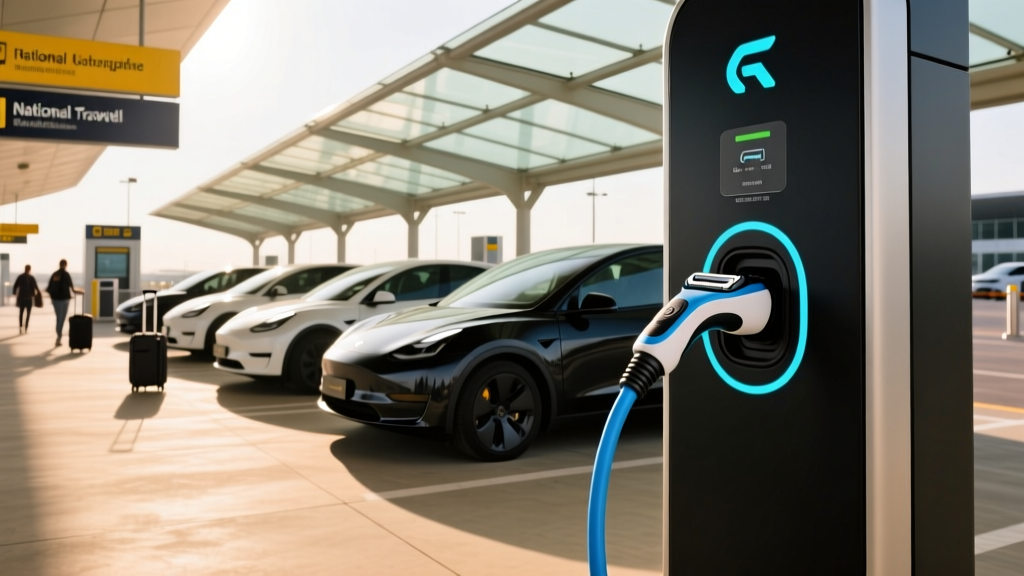
Ford equips the 2024 Mach-E Premium with a CCS1 (Combined Charging System) connector as standard. However, Ford has provided a NACS (Tesla-style) adapter to Mach-E owners since late 2023, and beginning with 2025 model-year vehicles, the native charge port is NACS. For the 2024 model, you'll use the adapter to access Tesla's Supercharger network — a significant practical advantage over competitors locked out of that infrastructure.
| Charging Level | Power (kW) | Speed | Notes |
|---|---|---|---|
| Level 1 (120V household) | ~1.4 kW | ~3-4 mi/hr | Emergency/top-off only |
| Level 2 (240V, Ford Mobile Charger) | ~6.6 kW | ~18 mi/hr | Included with vehicle; NEMA 14-50 outlet |
| Level 2 (240V, Ford Connected Charge Station) | 10.5 kW | ~30 mi/hr | Hardwired; 0-100% in ~9.5 hours |
| DC Fast Charge (CCS/NACS adapter) | 150 kW peak | 10-80% in ~38 min | Peak only at low SoC; tapers above 60% |
The critical detail most spec sheets bury: 150 kW is a peak, not a sustained rate. In real-world DC fast charging, the Mach-E's charge curve looks roughly like this:
- 10-40% SoC: Sustains near 140-150 kW. This is where the battery can accept maximum current.
- 40-60% SoC: Drops to 100-120 kW as the battery management system throttles input to protect cell health.
- 60-80% SoC: Falls further to 60-80 kW.
- Above 80%: Trickle charging, typically 25-40 kW. Plan your road-trip stops to charge to 80% and go.
This means a 10-80% session at a 150+ kW charger (like an Electrify America 350 kW stall or a Tesla V3 Supercharger via adapter) takes roughly 38 minutes. That's 10-15 minutes slower than the Hyundai Ioniq 5's 800V architecture, which sustains higher power deeper into the charge curve. For road trips where you stop every 2.5-3 hours, the difference is noticeable but not trip-ruining.
For home charging, the Ford Connected Charge Station (a rebranded ChargePoint Home Flex) delivers 10.5 kW on a 48-amp circuit, requiring a 60-amp breaker. A full charge from near-empty takes about 9.5 hours — fine for overnight replenishment. If your electrical panel supports a hardwired installation, budget $500-$1,200 for the unit plus electrician labor, depending on run length and whether a panel upgrade is needed. The included Ford Mobile Charger at 6.6 kW on a NEMA 14-50 outlet adds about 18 miles per hour of charging — adequate for lower-mileage commuters who can plug in every night.
Performance and Driving Dynamics
The RWD Premium with the Extended Range battery produces 290 horsepower and 324 lb-ft of torque from a single rear-mounted permanent-magnet synchronous motor. The 0-60 mph time of 6.1 seconds is brisk for a 4,800-pound SUV and more than adequate for highway merging and passing.
Opt for the AWD dual-motor configuration and output rises to 346 hp and 428 lb-ft, dropping the 0-60 time to 5.1 seconds. The AWD system is torque-biased rear under normal driving, engaging the front motor only when slip is detected or acceleration demands it. This preserves efficiency during steady-state cruising.
The Premium trim rides on a comfort-tuned suspension that absorbs highway expansion joints and urban potholes more gracefully than the GT's sport setup. Steering is light and accurate, if not particularly communicative. One-pedal driving mode provides aggressive regenerative deceleration — strong enough to bring the vehicle to a complete stop without touching the brake pedal in most city driving. The traditional brake pedal blends regen and friction braking seamlessly, though initial bite feels slightly soft, a common trait in heavier EVs managing regen handoff.
The Mach-E Premium is not a sports car despite the Mustang badge. Ford applied the name for marketing recognition, and the vehicle drives like a competent, quiet, well-isolated electric crossover. Buyers seeking track-day dynamics should look at the GT (480 hp, 3.8-second 0-60) or consider that the Mustang name here signals brand heritage rather than handling equivalence.
Interior, Cargo, and Technology
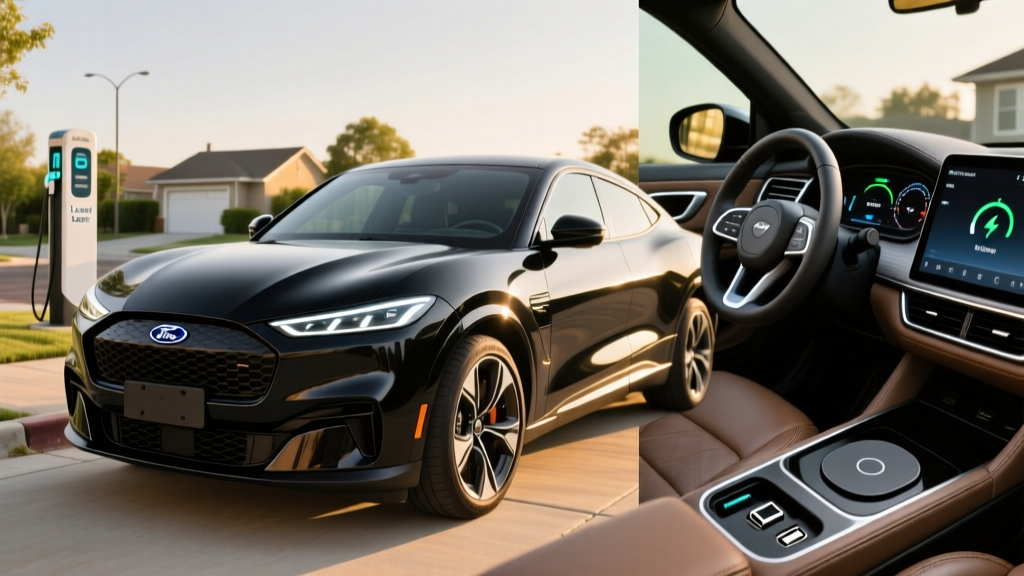
The Mach-E Premium's cabin is a step above the Select trim, with Synthetic leather (ActiveX) seating surfaces, a panoramic fixed glass roof, a 10.2-inch digital instrument cluster, and a vertically oriented 15.5-inch SYNC 4A touchscreen that dominates the center stack. The infotainment system supports wireless Apple CarPlay and Android Auto, over-the-air updates, and Ford's cloud-connected navigation with real-time traffic and charger availability.
Cargo volume:
- Behind rear seats: 29.7 cubic feet
- Rear seats folded: 59.7 cubic feet
- Front trunk (frunk): 4.7 cubic feet (drainable, useful for wet gear or groceries)
Passenger space:
- Front legroom: 43.3 inches
- Rear legroom: 38.9 inches
- Front headroom: 40.4 inches (reduced slightly by panoramic roof mechanism)
- Rear headroom: 38.2 inches
These dimensions are competitive with the Tesla Model Y (30.2 cu ft cargo, 41.8/39.4 legroom) and the Hyundai Ioniq 5 (27.2 cu ft cargo, 41.7/39.4 legroom). The Mach-E's rear seat is comfortable for two adults on longer trips, though the sloping roofline cuts into headroom for passengers over six feet tall.
Driver-Assistance Technology: The Premium trim includes Ford Co-Pilot360 Active 2.0, which bundles adaptive cruise control with stop-and-go, lane centering, and evasive steering assist. The available BlueCruise system (a subscription-based add-on after the initial trial period) enables hands-free driving on approximately 130,000 miles of pre-mapped divided highways in the United States.
SAE Automation Level: Level 2
BlueCruise is a Level 2 driver-assistance system per SAE International standards. This means the driver must remain attentive, keep eyes on the road (a driver-facing camera monitors gaze), and be prepared to take over steering and braking at any moment. It is not autonomous or self-driving. Only Level 4 services like Waymo One operate without a human driver engaged.
Pricing, Tax Credits, and Ownership Costs
The 2024 Mustang Mach-E Premium starts at $48,995 for RWD and $51,995 for AWD, before the $1,395 destination charge. Adding BlueCruise capability, panoramic roof (standard on Premium), and the Extended Range battery (also standard on Premium) means the Premium trim is already well-equipped at its base price. A fully optioned Premium AWD with upgraded wheels and paint can approach $55,000-$56,000.
| Trim | Base MSRP | Destination | §30D Credit (max) | Effective Price (if eligible) |
|---|---|---|---|---|
| Premium RWD Extended Range | $48,995 | $1,395 | Up to $7,500 | ~$42,890 |
| Premium AWD Extended Range | $51,995 | $1,395 | Up to $7,500 | ~$45,890 |
Federal tax credit eligibility (§30D): The 2024 Mach-E Premium qualifies for the federal EV tax credit, but the actual amount depends on several factors that changed under the Inflation Reduction Act:
- MSRP Cap: SUVs must be priced at or below $80,000 — the Mach-E Premium clears this easily.
- Buyer Income Cap: Adjusted gross income must not exceed $150,000 (single), $225,000 (head of household), or $300,000 (married filing jointly).
- Battery Sourcing: The credit is split into two halves — $3,750 for critical-minerals sourcing and $3,750 for battery-component manufacturing. As of 2024, the Mach-E's battery (sourced from Ford's partnership with SK On) meets partial sourcing requirements. Check the latest IRS qualified vehicle list for the current dollar amount, as sourcing compliance shifts with supply-chain changes.
- Point-of-Sale Transfer: Beginning in 2024, buyers can transfer the credit to the dealer at purchase, receiving the amount as a down-payment reduction rather than waiting to claim it on their tax return. This requires the dealer to be registered with the IRS Energy Credits Online portal.
- Foreign Entity of Concern (FEOC) restriction: Battery components from FEOC entities (certain Chinese, Russian, North Korean, and Iranian companies) disqualify the component half of the credit. This rule tightened in 2024 and again in 2025.
Given these rules, most eligible buyers can expect $3,750 to $7,500 in federal credit. Consult a tax professional for your specific situation — this article is not tax advice.
Five-Year Ownership Cost Considerations:
- Charging cost: At the U.S. average residential electricity rate of ~$0.17/kWh and the Mach-E's 34 kWh/100mi consumption, home charging costs roughly $0.058 per mile — compared to $0.12-$0.15/mile for a 25-MPG gas SUV at $3.50/gallon.
- Maintenance: No oil changes, no transmission fluid, minimal brake wear (regen does most of the work). Budget for cabin air filter, tire rotation, and wiper fluid. Expect ~$300-$500 over five years versus $2,000+ for a comparable ICE SUV.
- Insurance: EV insurance premiums run 15-25% higher than equivalent gas vehicles due to repair costs and battery replacement exposure. Get a quote before purchasing — premiums vary heavily by state, driver history, and insurer.
- Depreciation: EVs have experienced steeper depreciation than ICE vehicles in the 2023-2025 period, partly due to Tesla-initiated price wars and rapid technology turnover. The Mach-E has held value reasonably well compared to some competitors, but plan for 45-55% depreciation over five years based on current market trends.
Mach-E Premium vs. Key Competitors
The Mach-E Premium's natural rivals are the Tesla Model Y Long Range, the Hyundai Ioniq 5 (SEL/Limited AWD), and the Kia EV6 (GT-Line). Here's how the critical numbers compare:
| Spec | Mach-E Premium RWD ER | Model Y Long Range AWD | Ioniq 5 Limited AWD |
|---|---|---|---|
| EPA Range | 290 mi | 310 mi | 260 mi |
| Battery (Usable) | 91 kWh | ~75 kWh | 77.4 kWh |
| Max DC Charge | 150 kW | 250 kW | 240 kW (800V) |
| 10-80% Time | ~38 min | ~27 min | ~18 min |
| 0-60 mph | 6.1 sec | 4.8 sec | 5.1 sec |
| Base MSRP (comparable trim) | $48,995 | $48,990 | $52,600 |
| MPGe Combined | 98 | 117 | 98 |
| Cargo (behind rear seats) | 29.7 cu ft | 30.2 cu ft | 27.2 cu ft |
Where the Mach-E Premium wins: Ride comfort and cabin quietness. The Premium's suspension tuning is more compliant than the Model Y's firm setup, and interior noise levels at highway speed are noticeably lower. The BlueCruise hands-free highway system, while not a substitute for attention, is well-implemented and confidence-inspiring on long Interstate drives. The NACS adapter opens the Supercharger network, which remains the most reliable DC fast-charging infrastructure in the U.S.
Where it falls short: Charging speed is the Mach-E's most significant competitive disadvantage. At 150 kW peak, it charges 15-20 minutes slower than the Ioniq 5's 800-volt architecture on a road trip. The Model Y's 250 kW peak and lighter weight give it a meaningful efficiency advantage (117 vs. 98 MPGe), translating to lower electricity costs and more miles per charging stop. If you take frequent road trips of 300+ miles, the charging-speed gap matters.
Who Should Buy the Mach-E Premium?
Choose the Mach-E Premium if:
- You prioritize ride comfort and cabin quietness over outright performance
- Your daily commute is under 80 miles round-trip and you charge at home
- You want hands-free highway driving via BlueCruise for frequent Interstate commutes
- You prefer a traditional dealership experience for purchase and service
- You value the NACS adapter for Supercharger access on road trips
Look elsewhere if:
- Road-trip charging speed is a top priority (consider Ioniq 5 or Model Y)
- You need maximum efficiency and lowest per-mile electricity cost (Model Y wins)
- You want third-row seating (neither the Mach-E nor its direct rivals offer this; look at the Kia EV9 or Rivian R1S)
- You tow more than 1,500 lbs regularly
Warranty and Battery Longevity
Ford covers the Mach-E's high-voltage battery and electric powertrain components for 8 years or 100,000 miles, whichever comes first. The battery warranty guarantees that the pack will retain at least 70% of its original capacity during the coverage period. If capacity drops below that threshold, Ford will repair or replace the battery at no cost.
The 91 kWh Extended Range battery uses NMC (nickel-manganese-cobalt) chemistry, which offers higher energy density than LFP (lithium iron phosphate) but is more sensitive to sustained high states of charge. For maximum longevity:
- Set the charge limit to 80-90% for daily driving; charge to 100% only before long road trips.
- Avoid leaving the vehicle at 100% SoC for extended periods, especially in hot weather.
- Use DC fast charging when needed on road trips, but rely on Level 2 home charging for daily replenishment — frequent DC fast charging accelerates degradation slightly, though modern thermal management mitigates most of this.
Real-world degradation data from early 2021-2022 Mach-E owners (tracked on forums and via Recurrent Auto's fleet data) suggests approximately 5-8% capacity loss over the first three years and 50,000 miles, with the curve flattening afterward. This is consistent with NMC packs across the industry and well within the warranty threshold.
The bumper-to-bumper limited warranty covers 3 years / 36,000 miles, which is average for the segment. Roadside assistance runs 5 years / 60,000 miles.
Pros, Cons, and Final Assessment
Pros
- Comfortable, quiet ride quality that outclasses the Model Y on rough pavement
- NACS adapter provides access to Tesla Supercharger network
- BlueCruise hands-free driving is well-calibrated for highway use
- Generous cargo space with a practical, drainable frunk
- Competitive pricing at the Premium trim before incentives
- Strong build quality and intuitive physical controls alongside the touchscreen
Cons
- 150 kW peak DC charging is slow for the segment (Ioniq 5 does 240 kW)
- 98 MPGe combined trails the Model Y's 117 MPGe — higher electricity cost per mile
- AWD model's range drops to 275 miles EPA, and real-world highway driving reduces this further
- BlueCruise requires a paid subscription after the trial period
- Rear headroom is tight for tall passengers due to the sloping roofline
- 1,500-lb towing capacity limits utility for boat or camper trailers
The 2024 Ford Mustang Mach-E Premium is a well-rounded electric SUV that trades class-leading efficiency and charging speed for a more comfortable, refined daily-driving experience. It's the right EV for the buyer who values ride quality, straightforward dealer service, and highway hands-free driving — and who can charge at home most nights. If your use case involves frequent long-distance road trips where every charging minute counts, the Hyundai Ioniq 5 or Tesla Model Y serve that need more effectively. But for the vast majority of suburban and commuter driving, the Mach-E Premium delivers a polished, practical electrified experience that doesn't demand compromise on comfort.
Frequently Asked Questions
What is the real-world range of the 2024 Ford Mustang Mach-E Premium?
The EPA rates the RWD Extended Range model at 290 miles and the AWD at 275 miles. In real-world highway driving at 70-75 mph in moderate temperatures, expect 245-265 miles (RWD) or 230-250 miles (AWD). In freezing weather, range can drop to 195-230 miles due to battery chemistry limitations and cabin heating demand. The standard heat pump helps but does not eliminate cold-weather range loss.
How fast does the 2024 Mach-E Premium charge?
On a DC fast charger rated at 150 kW or higher, the Mach-E Premium peaks at 150 kW and charges from 10-80% in approximately 38 minutes. The charge rate tapers significantly above 60% SoC — this is normal for NMC chemistry. At home on a Level 2 Ford Connected Charge Station (10.5 kW), a full charge takes about 9.5 hours. The included Mobile Charger on a 240V outlet delivers 6.6 kW, adding about 18 miles per hour of charging.
Does the 2024 Mach-E Premium qualify for the federal EV tax credit?
Yes, the Mach-E Premium is on the IRS qualified vehicles list, but the actual credit amount depends on your income (capped at $150K single / $300K joint), battery-sourcing compliance (which determines whether you receive $3,750 or the full $7,500), and the vehicle's MSRP (well under the $80K SUV cap). The credit can be transferred to the dealer at point of sale as a down-payment reduction. Check the current IRS qualified vehicle list and consult a tax professional for your specific eligibility.
Is the 2024 Mach-E Premium worth buying over the Tesla Model Y?
It depends on your priorities. The Model Y Long Range AWD offers more range (310 vs. 275 miles AWD), faster charging (250 kW peak), and higher efficiency (117 vs. 93 MPGe for AWD). The Mach-E Premium wins on ride comfort, cabin quietness, and dealer-based service. If you prioritize driving refinement and hands-free BlueCruise over maximum efficiency and charging speed, the Mach-E Premium is a strong choice. If road-trip efficiency is paramount, the Model Y or Hyundai Ioniq 5 are better fits.
What are the biggest drawbacks of the 2024 Mach-E Premium?
The primary limitations are its 150 kW peak DC charging speed (slower than the Ioniq 5's 240 kW and Model Y's 250 kW), its moderate efficiency (98 MPGe combined for RWD, trailing the Model Y's 117), and the AWD model's reduced 275-mile EPA range. The 1,500-pound towing capacity is also limiting for buyers who need to haul trailers. BlueCruise requires a subscription after the trial period expires, adding to long-term ownership costs.
How long will the Mach-E battery last?
Ford warranties the 91 kWh NMC battery for 8 years or 100,000 miles, guaranteeing at least 70% capacity retention. Real-world fleet data suggests 5-8% degradation over the first three years and 50,000 miles, with the rate slowing afterward. Most owners can expect the battery to remain functional well beyond the warranty period. Setting daily charge limits to 80-90% and avoiding prolonged 100% SoC storage will maximize longevity.