Quick Verdict: The E-Transit Is a Last-Mile Workhorse, Not a Road-Trip Van
The 2024 Ford E-Transit is not trying to be everything to everyone. With an EPA-estimated 126 miles of range (for the low-roof cargo van), it is purpose-built for urban and suburban commercial routes — the kind of daily loops where a delivery van returns to base each night to charge on a Level 2 depot charger. For Fort Worth fleet operators running routes across the DFW metroplex, from Alliance logistics hubs to downtown Fort Worth job sites, the E-Transit solves a specific problem: zero tailpipe emissions, lower per-mile fuel costs, and reduced maintenance compared to a gas Transit. But if your routes regularly exceed 100 miles one-way or venture into rural West Texas, this van will leave you searching for DC fast chargers that may not exist along your route.
The E-Transit carries a 68 kWh usable lithium-ion battery (NMC chemistry), produces 266 horsepower, and supports DC fast charging up to 115 kW. Pricing starts around $46,895 for the cutaway variant and climbs past $55,000 for a fully loaded high-roof cargo van. The federal commercial clean vehicle credit (§45W) can offset up to $7,500 for qualifying business purchases, though eligibility depends on battery sourcing and MSRP caps. Let's break down the numbers that matter.
Range, Efficiency, and Real-World Expectations
Real-World Expectation: 90–110 miles highway-loaded or in summer A/C use; 80–100 miles in cold weather (below 40°F). Fort Worth's hot summers will push battery cooling demand, reducing effective range by roughly 10–15% on stop-and-go urban routes with heavy A/C.
The E-Transit's range varies by body configuration. The low-roof cargo van achieves the highest EPA rating at 126 miles. The medium-roof drops to approximately 119 miles, and the high-roof extended-length variant falls to around 108 miles, per fueleconomy.gov. Chassis cab and cutaway configurations rate even lower due to upfit weight and aerodynamic penalties.
Efficiency lands at roughly 2.0–2.2 kWh per mile depending on configuration, translating to about 62–67 MPGe combined. That's not exceptional by passenger EV standards, but commercial vans carry weight — the E-Transit's gross vehicle weight rating (GVWR) tops 9,500 lbs on some trims, and payload capacity reaches up to 3,880 lbs on the low-roof cargo van.
For a Fort Worth business running a 60-mile daily route with a return-to-depot charging model, the 126-mile EPA range provides comfortable headroom. But plan for degradation: in July heat (DFW regularly sees 100°F+ days), battery thermal management consumes energy, and a fully loaded van on I-35 at 70 mph will see real-world range closer to 85–95 miles. Cold-weather range loss is less of a concern in North Texas than in northern states, but January mornings in the 30s will still knock 10–15% off your usable range.
Battery, Powertrain, and Performance Specs
| Specification | 2024 Ford E-Transit |
|---|---|
| Battery Capacity (Usable) | 68 kWh |
| Battery Chemistry | NMC (Nickel Manganese Cobalt) |
| Motor Type | Single rear-mounted electric motor (RWD) |
| Horsepower | 266 hp |
| Torque | 317 lb-ft |
| 0–60 mph (est.) | ~8.5 seconds (unloaded cargo van) |
| Top Speed | ~75 mph (electronically limited) |
| Max Payload | Up to 3,880 lbs (low-roof cargo van) |
| Max Towing | Not rated for towing |
| Drivetrain | Rear-wheel drive |
The E-Transit uses a single electric motor on the rear axle producing 266 hp and 317 lb-ft of torque. That torque is available instantly from zero RPM, which matters when pulling away from a stoplight with 2,000 lbs of cargo in the back. Ford tuned this powertrain for commercial duty cycles, not drag races — the 0–60 time of roughly 8.5 seconds is adequate for merging onto I-30 or Loop 820 but won't win any stoplight contests.
The 68 kWh NMC battery sits beneath the load floor, preserving the same cargo volume as the gas-powered Transit. This is a significant engineering win: fleet operators can spec the E-Transit without sacrificing interior space. The battery pack uses a liquid thermal management system, which is essential for Texas heat and for sustaining DC fast-charge rates without overheating.
One notable limitation: the E-Transit is rear-wheel drive only. There is no AWD option, which is fine for Fort Worth's generally mild winters but worth noting for fleets operating in icy conditions further north.
Charging Speed: DC Fast, Level 2, and Depot Setup
| Charging Level | Power | Time / Rate | Best Use Case |
|---|---|---|---|
| Level 1 (120V) | ~1.4 kW | ~2–3 miles per hour | Emergency / trickle only |
| Level 2 (240V, 32A) | 7.7 kW | ~10–12 hours (0–100%) | Overnight depot charging |
| Level 2 (240V, 48A) | 11.5 kW | ~7–8 hours (0–100%) | Fleet depot, faster turnaround |
| DC Fast Charge | Up to 115 kW | ~45 minutes (15–80%) | Mid-day top-up, opportunity charging |
The E-Transit's onboard charger accepts up to 11.5 kW on Level 2 AC, which is the practical charging backbone for most fleet operations. A van returning to the depot at 20% state of charge will reach 100% in roughly 6–7 hours on an 11.5 kW Level 2 station — easily covering an overnight shift.
DC fast charging peaks at 115 kW, which is modest by 2026 passenger EV standards (where 250–350 kW is common) but reasonable for a commercial van that isn't designed for road trips. At 115 kW, you can add roughly 45 miles of range in 15 minutes, or reach 80% from 15% in about 45 minutes. The charge curve tapers significantly above 80% — expect the final 20% to take as long as the first 60%. This is standard lithium-ion behavior but worth planning around if you're relying on public DC fast chargers along a route.
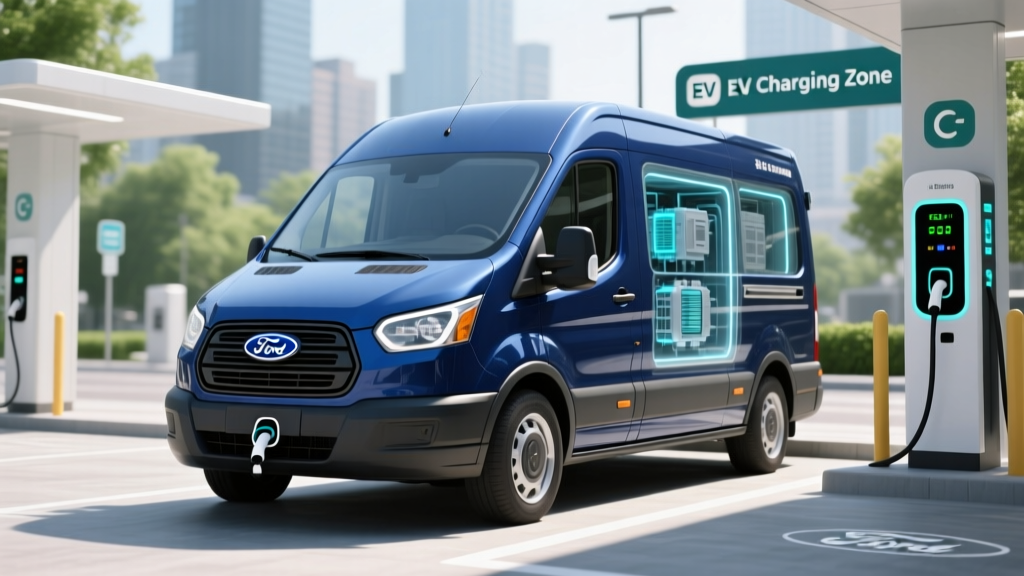
For Fort Worth fleet operators, the critical infrastructure question is depot charging. Ford offers the Ford Pro Charging ecosystem, which includes site assessments, Level 2 hardware (the Ford Connected Charge Station at ~$600–$800 per unit), and energy management software. A typical 10-van depot installation in the DFW area, including electrical panel upgrades, conduit runs, and permits, can range from $15,000 to $40,000 depending on existing electrical capacity. Consult a licensed electrician for your specific site — older industrial buildings in Fort Worth's Southside or near the Stockyards may need 400-amp service upgrades to support multiple simultaneous Level 2 chargers.
The E-Transit uses the CCS1 connector for DC fast charging. As of 2024, it does not ship with a NACS (Tesla Supercharger) port, though Ford has announced NACS adoption for future models. Public charging in the DFW area on Electrify America, EVgo, and ChargePoint networks is accessible via CCS1, though reliability varies by station.
Cargo Space, Configurations, and Worksite Tech
The E-Transit mirrors the gas Transit's body configurations, which is its strongest selling point for fleet upfitters:
- Cargo Van (Low Roof, Regular Length): 246.7 cu ft cargo volume, 101.4-inch wheelbase
- Cargo Van (Medium Roof, Regular Length): 278.3 cu ft cargo volume
- Cargo Van (High Roof, Extended Length): 487.3 cu ft cargo volume, 148-inch wheelbase
- Chassis Cab / Cutaway: Configurable for box trucks, shuttle bodies, and specialty upfits
Maximum payload ranges from approximately 3,880 lbs (low-roof cargo van) down to roughly 3,200 lbs for heavier configurations. The E-Transit does not offer a towing rating — if your operation requires pulling a trailer, you'll need to stay with the gas or diesel Transit.
On the tech front, the 2024 E-Transit comes with Ford's SYNC 4 infotainment system on a 12-inch touchscreen, standard on all trims. It includes cloud-connected navigation with EV-specific routing (factoring in charge station locations and battery state), over-the-air updates, and Ford Pro Telematics integration for fleet managers. The telematics system tracks vehicle location, state of charge, energy consumption, and driver behavior — a significant advantage for commercial operations managing multiple vehicles.
Driver-assistance features include:
- Pre-Collision Assist with Automatic Emergency Braking
- Lane-Keeping System
- Rear View Camera
- Available Blind Spot Information System (BLIS) with trailer coverage
- Available 360-degree camera
Note: These are SAE Level 0–1 driver aids. The E-Transit does not offer Ford's BlueCruise hands-free driving system, which is reserved for passenger models like the F-150 Lightning and Mustang Mach-E. The driver must remain fully engaged at all times.
Pricing, Tax Credits, and Total Cost of Ownership
| Configuration | Base MSRP (2024) | Est. Federal Credit (§45W) | Effective Price |
|---|---|---|---|
| Cutaway (138" WB) | ~$46,895 | Up to $7,500 | ~$39,395 |
| Chassis Cab (138" WB) | ~$48,500 | Up to $7,500 | ~$41,000 |
| Cargo Van, Low Roof | ~$51,995 | Up to $7,500 | ~$44,495 |
| Cargo Van, High Roof Ext. | ~$55,500 | Up to $7,500 | ~$48,000 |
The 2024 E-Transit qualifies for the Commercial Clean Vehicle Credit (§45W), not the consumer §30D credit, because its GVWR exceeds 8,500 lbs on most configurations. The §45W credit provides up to $7,500 for qualifying commercial vehicles (those under 14,000 lbs GVWR), subject to battery sourcing requirements and manufacturer qualification. This credit is claimed by the business on its tax return — it is not a point-of-sale rebate like the consumer credit can be. Consult a tax professional to confirm eligibility based on your business structure and the vehicle's battery component sourcing, per IRS guidelines.
For Fort Worth fleet buyers, additional incentives may be available through the Texas Commission on Environmental Quality (TCEQ) and local utility programs (Oncor or CoServ electric cooperatives may offer EV charging infrastructure rebates). These vary by year and funding availability — check current program status directly with each agency.
Total cost of ownership is where the E-Transit makes its case. Electricity in the DFW area averages roughly $0.12–$0.15 per kWh for commercial rates. Charging a 68 kWh battery from empty costs approximately $8.16–$10.20. At 2.1 kWh per mile, that's roughly $0.25–$0.32 per mile in energy cost. A comparable gas Transit getting 15 MPG at $3.20 per gallon costs about $0.21 per mile in fuel — so the energy cost advantage is modest at current Texas electricity and gas prices. However, the E-Transit eliminates oil changes, transmission fluid, and exhaust system maintenance, saving an estimated $1,500–$2,500 annually per vehicle in maintenance costs for a high-mileage commercial van.
Warranty Coverage
Ford backs the E-Transit with:
- Battery Warranty: 8 years / 100,000 miles (whichever comes first), with a capacity retention threshold of 70% — if the battery drops below 70% of original capacity within the warranty period, Ford will repair or replace it.
- Electric Powertrain Components: 5 years / 60,000 miles
- Bumper-to-Bumper: 3 years / 36,000 miles
- Roadside Assistance: 5 years / 60,000 miles
The 100,000-mile battery warranty is competitive for a commercial vehicle, though some fleet operators running 30,000+ miles per year will hit that cap in just over three years. Ford Pro offers extended service plans tailored for commercial fleets, which can be worth evaluating for high-utilization vehicles.
Pros and Cons
Pros
- Same cargo volume and upfit compatibility as gas Transit — no compromise on utility
- Instant torque from electric motor improves drivability with heavy loads
- Significantly lower maintenance costs (no oil, filters, exhaust, transmission fluid)
- Ford Pro ecosystem: telematics, charging infrastructure support, fleet management tools
- Zero tailpipe emissions for sustainability goals and urban clean-air compliance
- Quiet operation improves driver comfort on all-day routes
Cons
- 126-mile max EPA range limits use to short-haul / last-mile routes only
- DC fast charging at 115 kW is slow compared to modern passenger EVs
- Higher upfront cost than gas Transit ($51,995 vs. ~$43,000 for equivalent gas model)
- No towing capability
- RWD only — no AWD option for inclement weather
- Depot charging infrastructure requires upfront investment ($15K–$40K for multi-van setups)
- Real-world range in Texas heat drops to ~90 miles when loaded
Who Should Buy the 2024 Ford E-Transit?
The E-Transit is ideal for:
- Last-mile delivery fleets operating routes under 80 miles per day with depot return
- Municipal and campus fleets (universities, hospitals, city services) with predictable short routes
- HVAC, plumbing, and electrical contractors in the DFW metroplex running local service calls
- Businesses with sustainability mandates needing zero-emission commercial vehicles
It is not the right choice for:
- Long-haul routes exceeding 100 miles without mid-day charging access
- Operations requiring towing
- Businesses without access to overnight depot charging (Level 2 infrastructure is essential)
- Operators in extreme cold climates where range loss exceeds 30%
Competitive Landscape: E-Transit vs. Alternatives
The E-Transit's competitive set in the electric commercial van space is narrow but growing:
- BrightDrop Zevo 600 (formerly Chevy BrightDrop): Offers up to 250 miles of range and a larger cargo volume, but at a significantly higher price point (~$75,000+). BrightDrop has faced production and availability challenges.
- Mercedes-Benz eSprinter: The 2024 eSprinter offers approximately 200 miles of EPA range (with the larger 113 kWh battery) and DC fast charging up to 115 kW. Pricing is higher (~$70,000+), but range is substantially better.
- Rivian EDV (Amazon delivery van): Not available to general fleet buyers; exclusive to Amazon.
- Gas-powered Ford Transit: The baseline competitor. Lower upfront cost, unlimited range, established service network, but higher per-mile fuel and maintenance costs over a 5-year lifecycle.
Against the gas Transit, the E-Transit wins on maintenance costs and emissions but loses on range, upfront price, and refueling flexibility. The break-even point typically arrives around year 3–4 for high-utilization fleets (20,000+ miles/year) when factoring in fuel savings, maintenance reduction, and the federal tax credit.
Frequently Asked Questions
What is the real-world range of the 2024 Ford E-Transit in Fort Worth?
Expect 90–110 miles in typical Fort Worth driving conditions with a moderate load. The EPA rates the low-roof cargo van at 126 miles, but Texas summer heat (100°F+), highway speeds on I-35, and cargo weight all reduce effective range. In mild spring/fall weather with light loads on city routes, you may approach the EPA figure.
How fast does the E-Transit charge at home or at a depot?
On a Level 2 charger at 11.5 kW (48 amps, 240V), the E-Transit charges from 0–100% in approximately 7–8 hours. On a 7.7 kW Level 2 (32 amps), expect 10–12 hours. DC fast charging at 115 kW reaches 80% from 15% in about 45 minutes. For fleet operations, overnight Level 2 depot charging is the primary refueling method.
Does the 2024 E-Transit qualify for the federal EV tax credit?
Yes, but under the Commercial Clean Vehicle Credit (§45W), not the consumer §30D credit, because most E-Transit configurations exceed 8,500 lbs GVWR. The credit provides up to $7,500 for qualifying businesses, subject to battery sourcing requirements. The credit is claimed on the business's tax return — it is not available as a point-of-sale reduction. Consult a tax professional and review current IRS guidance for your specific situation.
Is the E-Transit worth buying vs. the gas Ford Transit?
It depends on your route profile. If your vans run under 80 miles per day and return to a depot for overnight charging, the E-Transit can deliver lower total cost of ownership within 3–4 years thanks to reduced maintenance and the federal tax credit. If your routes are longer, unpredictable, or require towing, the gas Transit remains the more practical choice. The E-Transit also makes sense for businesses with corporate sustainability targets or operating in areas with clean-air mandates.
What are the biggest drawbacks of the E-Transit?
Range is the primary limitation — 126 miles EPA maximum means this van is a metro-area tool, not a regional hauler. The 115 kW DC fast charge rate is slow by 2026 standards, and the upfront price premium over the gas Transit is roughly $8,000–$12,000 depending on configuration. You'll also need to invest in depot charging infrastructure, which can cost $15,000–$40,000 for a multi-van installation.
Can I tow with the E-Transit?
No. The 2024 E-Transit is not rated for towing. If your operation requires pulling a trailer, the gas or diesel Transit is your only option in Ford's commercial van lineup.
What is the battery warranty on the E-Transit?
Ford provides an 8-year / 100,000-mile battery warranty with a 70% capacity retention threshold. If the battery degrades below 70% of its original 68 kWh capacity within the warranty period, Ford will repair or replace it. The electric powertrain components carry a separate 5-year / 60,000-mile warranty.
Sources: EPA fuel economy data via fueleconomy.gov, Ford Motor Company commercial vehicle specifications, IRS Commercial Clean Vehicle Credit guidance at irs.gov. Pricing and incentive data reflect 2024 model year information; verify current availability and pricing with your local Ford Pro dealer.