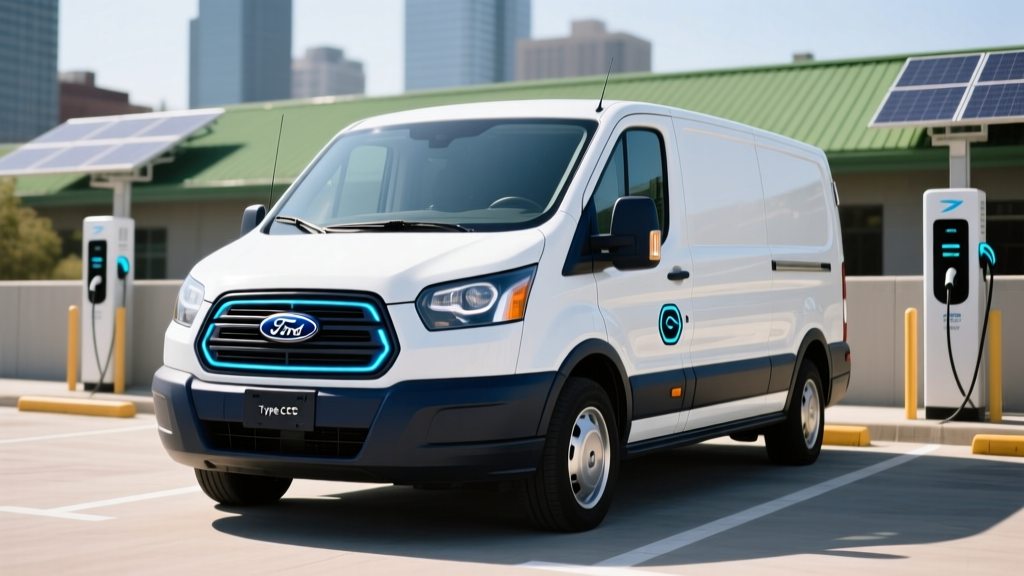
The 2024 Ford E-Transit Cab Chassis occupies a unique niche: it's a commercial-grade electric upfit platform designed for last-mile delivery, utility work, and vocational fleets that operate predictable daily routes. Unlike the cargo van variant, the cab chassis ships without a rear body, allowing upfitters to install custom boxes, flatbeds, dump beds, or service bodies. For fleet managers evaluating electrification, the E-Transit Cab Chassis presents a compelling total-cost-of-ownership case — but only within the strict boundaries of its range and payload envelope.
This review covers the 2024 model year E-Transit Cab Chassis (sold alongside the 2025 model through much of 2025 and into early 2026). We break down the exact specs, real-world range expectations, charging infrastructure requirements, and federal tax credit mechanics that determine whether this platform makes financial sense for your operation.
Core Specifications at a Glance
| Specification | 2024 Ford E-Transit Cab Chassis |
|---|---|
| EPA Estimated Range | 126 miles (Cargo Van 126 mi; Cutaway/Cab Chassis varies by upfit) |
| Usable Battery Capacity | 68 kWh (NMC lithium-ion) |
| Peak DC Fast-Charge Rate | 115 kW |
| 10–80% DC Fast-Charge Time | ~45 minutes |
| Level 2 AC Charge Rate | 10.5 kW (onboard charger) |
| Motor Output | 266 hp (198 kW) / 317 lb-ft torque |
| Drivetrain | Rear-wheel drive (single motor) |
| 0–60 mph | Not officially published; estimated ~10–12 sec (loaded) |
| Top Speed | Electronically limited to ~75 mph |
| Max Payload (Cab Chassis) | ~3,398 lbs (varies by upfit/weight rating) |
| GVWR | 9,500 lbs (Class 2b/3 boundary) |
| Wheelbase Options | 138 in (regular), 156 in (extended) |
| Base MSRP (Cab Chassis 138" WB) | ~$48,000 (before incentives, before upfit) |
| Battery/Powertrain Warranty | 8 years / 100,000 miles |
| Efficiency | ~2.0–2.4 kWh/mile (varies heavily by load and upfit) |
Real-World Range: What Fleets Actually See
Range is the E-Transit's most-discussed limitation, and it deserves honest treatment. Ford engineered this platform for predictable, return-to-base duty cycles — think parcel delivery, municipal maintenance, or utility service routes that cover 60–90 miles per day. The 68 kWh usable battery (gross capacity is slightly higher, with a buffer to protect longevity) uses NMC (nickel-manganese-cobalt) chemistry, which offers higher energy density than LFP but requires more careful thermal management.
According to fueleconomy.gov, the E-Transit cargo van achieves approximately 2.0 kWh/mile in combined driving. The cab chassis, especially when upfitted with a box body that increases frontal area and weight, will consume more energy per mile. Fleet operators we've spoken with report 2.2–2.6 kWh/mile in stop-and-go urban delivery routes with 1,500–2,500 lbs of payload.
Practical implication: If your daily route exceeds 80 miles round-trip — especially in northern climates with cold winters — the E-Transit Cab Chassis requires mid-day charging or route redesign. For routes under 70 miles, overnight Level 2 charging at the depot is sufficient.
Charging Speed and Infrastructure Requirements
| Charging Level | Power | Charge Time (10–80%) | Miles Added per Hour |
|---|---|---|---|
| Level 1 (120V AC) | ~1.4 kW | Not practical for daily use | ~2–3 mi/hr |
| Level 2 (240V AC) | 10.5 kW (vehicle-limited) | ~6–7 hours (full charge) | ~18–22 mi/hr |
| DC Fast Charge (CCS) | 115 kW peak | ~45 minutes | ~100–130 mi/hr (peak) |
The E-Transit uses the CCS1 connector standard (Ford has committed to transitioning future models to NACS, but 2024 models remain CCS). The 115 kW peak DC fast-charge rate is modest compared to passenger EVs like the Hyundai Ioniq 5 (240 kW) or Tesla Model Y (250 kW), but it's adequate for commercial depot charging workflows.
Charging curve reality: The 115 kW peak is sustained roughly between 15–45% State of Charge. Above 50%, the rate tapers progressively — expect ~80 kW at 60% SoC, dropping to ~40 kW above 80%. This is why Ford quotes 10–80% in ~45 minutes rather than a full 0–100% figure. For fleet operations, this means a 30-minute lunch break at a DC fast charger can recover approximately 50–60 miles of range — enough to extend a route but not eliminate range planning.
Home/depot Level 2 charging: The 10.5 kW onboard charger means a full overnight charge (10–100%) takes roughly 7–8 hours on a 48-amp Level 2 station. Fleet depots typically install multiple 40-amp or 48-amp Level 2 EVSEs (such as the ChargePoint CPF45 or Blink HQ 200) to charge vehicles overnight. Installation cost for a commercial multi-port depot setup ranges from $3,000–$8,000 per port, depending on electrical panel capacity and conduit runs. Consult a licensed commercial electrician for site-specific quotes.
Performance and Drivetrain
The E-Transit Cab Chassis uses a single rear-mounted electric motor producing 266 horsepower (198 kW) and 317 lb-ft of torque. Unlike many commercial vehicles that feel underpowered, the instant torque delivery makes the E-Transit surprisingly responsive in urban driving — it pulls away from stoplights with authority even when loaded. Ford does not publish an official 0–60 mph time for the cab chassis variant; based on the cargo van's ~9-second figure and the cab chassis's typically higher upfitted weight, expect 10–12 seconds to 60 mph depending on payload.
The rear-wheel-drive layout is adequate for most paved-road commercial use, but the absence of AWD is a legitimate concern for fleets operating in snow-belt regions. The E-Transit's weight distribution (battery pack mounted low and centrally) provides reasonable traction, and the regenerative braking system aids deceleration, but winter tire fitment is strongly recommended for cold-climate operators.
Top speed is electronically limited to approximately 75 mph — Ford's concession to range preservation and commercial safety profiles. Highway driving at 70+ mph also significantly increases energy consumption, further compressing an already tight range envelope.
Pricing, Trim Levels, and Tax Credit Eligibility
| Configuration | Approximate MSRP | Notes |
|---|---|---|
| Cab Chassis 138" WB (base) | ~$48,000 | Before upfit, before incentives |
| Cab Chassis 156" WB (extended) | ~$50,000 | Before upfit, before incentives |
| Cargo Van T-150 (low roof, 130" WB) | ~$45,000 | For comparison |
| Cargo Van T-350 (high roof, 148" WB) | ~$52,000 | For comparison |
Federal tax credit (§30D / §45W): Commercial fleet buyers should note that the E-Transit typically qualifies under IRC §45W (Commercial Clean Vehicle Credit) rather than the consumer §30D credit. The §45W credit provides up to $7,500 for vehicles under 14,000 lbs GVWR (which the E-Transit qualifies for at its 9,500 lb GVWR) when purchased for business or fleet use. Key requirements include:
- Vehicle must be purchased for business use (not personal)
- Must meet battery component and critical mineral sourcing requirements (per IRS guidelines)
- No MSRP cap applies to the commercial §45W credit (unlike §30D)
- No buyer income cap applies to the commercial credit
- Credit is non-refundable — your business must have sufficient tax liability to absorb it
For individual owner-operators purchasing an E-Transit for personal business use (sole proprietorships), the §30D consumer credit may apply instead, subject to the $80,000 MSRP cap for vans/pickups (the E-Transit clears this), income limits ($150K single / $300K joint), and battery sourcing requirements. Always consult a tax professional to determine which credit pathway applies to your specific entity structure and tax situation.
Effective price after credit: A fleet purchasing the cab chassis at ~$48,000 and qualifying for the full $7,500 §45W credit sees an effective acquisition cost of approximately $40,500 — before adding the upfit body ($5,000–$20,000+ depending on configuration). This positions the E-Transit competitively against a comparably equipped gasoline Transit cab chassis (~$38,000–$42,000 MSRP before upfit) when total cost of ownership is factored in.
Total Cost of Ownership: EV vs. Gas Transit
The economic case for the E-Transit Cab Chassis rests on operational cost savings over a 5–8 year fleet lifecycle:
- Fuel cost: At $0.12/kWh (commercial electricity rate) and 2.2 kWh/mile, the E-Transit costs ~$0.26/mile in energy. A gasoline Transit at 14 MPG and $3.50/gallon costs ~$0.25/mile. At higher gas prices or lower electricity rates, the EV pulls ahead; at current averages, energy costs are roughly comparable.
- Maintenance: The E-Transit eliminates oil changes, transmission fluid, spark plugs, and exhaust system maintenance. Ford estimates 40% lower scheduled maintenance costs versus the gas Transit over 5 years.
- Brake wear: Regenerative braking significantly extends brake pad life — many fleet EVs reach 80,000+ miles on original pads.
- Downtime: Fewer moving parts translate to fewer unexpected breakdowns, a meaningful factor for revenue-critical fleet vehicles.
For a fleet vehicle covering 20,000 miles/year over 7 years, the maintenance savings alone can offset $3,000–$5,000 of the EV price premium. Combined with the $7,500 tax credit, many fleets achieve cost parity or savings within 3–4 years.
Technology, Safety, and Driver Assistance
The 2024 E-Transit comes equipped with Ford's SYNC 4 infotainment system on a 12-inch touchscreen, including Apple CarPlay/Android Auto, cloud-connected navigation, and Ford Power-Up over-the-air software updates. For fleet managers, the standout feature is Ford Pro Telematics — a connected services platform that provides real-time vehicle location, state of charge, energy consumption analytics, geofencing alerts, and driver behavior scoring.
Driver assistance (SAE Level 2 — driver must remain fully engaged):
- Pre-Collision Assist with Automatic Emergency Braking
- Lane-Keeping System with Lane Departure Warning
- Blind Spot Information System (BLIS) with trailer coverage (when equipped)
- Rear View Camera with dynamic hitch assist
- Available Adaptive Cruise Control with Stop-and-Go
Notable drawbacks: The E-Transit lacks the Ford BlueCruise hands-free driving feature available on the F-150 Lightning and Mustang Mach-E. The interior materials are utilitarian (appropriate for a work vehicle, but basic). The single-zone HVAC system can struggle to maintain cabin temperature in extreme cold without significantly impacting range — a heat pump is not standard.
Pros and Cons
✓ Pros
- Low operating and maintenance costs vs. gas Transit
- Instant torque makes urban driving responsive even loaded
- Ford Pro telematics and fleet management integration
- Eligible for up to $7,500 federal commercial tax credit
- Quiet, zero-tailpipe-emission operation (ideal for indoor facilities and urban zones)
- Strong dealer and service network for commercial fleets
- 8-year/100,000-mile battery warranty
✗ Cons
- 126-mile EPA range (less with heavy upfits) limits route flexibility
- 115 kW peak DC charging is slow vs. modern passenger EVs
- No AWD option — problematic for snow-belt fleets
- Upfit cost adds significantly to total acquisition price
- No heat pump standard — cold-weather HVAC drains range
- CCS connector (NACS adapter may be needed for Tesla Supercharger access)
- Payload capacity reduced by battery weight vs. gas Transit
Who Should Buy the 2024 Ford E-Transit Cab Chassis?
Choose the E-Transit Cab Chassis if:
- Your fleet operates predictable daily routes under 80 miles round-trip
- Vehicles return to a central depot for overnight Level 2 charging
- You operate in urban areas with emissions restrictions or noise ordinances
- Total cost of ownership (not just acquisition price) drives your purchasing decisions
- Your business has sufficient tax liability to absorb the §45W commercial credit
Look elsewhere if:
- Your routes regularly exceed 100 miles per day without mid-day charging access
- You operate in extreme cold climates without heated garage storage
- You need AWD for unpaved or snow-covered routes
- Your upfit requirements push GVWR beyond the E-Transit's 9,500-lb limit
Competitive Landscape
The E-Transit Cab Chassis has limited direct competition in the electric commercial cab chassis segment:
- BrightDrop Zevo 600 (formerly Chevrolet): Larger, longer range (~250 mi), but significantly more expensive and primarily a step-van delivery platform rather than a true cab chassis.
- Gasoline Ford Transit Cab Chassis: The baseline comparison — lower upfront cost, unlimited range, but higher fuel and maintenance expenses over the vehicle lifecycle.
- Rivian EDV (Amazon delivery van): Not available to general fleet buyers; Amazon-exclusive platform.
For most general fleet buyers seeking an electric cab chassis with mainstream dealer support, the E-Transit remains the default option in its weight class as of the 2024–2025 model years.
Frequently Asked Questions
What is the real-world range of the 2024 Ford E-Transit Cab Chassis?
The EPA rates the E-Transit at 126 miles (cargo van variant). The cab chassis, depending on upfit weight and aerodynamics, typically achieves 95–126 miles EPA equivalent. In real-world fleet operation with moderate payload, expect 80–110 usable miles in mild weather and 60–85 miles in cold weather below 32°F.
How fast does the E-Transit Cab Chassis charge?
On a DC fast charger (CCS connector), the E-Transit peaks at 115 kW and charges from 10–80% in approximately 45 minutes. On a Level 2 home or depot charger (240V), the 10.5 kW onboard charger delivers a full charge in 7–8 hours, adding roughly 18–22 miles of range per hour of charging.
Does the E-Transit Cab Chassis qualify for the federal EV tax credit?
For fleet and business purchases, the E-Transit typically qualifies under IRC §45W (Commercial Clean Vehicle Credit) for up to $7,500, subject to battery sourcing requirements. Unlike the consumer §30D credit, §45W has no MSRP cap and no buyer income limit, but the credit is non-refundable (your business must have sufficient tax liability). Consult a tax professional and review current IRS guidance before purchasing.
Is the E-Transit Cab Chassis worth buying versus the gas Transit?
It depends on your duty cycle. If your routes are under 80 miles daily with depot charging, the E-Transit's lower fuel and maintenance costs (plus the $7,500 tax credit) can achieve cost parity within 3–4 years. For long or variable routes, the gas Transit remains the practical choice. The E-Transit is a specialized tool for a specific operational pattern — not a universal replacement.
What upfit options are available for the E-Transit Cab Chassis?
Ford's Qualified Vehicle Modifier (QVM) network supports a wide range of upfits: cargo boxes (dry and refrigerated), flatbeds, dump bodies, service/utility bodies, and custom configurations. Upfit costs range from $5,000 for a basic flatbed to $20,000+ for a refrigerated box body. Confirm with your upfitter that the body is compatible with the E-Transit's specific frame dimensions and weight distribution.
What is the battery warranty on the E-Transit?
Ford covers the high-voltage battery and electric powertrain components for 8 years or 100,000 miles (whichever comes first). The warranty covers defects and excessive capacity loss — Ford defines this as the battery retaining less than 70% of its original capacity during the warranty period. This is competitive with other commercial EVs and provides meaningful protection for fleet operators planning long service cycles.