Quick Verdict: The Last-Mile Workhorse That Knows Its Lane
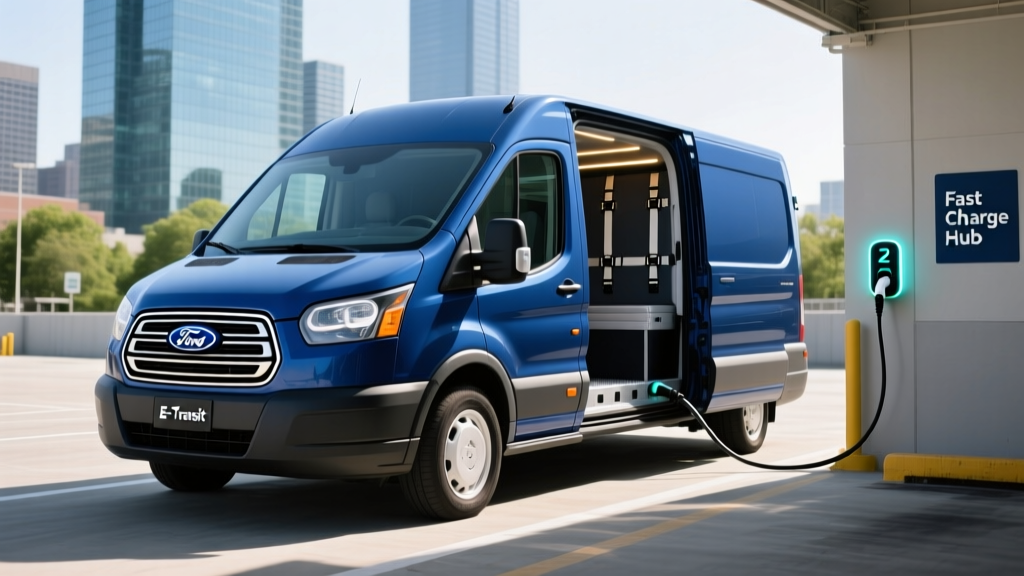
The 2024 Ford E-Transit-350 Cargo isn't trying to win drag races or cross the country on a single charge. It's a purpose-built electric commercial van designed for a very specific job: predictable, short-haul delivery and service routes. With an EPA-estimated 126 miles of range, a 68 kWh usable battery, and Ford Pro's commercial ecosystem behind it, the E-Transit-350 Cargo makes a compelling case for fleets that can charge at the depot overnight. For owner-operators and small businesses running sub-100-mile daily loops, it delivers real operating-cost savings. But if your routes regularly exceed 120 miles or venture into cold climates without depot charging, you'll hit its limitations fast.
| Spec | Value |
|---|---|
| EPA Range | 126 miles (low-roof, cutaway); 108–126 mi depending on body |
| Battery (Usable) | 68 kWh, NMC lithium-ion |
| Motor / Drivetrain | 266 hp (198 kW), 317 lb-ft torque, RWD |
| 0–60 mph | ~8.5 seconds (unladen, estimated) |
| Max DC Fast Charge | 115 kW (CCS1) |
| 10–80% DC Charge Time | ~45 minutes |
| Level 2 Charge Rate | 11.3 kW onboard charger (~2.3 hrs to full from 0%) |
| EPA Efficiency | ~2.0 kWh/mile (~50 MPGe combined, varies by body config) |
| Max Cargo Volume | Up to 487.3 cu ft (high-roof, extended wheelbase) |
| Max Payload | Up to 3,880 lbs (varies by config) |
| Base MSRP | ~$51,995 (T-350 low-roof, before options/destination) |
| Battery Warranty | 8 years / 100,000 miles |
Range and Efficiency: Built for the Depot-Return Loop
Ford rates the E-Transit-350 Cargo at up to 126 miles on the EPA cycle for the low-roof, regular wheelbase configuration. High-roof and extended-wheelbase variants see that number drop to as low as 108 miles due to increased frontal area and weight. According to fueleconomy.gov, efficiency lands around 2.0 kWh per mile, which translates roughly to 50 MPGe combined — not class-leading, but expected for a 6,000+ lb commercial van.
EPA sticker: 126 miles. Expect 95–110 miles in mixed driving with partial payload. Highway-dominant routes at 70 mph will compress range to ~85–95 miles. In winter conditions (below 32°F), plan for a 25–35% reduction — that 126-mile van becomes a ~80–90-mile van. If your daily route is under 75 miles round-trip, you'll have comfortable buffer year-round. Above 100 miles daily, and you're cutting it close in cold months.
The 68 kWh usable battery uses NMC (nickel-manganese-cobalt) chemistry. This provides reasonable energy density for the van's size, though it doesn't match the cycle-life longevity of LFP cells found in some competitors' commercial vehicles. For fleet operators running one or two daily charge cycles, NMC degradation should be manageable within the 8-year warranty window. Ford includes a proactive battery health monitoring system through Ford Pro, which tracks state of health (SoH) remotely and flags cells that are falling out of balance before they become a range problem.
Charging: Depot-Friendly, Road-Trip-Limited
The E-Transit-350's charging story is best understood in two contexts: overnight depot charging (where it excels) and mid-day DC fast charging (where it's adequate but not quick).
| Level | Power | Time | Notes |
|---|---|---|---|
| Level 1 (120V) | ~1.4 kW | ~48+ hours (0–100%) | Emergency/trickle only; impractical for daily use |
| Level 2 (240V) | 11.3 kW | ~6–7 hours (0–100%) | Ideal for overnight depot charging; full battery by morning |
| DC Fast (CCS1) | 115 kW peak | ~45 min (10–80%) | Charge curve tapers significantly above 80%; 80–100% adds ~25 min |
The 11.3 kW onboard AC charger is one of the E-Transit's strongest assets for fleet duty. Plug in at 6 PM after the last route, and the battery is fully replenished by midnight — no driver intervention required. Ford Pro's connected services let fleet managers schedule charging to hit off-peak electricity rates, which can cut energy costs to $0.06–$0.10/kWh in many utility territories.
On DC fast charging, the 115 kW peak rate is modest by 2024 passenger-EV standards (many sedans and SUVs hit 200–350 kW), but it's competitive in the commercial van segment. The charge curve is the real story: the E-Transit sustains roughly 90–110 kW up to about 55% state of charge, then tapers progressively. A 10–80% session takes approximately 45 minutes at a properly functioning 150 kW+ station. That's long enough for a driver lunch break, but it means mid-day opportunity charging requires route planning. The E-Transit uses the CCS1 connector standard, giving access to Electrify America, EVgo, and most non-Tesla public networks.
Performance and Drivetrain: Torque for the Job Site
The E-Transit-350 Cargo uses a single rear-mounted electric motor producing 266 horsepower and 317 lb-ft of torque, driving the rear wheels. That torque figure is the headline — it's available from 0 RPM, which means the van pulls away from stoplights and loading docks with authority, even when carrying a full payload. The 0–60 mph time of approximately 8.5 seconds (unladen) won't impress anyone, but it's entirely adequate for urban and suburban commercial driving. Top speed is electronically limited to around 75 mph.
Rear-wheel drive is standard. Ford does not offer an AWD variant. For most delivery and service applications in paved urban environments, RWD is sufficient — the van's weight over the rear axle (especially when loaded) provides reasonable traction. However, operators in regions with heavy snow or frequent unpaved-road access should factor in winter tires or consider whether a RWD commercial van fits their terrain.
Regenerative braking is adjustable through multiple modes, including a one-pedal-driving setting that allows significant deceleration without touching the brake pedal. Fleet drivers typically adapt to one-pedal mode within a few days, and the energy recaptured in stop-and-go urban routes meaningfully extends range.
Cargo, Configurations, and Upfitting
The E-Transit-350 is available in three roof heights (low, medium, high), three body lengths, and three body styles (cargo van, cutaway, and chassis cab). The cargo van in its largest configuration (high-roof, extended wheelbase) offers up to 487.3 cubic feet of cargo volume — essentially the same interior dimensions as the gasoline Transit-350. This is by design: Ford engineered the E-Transit's battery pack under the floor to preserve the exact same cargo envelope that upfitters and fleet operators already spec for.
Payload capacity reaches up to 3,880 lbs depending on configuration, though the high-roof extended-wheelbase cargo van sits closer to 3,200 lbs due to its heavier curb weight. The floor is flat and unobstructed, with the battery pack fully enclosed beneath. Ford offers the E-Transit through its Ford Pro upfitting network, meaning shelving, refrigeration units, ladder racks, and partition bulkheads can be installed before delivery — a significant advantage for fleets that need turnkey vehicles.
Notable drawback: the E-Transit-350 does not offer a trailer tow rating competitive with its gas-powered Transit sibling. Maximum towing is limited to approximately 4,500 lbs (with the factory tow package), well below the 7,500+ lbs available on a gas Transit-350. If your operation involves towing equipment trailers, the E-Transit likely isn't the right tool.
Tech, Driver Assists, and the Ford Pro Ecosystem
The E-Transit-350 comes standard with Ford's SYNC 4 infotainment system on a 12-inch touchscreen — a significant upgrade from the basic units in older commercial vans. Apple CarPlay and Android Auto are wireless. The system integrates with Ford Pro's fleet management platform, which provides real-time vehicle location, battery state of charge, geofencing alerts, and maintenance scheduling. For fleet managers, this telematics layer is arguably the E-Transit's most valuable feature — it turns each van into a managed, data-producing asset.
Standard driver-assistance features include:
- Pre-Collision Assist with Automatic Emergency Braking (AEB)
- Lane-Keeping System
- Rear View Camera
- Blind Spot Information System (BLIS) with trailer coverage (available)
- Adaptive Cruise Control (available on select trims)
- 360-Degree Camera (available)
Important clarity: these are SAE Level 1–2 driver-assistance features. The driver must remain fully engaged at all times. There is no hands-free or "self-driving" mode available on the E-Transit. Ford's BlueCruise hands-free system is not offered on this platform.
Pricing, Tax Credits, and Total Cost of Ownership
| Item | Amount |
|---|---|
| Base MSRP (T-350 Cargo Van, Low Roof) | ~$51,995 |
| High-Roof Extended WB As-Tested | ~$58,000–$62,000 |
| Federal Commercial Clean Vehicle Credit (§45W) | Up to $7,500 (for qualified commercial/business buyers) |
| Federal §30D Clean Vehicle Credit (personal use) | Up to $7,500 — subject to MSRP cap ($80K vans), income limits, battery sourcing rules |
| Estimated Price After Max Federal Credit | ~$44,495 (base, commercial buyer) |
Tax credit eligibility requires careful attention. Most E-Transit buyers are commercial entities (businesses, fleets, government agencies), which qualify under IRS §45W (Commercial Clean Vehicle Credit) rather than the consumer-facing §30D credit. The §45W credit provides up to $7,500 for vehicles under 14,000 lbs GVWR, with fewer sourcing restrictions than §30D. For individuals purchasing an E-Transit for personal use (e.g., a mobile workshop or personal hauler), the §30D credit may apply, but eligibility depends on adjusted gross income limits ($150K single / $300K joint), battery component sourcing, and critical mineral requirements. Always verify current-year rules with a tax professional and consult the IRS Clean Vehicle Credit page.
On total cost of ownership, the math favors the E-Transit for high-mileage fleet duty. At an average commercial electricity rate of $0.12/kWh and efficiency of 2.0 kWh/mile, fuel cost lands around $0.24/mile. A comparable gas Transit-350 at 14 MPG combined and $3.50/gallon runs about $0.25/mile on fuel alone — but the E-Transit eliminates oil changes, transmission fluid, and significantly reduces brake wear through regen. Ford Pro's maintenance data suggests a 40–50% reduction in scheduled maintenance costs versus the gas Transit over 5 years. For a van running 20,000 miles/year, that's roughly $1,500–$2,000 in annual savings on fuel and maintenance combined.
Pros and Cons
- Same cargo dimensions as gas Transit — no upfitter re-engineering needed
- 11.3 kW Level 2 charger enables full overnight depot recharge
- Ford Pro telematics and fleet management integration is best-in-class
- Instant torque makes loaded driving feel confident in urban traffic
- Significantly lower maintenance costs vs. gas Transit
- Up to $7,500 federal commercial tax credit reduces effective price
- 126-mile max EPA range is limiting for routes exceeding 100 miles
- 25–35% range loss in cold weather compresses usable range further
- 115 kW DC fast-charge peak is slow by modern EV standards
- Towing limited to ~4,500 lbs — well below gas Transit capability
- No AWD option for snow/unpaved-route operators
- Higher upfront cost than gas Transit, even after tax credits
Who Should Buy the 2024 Ford E-Transit-350 Cargo?
This van is the right tool for a narrow but deep use case. If your business runs predictable daily routes under 100 miles, returns to a depot every night, and operates primarily in urban or suburban environments, the E-Transit-350 will likely save you money over three to five years while eliminating tailpipe emissions in the communities you serve. Bakery delivery, plumbing/HVAC service, last-mile parcel delivery, and municipal fleet duty are all strong fits.
If your routes are variable, regularly exceed 120 miles, require towing, or operate in extreme cold without reliable depot charging, the gas-powered Transit-350 or a diesel Sprinter remains the pragmatic choice. The E-Transit isn't a compromise vehicle — it's a purpose-built tool. Know your route data before you spec one.
Frequently Asked Questions
What is the real-world range of the 2024 Ford E-Transit-350 Cargo?
The EPA rates the E-Transit-350 at up to 126 miles (low-roof configuration). In real-world mixed driving with partial payload, expect 95–110 miles. Highway-dominant routes drop that to ~85–95 miles. In winter temperatures below freezing, plan for 80–90 miles of usable range due to battery chemistry and cabin heating demands.
How fast does the E-Transit-350 charge at home and on the road?
On a Level 2 (240V) home or depot charger, the 11.3 kW onboard charger fills the 68 kWh battery in approximately 6–7 hours — ideal for overnight charging. On a DC fast charger, the 115 kW peak rate delivers a 10–80% charge in about 45 minutes. Charging slows significantly above 80% SoC to protect battery health.
Does the 2024 E-Transit qualify for the federal EV tax credit?
Yes, but the applicable credit depends on the buyer. Commercial and fleet buyers typically qualify under IRS §45W (Commercial Clean Vehicle Credit) for up to $7,500. Personal-use buyers may qualify under §30D, subject to income caps ($150K single / $300K joint), MSRP limits, and battery-sourcing requirements. Consult a tax professional and check current IRS guidance.
Is the E-Transit-350 worth buying versus the gas Transit or competitors?
For depot-based fleets running under 100 miles daily, the E-Transit offers lower fuel and maintenance costs, with the Ford Pro telematics ecosystem providing operational advantages the gas Transit can't match. Versus the Mercedes-Benz eSprinter (200-mile range, higher price) or BrightDrop Zevo 600 (250-mile range, limited availability), the E-Transit trades range for a lower entry price and broader dealer/service network. If range is your top priority, the eSprinter is the stronger pick. If cost-per-mile and ecosystem matter more, the E-Transit wins.
What is the battery warranty on the E-Transit-350?
Ford covers the E-Transit's high-voltage battery for 8 years or 100,000 miles, whichever comes first. The warranty guarantees the battery will retain a minimum level of capacity (typically 70% state of health) during that period. The electric powertrain components are covered under the same 8-year/100,000-mile term.
Can the E-Transit-350 tow a trailer?
Yes, but with limitations. Maximum towing capacity is approximately 4,500 lbs with the factory tow package — significantly less than the 7,500+ lbs available on a gas-powered Transit-350. Towing also reduces range substantially. If regular towing is part of your operation, the gas Transit is the better choice.