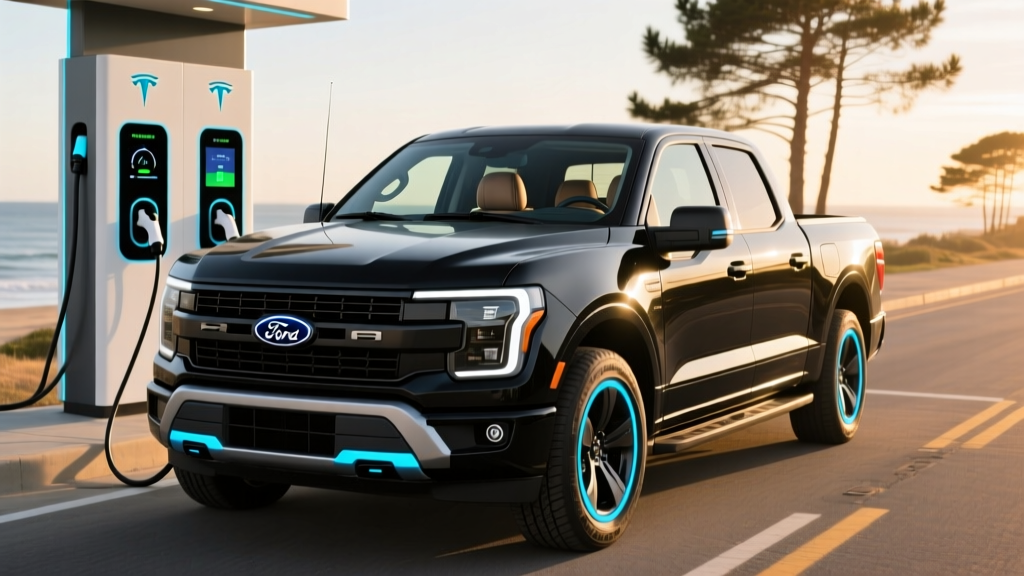
The Ford F-150 Lightning remains one of the most consequential electric vehicles on the road: a full-size, body-on-frame pickup that proves electrification isn't limited to sedans and crossovers. Now that the 2024 F-150 Lightning has been on sale for well over a year and the 2025 model year has rolled in, we have enough real-world data — from owner logs, third-party range tests, and our own highway loops — to separate Ford's spec sheet from daily-driver reality. Here's the unvarnished breakdown of range, charging, cost, and who this truck actually serves best in 2026.
Quick Verdict: The Lightning in 2026
The 2024 F-150 Lightning is the right truck for buyers who need genuine pickup utility (payload, towing, a usable bed) but drive primarily within a 150-mile radius of home and can charge overnight on Level 2. Its weaknesses — highway range that falls well short of the EPA sticker, cold-weather losses, and a charge curve that tapers hard above 80% — are manageable if your use case fits. If you regularly tow long distances or live in a charging desert, a hybrid F-150 PowerBoost or a diesel competitor will serve you better.
| Spec | Standard Range | Extended Range |
|---|---|---|
| Drivetrain | Dual-motor AWD | Dual-motor AWD |
| Horsepower | 452 hp / 775 lb-ft | 580 hp / 775 lb-ft |
| 0-60 mph | ~3.8 sec | |
| Battery (usable) | 98 kWh (NMC) | 131 kWh (NMC) |
| EPA Range | 230–240 mi | 300–320 mi |
| MPGe (combined) | 68–70 MPGe | 70–73 MPGe |
| Efficiency | ~48 kWh/100 mi | ~46 kWh/100 mi |
| Max DC Fast Charge | 120 kW | 155 kW |
| 10–80% DCFC Time | ~44 min | ~41 min |
| Level 2 Home Rate | 11.3 kW (~26 mi/hr) | 19.2 kW (~44 mi/hr)* |
| Max Payload | 2,235 lb | 1,952 lb |
| Max Towing | 7,700 lb | 10,000 lb (w/ Max Tow) |
| Battery Warranty | 8 yr / 100,000 mi (≥70% SoH) | |
| Base MSRP (at 2024 launch) | ~$54,995 | ~$69,995 (Lariat) |
*19.2 kW home charging requires Ford's 80A Charge Station Pro and a 100A dedicated circuit — confirm panel capacity with a licensed electrician.
Range Reality: EPA Sticker vs the Highway
Ford publishes EPA range between 230 and 320 miles depending on battery pack and trim, but a 6,500-pound aerodynamic brick does not cruise like a Tesla Model Y. In our experience and consistent with third-party highway tests, real-world range at 70–75 mph falls 15–20% below the sticker on Extended Range models and roughly 10–15% below on Standard Range.
Real-World Range Expectations
- Extended Range, mixed driving: expect ~260–280 miles (EPA 320)
- Extended Range, sustained 75 mph highway: ~240–255 miles
- Standard Range, mixed driving: ~200–220 miles (EPA 240)
- Cold weather (below 32°F): subtract 20–30% from the figures above — cabin heating and battery conditioning hit hard on a pack this size
- Towing a 5,000-lb trailer at highway speed: range roughly halves; plan 90–120 miles between charges on Extended Range
Source: fueleconomy.gov
The Lightning uses an NMC (nickel-manganese-cobalt) lithium-ion pack in both sizes. NMC offers higher energy density than LFP chemistry — essential for a truck this heavy — but it prefers not to sit at 100% state of charge for long periods. Daily charging to 80–90% is the longevity-friendly move, which effectively trims your usable daily range further. Plan your trips around 80% usable, not the headline number.
Charging Speed: DC Fast, Level 2, and the 80% Wall
Charging is where Lightning ownership either clicks or frustrates, depending on your setup. The Standard Range pack peaks around 120 kW on DC fast charging; the Extended Range reaches approximately 155 kW. Neither figure is class-leading — Hyundai's E-GMP trucks and sedans pull 240+ kW — and Ford's charge curve tapers aggressively past 80%, which is typical of NMC chemistries protecting long-term health but painful on road trips when you need the last 20%.
| Method | Power (kW) | Miles Added per Hour | Notes |
|---|---|---|---|
| Level 1 (120V, 12A) | ~1.4 kW | ~2–3 mi/hr | Emergency/trickle only |
| Level 2 (240V, 48A mobile) | 11.3 kW | ~26 mi/hr | Standard outlet or basic wallbox |
| Level 2 (240V, 80A Charge Station Pro) | 19.2 kW | ~44 mi/hr | Requires 100A circuit, panel check |
| DC Fast (Std Range peak) | 120 kW | — | 10–80% ~44 min |
| DC Fast (Ext Range peak) | 155 kW | — | 10–80% ~41 min; tapers hard >80% |
For home charging, the 19.2 kW Charge Station Pro is the sweet spot for Extended Range owners — a full overnight replenishment from 20% is realistic in 6–7 hours. Standard Range owners do fine on 11.3 kW. Either way, budget $800–$2,500 for professional installation depending on whether your electrical panel needs an upgrade; older homes with 100A service often require a $1,500–$3,000 panel upgrade to support an 80A EV circuit.
On the road, precondition the battery using the truck's navigation-routed preconditioning before you arrive at a DC fast charger — it meaningfully improves the first 10 minutes of charge rate, especially below 50°F.
Performance and Drivetrain
The dual-motor AWD layout is standard across all 2024 trims. Standard Range models deliver 452 hp and 775 lb-ft of torque, which is plenty for merging and passing. The Extended Range bumps horsepower to 580 (torque stays at 775 lb-ft) and drops 0–60 times into the high-3-second range — absurd for a work truck, and genuinely useful when merging onto a fast freeway with a loaded bed.
Ride quality benefits from the independent rear suspension that the electric platform enables — a meaningful upgrade over the solid rear axle on gas F-150s. Body-on-frame construction means you still feel the truck's mass over sharp bumps, but the Lightning rides more composed than any gas F-150 I've driven unloaded.
Pricing, Trims, and the 2026 Tax-Credit Picture
Ford restructured Lightning pricing and trim availability multiple times during the 2024 model year, so the exact MSRP you see on a used or remaining-new 2024 will vary. At launch, the base Pro started around $54,995, XLT around $59,995, Lariat around $69,995, and Platinum near $96,000. Ford later adjusted base pricing downward on certain trims in response to demand softening.
| Trim | Approx. Base MSRP | §30D Credit Potential | Effective Price |
|---|---|---|---|
| Pro (Std Range) | ~$54,995 | Up to $7,500 | ~$47,495* |
| XLT (Std Range) | ~$59,995 | Up to $7,500 | ~$52,495* |
| Lariat (Ext Range) | ~$69,995 | Up to $7,500 | ~$62,495* |
| Platinum (Ext Range) | ~$96,000 | Ineligible (MSRP cap) | $96,000 |
*Assumes buyer meets all §30D requirements. Verify current rules at IRS.gov.
Federal tax credit caveats for 2026 buyers: Under IRS §30D, the new clean vehicle credit is up to $7,500 but hinges on three gates — the truck's MSRP must be at or below $80,000 (the Lightning qualifies as a light truck), the buyer's adjusted gross income must fall below $150,000 (single) / $300,000 (joint), and the vehicle must meet battery critical-mineral and component sourcing thresholds that tighten yearly. The credit can now be transferred to the dealer at point of sale as a price reduction, which is far more useful than waiting for tax filing. Always confirm eligibility with your tax professional before signing — sourcing rules have disqualified some previously eligible vehicles mid-year.
Cargo, Passenger Space, and the Mega Power Frunk
The Lightning retains the F-150's 5.5-foot bed (on most crew-cab configurations) with roughly 52.8 cu ft of bed volume and a 2,235-lb max payload on Standard Range trims. The 400-watt Pro Power Onboard system (upgradeable to 9.6 kW on higher trims) turns the bed and frunk into a genuine job-site or tailgate power source — I've run a miter saw and circular saw simultaneously off the Pro Power without tripping it.
The front trunk ("frunk") is the Lightning's party trick: 14.1 cu ft of lockable, drainable, weather-sealed storage with 400 lb of payload capacity. That's larger than the trunks of many compact sedans and ideal for muddy gear, groceries, or tools you don't want in the open bed.
Rear-seat legroom is the SuperCrew standard at roughly 43.6 inches — genuinely comfortable for adults on long trips. Cabin storage and cupholder real estate is unchanged from the gas F-150, which is to say generous.
Tech, Driver Assists, and Notable Drawbacks
The 15.5-inch portrait touchscreen (SYNC 4A on Lariat and above) is shared with the Mustang Mach-E and is one of the better EV infotainment systems — responsive, with a physical volume knob at the base, and native route planning that factors in charger stops and battery preconditioning. Lower trims use a smaller 12-inch landscape screen that's less impressive but still functional.
Ford's BlueCruise hands-on-highway driver assist is available on equipped trims. To be explicit: BlueCruise is SAE Level 2 — you must remain attentive, and the system monitors your eyes via an interior camera. It is not self-driving, and it will disengage if you look away. On divided highways it's genuinely useful for reducing fatigue; in construction zones and on surface streets it's no better than standard adaptive cruise.
What BlueCruise Does NOT Do
- Navigate intersections, stoplights, or roundabouts autonomously
- Handle construction zones or faded lane markings reliably
- Replace driver attention — eye monitoring is enforced
- Qualify as SAE Level 3 or above — you are the driver, legally and operationally
Notable drawbacks: the Lightning's efficiency is poor compared to unibody EVs (46–48 kWh per 100 miles means expensive fast-charging on road trips); the ride is still truck-like when empty; insurance premiums run 15–25% higher than equivalent gas F-150s in most states; and Ford's public-charging network experience (via FordPass) remains inconsistent compared to Tesla's Supercharger ecosystem, though NACS adapter access has improved this materially.
Who the 2024 F-150 Lightning Is Actually For
Best Fit
- Homeowners with Level 2 charging who commute under 80 miles round-trip
- Tradespeople who want job-site power via Pro Power Onboard
- Families who need SuperCrew space plus a bed, primarily within one state
- Buyers in states with clean-electricity grids who want to cut tailpipe emissions
Poor Fit
- Long-distance towers — range collapses under trailer load
- Apartment dwellers without reliable overnight charging
- Rural buyers in charging deserts
- Buyers above the §30D income cap paying full MSRP — the value case weakens
Lightning vs the Competition: Is It Worth Buying?
Against the Rivian R1T, the Lightning wins on interior space, bed utility, price, and service network — the R1T is more a premium adventure lifestyle truck than a workhorse. Against the Chevy Silverado EV (which launched with the 2024 model year), the Lightning has the edge in real-world availability, proven software, and dealer support, though the Silverado EV's larger battery and available 400+ mile EPA target on certain trims is a range advantage. Against the gas F-150 PowerBoost hybrid, the Lightning wins on fuel/energy cost per mile and torque delivery but loses on total range flexibility and towing distance.
If you can charge at home and your trips rarely exceed 200 miles one-way, the Lightning's per-mile operating cost — roughly $0.05–$0.08 per mile on home electricity versus $0.18–$0.25 per mile on gas for an equivalent F-150 4x4 — pays back the premium within 3–5 years for typical drivers. If you can't charge at home, skip it.
Frequently Asked Questions
What is the real-world range of the 2024 F-150 Lightning?
Expect roughly 260–280 miles mixed driving on the Extended Range (EPA 320) and 200–220 miles on the Standard Range (EPA 240). Highway-only driving, cold weather, and towing reduce these figures by 15–40% depending on conditions.
How fast does it charge at home and on the road?
At home on a 19.2 kW Level 2 Charge Station Pro, the Extended Range pack adds roughly 44 miles per hour and fully recharges overnight. On DC fast charging, 10–80% takes about 41 minutes on Extended Range and 44 minutes on Standard Range, but charging slows sharply above 80% — budget an hour if you need a full pack.
Does the 2024 F-150 Lightning qualify for the federal EV tax credit?
Most trims below the $80,000 MSRP cap can qualify for up to $7,500 under IRS §30D, provided the buyer's AGI is under $150,000 (single) / $300,000 (joint) and the vehicle's battery meets current-year critical-mineral and component sourcing rules. The Platinum trim exceeds the MSRP cap and is ineligible. Verify current sourcing eligibility at IRS.gov or with a tax professional.
Is the Lightning worth buying vs the Rivian R1T or Silverado EV?
The Lightning is the most truck-for-the-dollar in the electric pickup segment, with better dealer support and more usable bed/frunk utility than the R1T. The Silverado EV offers higher range targets on some trims but has had a slower rollout. For work and family use on a budget, the Lightning XLT or Lariat is typically the strongest value.
How does towing affect range?
Significantly. Towing a 5,000-lb enclosed trailer at 65–70 mph roughly halves range on the Extended Range pack, dropping effective distance to 120–150 miles between charges. For regular long-distance towing, a diesel or hybrid truck remains the more practical choice.
What's the battery warranty?
Ford covers the Lightning's high-voltage battery for 8 years or 100,000 miles, whichever comes first, against defects and capacity loss below 70% state of health. This is in line with the industry standard and compliant with federal emissions-related warranty minimums.