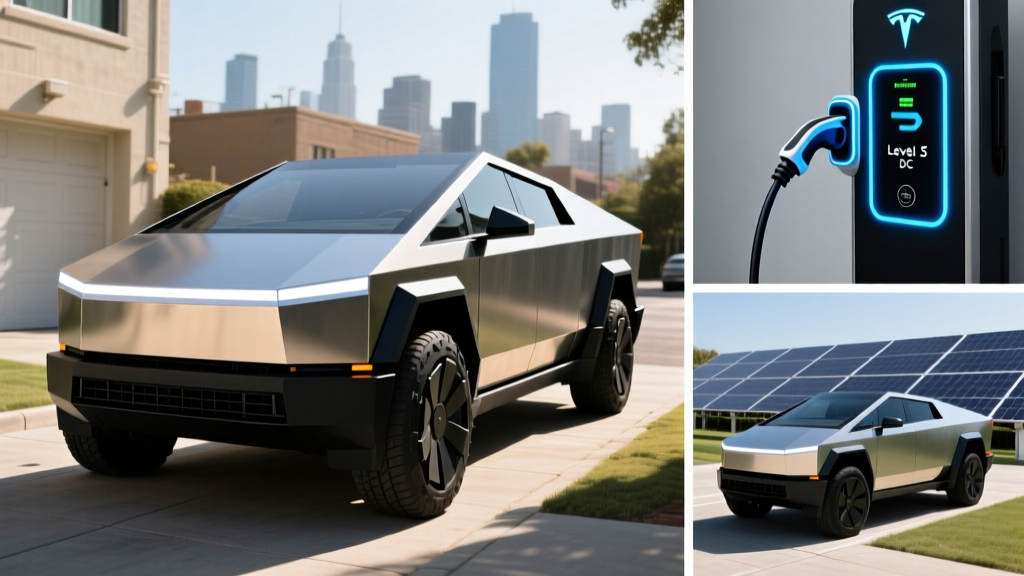
The Tesla Cybertruck arrived in late 2023 as one of the most polarizing vehicles ever put into production. By the 2024 model year, deliveries had ramped to meaningful volume, and real-world owners have accumulated enough miles to separate marketing promises from pavement reality. This review covers the 2024 Cybertruck across its three trims — AWD, Cyberbeast, and the base RWD (slated for 2025 availability) — with hard numbers on range, charging, performance, and ownership economics.
If you're researching the 2024 Cybertruck as a potential purchase, you need more than the spec sheet. You need to know what happens at 75 mph on a winter highway, how fast the charge curve actually tapers, and whether the §30D federal tax credit applies to your specific situation. Let's get into the data.
Range and Efficiency: EPA vs. the Real World
The 2024 Cybertruck is available in two drivable trims for the 2024 model year: the Dual Motor AWD and the tri-motor Cyberbeast. Here's how the EPA rates them, along with what you should actually expect when you leave the driveway.
Real-world expectation: 270–310 miles at highway speeds (65–75 mph); expect 20–30% range reduction in sub-freezing temperatures due to cabin heating demand and battery chemistry. City driving with regenerative braking recovers energy and can approach or slightly exceed the EPA figure.
2024 Cybertruck Cyberbeast (Tri-Motor): EPA-estimated 320 miles
Real-world expectation: 250–290 miles highway; tri-motor drivetrain draws more energy under hard acceleration. Cold-weather loss mirrors the AWD trim.
Range Extender Option: Tesla announced a bed-mounted range-extender battery pack targeting 470+ miles total, but as of the 2024 model year, this option has not shipped to customers and remains unavailable for purchase.
Efficiency on the AWD trim is rated at approximately 56 MPGe combined, which translates to roughly 59 kWh per 100 miles driven. That's notably less efficient than a sedan like the Tesla Model S (which achieves around 30 kWh/100 mi) — but this is a 6,800+ lb stainless-steel truck with the aerodynamic profile of a wedge. Efficiency was never the selling point.
For context, fueleconomy.gov lists the 2024 Cybertruck AWD at 340 miles of range and 56 MPGe combined. These are laboratory-derived figures; your results depend heavily on speed, temperature, payload, and terrain.
Battery, Chemistry, and Powertrain Specs
| Specification | AWD (Dual Motor) | Cyberbeast (Tri-Motor) |
|---|---|---|
| Battery Capacity (usable) | ~123 kWh | ~123 kWh |
| Battery Chemistry | NMC (Nickel Manganese Cobalt) | NMC |
| Horsepower | 600 hp | 845 hp |
| 0–60 mph | 4.1 seconds | 2.6 seconds |
| Drivetrain | Dual Motor AWD | Tri-Motor AWD |
| Towing Capacity | 11,000 lbs | 11,000 lbs |
| Payload Capacity | 2,500 lbs | 2,500 lbs |
| EPA Range | 340 miles | 320 miles |
| Efficiency (combined) | 56 MPGe / ~59 kWh/100mi | 52 MPGe / ~64 kWh/100mi |
The Cybertruck uses an NMC (nickel manganese cobalt) battery pack, consistent with Tesla's performance-oriented vehicles. NMC chemistry offers higher energy density than LFP (lithium iron phosphate), which is necessary given the Cybertruck's mass and range targets. The trade-off: NMC batteries are more sensitive to sustained 100% state-of-charge storage and extreme heat, so daily charging to 80–90% is recommended for longevity.
The 800-volt electrical architecture is a significant engineering choice. Higher voltage means the truck can accept more power at the charger without requiring proportionally thicker (heavier) cables. This directly enables the DC fast-charging speeds below.
Charging Speed: DC Fast, Level 2, and the Curve Reality
Charging speed is where the Cybertruck's 800V architecture earns its keep — and where real-world nuance matters most.
| Charging Level | Power (kW) | Speed / Time |
|---|---|---|
| DC Fast Charge (peak) | 250 kW (at V3 Supercharger) | 10–80% in ~28 minutes |
| DC Fast Charge (sustained avg) | ~170–190 kW (10–80% session avg) | Charge curve tapers significantly above 60% SoC |
| Level 2 (home / destination) | 11.5 kW (48A) | ~34 miles of range per hour; 0–100% in ~12 hours |
| Level 1 (120V outlet) | ~1.4 kW | ~4 miles of range per hour (emergency/trickle only) |
The charge curve matters more than the peak number. The Cybertruck hits 250 kW only at a low state of charge (roughly 10–25% SoC) at a V3 Supercharger. As the battery fills, the rate tapers — by 60% SoC you're likely seeing 150–170 kW, and above 80% it drops sharply to protect battery health. The ~28-minute 10–80% figure reflects this averaged curve, not a sustained 250 kW pull.
At home, the Cybertruck accepts up to 11.5 kW on a Level 2 Wall Connector (hardwired, 60A circuit). This is adequate for overnight replenishment — you'll recover a full charge in about 12 hours. If your home electrical panel is a 100A service, you may need a panel upgrade (typically $1,500–$3,500) to support a 60A dedicated circuit. Always confirm with a licensed electrician before purchasing equipment.
The Cybertruck ships with a NACS (North American Charging Standard) port natively, meaning it plugs directly into Tesla Superchargers without an adapter. For CCS-based networks like Electrify America, you'll need a NACS-to-CCS adapter — Tesla sells one, and third-party options are available.
Pricing, Trims, and Federal Tax Credit Eligibility
| Trim | Base MSRP | Federal §30D Credit Eligibility | Effective Price (if eligible) |
|---|---|---|---|
| AWD (Dual Motor) | $79,990 | Not eligible — MSRP exceeds $80,000 truck cap* | $79,990 |
| Cyberbeast (Tri-Motor) | $99,990 | Not eligible — MSRP exceeds $80,000 truck cap | $99,990 |
| RWD (Base, 2025 availability) | $60,990 (announced) | Potentially eligible — under $80,000 cap, pending battery sourcing confirmation | ~$53,490 (if full $7,500 applies) |
*Under IRS §30D rules, the MSRP cap for trucks, vans, and SUVs is $80,000. The Cybertruck AWD at $79,990 sits exactly at the threshold — however, destination fees and mandatory options can push the final MSRP above the cap. Consult the IRS qualified vehicle list and a tax professional for your specific situation.
Additional §30D eligibility requirements (for any trim that qualifies on MSRP):
- Buyer income caps: Modified AGI must not exceed $150,000 (single), $225,000 (head of household), or $300,000 (joint filers)
- Battery component sourcing: A percentage of battery components must be manufactured or assembled in North America (threshold increases annually)
- Critical minerals: A percentage of critical minerals must be sourced from the U.S. or free-trade-agreement partners
- Point-of-sale transfer: Eligible buyers can transfer the credit to the dealer at purchase, reducing the purchase price directly rather than waiting for a tax refund
The Cyberbeast at $99,990 is definitively above the truck MSRP cap and does not qualify for the federal credit regardless of buyer income. For the AWD trim, eligibility is borderline and depends on exact MSRP configuration and current-year sourcing rules. The upcoming RWD trim at $60,990 is the most credit-likely candidate, but its availability has been pushed to 2025.
Cargo, Interior Space, and Daily Practicality
The Cybertruck is a full-size pickup, but its unconventional geometry creates a unique interior and bed profile.
- Bed length: 6 feet (with tailgate up); extends to approximately 7.5 feet with the powered tonneau-style "exoskeleton" tailgate deployed
- Bed volume: 67 cubic feet
- Front trunk (frunk): ~7.1 cubic feet — usable for groceries or a charging cable kit, not a second full bed
- Seating: 5 passengers (bench front seat in some configurations, or dual front buckets)
- Front legroom: ~41.5 inches
- Rear legroom: ~38.2 inches — adequate for adults on short trips, tight for long highway drives
- Curb weight: ~6,800 lbs (AWD), ~6,900 lbs (Cyberbeast)
The powered bed cover is a standout feature — it's rigid, lockable, and supports up to 300 lbs of distributed weight. Combined with the stainless-steel exoskeleton body, it creates a secure, weather-sealed cargo area that traditional tonneau covers can't match. However, the angular bed walls and wheel-well intrusions make loading flat sheets of plywood (a common truck benchmark) more complicated than in a conventional F-150 or Silverado bed.
Technology, Driver Assistance, and Standout Features
The Cybertruck runs Tesla's current-generation infotainment stack on an 18.5-inch center touchscreen with a secondary 9.4-inch rear-seat display. Notable tech features include:
- Steer-by-wire: The Cybertruck is the first mass-production Tesla to eliminate the mechanical steering column. A yoke-style steering wheel (with less than one full turn lock-to-lock) controls the front wheels electronically. This enables the extremely quick 18.5-foot turning radius despite the truck's 223-inch length.
- 48-volt electrical architecture: Replaces the traditional 12V system for most vehicle functions, reducing wiring harness weight and enabling higher-power accessories.
- Autopilot / FSD (Supervised): Tesla's driver-assistance suite is included (Autopilot) or available as an upgrade (Full Self-Driving, Supervised). This is an SAE Level 2 system — the driver must remain attentive, hands on the yoke, and ready to take over at all times. It is not autonomous driving.
- Bioweapon Defense Mode: HEPA air filtration system with positive cabin pressurization.
- Powershare / V2L: The Cybertruck can output up to 9.6 kW of 120V/240V power from bed and cabin outlets, functioning as a mobile generator for job sites, camping, or emergency home backup (with appropriate transfer switch).
The steer-by-wire system is genuinely novel. On tight city streets and parking lots, the reduced steering ratio means minimal hand movement. On the highway, it's stable and precise. Some drivers report a learning curve of 1–2 weeks before it feels natural. The absence of a mechanical connection also means no road vibration transfers to the yoke — a comfort benefit on rough surfaces.
Warranty, Reliability, and Ownership Considerations
| Coverage | Term |
|---|---|
| Basic Vehicle Limited Warranty | 4 years / 50,000 miles |
| Battery & Drive Unit Warranty | 8 years / 120,000 miles (minimum 70% battery capacity retention) |
| Corrosion Warranty | Stainless steel body — no traditional rust-through warranty published; Tesla states the exoskeleton is corrosion-resistant by material nature |
The 8-year / 120,000-mile battery warranty is competitive with other full-size EVs (the Ford F-150 Lightning offers 8 years / 100,000 miles). The 70% capacity retention threshold is standard — if your battery degrades below 70% of original capacity within the warranty period, Tesla will repair or replace it. In practice, NMC batteries in Tesla vehicles have shown approximately 10–12% degradation over the first 100,000 miles based on fleet data, which keeps most owners well above the threshold.
Insurance costs are a real consideration. The Cybertruck's stainless-steel body panels, steer-by-wire system, and high repair complexity push premiums above average. Owners report annual insurance costs of $3,000–$5,500 depending on location, driving record, and coverage level — significantly higher than a comparably priced F-150 Lightning in many markets. Get quotes before committing.
Pros, Cons, and Who Should Buy the 2024 Cybertruck
Pros
- Class-leading 0–60 performance (2.6s Cyberbeast rivals supercars)
- 11,000-lb towing capacity competitive with full-size ICE trucks
- Stainless-steel exoskeleton eliminates paint damage and dent concerns
- Steer-by-wire gives an exceptionally tight turning radius
- V2L / Powershare outputs up to 9.6 kW — genuine job-site and emergency utility
- Tesla Supercharger network access (NACS native) remains the most reliable DC fast-charging network in the U.S.
- 800V architecture enables strong DC fast-charge speeds
Cons
- AWD and Cyberbeast trims exceed or borderline the §30D MSRP cap — no federal tax credit for most buyers
- Efficiency of ~59 kWh/100 mi means high electricity costs per mile vs. sedans
- Highway real-world range falls 15–20% below EPA estimate
- Insurance premiums are significantly above average for the price class
- Rear-seat legroom is tight for a truck at this price point
- Build-quality inconsistencies reported by early owners (panel gaps, trim alignment)
- Cyberbeast's tri-motor weight and power draw reduce range vs. AWD
- No Apple CarPlay or Android Auto — Tesla's proprietary infotainment only
Who the 2024 Cybertruck Suits Best
Buy it if: You want a performance truck that doubles as a mobile power station, you have reliable home Level 2 charging, you value the Supercharger network for road trips, and you're comfortable with a premium price and no federal tax credit on the available trims.
Consider alternatives if: Maximum range and efficiency are your priority (Rivian R1T or F-150 Lightning extended-range offer competitive range at lower MSRP), you need a conventional steering feel, you require the §30D tax credit to justify the purchase, or you regularly carry rear-seat passengers on long trips.
Frequently Asked Questions
What is the real-world range of the 2024 Cybertruck?
The AWD trim's EPA estimate is 340 miles, but expect 270–310 miles in mixed highway driving at 65–75 mph. In cold weather (below 32°F), range drops an additional 20–30% due to cabin heating and reduced battery efficiency. The Cyberbeast delivers 250–290 miles real-world highway. City driving with regenerative braking can push closer to the EPA sticker.
How fast does the 2024 Cybertruck charge?
On a Tesla V3 Supercharger, the Cybertruck peaks at 250 kW and charges from 10–80% in approximately 28 minutes. However, peak speed only holds at low SoC — the average rate across the session is closer to 170–190 kW. At home on a Level 2 Wall Connector (11.5 kW), a full charge takes about 12 hours, adding roughly 34 miles of range per hour.
Does the 2024 Cybertruck qualify for the federal EV tax credit?
The Cyberbeast ($99,990) is above the $80,000 MSRP cap for trucks under IRS §30D and does not qualify. The AWD ($79,990) sits at the cap boundary — destination charges and options may push it over, and battery-sourcing rules apply. The base RWD ($60,990, expected 2025) is the most likely candidate for the full $7,500 credit, subject to income limits ($300,000 joint / $150,000 single) and critical-mineral sourcing thresholds. Always verify on the IRS qualified vehicle list and consult a tax professional.
Is the 2024 Cybertruck worth buying vs. the Rivian R1T or F-150 Lightning?
It depends on your priority. The Cybertruck Cyberbeast is faster than both (2.6s 0–60) and has the most distinctive utility (Powershare V2L, stainless body). The Rivian R1T offers more conventional truck practicality, a quad-motor option, and better rear-seat space. The F-150 Lightning provides the most traditional truck experience with a proven platform and broader §30D eligibility on lower trims. If performance and Tesla's Supercharger network matter most, the Cybertruck wins. If tax credit eligibility, interior space, or conventional truck ergonomics matter more, the Lightning or R1T may serve you better.
How much does it cost to charge a Cybertruck at home?
With a ~123 kWh usable battery and a national average electricity rate of $0.16/kWh, a full 0–100% home charge costs approximately $19.68. At ~59 kWh/100 mi efficiency, that's roughly $0.094 per mile — compared to about $0.18–$0.22 per mile for a gas truck getting 18 MPG at $3.50/gallon. Annual fuel savings for a 12,000-mile driver are approximately $1,000–$1,500, though this varies by local electricity and gas prices.
Can the Cybertruck tow a camper or boat?
Yes — the 11,000-lb towing capacity handles most travel trailers, boat trailers, and car haulers. However, towing at or near maximum capacity will reduce range by 40–55%, bringing real-world towing range to approximately 130–180 miles. Plan charging stops accordingly on long hauls.
The 2024 Cybertruck is an engineering statement as much as a vehicle. Its steer-by-wire, 800V architecture, and stainless-steel exoskeleton push boundaries that no other production truck touches. Whether those innovations justify the price, the insurance costs, and the tax-credit limitations depends entirely on your use case. The numbers above should give you everything you need to decide.