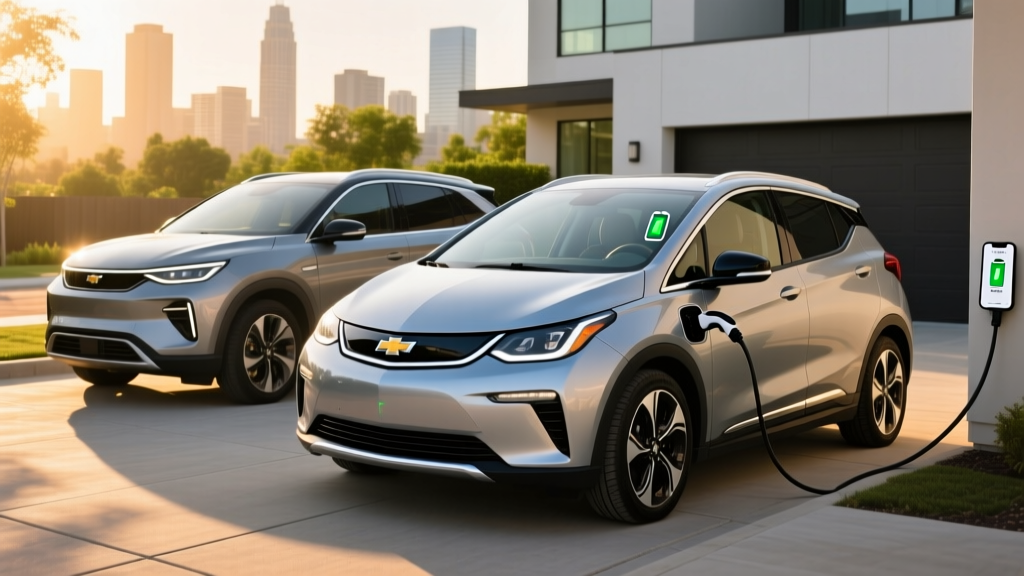
The 2024 Chevrolet Bolt EV and Bolt EUV occupy a space no other new electric vehicle has managed to claim: a sub-$30,000 starting price with over 250 miles of EPA-estimated range and practical daily usability. For budget-conscious EV shoppers in 2026, the Bolt remains a benchmark for affordability, even as newer competitors enter the market. This review covers both the standard Bolt EV hatchback and the slightly larger Bolt EUV crossover variant, examining range, charging behavior, performance, interior practicality, and total ownership cost with exact figures.
EPA Estimate: 259 miles (Bolt EV) / 247 miles (Bolt EUV)
Real-World Expectation: 220–245 miles in mixed driving; 200–220 miles sustained highway at 70+ mph; 160–185 miles in sub-30°F winter conditions. The Bolt's 65 kWh usable battery and efficient powertrain deliver strong city range, but highway speeds and cold weather reduce efficiency noticeably.
Battery, Range, and Efficiency
The 2024 Bolt EV and EUV share the same 65 kWh (usable) lithium-ion NMC (nickel manganese cobalt) battery pack manufactured by LG Energy Solution. This is a carryover from the refreshed 2022+ battery architecture, which improved energy density over the original 2017–2019 Bolt's 60 kWh pack.
| Spec | Bolt EV (Hatchback) | Bolt EUV (Crossover) |
|---|---|---|
| EPA Range | 259 miles | 247 miles |
| Battery (Usable) | 65 kWh NMC | 65 kWh NMC |
| MPGe (Combined) | 120 MPGe | 115 MPGe |
| Efficiency | 28 kWh/100 mi | 29 kWh/100 mi |
| Motor Output | 200 hp / 266 lb-ft | 200 hp / 266 lb-ft |
| 0–60 mph | ~6.5 seconds | ~7.0 seconds |
| Drivetrain | FWD (single motor) | FWD (single motor) |
| Cargo (rear seats up) | 16.3 cu ft | 16.3 cu ft |
| Cargo (rear seats folded) | 57.0 cu ft | 56.9 cu ft |
| Rear Legroom | 36.0 in | 39.1 in |
The Bolt's EPA-rated 120 MPGe combined (Bolt EV) translates to roughly 28 kWh per 100 miles of driving. In temperate city and suburban driving, owners frequently report exceeding the EPA range estimate, thanks to generous regenerative braking and low-speed efficiency. However, sustained highway driving at 75 mph pushes consumption closer to 32–34 kWh/100 mi, dropping effective range to roughly 200–215 miles.
Cold-weather impact: In temperatures below 30°F, expect a 25–35% range reduction. The Bolt lacks a heat pump, relying instead on resistive cabin heating, which is a significant energy draw. Preconditioning the cabin while plugged in is essential for maximizing winter range.
Charging Speeds: DC Fast, Level 2, and Level 1
Charging is where the 2024 Bolt reveals its most notable compromise. While home Level 2 charging is excellent, DC fast charging remains a weak point compared to competitors on 800V architectures.
| Charging Level | Power / Rate | Time / Range Added |
|---|---|---|
| Level 1 (120V household) | ~1.2 kW | ~4 miles per hour |
| Level 2 (240V home/public) | 11.5 kW max (48A) | ~39 miles per hour; 0–100% in ~7 hours |
| DC Fast Charge (CCS) | 55 kW peak | 10–80% in ~55 minutes; ~100 miles in 30 min |
Level 2 home charging is a genuine strength. The Bolt's onboard charger accepts up to 11.5 kW (48 amps), which is among the best in its class. On a properly installed 240V/60A circuit with a 48A hardwired EVSE, you'll add roughly 39 miles of range per hour — enough to fully replenish the 65 kWh battery overnight in about 7 hours. Most competitors in this price range cap at 7.2 or 9.6 kW.
DC fast charging is the Bolt's Achilles' heel. The peak rate of 55 kW (via CCS1 connector) is slow by 2026 standards, where vehicles like the Hyundai Ioniq 5 peak at 240 kW and the Tesla Model Y at 250 kW. A 10–80% session takes approximately 55 minutes. The charge curve is relatively flat — the Bolt sustains close to 50–55 kW through about 60% state of charge, then tapers to roughly 38 kW through 80%, and drops further above 80%. For road trippers, this means planning for longer charging stops, roughly 45–60 minutes every 180–200 miles.
Chevrolet has confirmed that a future Bolt generation will adopt the NACS connector and faster DC charging, but the 2024 model ships with CCS1. Adapters (CCS-to-NACS) are available for accessing Tesla Supercharger V2 stalls, though V3/V4 stalls may require Chevrolet's official adapter.
Performance and Drivetrain
The 2024 Bolt is powered by a single front-mounted permanent-magnet electric motor producing 200 horsepower and 266 lb-ft of torque. Power delivery is instant, as with all EVs, giving the Bolt a peppy feel in city traffic and merging situations.
The Bolt EV hatchback hits 0–60 mph in approximately 6.5 seconds, while the heavier EUV crossover takes about 7.0 seconds. Neither is a performance vehicle, but both are adequately quick for daily driving. The front-wheel-drive layout means torque steer is mildly perceptible under hard acceleration from a stop, and the Bolt's relatively narrow all-season tires prioritize efficiency over grip.
Ride quality is compliant and comfortable, with a low center of gravity from the floor-mounted battery pack contributing to stable handling. Cabin noise levels are low at city speeds but wind and tire noise become noticeable above 65 mph. The Bolt does not offer all-wheel drive — buyers in heavy snow regions should consider dedicated winter tires.
Interior, Tech, and Driver Assistance
Inside, the 2024 Bolt features a 10.2-inch touchscreen running Chevrolet Infotainment 3 Plus with wireless Apple CarPlay and Android Auto. A 10.2-inch digital driver display replaces traditional gauges, showing range, energy flow, and regeneration levels. The interface is responsive and logically laid out, though the resolution and graphics feel a generation behind premium competitors.
Notable tech features:
- One-pedal driving mode with aggressive regen (allows near-complete stops without brake pedal)
- Regen on Demand paddle behind the steering wheel for adjustable braking
- Wi-Fi hotspot capability (OnStar 4G LTE)
- MyChevrolet app with remote start, charge status, and preconditioning
- Available Super Cruise (EUV Premier only) — GM's hands-off, eyes-on Level 2 highway driving system on mapped roads
Super Cruise allows hands-free driving on over 400,000 miles of compatible divided highways in the US and Canada, but requires continuous driver attention via an infrared camera monitoring your eyes. You must remain alert, keep your eyes on the road, and take over when prompted. It is not autonomous driving.
Standard safety and driver-assist features include automatic emergency braking, forward collision alert, lane keep assist, following distance indicator, and IntelliBeam automatic high beams. The Bolt earned a 5-Star Overall Safety Rating from NHTSA.
Drawbacks: The Bolt's interior materials are predominantly hard plastics, acceptable at this price point but noticeably less refined than competitors like the Hyundai Kona Electric or Volkswagen ID.4. Rear seat comfort in the standard Bolt EV is tight for adults on long trips — the EUV's extra 3.1 inches of rear legroom make it the better choice for families. There is no front trunk (frunk), and the cargo area, while adequate at 16.3 cu ft, is smaller than many compact crossovers.
Pricing, Trims, and Federal Tax Credit
For 2024, Chevrolet positioned the Bolt as the most affordable long-range EV in the US market. Pricing remained unchanged from the significant price cut GM announced for the 2023 model year.
| Trim | Base MSRP | Est. §30D Credit* | Effective Price* |
|---|---|---|---|
| Bolt EV 1LT | $26,500 | Up to $7,500 | From ~$19,000 |
| Bolt EV 2LT | $29,700 | Up to $7,500 | From ~$22,200 |
| Bolt EUV LT | $27,800 | Up to $7,500 | From ~$20,300 |
| Bolt EUV Premier | $31,800 | Up to $7,500 | From ~$24,300 |
*Federal tax credit caveats (IRS §30D): The Bolt EV and EUV have historically qualified for the full $7,500 federal tax credit, as their battery components and critical minerals have met IRS sourcing requirements. However, eligibility depends on:
- Buyer income caps: AGI ≤ $150,000 (single), $225,000 (head of household), $300,000 (married filing jointly)
- MSRP caps: ≤ $55,000 for sedans/hatchbacks (Bolt EV), ≤ $80,000 for SUVs/crossovers (Bolt EUV) — both qualify easily
- Battery sourcing: Critical minerals and battery components must meet annual escalating thresholds; verify current-year compliance on IRS.gov or with your dealer
- Point-of-sale transfer: As of 2024, buyers can transfer the credit to the dealer at purchase, reducing the sale price directly rather than waiting for a tax refund
- Tax liability: The credit is non-refundable if claimed on your return (but point-of-sale transfer bypasses this limitation)
Always confirm eligibility with your tax professional and check the IRS clean vehicle credit page before purchasing, as sourcing requirements tighten annually.
Warranty and Long-Term Ownership
Chevrolet backs the 2024 Bolt with a solid warranty package:
- Battery & Powertrain: 8 years / 100,000 miles (whichever comes first), covering defects and capacity loss below 60% of original capacity
- Bumper-to-Bumper: 3 years / 36,000 miles
- Corrosion: 6 years / 100,000 miles
- Roadside Assistance: 5 years / 100,000 miles
The 60% capacity retention threshold on the battery warranty is less generous than some competitors (Hyundai/Kia guarantee 70% over 10 years/100,000 miles). However, real-world Bolt battery degradation has proven modest: most owners report 5–8% capacity loss over the first 50,000 miles based on community data. The NMC chemistry, combined with GM's conservative buffer management, has yielded reliable long-term performance.
Maintenance costs are minimal compared to gasoline vehicles — no oil changes, no transmission fluid, and regenerative braking significantly extends brake pad life. Expect to replace cabin air filters, wiper blades, and eventually tires (the Bolt's stock Michelin Energy Saver tires prioritize efficiency but wear faster under the vehicle's ~3,500 lb curb weight and instant torque).
Who Should Buy the 2024 Chevy Bolt?
- You want the lowest-cost new EV with 250+ miles of range
- Your driving is primarily city/suburban commuting under 60 miles daily
- You have access to Level 2 home charging and rarely road-trip more than 200 miles
- You're a solo driver or couple who don't need expansive rear-seat space
- You need extra rear legroom for children or adult passengers
- You want available Super Cruise for highway commuting
- You prefer a crossover ride height and styling
- You're willing to trade 12 miles of range for added interior volume
- You take frequent road trips over 300 miles and can't tolerate 55-minute charging stops
- You need AWD for severe winter conditions
- You want premium interior materials or cutting-edge infotainment
- You need towing capacity (the Bolt is not rated for towing)
Bolt vs. Key Competitors
| Spec | Chevy Bolt EV | Hyundai Kona Electric | Nissan LEAF SV Plus |
|---|---|---|---|
| EPA Range | 259 mi | 261 mi | 212 mi |
| Base MSRP | $26,500 | $32,675 | $36,190 |
| Battery | 65 kWh NMC | 64.8 kWh NMC | 60 kWh NMC |
| DC Fast Charge | 55 kW (CCS) | 100 kW (CCS) | 100 kW (CHAdeMO) |
| Level 2 Max | 11.5 kW | 10.9 kW | 7.2 kW |
| 0–60 mph | 6.5 sec | 7.2 sec | 6.9 sec |
| §30D Credit | Up to $7,500 | Up to $7,500 | Up to $3,750 |
The Bolt's price advantage is significant — even after the Kona Electric and LEAF apply tax credits, the Bolt remains the cheapest option by several thousand dollars. The LEAF's CHAdeMO connector is increasingly a liability as the US charging infrastructure has standardized on CCS and NACS. The Kona Electric charges faster on DC (100 kW vs. 55 kW) but costs $6,000+ more before incentives.
Pros and Cons
- Lowest MSRP of any 250+ mile EV
- Excellent 11.5 kW Level 2 home charging
- Peppy 200 hp motor with smooth one-pedal driving
- Full $7,500 federal tax credit eligibility (verify annually)
- Practical hatchback/crossover cargo space
- Available Super Cruise on EUV Premier
- Strong NHTSA 5-star safety rating
- Slow 55 kW DC fast charging limits road-trip practicality
- No heat pump — significant winter range loss
- CCS1 connector (NACS adapter needed for Tesla Superchargers)
- Hard-plastic interior materials
- No AWD option
- Not rated for towing
- Battery warranty threshold at 60% capacity (below some competitors)
Frequently Asked Questions
What is the real-world range of the 2024 Chevy Bolt?
Expect 220–245 miles in mixed driving in moderate temperatures. Highway driving at 70+ mph drops effective range to roughly 200–215 miles. In sub-30°F winter conditions, plan for 160–185 miles due to resistive heating and reduced battery efficiency.
How fast does the 2024 Bolt charge at home and on the road?
On a 240V Level 2 home charger, the Bolt accepts up to 11.5 kW, adding about 39 miles per hour and fully charging in ~7 hours. On DC fast chargers, it peaks at 55 kW, taking approximately 55 minutes for a 10–80% charge — slow compared to competitors.
Does the 2024 Chevy Bolt qualify for the $7,500 federal tax credit?
The Bolt EV and EUV have qualified for the full §30D credit, but eligibility depends on your income (AGI caps apply), battery sourcing compliance for the current tax year, and the vehicle's MSRP (well under caps). Verify on IRS.gov and with a tax professional before purchasing. Point-of-sale transfer is available.
Is the 2024 Bolt worth buying vs. newer EVs?
For budget-focused buyers who primarily commute and charge at home, the Bolt remains one of the best values in the EV market. Its main weakness — slow DC charging — matters primarily for frequent road trippers. If most of your driving is under 60 miles daily and you can install a Level 2 home charger, the Bolt's effective price after tax credits is hard to beat.
Does the Bolt have a heat pump for winter efficiency?
No. The 2024 Bolt uses resistive electric heating for the cabin, which draws significantly more energy than a heat pump system. This contributes to the Bolt's 25–35% range reduction in freezing temperatures. Preconditioning while plugged in is strongly recommended in cold climates.
Can I charge the Bolt at Tesla Superchargers?
The 2024 Bolt uses a CCS1 connector. You can access Tesla Superchargers using a CCS-to-NACS adapter. GM has offered adapters to Chevrolet EV owners; check with your dealer for availability. Note that charging speeds will still be limited by the Bolt's 55 kW peak, regardless of the Supercharger's capability.
What is the battery replacement cost for the Bolt?
Out-of-warranty battery replacement for the Bolt is estimated between $14,000 and $16,000 (parts and labor) based on current pricing. However, real-world data shows Bolt batteries degrading slowly — most owners retain 90%+ capacity at 50,000 miles. Full replacement within the vehicle's useful life is uncommon.