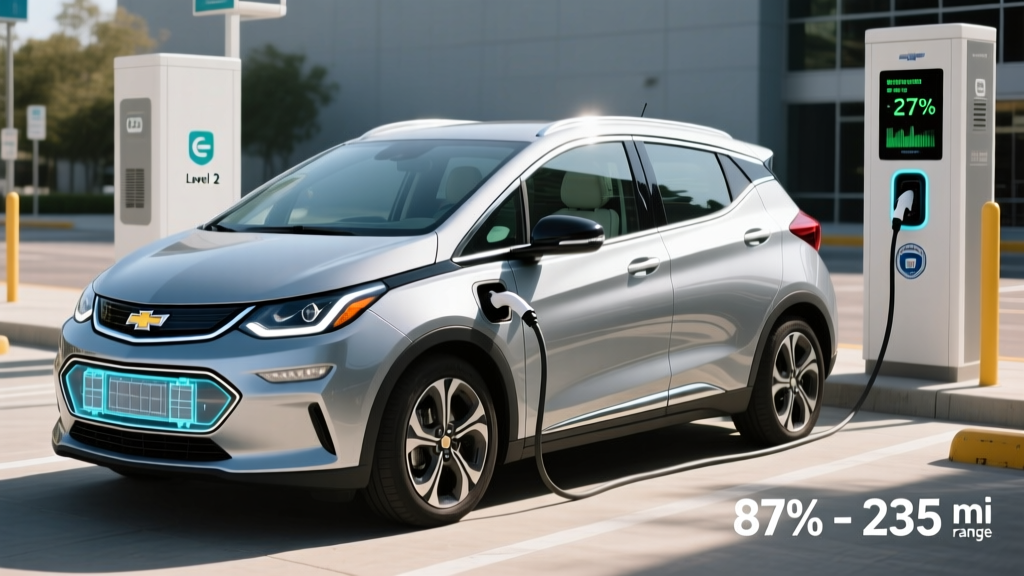
The 2024 Chevrolet Bolt EV occupies a rare space in the electric-vehicle market: a proven, affordable, long-range hatchback that undercuts nearly every competitor on price while delivering practical daily utility. After Chevrolet's aggressive price cut for the 2023 model year — dropping the base 1LT to $26,500 — the Bolt EV became the cheapest new EV in America with over 250 miles of EPA range. The 2024 model carries over unchanged, which is both its strength and its limitation.
This review breaks down the real numbers buyers need: actual range in highway and cold-weather driving, charging speed limitations, total cost after the federal tax credit, and whether the Bolt EV's aging platform still makes sense against newer rivals like the Hyundai Kona Electric and Nissan Leaf.
Range and Efficiency: 259 Miles EPA, But Expect Less on the Highway
Real-World Highway Expectation: ~210–230 miles at 70+ mph
Cold-Weather Expectation (below 32°F): ~175–200 miles with cabin heating
The 2024 Bolt EV's EPA-rated 259 miles is legitimate for mixed city and suburban driving, where regenerative braking recaptures energy and the single-speed reduction gear operates efficiently. The combined efficiency rating of 120 MPGe (28 kWh per 100 miles) is competitive with larger, more expensive EVs.
However, the Bolt EV's relatively small frontal area and lack of a heat pump work against it on highway road trips. At sustained 70–75 mph speeds, expect range to drop to roughly 210–230 miles. In freezing temperatures with the resistive cabin heater running, that figure can fall to 175–200 miles. The Bolt EV uses a PTC (positive temperature coefficient) heater rather than a heat pump, which draws significantly more energy from the 65 kWh battery pack in cold conditions.
For context, competitors like the Hyundai Kona Electric (261 miles EPA) and the Tesla Model 3 RWD (272 miles EPA) show similar highway and cold-weather reductions. The Bolt EV's range is genuine for its class — just plan conservatively for winter road trips.
Battery and Powertrain: 65 kWh NMC Pack, 200 HP Front-Wheel Drive
| Specification | Value |
|---|---|
| Battery Capacity (usable) | 65 kWh |
| Battery Chemistry | NMC (Nickel Manganese Cobalt) |
| EPA Range | 259 miles |
| Efficiency | 120 MPGe / 28 kWh per 100 mi |
| Motor Output | 200 hp / 266 lb-ft torque |
| Drivetrain | Front-wheel drive (single motor) |
| 0–60 mph | ~6.5 seconds |
| Top Speed | 93 mph (electronically limited) |
| Cargo Volume (rear seats up) | 16.3 cu ft |
| Cargo Volume (rear seats folded) | 57.0 cu ft |
| Rear Legroom | 36.0 inches |
| Battery Warranty | 8 years / 100,000 miles |
| Bumper-to-Bumper Warranty | 3 years / 36,000 miles |
The Bolt EV's 65 kWh NMC lithium-ion battery pack is a carryover from the 2020 refresh, when Chevrolet upgraded from the original 60 kWh pack. NMC chemistry provides good energy density for the Bolt's compact footprint, though it requires more careful thermal management than LFP (lithium iron phosphate) packs found in some newer competitors. Chevrolet's battery management system includes active liquid cooling and heating, which helps preserve long-term battery health.
The single front-mounted permanent-magnet motor produces 200 horsepower and 266 lb-ft of torque, delivering a 0–60 mph time of approximately 6.5 seconds. That's quick for a sub-$30,000 hatchback — the instant torque makes the Bolt EV feel punchy in city driving and confident during highway merging. The front-wheel-drive layout means some torque steer under hard acceleration, but it's manageable and typical for the segment.
One-pedal driving is well-executed through the "L" mode and the on-demand regen paddle behind the steering wheel. The Bolt EV can come to a complete stop using regeneration alone, reducing brake wear and improving efficiency in stop-and-go traffic.
Charging Speed: The Bolt EV's Biggest Limitation
| Charging Level | Power / Rate | Time / Miles Added |
|---|---|---|
| Level 1 (120V standard outlet) | ~1.2 kW | ~4 miles per hour |
| Level 2 (240V home charger) | 11.5 kW (48A) | ~39 miles per hour; full charge ~7 hours |
| DC Fast Charge (CCS) | 55 kW peak | 10–80% in ~55 minutes |
Here's where the 2024 Bolt EV shows its age most clearly. The DC fast-charging rate peaks at just 55 kW — a figure that was acceptable in 2017 but is now a significant disadvantage. For comparison, the Hyundai Kona Electric charges at up to 100 kW, the Tesla Model 3 at 170 kW, and the Kia EV6 at up to 240 kW.
At 55 kW peak, a 10–80% DC fast charge takes approximately 55 minutes under ideal conditions (warm battery, compatible station). The charge curve is relatively flat — the Bolt EV sustains close to its peak rate through most of the session — but the absolute speed means road-trip stops are noticeably longer than in newer EVs. On a 300-mile road trip, you'll likely need one full stop of roughly an hour to recharge comfortably.
Home charging is where the Bolt EV performs well. The onboard charger accepts up to 11.5 kW on Level 2 (240V), which is competitive and means a full overnight charge in about 7 hours. Chevrolet includes a dual-level charging cord with every Bolt EV that works on both 120V and 240V outlets (with the appropriate adapter), though most owners will want to install a dedicated Level 2 wallbox for daily convenience.
The charging port uses the CCS1 connector standard. Note that Chevrolet has announced a transition to the NACS (Tesla-style) connector for future models, but the 2024 Bolt EV uses CCS1 exclusively. GM has confirmed that CCS-to-NACS adapters will be available for existing GM EV owners to access Tesla Superchargers, expanding the Bolt EV's road-trip charging options once adapters are widely distributed.
Pricing, Trims, and Federal Tax Credit Eligibility
| Trim | Base MSRP | Est. After §30D Credit* |
|---|---|---|
| 1LT | $26,500 | ~$19,000 |
| 2LT | $29,700 | ~$22,200 |
*Federal tax credit estimates assume full eligibility under IRS §30D rules. Actual credit amount depends on battery sourcing, buyer income, and tax liability. See eligibility details below.
The 2024 Bolt EV is available in two trims. The 1LT at $26,500 includes the 10.2-inch infotainment touchscreen, wireless Apple CarPlay and Android Auto, Chevy Safety Assist suite (automatic emergency braking, lane-keeping assist, following distance indicator), and the dual-level charging cord. The 2LT at $29,700 adds leatherette seating, a heated steering wheel, heated front seats, adaptive cruise control, a 360-degree camera system, and Bose premium audio.
Even at full MSRP, the Bolt EV is a value leader. After applying the federal tax credit, it becomes one of the least expensive new vehicles — electric or gas — available in the United States.
Federal EV Tax Credit (§30D) Eligibility
- MSRP Cap: Must be under $55,000 for sedans/hatchbacks — the Bolt EV qualifies at $26,500–$29,700.
- Buyer Income Cap: Modified AGI must not exceed $150,000 (single), $225,000 (head of household), or $300,000 (joint filers).
- Battery Sourcing: The credit is split into two halves — $3,750 for critical minerals and $3,750 for battery component sourcing. Sourcing requirements tighten annually. Verify current-year battery compliance on the IRS qualified vehicles list before purchasing.
- Point-of-Sale Transfer: As of 2024, buyers can transfer the credit to the dealer at purchase, reducing the out-of-pocket cost immediately rather than waiting to claim it on their tax return.
- VIN Requirement: The vehicle must be assembled in North America — the Bolt EV is built at GM's Lake Orion, Michigan plant, which qualifies.
The Bolt EV has historically qualified for the full $7,500 credit, but battery-sourcing rules evolve each year. Always confirm the specific VIN's eligibility through the dealer and cross-reference with the IRS qualified-vehicle database before finalizing your purchase. Consult a tax professional if your income is near the cap thresholds.
Interior, Technology, and Daily Usability
The Bolt EV's interior is functional rather than luxurious, which is expected at this price point. The 10.2-inch infotainment touchscreen runs Chevrolet's Infotainment 3 system, which is responsive and intuitive. Wireless Apple CarPlay and Android Auto are standard across both trims — a welcome feature that eliminates cable clutter.
The digital instrument cluster is an 8-inch display that shows range, energy flow, and driving data clearly. Physical climate controls below the screen are a practical choice that many drivers prefer over touchscreen-only HVAC interfaces.
Passenger space is adequate for four adults. Rear legroom measures 36.0 inches, which is tight for taller passengers on longer trips but acceptable for daily commuting and school runs. The cargo area provides 16.3 cubic feet behind the rear seats and 57.0 cubic feet with the 60/40 split rear seats folded — enough for a week's groceries, camping gear, or a couple of suitcases.
The Chevy Safety Assist suite includes automatic emergency braking with pedestrian detection, lane-keeping assist with lane departure warning, following distance indicator, forward collision alert, and IntelliBeam automatic high beams. The 2LT adds adaptive cruise control and a surround-view camera. Note that the Bolt EV does not offer GM's Super Cruise hands-free driving system — the driver-assistance features are SAE Level 1 and require full driver engagement at all times.
Real-World Ownership: Who the Bolt EV Suits Best
- You're a daily commuter driving under 100 miles round-trip with home Level 2 charging access.
- You want the lowest-cost entry into a new EV with 250+ miles of range.
- You primarily drive in urban or suburban environments where regenerative braking maximizes efficiency.
- You qualify for the full federal tax credit and want a sub-$20,000 net purchase price.
- You need a practical hatchback for groceries, kids, and occasional weekend trips within ~200 miles.
- You take frequent road trips over 300 miles and need fast DC charging (55 kW is slow for highway travel).
- You need all-wheel drive for snow-belt winters — the Bolt EV is FWD only.
- You want the latest interior design, premium materials, or advanced driver-assistance like hands-free highway driving.
- You regularly carry four adults and need generous rear-seat legroom.
The Bolt EV is an outstanding commuter car and a compelling second vehicle for households transitioning to electric. Its combination of low purchase price, strong city efficiency, and practical hatchback utility make it a rational choice for budget-conscious EV adopters. The trade-off is primarily in DC fast-charging speed and highway-range confidence on longer trips.
For owners with reliable home Level 2 charging, the Bolt EV's DC charging limitation matters less — you'll start every day with a full 259-mile battery and only use public fast chargers a handful of times per year. For apartment dwellers or those without home charging, the slow DC rate means longer sessions at public chargers, which can add friction to daily life.
Pros and Cons at a Glance
- Lowest MSRP of any 250+ mile EV in the U.S. market
- Genuine 259-mile EPA range with excellent city efficiency (120 MPGe combined)
- Punchy 200 hp motor with instant torque; 0–60 in ~6.5 seconds
- Strong Level 2 home charging at 11.5 kW (~7-hour full charge)
- Wireless Apple CarPlay/Android Auto standard on all trims
- Comprehensive Chevy Safety Assist suite standard
- Qualifies for up to $7,500 federal tax credit (verify sourcing annually)
- Proven platform with years of real-world reliability data
- One-pedal driving with on-demand regen paddle
- DC fast charging limited to 55 kW peak — slowest in its class
- No heat pump — significant range loss in cold weather
- Front-wheel drive only; no AWD option
- Dated interior design and materials vs. newer competitors
- Rear seat legroom is tight for taller passengers
- No Super Cruise or hands-free driving capability
- CCS1 connector (adapter needed for future NACS Supercharger access)
- Platform is aging — originally introduced for 2017 model year
How the 2024 Bolt EV Compares to Key Competitors
The Bolt EV's closest rivals are the Hyundai Kona Electric (261 miles EPA, ~$32,675 base, 100 kW DC charging) and the Nissan Leaf SV Plus (212 miles EPA, ~$36,190 base, 100 kW DC charging but CHAdeMO connector). The Kona Electric charges nearly twice as fast on DC and offers a more modern interior, but costs roughly $6,000 more before incentives. The Leaf's CHAdeMO connector is increasingly orphaned as the industry standardizes on CCS/NACS, making the Bolt EV's CCS1 a better long-term bet.
The Tesla Model 3 RWD (272 miles EPA, ~$38,990 base) is a class above in charging speed, Supercharger network access, and technology, but costs significantly more. For buyers whose priority is pure value and daily commuting, the Bolt EV's price advantage of $12,000+ is difficult to justify away.
Chevrolet has confirmed that the Bolt EV will be discontinued after the 2024 model year to make way for a next-generation EV on GM's Ultium platform. This means 2024 is the final opportunity to purchase a new Bolt EV — and potentially the last chance to get one at these prices with full tax-credit eligibility.
Frequently Asked Questions
What is the real-world range of the 2024 Chevrolet Bolt EV?
The EPA rates the Bolt EV at 259 miles combined. In real-world city and suburban driving, many owners report achieving close to or slightly above that figure thanks to strong regenerative braking. On sustained highway driving at 70+ mph, expect 210–230 miles. In freezing weather with cabin heat, plan for 175–200 miles.
How fast does the Bolt EV charge at home and on DC fast chargers?
On a Level 2 home charger (240V), the Bolt EV charges at up to 11.5 kW, adding roughly 39 miles per hour and reaching a full charge in about 7 hours. On DC fast chargers, it peaks at 55 kW, requiring approximately 55 minutes for a 10–80% charge. This is the Bolt EV's primary weakness compared to newer EVs that charge at 100–250 kW.
Does the 2024 Bolt EV qualify for the $7,500 federal EV tax credit?
The Bolt EV has historically qualified for the full $7,500 credit under IRS §30D. Eligibility requires the buyer to meet income caps ($150K single / $300K joint), the vehicle to be under the $55,000 MSRP cap, and battery components and critical minerals to meet annual sourcing thresholds. The credit can be transferred to the dealer at point of sale. Always verify current-year eligibility on the IRS qualified vehicles list.
Is the Bolt EV worth buying over the Hyundai Kona Electric or Tesla Model 3?
If your priority is the lowest cost of entry into a long-range EV and you have home charging, the Bolt EV is hard to beat — especially after the tax credit. If you road-trip frequently and need fast DC charging, the Kona Electric (100 kW) or Model 3 (170 kW) are better fits despite higher prices. The Bolt EV excels as a commuter and daily driver; it's less ideal as a primary road-trip vehicle.
What is the Bolt EV's battery warranty?
Chevrolet covers the battery and electric powertrain for 8 years or 100,000 miles, whichever comes first. The warranty guarantees the battery will retain a minimum level of capacity (typically 60–70% of original, per GM's terms). The bumper-to-bumper warranty is 3 years / 36,000 miles.
Can the Bolt EV use Tesla Superchargers?
The 2024 Bolt EV uses the CCS1 connector. GM has announced that existing GM EV owners will be able to access Tesla Superchargers using a GM-approved CCS-to-NACS adapter. Availability and pricing of these adapters should be confirmed with your Chevrolet dealer.