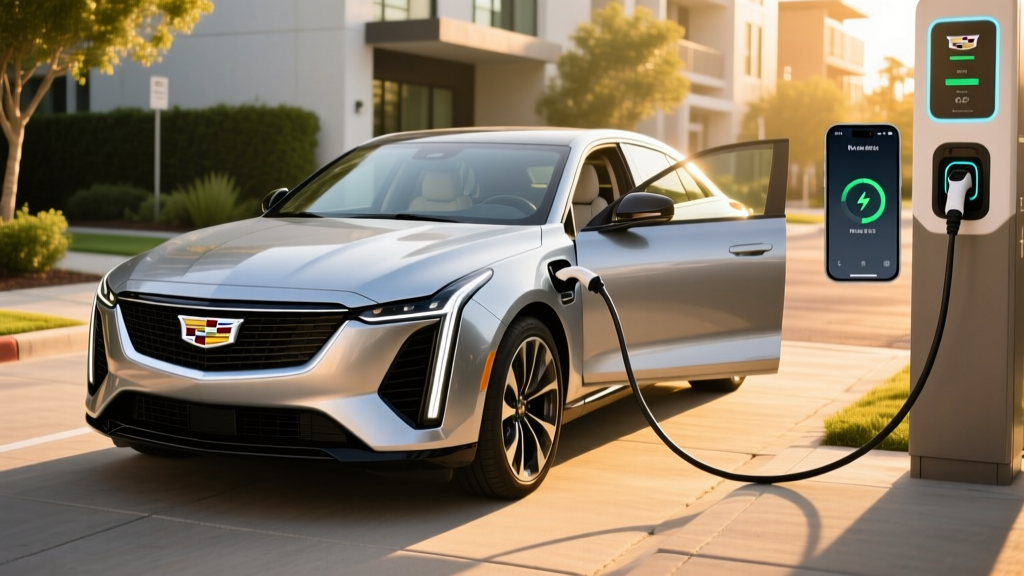
The Cadillac Optiq arrives as GM's compact luxury EV entry, slotted below the Lyriq and aimed squarely at buyers cross-shopping the Tesla Model Y, BMW iX1, and upcoming electric offerings from Audi and Mercedes. Built on GM's Ultium platform, the Optiq promises the brand's signature quiet ride and tech-forward cabin in a more accessible footprint. But with the compact luxury EV segment growing crowded, does the Optiq deliver where it counts — range, charging speed, and real-world value?
We've analyzed the official specs, EPA data, and ownership economics to give you the numbers that matter. Here's what you need to know before putting down a deposit.
Range, Battery, and Real-World Efficiency
The 2024 Cadillac Optiq is equipped with an Ultium lithium-ion battery pack using NMC (nickel manganese cobalt) chemistry, with a usable capacity of approximately 85 kWh. GM targets an EPA-estimated range of 300 to 310 miles depending on trim and wheel configuration (larger wheels reduce range slightly).
EPA Estimate: ~300–310 miles
Highway (70 mph sustained): Expect ~250–270 miles — aerodynamic drag cuts efficiency at speed.
Cold Weather (below 30°F): Plan for 20–30% range loss, dropping effective range to ~210–250 miles depending on cabin heating demand.
Combined real-world daily driving: Most owners will see 260–290 miles in mixed conditions during moderate weather.
Efficiency is rated at approximately 95 MPGe combined (roughly 35 kWh/100 miles), which is competitive for the segment but trails the Tesla Model Y's class-leading ~120 MPGe. The Optiq's heavier luxury build and sound-deadening materials contribute to the slight efficiency penalty.
| Spec | Value |
|---|---|
| EPA Range | ~300–310 mi |
| Battery (Usable) | ~85 kWh, NMC (Ultium) |
| Efficiency | ~95 MPGe / 35 kWh/100mi |
| Max DC Fast Charge | ~150 kW (peak) |
| 10–80% DC Charge Time | ~30 minutes |
| Level 2 Home Charge Rate | 11.5 kW (~31 mi/hr) |
| 0–60 mph | ~5.5 sec (AWD) |
| Horsepower | ~340 hp (dual-motor AWD) |
| Drivetrain | Dual-motor AWD (RWD available) |
| Cargo Volume | ~26 cu ft (rear seats up) / ~55 cu ft (folded) |
| Base MSRP | ~$48,000–$52,000 (est.) |
Charging Speed: DC Fast and Home Level 2
Charging capability is where many luxury EVs stumble, and the Optiq is adequate rather than exceptional. The SUV supports a peak DC fast-charge rate of approximately 150 kW via its CCS connector (with NACS adoption expected for future model years as GM transitions to Tesla's standard). At peak speed, a 10–80% charge takes roughly 30 minutes.
However, as with all EVs, peak rate is not sustained rate. The Optiq's charge curve tapers significantly above 80% State of Charge (SoC) to protect battery health. Expect 80–100% to add another 20–25 minutes. On a road trip, plan your stops around the 10–80% window for the best time efficiency.
| Level | Power | Speed (Approx.) |
|---|---|---|
| Level 1 (120V) | 1.4 kW | ~4 mi/hr |
| Level 2 (240V, 48A) | 11.5 kW | ~31 mi/hr |
| DC Fast Charge | 150 kW peak | 10–80% in ~30 min |
For home charging, the Optiq accepts up to 11.5 kW on Level 2 (48 amps on a 240V circuit), adding roughly 31 miles of range per hour. A full overnight charge from 20% to 100% takes about 7–8 hours on a properly installed Level 2 home charger — more than sufficient for daily use. Home installation of a 240V/50A circuit typically runs $800–$2,000 depending on your panel's proximity to the garage and whether a panel upgrade is needed.
Preconditioning tip: Use the Optiq's scheduled departure or navigation-to-charger feature to warm the battery before a DC fast-charge session. A cold battery will charge significantly slower, especially in winter.
Performance and Driving Dynamics
The Optiq's dual-motor all-wheel-drive powertrain produces approximately 340 horsepower and launches the SUV from 0–60 mph in roughly 5.5 seconds. A rear-wheel-drive variant is expected with slightly lower output but marginally better range.
Acceleration is confident for highway merging and passing, though the Optiq isn't positioned as a performance EV — that role belongs to Cadillac's V-Series electric lineup. The emphasis here is on refinement: GM's Ultium platform delivers a low center of gravity, and Cadillac's tuning prioritizes ride comfort and cabin isolation over sporty edge. Expect a compliant, quiet drive that soaks up road imperfections well, in keeping with the brand's luxury positioning.
Regenerative braking offers multiple modes, including a one-pedal driving option that brings the vehicle to a full stop without touching the brake pedal. The transition between regen and friction braking is smooth — a common pain point in lesser EVs that Cadillac has largely solved.
Interior, Tech, and Cargo Space
The Optiq's cabin follows Cadillac's current design language with a dominant curved LED display spanning the dashboard — a 33-inch diagonal advanced LED screen combining instrument cluster and infotainment. The system runs Google Built-In, providing native Google Maps navigation, Google Assistant voice control, and access to the Play Store for apps like Spotify and YouTube (parked only).
Wireless Apple CarPlay and Android Auto are standard, along with wireless phone charging and a premium audio system (likely a 19-speaker AKG setup on higher trims). The center console features a rotary controller alongside the touchscreen, giving drivers redundant input methods — a practical choice for those who dislike reaching for a screen while driving.
On the driver-assistance front, the Optiq comes equipped with Super Cruise on compatible trims — GM's hands-free Level 2 highway driving system. Super Cruise operates on over 400,000 miles of mapped divided highways in the US and Canada, using a driver-attention camera to ensure eyes remain on the road.
Super Cruise is a hands-free driver-assist system, not a self-driving system. The driver must remain attentive, keep eyes on the road, and be prepared to take over at any time. This is classified as SAE Level 2 automation — the vehicle controls steering and speed under specific conditions, but full driver supervision is required at all times.
Cargo space is competitive for the compact luxury segment: approximately 26 cubic feet behind the second row and up to 55 cubic feet with the rear seats folded. A small front trunk (frunk) is not confirmed for all trims — some Ultium-based vehicles omit this feature due to packaging of front-drive components in AWD models. Rear-seat legroom is adequate for adults on shorter trips but tighter than the Lyriq, reflecting the Optiq's smaller wheelbase.
Pricing, Trims, and Federal Tax Credit Eligibility
The 2024 Cadillac Optiq is expected to start around $48,000–$52,000 for the base Luxury trim, with Premium Luxury and Sport trims pushing into the $55,000–$62,000 range when fully equipped. This positions the Optiq below the Lyriq (starting ~$57,000) and in direct competition with the Tesla Model Y, BMW iX1, and Genesis GV60.
| Trim | Est. MSRP | After Max §30D Credit |
|---|---|---|
| Luxury (base) | ~$48,000–$52,000 | ~$40,500–$44,500 |
| Premium Luxury | ~$55,000–$58,000 | ~$47,500–$50,500 |
| Sport | ~$58,000–$62,000 | ~$50,500–$54,500 |
Federal tax credit eligibility under IRS §30D is the big variable. The Optiq, as a GM Ultium vehicle assembled in North America, is positioned to qualify — but several conditions apply:
- MSRP Cap: SUVs must be priced at or below $80,000. All expected Optiq trims clear this threshold.
- Buyer Income Cap: Adjusted gross income must not exceed $150,000 (single), $225,000 (head of household), or $300,000 (joint filers).
- Battery Sourcing: A percentage of critical minerals and battery components must be sourced from the US or free-trade-agreement countries. These thresholds increase annually. Check the latest fueleconomy.gov listing for the specific model year's eligibility status.
- Point-of-Sale Transfer: As of 2024, buyers can transfer the credit to the dealer at purchase, reducing the purchase price upfront rather than waiting for a tax refund. The dealer must be IRS-registered.
The maximum credit is $7,500, but partial credits ($3,750) apply if only one of the two sourcing requirements (critical minerals or battery components) is met. Always verify current-year eligibility on the IRS website and consult a tax professional — rules evolve and individual circumstances vary.
Warranty and Long-Term Ownership
GM backs the Optiq's battery and powertrain with an 8-year/100,000-mile warranty, covering defects and excessive capacity degradation. GM defines excessive degradation as falling below approximately 60–70% of original capacity during the warranty period — though the exact threshold should be confirmed in your purchase documentation.
The limited vehicle warranty covers 4 years/50,000 miles. Based on data from other Ultium-based vehicles (Lyriq, Blazer EV, Silverado EV), early battery degradation appears minimal — most owners report 95%+ State of Health (SoH) after the first year. NMC chemistry typically shows a steeper initial drop (2–5% in year one) before leveling off, with projected 10-year retention of 85–90% under normal use.
Battery replacement cost, should it be needed out of warranty, is estimated at $12,000–$18,000 for an Ultium pack of this size — though module-level repair (replacing individual degraded modules rather than the full pack) may reduce costs significantly as the Ultium platform matures and third-party repair networks develop.
Pros, Cons, and the Competition
- Quiet, refined ride quality true to Cadillac's luxury positioning
- Super Cruise hands-free highway driving on 400,000+ miles of roads
- Competitive 300+ mile EPA range
- Google Built-In infotainment with native Maps and Assistant
- Likely qualifies for full $7,500 federal tax credit (verify per trim/year)
- Strong cargo capacity for the compact luxury segment
- 150 kW peak DC charging lags behind Hyundai/Kia's 350 kW capability
- Efficiency (~95 MPGe) trails Tesla Model Y (~120 MPGe)
- CCS connector for 2024 — NACS transition means future Supercharger access requires an adapter
- GM's early Ultium software had reliability issues; check for OTA update maturity
- Rear seat space tighter than some competitors (BMW iX1, Model Y)
- No confirmed frunk on AWD trims
Key competitors to cross-shop:
- Tesla Model Y: Superior efficiency, faster charging, extensive Supercharger network — but less traditional luxury feel and no Super Cruise equivalent included free.
- BMW iX1: Similar price point, strong build quality, but shorter range (~240 mi EPA).
- Genesis GV60: 800V architecture enables 350 kW charging, striking design, but smaller dealer network.
- Volvo EX40 (formerly XC40 Recharge): Comparable range and luxury, Google-based infotainment, but slower DC charging.
Who Should Buy the Cadillac Optiq?
- You want a traditional luxury brand with a quiet, comfortable ride over sporty handling
- Super Cruise hands-free driving is a priority for your highway commute
- You need 300+ miles of range for occasional road trips but mostly drive locally
- Google Built-In and a large, integrated display matter to your daily experience
- You qualify for the §30D tax credit and want to reduce effective purchase price
- Fastest possible DC charging is critical (consider Genesis GV60 or Hyundai Ioniq 5)
- Maximum efficiency and lowest cost-per-mile are priorities (Tesla Model Y wins)
- You need maximum rear-seat room for taller passengers regularly
- You want immediate, adapter-free Tesla Supercharger access (wait for NACS-equipped models)
Frequently Asked Questions
What is the real-world range of the 2024 Cadillac Optiq?
The EPA estimates 300–310 miles. In real-world mixed driving during moderate weather, expect 260–290 miles. Highway driving at 70+ mph reduces this to roughly 250–270 miles, and cold weather (below 30°F) can drop range by 20–30%, yielding approximately 210–250 miles.
How fast does the Optiq charge at home and on the road?
On DC fast charging, the Optiq peaks at approximately 150 kW, reaching 10–80% in about 30 minutes. At home on a Level 2 (240V/48A) charger, it accepts up to 11.5 kW, adding roughly 31 miles of range per hour — a full overnight charge from low to full takes 7–8 hours.
Does the 2024 Cadillac Optiq qualify for the $7,500 federal EV tax credit?
It is positioned to qualify, as it is expected to be assembled in North America and priced well under the $80,000 SUV MSRP cap. However, eligibility depends on battery-sourcing requirements (critical minerals and components), your income level, and current-year IRS rules. Always verify on irs.gov and consult a tax professional.
Is the Optiq worth buying over a Tesla Model Y or BMW iX1?
The Optiq is the better choice if you prioritize a traditional luxury ride, Super Cruise, and a Google-integrated cabin. The Model Y wins on efficiency, charging speed, and charging network access. The BMW iX1 offers strong build quality but sacrifices range. Your decision hinges on which trade-offs matter most for your driving patterns.
What is the battery warranty on the Cadillac Optiq?
GM provides an 8-year/100,000-mile battery and powertrain warranty covering defects and excessive capacity loss. The vehicle limited warranty covers 4 years/50,000 miles.
Does the Optiq have Super Cruise?
Yes, Super Cruise is available on compatible trims. It is an SAE Level 2 hands-free driver-assist system for use on mapped divided highways. The driver must remain attentive and keep eyes on the road at all times — it is not a self-driving system.
Sources: EPA fueleconomy.gov, IRS §30D Clean Vehicle Credits, Cadillac official specifications. All specifications are based on manufacturer data available at time of writing; final EPA certification and pricing may vary by model year and trim. Verify tax credit eligibility with the IRS and a qualified tax professional.