Quick Verdict: The Lyriq Sport Balances Luxury and Electric Practicality
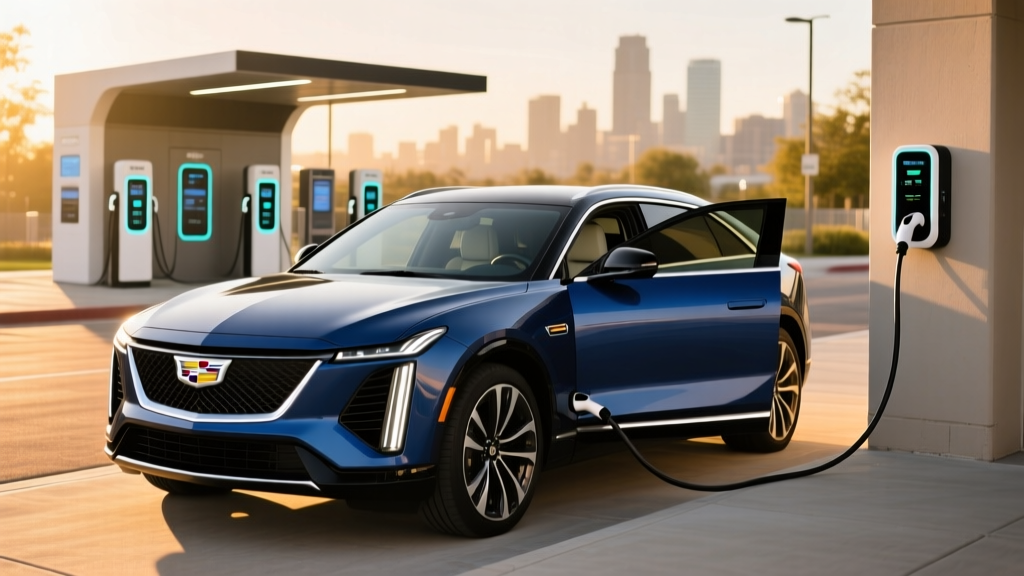
The 2024 Cadillac Lyriq Sport represents General Motors' most credible entry into the premium electric SUV segment. Built on GM's Ultium platform with a dual-motor all-wheel-drive powertrain producing 500 horsepower, the Sport trim transforms the Lyriq from a comfortable cruiser into a genuinely quick luxury hauler. With an EPA-estimated 314 miles of range, a 102-kWh battery pack, and a starting MSRP around $62,690 (before destination), it undercuts European rivals on price while delivering competitive range and charging performance.
But luxury EV buyers need more than spec-sheet numbers. This review breaks down the real-world range you can actually expect, the charging curve realities at DC fast chargers, federal tax credit eligibility under current IRS §30D rules, and whether the Lyriq Sport holds up against the BMW iX, Genesis Electrified GV70, and Tesla Model X in daily ownership.
Range, Efficiency, and the Real-World Caveat
Real-World Expectation: 260–290 miles on mixed highway driving; 220–250 miles in sustained cold weather (below 30°F) with cabin heating. City driving with regenerative braking can push closer to or slightly above the EPA figure.
The Lyriq Sport's 314-mile EPA rating is competitive for a dual-motor luxury SUV in this price bracket. For context, the BMW iX xDrive50 achieves 324 miles EPA, while the Genesis Electrified GV70 manages only 236 miles. The Lyriq's advantage comes from its large 102-kWh usable battery capacity and GM's efficient Ultium heat-pump thermal management system.
Efficiency lands at approximately 89 MPGe combined (38 kWh/100 miles) per fueleconomy.gov. That's respectable for a 5,800-pound AWD SUV, though it trails the more aerodynamic Tesla Model X Long Range (102 MPGe combined). On highway-heavy road trips at 75 mph, expect consumption to rise to roughly 42–45 kWh/100 miles, which translates to about 230–260 miles of practical range before you'll want to stop and charge.
The critical factor for Lyriq Sport buyers: this is a large, heavy vehicle with NMC chemistry optimized for energy density rather than extreme efficiency. If your commute is mostly highway miles at sustained speed, budget for the lower end of the real-world range. If you drive primarily in stop-and-go city traffic where regenerative braking recovers energy, you'll see results closer to the sticker.
Battery Chemistry, Capacity, and Longevity
| Specification | Detail |
|---|---|
| Battery Chemistry | NCMA (Nickel-Cobalt-Manganese-Aluminum) — Ultium platform |
| Total Battery Capacity | ~102 kWh usable |
| Thermal Management | Active liquid cooling + heat pump |
| Battery Warranty | 8 years / 100,000 miles (capacity retention ≥60%) |
| Powertrain Warranty | 6 years / 70,000 miles |
| Bumper-to-Bumper | 4 years / 50,000 miles |
The Lyriq uses GM's Ultium battery architecture with NCMA pouch cells — a variant of NMC chemistry that adds aluminum to the cathode for improved thermal stability and slightly higher energy density. Unlike LFP (lithium iron phosphate) batteries found in some Tesla and Ford models, NCMA offers greater range per kilogram but requires more careful state-of-charge management for long-term health.
For daily driving, GM recommends charging to 80–90% and reserving 100% charges for road trips. The onboard battery management system includes a buffer (roughly 3–5 kWh above and below the displayed 0–100%) to protect against deep discharge and overcharge degradation. Based on early Ultium platform data and comparable NMC packs from GM's Bolt EUV, expect approximately 8–12% degradation over the first 100,000 miles under normal use — well within the 60% capacity retention warranty threshold.
Charging Speed: DC Fast Charging and Home Level 2
| Charging Level | Power / Rate | Time / Miles Added |
|---|---|---|
| Level 1 (120V household) | ~1.4 kW | ~3–4 miles per hour |
| Level 2 (240V home, 48A) | 11.5 kW | ~31 miles per hour; full charge in ~9.5 hours |
| Level 2 (240V, 32A) | 7.7 kW | ~21 miles per hour; full charge in ~14 hours |
| DC Fast Charge (peak) | 190 kW | 10–80% in ~33 minutes |
| DC Fast Charge (sustained avg) | ~120–140 kW | 10–80% realistic average |
The Lyriq Sport's DC fast-charging peak of 190 kW is its most debated specification. On paper, it trails the Hyundai Ioniq 5 (240 kW), Kia EV9 (236 kW), and Porsche Taycan (270 kW). In practice, the charging curve tells a more nuanced story.
At a 350 kW Electrify America or compatible CCS station, the Lyriq will ramp quickly to its 190 kW peak between roughly 10–40% state of charge, then taper progressively. The 10–80% time of approximately 33 minutes is competitive with the BMW iX (34 minutes at 150 kW peak) but noticeably slower than the Ioniq 5's 18-minute benchmark. Above 80% SoC, charging slows dramatically to protect the NCMA cells — expect 80–100% to add another 25–30 minutes.
For home charging, the Lyriq's 11.5 kW onboard charger is a genuine advantage. With a properly installed 48-amp Level 2 wall connector on a 60-amp circuit, you'll recover the full 314-mile range overnight in about 9.5 hours. Most Lyriq owners report waking to a full battery every morning with a standard home setup, which is where the majority of EV charging actually happens. Home Level 2 installation typically costs $800–$2,000 depending on panel capacity and run length — factor this into your purchase budget.
Connector note: The 2024 Lyriq ships with a CCS1 connector. GM has announced NACS (Tesla Supercharger) adoption for future model years, and adapters are expected for existing vehicles. Check with your dealer for current adapter availability.
Performance: 500 HP Dual-Motor AWD
The Sport trim's dual-motor all-wheel-drive system produces 500 horsepower and 450 lb-ft of torque — a substantial upgrade over the single-motor RWD Luxury trim's 340 hp. The result is a 0–60 mph time of approximately 4.6 seconds, which puts the Lyriq Sport firmly in sport-SUV territory alongside the BMW iX xDrive50 (4.4 seconds) and well ahead of the Genesis Electrified GV70 (4.5 seconds with boost, but 236 miles of range).
What the numbers don't fully convey is the delivery. Electric torque is instantaneous, and the Lyriq Sport launches with the kind of effortless surge that makes merging and passing maneuvers trivial. The low center of gravity from the under-floor battery pack keeps body roll controlled through corners, though at 5,760 pounds, this is never going to feel like a sports sedan. The one-pedal driving mode with aggressive regenerative braking is well-calibrated and makes stop-and-go traffic nearly effortless.
The available air suspension (standard on Sport 3) smooths out highway imperfections effectively, and the cabin remains remarkably quiet at speed — aided by acoustic laminated glass and active noise cancellation. Towing capacity is rated at 1,500 pounds, which covers a small utility trailer or a pair of dirt bikes but rules out any serious boat or camper towing.
Interior, Tech, and Cargo Space
The Lyriq's interior is where Cadillac makes its strongest case against Tesla and the German establishment. The centerpiece is a 33-inch curved LED display that spans the driver cluster and infotainment screen in a single seamless panel running Google Built-In (Google Maps, Google Assistant, and the Play Store natively). The system is responsive, visually sharp, and avoids the menu-diving frustration that plagues some competitor interfaces.
Super Cruise, GM's hands-off Level 2 driver-assistance system, is available on the Lyriq and works on over 400,000 miles of mapped highways in North America. It remains one of the most capable and trustworthy Level 2 systems on the market, with a driver-monitoring camera that ensures you stay attentive. Note: Super Cruise is not self-driving — it is an SAE Level 2 system requiring continuous driver supervision, and it will not operate on unmapped roads or in construction zones.
| Dimension | Measurement |
|---|---|
| Cargo Volume (behind rear seats) | 28.0 cu ft |
| Cargo Volume (rear seats folded) | 60.8 cu ft |
| Front Legroom | 41.4 inches |
| Rear Legroom | 39.6 inches |
| Front Headroom | 38.6 inches |
| Rear Headroom | 37.7 inches |
| Frunk (Front Trunk) | None — space occupied by electronics |
Cargo space is adequate but not class-leading. The 28.0 cubic feet behind the second row trails the Tesla Model X (37.1 cu ft) and the BMW iX (35.5 cu ft). The absence of a frunk is a missed opportunity for stowing charging cables or a small bag, and it's a packaging consequence of the Ultium platform's electronics layout. Rear-seat passengers enjoy generous legroom and a flat floor, making the Lyriq a comfortable five-passenger vehicle for adults on longer trips.
Pricing, Trims, and Federal Tax Credit Eligibility
| Trim | Base MSRP (incl. destination) | Est. Federal Credit | Effective Price |
|---|---|---|---|
| Sport 1 (AWD) | ~$62,690 | Up to $7,500* | ~$55,190* |
| Sport 2 (AWD) | ~$67,290 | Up to $7,500* | ~$59,790* |
| Sport 3 (AWD, Air Susp.) | ~$72,490 | Up to $7,500* | ~$64,990* |
*Federal tax credit eligibility under IRS §30D is subject to multiple requirements. Consult a tax professional and see irs.gov for current rules.
- MSRP Cap: SUVs must have an MSRP at or below $80,000. All Lyriq Sport trims qualify.
- Buyer Income Cap: Modified AGI must not exceed $150,000 (single), $225,000 (head of household), or $300,000 (joint filers).
- Battery Sourcing: A percentage of critical minerals and battery components must be sourced from the U.S. or free-trade-agreement countries. These thresholds increase annually. Verify current-year compliance with the dealer.
- Point-of-Sale Transfer: As of 2024, buyers can transfer the credit to the dealer at purchase, reducing the purchase price directly rather than waiting for a tax refund.
- North American Assembly: The Lyriq is assembled in Spring Hill, Tennessee — this requirement is met.
The Lyriq Sport's pricing positions it strategically between the Tesla Model X ($79,990 base, significantly more expensive) and the Genesis Electrified GV70 (~$66,450 base, but with only 236 miles of range). The BMW iX xDrive50 starts around $87,250, making the Lyriq a substantial value play in the luxury electric SUV segment. A well-equipped Sport 2 with premium packages typically lands in the $68,000–$72,000 range before incentives.
Lyriq Sport vs. Key Competitors
| Spec | 2024 Cadillac Lyriq Sport | BMW iX xDrive50 | Genesis Electrified GV70 | Tesla Model X LR |
|---|---|---|---|---|
| EPA Range | 314 mi | 324 mi | 236 mi | 335 mi |
| Battery (usable) | 102 kWh | 105.2 kWh | 77.4 kWh | 100 kWh |
| DC Fast Charge Peak | 190 kW | 150 kW | 240 kW | 250 kW |
| 10–80% Time | ~33 min | ~34 min | ~18 min | ~30 min |
| 0–60 mph | 4.6 sec | 4.4 sec | 4.5 sec (boost) | 3.8 sec |
| Horsepower | 500 hp | 516 hp | 429 hp (boost) | 670 hp |
| Base MSRP | ~$62,690 | ~$87,250 | ~$66,450 | ~$79,990 |
| Cargo (rear seats up) | 28.0 cu ft | 35.5 cu ft | 28.7 cu ft | 37.1 cu ft |
The Lyriq Sport's strongest competitive argument is value. It delivers 314 miles of range and 500 hp at a price point $15,000–$25,000 below the BMW iX and Tesla Model X. The trade-off is slightly slower DC charging than the Korean platforms and less cargo volume than the iX and Model X. The Genesis GV70 charges faster but sacrifices nearly 80 miles of range and offers less interior space.
If Super Cruise capability on long highway commutes matters to you, the Lyriq is the only vehicle in this comparison offering hands-off Level 2 driving on hundreds of thousands of miles of mapped roads. The Tesla Model X has Autopilot/FSD, but its FSD (Supervised) system requires constant hand-on-wheel readiness and is not universally regarded as more capable than Super Cruise in its operational domain.
Who the Lyriq Sport Suits Best
- You want a luxury electric SUV under $65,000 (after credit) with 300+ miles of range
- You commute on Super Cruise-compatible highways and value hands-off Level 2 assist
- You prioritize a quiet, refined cabin with premium materials over maximum cargo space
- You want strong straight-line performance (4.6-second 0–60) without paying BMW/Tesla premiums
- You can install a Level 2 home charger and will do most charging overnight
- You regularly take 400+ mile road trips and need the fastest possible DC charging (consider Ioniq 5 or EV9)
- Maximum cargo space is essential (BMW iX or Model X offer 7+ more cubic feet)
- You need a frunk for charging cable storage
- You require towing capacity above 1,500 pounds
- You want LFP battery chemistry for simpler daily charging habits (no 80% limit needed)
Pros and Cons
- 314-mile EPA range is competitive for the AWD luxury SUV class
- 500 hp dual-motor performance at a sub-$63K starting price
- Super Cruise Level 2 system is excellent on mapped highways
- Quiet, well-appointed interior with the stunning 33-inch curved display
- 11.5 kW Level 2 onboard charger enables fast home charging
- Qualifies for up to $7,500 federal tax credit (subject to eligibility)
- Assembled in Tennessee — supports domestic manufacturing
- 190 kW DC fast-charge peak is slower than Korean and Tesla competitors
- No frunk — a notable omission at this price point
- Cargo volume (28.0 cu ft) trails the iX and Model X
- 1,500-lb towing capacity limits utility for boat/camper owners
- CCS1 connector; NACS adapter availability is still evolving
- Real-world highway range drops to ~250 miles at sustained 75+ mph
- Touch-sensitive climate controls on the dash can be distracting while driving
Frequently Asked Questions
What is the real-world range of the 2024 Cadillac Lyriq Sport?
The EPA rates the Lyriq Sport AWD at 314 miles. In real-world mixed highway driving at 70–75 mph, expect 260–290 miles. In cold weather (below 30°F) with cabin heating, range can drop to 220–250 miles. City driving with regenerative braking may yield results near or slightly above the EPA estimate.
How fast does the Lyriq Sport charge?
On a DC fast charger, the Lyriq Sport peaks at 190 kW and charges from 10–80% in approximately 33 minutes. At home on a 48-amp Level 2 charger (11.5 kW), it adds about 31 miles per hour and fully charges in roughly 9.5 hours. On a standard 120V outlet, expect 3–4 miles per hour — suitable only for occasional top-ups.
Does the 2024 Cadillac Lyriq Sport qualify for the federal EV tax credit?
The Lyriq Sport is assembled in Tennessee and its MSRP falls below the $80,000 SUV cap, making it potentially eligible for up to $7,500 under IRS §30D. However, eligibility depends on your income (AGI caps apply), battery component and critical mineral sourcing compliance for the specific model year, and whether you've already received the credit for another vehicle. The credit can be transferred to the dealer at point of sale. Always verify with your tax professional and dealer before purchasing.
Is the Lyriq Sport worth buying over the BMW iX or Tesla Model X?
If value is your priority, the Lyriq Sport offers 90% of the iX's capability at roughly 70% of the price. The iX provides more cargo space and slightly more range, but costs $25,000 more. The Model X is faster and has access to the Supercharger network, but starts at nearly $80,000. For buyers who want luxury, strong range, and Super Cruise at the best price in the segment, the Lyriq Sport is the strongest value proposition.
What battery chemistry does the Lyriq use, and how long will it last?
The Lyriq uses GM's Ultium NCMA (nickel-cobalt-manganese-aluminum) battery chemistry, which prioritizes energy density for maximum range. GM warranties the battery for 8 years or 100,000 miles against capacity loss below 60%. Based on comparable NMC packs, expect 8–12% degradation over 100,000 miles with normal use. Unlike LFP batteries, NCMA performs best when daily charging is limited to 80–90%.
Can I use Tesla Superchargers with the 2024 Lyriq Sport?
The 2024 Lyriq ships with a CCS1 connector and cannot natively connect to Tesla's NACS (North American Charging Standard) plugs. GM has committed to NACS adoption, and a CCS-to-NACS adapter is expected to become available for existing Lyriq owners. Check with your Cadillac dealer for adapter availability and compatibility updates, as this situation continues to evolve.