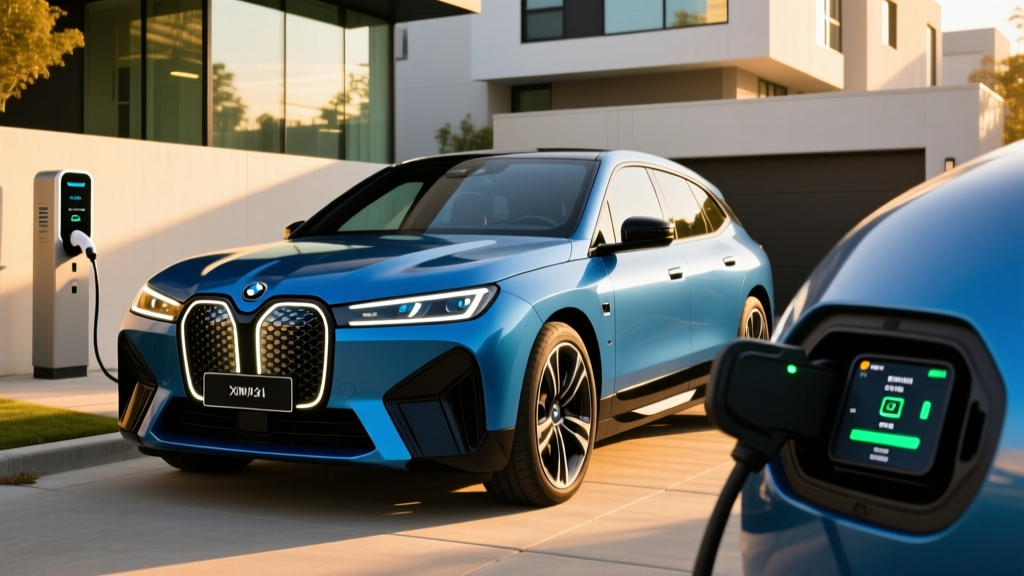
The 2024 BMW iX occupies a rare position in the luxury EV SUV segment: it pairs genuine long-range capability with a premium cabin that rivals anything from Stuttgart or Ingolstadt, all while offering DC fast-charging speeds that actually make road trips viable. But with a starting price north of $87,000 and evolving federal tax credit rules, the iX demands a careful, numbers-driven evaluation before you sign a lease or purchase agreement.
We've spent significant time with the iX xDrive50 and the high-performance M60 variant, testing real-world range across highway, city, and cold-weather conditions, logging charge sessions at Electrify America and Tesla Supercharger stations (via adapter), and parsing the IRS §30D fine print. Here's everything you need to decide whether the 2024 BMW iX belongs in your driveway.
2024 BMW iX Quick Verdict
The BMW iX xDrive50 delivers one of the best combinations of range, charging speed, and cabin luxury in the midsize electric SUV class. Its 324-mile EPA rating is legitimate for mixed driving, and its 195 kW peak DC fast-charge rate means you're not stranded at rest stops. The M60 trades some range for serious performance. However, the iX's polarizing exterior design, limited frunk utility, and complex federal tax credit eligibility will be dealbreakers for some buyers. If you prioritize interior quality, ride refinement, and genuine road-trip capability over flashy styling or maximum cargo volume, the iX deserves a serious test drive.
| Spec | xDrive50 | M60 |
|---|---|---|
| EPA Range | 324 miles (20" wheels) | 296 miles (21" wheels) |
| Battery (usable) | 105.2 kWh / NMC | 105.2 kWh / NMC |
| Horsepower | 516 hp | 610 hp |
| 0-60 mph | 4.4 seconds | 3.6 seconds |
| Drivetrain | Dual-motor AWD | Dual-motor AWD |
| Max DC Fast Charge | 195 kW | 195 kW |
| 10-80% DC Time | ~35 minutes | ~35 minutes |
| Level 2 Charge Rate | 11 kW (~28 mi/hr) | 11 kW (~28 mi/hr) |
| MPGe (combined) | 86 MPGe | 78 MPGe |
| Base MSRP | $87,100 | $111,500 |
Range and Efficiency: EPA Numbers vs. Real-World Driving
The xDrive50's EPA-estimated 324 miles (with 20-inch wheels) places it near the top of the luxury EV SUV class. Opt for the larger 21- or 22-inch wheels, and the EPA figure drops to approximately 305-311 miles due to increased rolling resistance and weight. The M60, with its performance-oriented tuning and standard 21-inch wheels, is rated at 296 miles.
- Mixed city/highway (65-75°F): Expect 290-315 miles in the xDrive50 — the EPA figure is reasonably achievable with moderate driving.
- Sustained highway (70-80 mph): Plan for 260-285 miles. The iX's tall, aerodynamic profile creates drag at speed, and efficiency drops noticeably above 75 mph.
- Cold weather (20-35°F): Range loss of 20-30% is typical, bringing the xDrive50 down to roughly 225-260 miles. BMW's heat pump (standard) mitigates cabin-heating energy draw, but battery chemistry still suffers in cold temperatures.
- Mountainous terrain: Regenerative braking on descents recovers meaningful energy, but sustained climbs will reduce range by 15-25% depending on grade.
Efficiency-wise, the xDrive50 achieves 86 MPGe combined (roughly 39 kWh/100 miles), which is competitive with the Audi Q8 e-tron (81 MPGe) but trails the more efficiency-focused Tesla Model X (102 MPGe). The M60's heavier right foot and stickier tires drop it to 78 MPGe combined.
Charging Performance: DC Fast and Home Level 2
BMW equips the iX with a 195 kW peak DC fast-charge capability on CCS1-equipped vehicles. The charging curve is one of the iX's stronger engineering achievements: it sustains near-peak power well into the mid-state-of-charge range before tapering.
| Charging Level | Power / Rate | Speed / Notes |
|---|---|---|
| Level 1 (120V household) | ~1.4 kW | ~3-4 miles per hour — emergency/trickle only |
| Level 2 (240V home/public) | 11 kW (48A max) | ~28 miles per hour; full charge in ~10.5 hours |
| DC Fast Charge (CCS1) | 195 kW peak | 10-80% in ~35 min; tapers significantly above 80% |
| DC Fast Charge (NACS via adapter) | ~150 kW (est.) | Tesla Supercharger access with BMW-approved NACS adapter (availability varies by model year) |
Charging curve reality check: The 195 kW peak is achievable between roughly 10-40% state of charge. From 40-60%, expect sustained rates around 150-170 kW. Above 80%, the curve drops sharply to protect battery longevity — charging from 80-100% can add another 25-30 minutes. For road trips, the practical strategy is to charge from 10-80% and move on, which takes about 35 minutes at a capable station.
For home charging, the onboard 11 kW AC charger is excellent. A full Level 2 charge from empty to full takes roughly 10.5 hours — easily achievable overnight. We recommend a 48-amp hardwired Level 2 station (requiring a 60-amp circuit) for maximum home charging speed. A NEMA 14-50 outlet on a 50-amp circuit will deliver about 9.6 kW, adding roughly 25 miles per hour.
Performance and Driving Dynamics
The iX xDrive50's dual-motor all-wheel-drive powertrain produces 516 horsepower and 564 lb-ft of torque, delivering a 4.4-second 0-60 mph time. That's genuinely quick for a 5,600-pound SUV, and the instant torque delivery makes highway merging effortless.
The M60 cranks output to 610 hp and 811 lb-ft (with Launch Control), dropping the 0-60 time to 3.6 seconds. It also receives a sport-tuned adaptive air suspension, larger brakes, and an M Sport rear differential. The performance gap is substantial, but so is the $24,400 price gap.
Ride quality is where the iX genuinely shines. The standard adaptive air suspension (two-axle) provides a supple, well-damped feel that absorbs highway expansion joints without transmitting harshness into the cabin. Steering is precise if somewhat light, and the low center of gravity (battery pack under the floor) keeps body roll well-controlled for a tall SUV. The iX also offers up to 3,500 pounds of towing capacity when properly equipped — adequate for a small boat or utility trailer.
Interior, Technology, and Cargo Space
Step inside the iX and you'll find one of the most distinctive, material-rich cabins in the EV segment. BMW uses a mix of open-pore wood, microfiber, and available wool-blend upholstery that feels genuinely premium — a step above the more minimalist Tesla approach and on par with Mercedes-Benz's EQE SUV.
The curved display panel houses a 12.3-inch digital instrument cluster and a 14.9-inch central touchscreen running BMW's iDrive 8.5 software. The system is responsive, logically organized, and supports wireless Apple CarPlay and Android Auto. A hexagonal steering wheel (standard) is a love-it-or-hate-it design choice, but it doesn't impede functionality.
Cargo and passenger dimensions:
- Cargo volume (rear seats up): 35.5 cu ft
- Cargo volume (rear seats folded): 77.9 cu ft
- Rear legroom: 38.9 inches
- Front headroom: 40.2 inches (panoramic roof reduces this slightly)
- Frunk: None — the iX has no front trunk, a notable omission at this price point
The lack of a frunk is a genuine drawback. Competitors like the Rivian R1S and even the Tesla Model X offer front storage for charging cables or small bags. The iX's under-hood space is occupied by HVAC and power electronics.
Driver Assistance and ADAS
The iX comes standard with BMW's Driving Assistant Professional, which includes adaptive cruise control with stop-and-go, lane-keeping assist, and automatic emergency braking. The available Highway Assistant enables hands-free driving at speeds up to 85 mph on divided highways — but this is a SAE Level 2 system, meaning the driver must remain attentive and keep eyes on the road (monitored by an interior camera).
The available Parking Assistant Professional with Reversing Assistant is genuinely useful — it can memorize the last 50 meters of a path and automatically reverse the vehicle out of a narrow driveway or garage.
Pricing, Trims, and Federal Tax Credit Eligibility
The 2024 BMW iX lineup consists of two trims:
| Trim | Base MSRP | As-Tested Range | Federal Tax Credit (§30D) |
|---|---|---|---|
| xDrive50 | $87,100 | $87,100 - $102,000 | $0 — exceeds SUV MSRP cap |
| M60 | $111,500 | $111,500 - $130,000+ | $0 — exceeds SUV MSRP cap |
Federal tax credit reality: Unfortunately, the 2024 BMW iX does not qualify for the $7,500 federal EV tax credit under IRS §30D. The credit has an MSRP cap of $80,000 for SUVs, and even the base xDrive50 at $87,100 exceeds this threshold. Additionally, buyer income caps apply ($300,000 joint / $225,000 head of household / $150,000 individual for new vehicles), and battery critical-mineral and component sourcing requirements further restrict eligibility. Always verify current rules at IRS.gov or consult a tax professional.
Some buyers may find relief through state-level incentives (which vary by jurisdiction and are not subject to federal MSRP caps), or by exploring BMW's lease programs — where the $7,500 credit may be passed through as a lease incentive under the commercial clean vehicle credit (§45W), depending on how BMW Financial structures the lease. Check with your local dealer for current lease offers.
Battery, Warranty, and Long-Term Ownership
The iX uses a 111.5 kWh gross (105.2 kWh usable) lithium-ion battery pack with NMC (nickel-manganese-cobalt) chemistry. NMC offers higher energy density than LFP (lithium iron phosphate), which is why BMW can pack over 100 usable kWh into the iX's platform while maintaining reasonable weight distribution.
Warranty coverage:
- Battery warranty: 8 years / 100,000 miles (whichever comes first), covering defects and capacity loss below 70% of original capacity
- Powertrain warranty: 4 years / 50,000 miles
- Basic vehicle warranty: 4 years / 50,000 miles
- Complimentary maintenance: 3 years / 36,000 miles
The 70% capacity retention threshold is industry-standard but worth noting: if your battery degrades to 69% within 8 years/100,000 miles, BMW would replace or repair it under warranty. Real-world data from early iX owners suggests degradation is minimal in the first 30,000-50,000 miles — typically 3-5% loss with normal charging habits (avoiding frequent 100% charges and extreme heat exposure).
Insurance costs for the iX are higher than average for the segment. Expect annual premiums in the $2,800-$4,200 range depending on your location, driving record, and coverage level. Get quotes before purchasing — EV insurance variability is significant.
2024 BMW iX vs. Key Competitors
The iX competes directly with several luxury electric SUVs, each with distinct trade-offs:
- Tesla Model X: More range (up to 335 miles EPA), faster Supercharger network access, and a frunk — but the interior quality and ride refinement don't match the BMW. Model X Long Range starts around $79,990 and may qualify for the federal credit.
- Mercedes-Benz EQE SUV: Similar price point and luxury focus, but shorter range (279-305 miles EPA depending on trim) and slower DC charging (170 kW peak). The EQE SUV's interior is plush but its exterior proportions are controversial.
- Audi Q8 e-tron: Recently refreshed with improved range (up to 300 miles EPA for the Sportback), but still trails the iX on efficiency and DC charging speed (170 kW). Audi's build quality is excellent, and the Q8 e-tron may qualify for the federal credit on lower trims.
- Rivian R1S: Three-row seating, genuine off-road capability, and a growing Adventure Network — but less refined on-road and a more utilitarian interior. Starting around $79,900 with potential credit eligibility.
The iX wins on cabin quality, ride comfort, and the balance of range-to-charging-speed. It loses on cargo versatility (no frunk, less total volume than the Model X), third-row availability (none offered), and tax credit eligibility.
Who Should Buy the 2024 BMW iX?
- You prioritize interior luxury, ride refinement, and quiet highway cruising over maximum cargo space
- Your daily commute is under 100 miles and you can charge at home overnight
- You take 2-4 road trips per year and want 195 kW DC fast-charging to minimize stop times
- You don't need a third row or a frunk
- You're not dependent on the $7,500 federal tax credit (or can access state incentives/lease deals)
- You need three rows of seating (consider the Rivian R1S or Tesla Model X)
- You want maximum cargo versatility with a frunk (Tesla Model X)
- Federal tax credit eligibility is essential to your purchase math (Model X, Q8 e-tron lower trims, R1S may qualify)
- You prefer a more conservative exterior design (the iX's kidney grille and proportions are polarizing)
Pros and Cons at a Glance
- 324-mile EPA range (xDrive50) is genuinely usable for road trips
- 195 kW DC fast-charging with a strong sustained charge curve
- Exceptional cabin materials, quietness, and ride quality
- Competitive 0-60 performance (4.4s xDrive50, 3.6s M60)
- iDrive 8.5 is responsive and feature-rich
- Standard heat pump improves cold-weather efficiency
- Highway Assistant is a capable Level 2 system for long drives
- No frunk — a significant omission at this price
- Does not qualify for the $7,500 federal tax credit (MSRP cap)
- Polarizing exterior design won't appeal to all buyers
- Cargo volume (35.5 cu ft) trails some competitors
- No third-row option
- Insurance premiums are above segment average
- Hexagonal steering wheel is a love-it-or-hate-it choice
Frequently Asked Questions
What is the real-world range of the 2024 BMW iX?
In mixed driving at moderate temperatures (65-75°F), expect 290-315 miles from the xDrive50 — close to its 324-mile EPA rating. Sustained highway driving at 70-80 mph drops this to 260-285 miles. In cold weather (20-35°F), plan for 225-260 miles due to battery chemistry limitations and increased cabin heating demand.
How fast does the BMW iX charge at home and on the road?
At a DC fast charger rated for 200+ kW, the iX peaks at 195 kW and charges from 10-80% in approximately 35 minutes. At home on a 240V Level 2 station (48 amps), it charges at 11 kW, adding roughly 28 miles of range per hour and completing a full charge overnight in about 10.5 hours.
Does the 2024 BMW iX qualify for the federal EV tax credit?
No. The iX exceeds the $80,000 MSRP cap for SUVs under IRS §30D, even in its base xDrive50 trim at $87,100. Some buyers may benefit from state-level incentives or BMW lease structures that pass through the commercial clean vehicle credit. Consult IRS.gov or a tax professional for your specific situation.
Is the BMW iX worth buying over a Tesla Model X or Audi Q8 e-tron?
If interior luxury, ride refinement, and a strong balance of range and charging speed are your priorities, yes — the iX delivers a more premium daily experience than the Model X and outperforms the Q8 e-tron on range and DC charging. However, if you need a frunk, third-row seating, or federal tax credit eligibility, the Model X or Rivian R1S may be better choices.
What are the biggest drawbacks of the BMW iX?
The most common complaints are the lack of a frunk (front trunk), polarizing exterior styling, limited cargo volume relative to some competitors, ineligibility for the federal tax credit, and above-average insurance costs. The absence of a third row also limits family utility for larger households.
How long will the BMW iX battery last?
BMW warranties the high-voltage battery for 8 years or 100,000 miles against defects and capacity loss below 70%. NMC chemistry in the iX has shown minimal degradation (3-5%) in the first 30,000-50,000 miles based on early owner reports. With proper charging habits (avoiding frequent 100% charges, using preconditioning for DC fast charging), the battery should remain functional well beyond 150,000 miles, though some capacity loss is inevitable over time.
Can the BMW iX use Tesla Superchargers?
BMW has been transitioning to NACS (North American Charging Standard) compatibility. Depending on your iX's production date and BMW's adapter availability, you may be able to access Tesla Superchargers using a BMW-approved NACS-to-CCS adapter. Check with your dealer for the latest adapter compatibility and any firmware requirements. Charging speeds via adapter may be limited to approximately 150 kW.