The BMW i4 eDrive40: A Sport Sedan That Happens to Be Electric
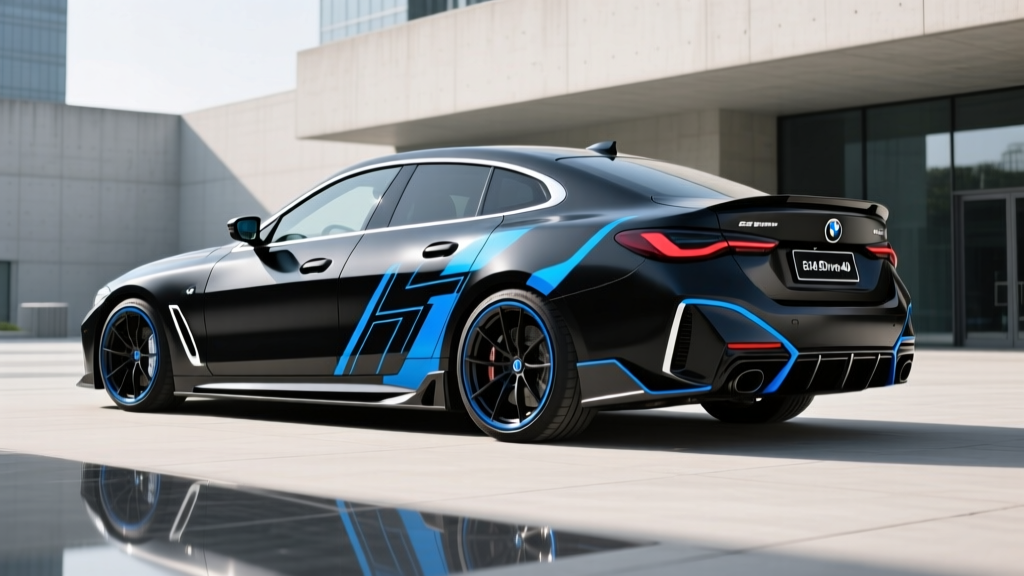
The 2024 BMW i4 eDrive40 occupies a specific niche: a premium rear-wheel-drive electric sport sedan that looks, drives, and feels like a conventional BMW 4 Series Gran Coupe — because it essentially is one, re-engineered around a CLAR-platform battery pack. For buyers researching a 2024 BMW i4 eDrive40 wrap kit, the appeal is twofold. You get a 301-mile EPA-range daily driver with genuine sporting dynamics, and a sleek fastback silhouette that serves as one of the best canvases in the EV segment for vinyl customization.
This review covers every number that matters — range, charging curves, battery chemistry, pricing after federal tax credits, and real-world ownership considerations — so you know exactly what you're buying before you pick your wrap color.
Range, Battery, and Efficiency: The Numbers That Matter
| Specification | 2024 BMW i4 eDrive40 |
|---|---|
| EPA Estimated Range | 301 miles (19" wheels) / 282 miles (20" wheels) |
| Battery Capacity (Usable) | 81.5 kWh (NMC chemistry, gross 83.9 kWh) |
| Battery Chemistry | NMC (Nickel Manganese Cobalt) |
| Efficiency | 109 MPGe combined / 31 kWh/100 mi |
| Drivetrain | Rear-Wheel Drive (single motor) |
| Horsepower | 335 hp (250 kW) |
| Torque | 317 lb-ft |
| 0–60 mph | 5.5 seconds |
| Top Speed | 118 mph (electronically limited) |
Real-World Range Expectations
The EPA rates the i4 eDrive40 at 301 miles with the standard 19-inch aero wheels. Step up to the optional 20-inch sport wheels and that drops to 282 miles. But the EPA cycle is a mixed city/highway test conducted at moderate temperatures.
Highway driving (70–75 mph, sustained): Expect approximately 240–265 miles before needing to charge, depending on temperature and elevation changes. The i4's aerodynamic drag coefficient of 0.24 helps, but sustained highway speeds are where every EV loses efficiency versus the EPA sticker.
Cold weather (below 32°F): Plan for 20–30% range reduction. The i4 uses a heat pump (standard on 2024 models), which mitigates cabin-heating energy draw, but battery chemistry itself becomes less efficient in cold. A 301-mile EPA car becomes roughly a 210–240-mile car on a 20°F January morning unless you precondition while plugged in.
City/commuter driving: This is where the i4 shines closest to its sticker. Regenerative braking recovers energy in stop-and-go traffic, and you may see 290–310 miles in mild-weather urban use.
The 81.5 kWh usable capacity uses NMC (nickel manganese cobalt) pouch cells supplied primarily by Samsung SDI and CATL. NMC offers higher energy density than LFP (lithium iron phosphate), which is why BMW can fit this much capacity into the Gran Coupe floorpan without compromising cabin space. The trade-off: NMC cells are more sensitive to sustained 100% state-of-charge storage, so BMW recommends daily charging to 80–90% and only charging to full before long trips. Source: EPA Fuel Economy.
Charging Speed: DC Fast Charging and Home Level 2
Charging infrastructure compatibility is where the i4 eDrive40 shows both strengths and one notable limitation for 2024 buyers.
| Charging Level | Max Rate | Speed / Time | Connector |
|---|---|---|---|
| Level 1 (120V household) | 1.4 kW | ~3–4 miles per hour | J1772 adapter |
| Level 2 (240V home/public) | 11 kW (onboard charger) | ~32 miles per hour; 0–100% in ~8.5 hours | J1772 |
| DC Fast Charge | 205 kW peak | 10–80% in ~31 minutes | CCS1 (Combo) |
The DC fast-charging reality: BMW quotes a 205 kW peak, but like every EV, the i4 doesn't sustain that rate across the full charging window. The charge curve peaks around 200–205 kW between roughly 10–30% state of charge, then steps down to approximately 150 kW through 50%, and further tapers to 50–70 kW above 70%. The 31-minute 10–80% figure accounts for this taper. On a road trip, this means a 20-minute stop adds roughly 150–170 miles of range — adequate but not class-leading versus Hyundai/Kia's 800V architecture (which achieves 10–80% in ~18 minutes).
NACS adapter note: The 2024 i4 ships with CCS1. BMW has confirmed that beginning with 2025 model-year production, North American i4 models will transition to the NACS (Tesla-style) charge port. If you're buying a 2024 model, BMW offers a CCS-to-NACS adapter for Supercharger access, which opened to non-Tesla vehicles through Tesla's adapter program. This significantly expands your DC fast-charging network.
Home charging: The 11 kW onboard AC charger is competitive. On a 48-amp Level 2 home circuit (hardwired, requiring a 60-amp breaker), you'll recover a full battery overnight in about 8.5 hours. A typical 40-amp circuit (common in older homes) limits you to about 9.6 kW, adding roughly 28 miles per hour. Budget $500–$1,500 for professional Level 2 home installation depending on panel proximity and whether your electrical panel needs a 200-amp upgrade.
Pricing, Trims, and Federal Tax Credit Eligibility
| Trim / Configuration | Base MSRP | Est. After §30D Credit* |
|---|---|---|
| i4 eDrive40 (19" wheels) | $57,900 | $50,400 |
| i4 eDrive40 (w/ M Sport Package) | $61,900 | $54,400 |
| i4 xDrive40 (AWD) | $61,400 | $53,900 |
| i4 M50 (performance) | $70,700 | $63,200 |
*Federal tax credit availability depends on multiple factors. See eligibility details below.
The 2024 BMW i4 eDrive40 starts at $57,900 including destination. A well-equipped example with the Premium Package, 20-inch wheels, and metallic paint typically lands in the $63,000–$67,000 range before incentives. The M Sport Package adds visual aggression that pairs well with a wrap kit — and costs an additional ~$4,000.
Federal §30D Tax Credit: Does the i4 Qualify?
Under current IRS rules, the BMW i4 eDrive40's eligibility for the full $7,500 federal tax credit depends on battery-component and critical-mineral sourcing requirements that shifted significantly through 2024. BMW's battery cells are sourced from Samsung SDI and CATL, and critical-mineral supply chains have been restructured to maximize credit eligibility.
- MSRP cap: The i4 is classified as a sedan, subject to the $55,000 MSRP cap under §30D. The base eDrive40 at $57,900 exceeds this cap, which can disqualify it from the federal credit unless reclassified or unless the buyer uses the point-of-sale transfer provision through a participating dealer.
- Income caps: Modified AGI must not exceed $150,000 (single), $225,000 (head of household), or $300,000 (joint filing).
- Point-of-sale transfer: As of 2024, buyers can transfer the credit to the dealer at purchase, reducing the sale price directly — even if tax liability is lower than the credit amount.
Bottom line: Because the i4 eDrive40 base MSRP exceeds the $55,000 sedan cap, many buyers will not qualify for the full federal credit on this specific trim. However, the i4 xDrive40 (AWD) may qualify under the SUV/truck $80,000 cap if BMW has successfully petitioned for reclassification. Always verify current eligibility at fueleconomy.gov and consult a tax professional. State incentives (California, Colorado, New York, and others) may provide additional rebates of $1,000–$7,500 independently of federal rules.
Driving Dynamics, Interior, and Tech
The i4's party trick is that it doesn't feel like an "EV compromise." The CLAR platform was designed from inception to accommodate both internal-combustion and electric powertrains, and BMW has used that flexibility to preserve the 4 Series Gran Coupe's balanced weight distribution. The eDrive40's single rear motor produces 335 hp, launching to 60 mph in 5.5 seconds — quick enough to merge confidently and entertaining on a back road, though the dual-motor M50 (536 hp, 3.7 seconds) exists for those who want genuine M-car performance.
Ride quality: The battery pack's low center of gravity and approximately 4,700-pound curb weight give the i4 a planted, confident feel. The adaptive M suspension (optional) provides genuinely adjustable damping. Road noise is well-isolated, and the simulated "IconicSounds Electric" (composed by Hans Zimmer) is optional and can be disabled entirely.
Interior and cargo:
- Curved display: 12.3" instrument cluster + 14.9" infotainment touchscreen running BMW iDrive 8.5
- Front headroom: 39.8 inches | Rear headroom: 36.6 inches (fastback roofline cuts rear space)
- Front legroom: 42.2 inches | Rear legroom: 34.5 inches
- Cargo volume: 16.6 cu ft (rear seats up) / 45.6 cu ft (rear seats folded)
- No front trunk (frunk) — the CLAR platform's shared architecture means the motor bay is not optimized for storage
Driver assistance: The i4 comes standard with Active Driving Assistant, which includes forward collision warning, automatic emergency braking, lane-departure warning, and blind-spot monitoring. The optional Driving Assistance Professional Package adds adaptive cruise control with stop-and-go, lane-keeping assist, and automatic lane-change on highway (a SAE Level 2 system — the driver must remain engaged and hands on or near the wheel at all times).
Wrap Kit Considerations for the i4 eDrive40
If you're specifically searching for a 2024 BMW i4 eDrive40 wrap kit, there are practical considerations unique to this model:
- Surface area: The Gran Coupe's fastback profile, including the rear hatch and integrated spoiler, requires approximately 60–65 linear feet of 60-inch-wide vinyl for a full color-change wrap. Budget $3,000–$5,500 for a quality full-body wrap from a certified installer (3M, Avery Dennison, or XPEL films).
- Paint protection: Many i4 buyers opt for a partial paint-protection film (PPF) on high-impact areas (front bumper, hood, mirrors) combined with a satin or color-shift wrap on the remaining panels. This hybrid approach costs $2,500–$4,000.
- Charge-port area: The CCS1 charge port is located on the driver-side rear quarter panel. A quality wrap installer will cut precisely around this area and leave the port door functional. Some wrap shops offer custom port-door accents.
- Warranty note: A vinyl wrap does not void BMW's factory paint warranty, but any paint damage discovered during wrap removal may not be covered if the original paint was already compromised. BMW's paint warranty is 4 years/50,000 miles.
- Sensor compatibility: The i4's parking sensors, cameras, and radar units are integrated into the bumpers and grille. Wraps must not cover sensor surfaces — a reputable installer will mask these areas. Improper wrapping over ADAS sensors can interfere with emergency braking and adaptive cruise.
Pros, Cons, and Competitive Positioning
Pros
- 301-mile EPA range is competitive for the luxury sedan segment
- Genuine BMW driving dynamics — steering feel and chassis balance exceed most EV rivals
- 11 kW Level 2 onboard charger is among the fastest in its class for home charging
- Excellent build quality, premium materials, and iDrive 8.5 infotainment
- Fastback cargo area (16.6 cu ft) is practical for the segment
- Strong fastback design is ideal for vinyl wrap customization
Cons
- Base MSRP of $57,900 exceeds the §30D federal tax credit sedan cap ($55,000)
- No frunk — a missed opportunity for a dedicated EV platform competitor
- DC fast charging at 205 kW is good but trails Hyundai/Kia 800V architecture (~350 kW capable)
- Rear headroom is tight for taller passengers due to fastback roofline
- CCS1 port (2024 model year) requires adapter for Tesla Supercharger access
- Insurance premiums run 15–25% higher than comparable gas 4 Series models
Key competitors to cross-shop:
- Tesla Model 3 Long Range: 341-mile EPA range, $42,990 base, faster DC charging, but less premium interior and no BMW dealer service network.
- Polestar 2 Long Range Single Motor: 320-mile EPA range, $49,900 base, Scandinavian design, Google-based infotainment, but less cargo space.
- Mercedes-Benz EQB / EQE Sedan: The EQE offers more luxury at higher cost ($74,900+), while the EQB is a compact SUV alternative.
- Hyundai Ioniq 6 SEL: 361-mile EPA range, 800V fast charging (10–80% in 18 min), $42,450 base — a value leader, but less premium badge prestige.
Warranty and Ownership Costs
- New-vehicle limited warranty: 4 years / 50,000 miles
- High-voltage battery warranty: 8 years / 100,000 miles (covers defects and capacity loss below 70% of original capacity)
- Powertrain warranty: 8 years / 100,000 miles (electric motor, power electronics)
- Complimentary maintenance: 3 years / 36,000 miles (brake fluid, cabin filters, inspections — EVs need far less routine maintenance than ICE vehicles)
- Estimated 5-year total cost of ownership: Edmunds and Kelley Blue Book estimate the i4 eDrive40 at approximately $62,000–$68,000 over five years including depreciation, insurance, energy, maintenance, and repairs. Depreciation is the largest cost component — BMW EVs have historically depreciated more steeply than Tesla, though this gap has narrowed. Source: Kelley Blue Book.
Who Should Buy the 2024 BMW i4 eDrive40?
The i4 eDrive40 is the right EV if:
- You want a premium sport sedan with genuine driving engagement, not just a tech pod
- Your daily commute is under 100 miles round-trip, and you have access to Level 2 home charging
- You value BMW dealer service and the brand's resale network
- You're planning a wrap or PPF customization and want a design that photographs well
- You primarily carry 1–2 passengers (the rear seat is best for children or occasional adult use)
Look elsewhere if:
- You need maximum range per dollar — the Tesla Model 3 LR and Ioniq 6 beat the i4 here
- You frequently carry four adults — the rear headroom and legroom are limiting
- DC fast-charging speed is your top priority — Hyundai/Kia's 800V platform charges significantly faster
- You need the federal $7,500 tax credit and cannot absorb the $57,900+ price — the sedan MSRP cap may disqualify the i4
Frequently Asked Questions
What is the real-world range of the 2024 BMW i4 eDrive40?
The EPA rates it at 301 miles (19" wheels). In real-world mixed driving at moderate temperatures, expect 260–285 miles. Highway-only driving at 75 mph drops this to roughly 240–265 miles. In freezing weather, plan for 210–240 miles unless you precondition the battery while plugged in.
How fast does the i4 eDrive40 charge?
On DC fast charging, it peaks at 205 kW and charges from 10–80% in approximately 31 minutes, adding roughly 150–170 miles in a 20-minute stop. At home on a Level 2 (240V, 48-amp) charger, the 11 kW onboard charger adds about 32 miles per hour, fully recharging overnight in ~8.5 hours.
Does the 2024 BMW i4 eDrive40 qualify for the federal EV tax credit?
Likely not the full $7,500. The i4 is classified as a sedan, and the §30D sedan MSRP cap is $55,000. The base eDrive40 starts at $57,900, exceeding this threshold. However, the point-of-sale transfer provision, state-level incentives, and potential reclassification of certain trims may alter eligibility. Always check fueleconomy.gov for the latest data and consult a tax professional.
Is the BMW i4 eDrive40 worth buying vs. competitors?
If you prioritize driving dynamics, interior quality, and brand prestige, the i4 is arguably the best-driving EV sedan in its price class. If maximum range, fastest charging, or lowest price matter more, the Tesla Model 3 Long Range or Hyundai Ioniq 6 offer compelling alternatives. The i4 wins on refinement; it loses on value metrics.
Can I wrap a 2024 BMW i4 eDrive40 without affecting its sensors?
Yes, provided you use a certified installer experienced with ADAS-equipped vehicles. The i4's parking sensors, radar units (in the lower front bumper and rear bumper), and cameras must not be covered with vinyl. A professional installer will mask these areas. Budget $3,000–$5,500 for a full color-change wrap using quality cast vinyl (3M 2080, Avery Supreme Wrapping Film, or XPEL Fusion).
What is the battery warranty on the i4?
BMW covers the high-voltage battery for 8 years or 100,000 miles, whichever comes first. The warranty covers defects and capacity degradation below 70% of original usable capacity. BMW's NMC cells have shown strong longevity in the iX and i4 fleets, with most owners reporting less than 5% degradation in the first two years of ownership.