The 2024 Chevrolet Blazer EV RS arrived with fanfare and then immediately tripped over its own software. Early owners reported infotainment glitches and build-quality quirks that forced Chevy to issue a stop-sale and patch the platform throughout 2024. Now, with those issues largely resolved through over-the-air updates and manufacturing refinements, the Blazer EV RS has matured into the midsize electric crossover Chevy intended — one that pairs a spacious cabin with competitive range and genuinely fast DC charging on the Ultium platform.
If you're evaluating a 2024 Blazer EV RS on the used market or comparing leftover new inventory against 2025-2026 models, this review covers every number that matters: real-world range, charging curves, pricing after tax credits, and where it wins (and loses) against the Hyundai Ioniq 5, Ford Mustang Mach-E, and Tesla Model Y.
2024 Blazer EV RS: Quick Verdict
The Blazer EV RS is a compelling choice for buyers who prioritize cabin space, ride comfort, and DC fast-charging speed over sporty handling or cutting-edge software polish. Its 102 kWh usable battery delivers strong real-world range, and the 190 kW peak charge rate makes road trips practical. The RS trim's dual-motor AWD setup provides confident acceleration without pretending to be a performance SUV. It's a family-oriented electric cruiser, not a track car — and that's exactly where it excels.
| Spec | Value |
|---|---|
| EPA Range (AWD RS) | 321 miles |
| Battery (Usable) | 102 kWh, NMC (Ultium) |
| Drivetrain | Dual-motor AWD |
| Horsepower / Torque | 557 hp / 648 lb-ft (Wide Open Watts mode) |
| 0-60 mph | ~4.0 seconds (WoW mode) |
| DC Fast Charge (Peak) | 190 kW |
| 10-80% DC Charge Time | ~31 minutes |
| Level 2 Home Charging | 11.5 kW (~34 mi/hr) |
| MPGe (Combined) | 89 MPGe |
| Efficiency | 38 kWh/100 mi |
| Cargo (Behind Rear Seats) | 25.5 cu ft |
| Cargo (Seats Folded) | 59.1 cu ft |
| Base MSRP (RS AWD) | $59,900 (2024 launch; later reduced) |
| Battery/Powertrain Warranty | 8 years / 100,000 miles |
Real-World Range: What the EPA Sticker Doesn't Tell You
The EPA rates the 2024 Blazer EV RS (dual-motor AWD with the 102 kWh pack) at 321 miles. That's a strong number for a midsize SUV, but as any experienced EV owner knows, the sticker is a starting point — not a guarantee.
- Mixed driving (55/45 city/highway): ~290-310 miles achievable in mild weather (60-75°F)
- Sustained highway (70-75 mph): Expect ~255-275 miles; the Blazer's boxy shape and 5,400-lb curb weight hurt at speed
- Cold weather (below 32°F): Budget for 20-30% range loss, bringing effective range to ~225-260 miles without preconditioning
- With heat pump preconditioning: Cold-weather loss can be mitigated to ~15% when the battery is warmed before departure
The Blazer EV RS uses GM's Ultium platform with an NMC (nickel manganese cobalt) lithium-ion chemistry. NMC packs offer higher energy density than LFP alternatives, which is how Chevy fits 102 kWh of usable capacity into this platform. The trade-off: NMC cells prefer not to sit at 100% state of charge for extended periods. Daily charging to 80% is recommended for longevity, reserving 100% fills for road trips.
At 38 kWh per 100 miles combined, the Blazer EV RS is less efficient than lighter competitors like the Tesla Model Y (28 kWh/100 mi) or the Hyundai Ioniq 5 AWD (33 kWh/100 mi). That's physics — this is a larger, heavier vehicle. But for buyers who need the interior volume, the efficiency penalty is a reasonable trade-off.
Charging Speed: DC Fast, Level 2, and the Charge Curve Reality
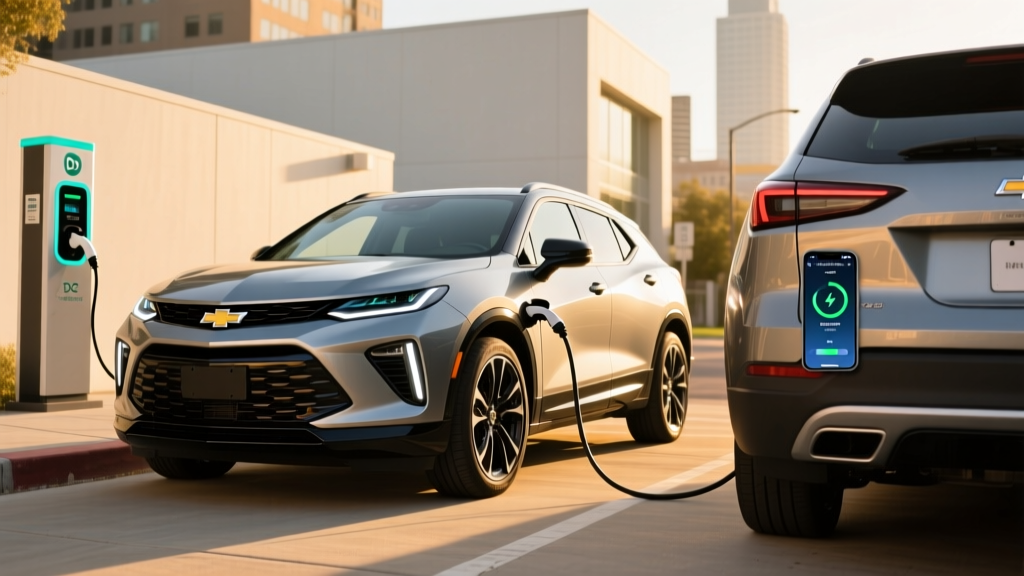
Charging is where the Blazer EV RS quietly excels. The 190 kW peak DC fast-charging rate is competitive for its class, but the real story is the charge curve — how the vehicle sustains that speed as the battery fills.
| Charging Level | Power / Rate | Time / Range Added |
|---|---|---|
| Level 1 (120V household) | ~1.4 kW | ~4 miles per hour |
| Level 2 (240V home, 48A) | 11.5 kW | ~34 miles per hour; 0-100% in ~9.5 hours |
| DC Fast Charge (peak) | 190 kW | 10-80% in ~31 minutes |
| DC Fast Charge (sustained avg.) | ~130-140 kW avg. | Expect ~180 miles added in 20 min |
Charge curve reality check: The Blazer EV RS hits its 190 kW peak around 15-25% state of charge and holds strong through approximately 50%. Above 60%, the rate tapers to roughly 100-120 kW, and above 80%, it drops further to protect the NMC cells. This is normal behavior for all NMC packs, but it means that charging from 80-100% at a DC fast charger is painfully slow and expensive. Plan your road-trip stops around 10-80% sessions and move on.
For home charging, the 11.5 kW onboard charger is a strong point. On a 48-amp Level 2 circuit (hardwired, 60-amp breaker), you'll add roughly 34 miles of range per hour — enough to fully replenish the pack overnight in about 9.5 hours. If your home panel supports only a 40-amp circuit (32-amp charger), expect about 23 miles per hour, which is still adequate for most daily routines.
The Blazer EV RS ships with a NACS (Tesla-style) charge port on newer production units and CCS on earlier builds. GM transitioned to NACS during 2024, so verify the connector on any specific vehicle. Either way, adapters are available, and the Supercharger network is accessible via NACS-equipped models or through GM's included adapter for CCS-port vehicles.
Performance and Driving Dynamics
The RS trim's dual-motor AWD system produces a combined 557 horsepower and 648 lb-ft of torque when Wide Open Watts (WoW) mode is engaged. Chevy quotes a 0-60 mph time of approximately 4.0 seconds, which is genuinely quick for a 5,400-pound family SUV. In normal driving modes, output is dialed back for smoother, more efficient acceleration — you won't accidentally trigger WoW in a school zone.
Driving dynamics lean comfort over sport. The suspension absorbs highway imperfections well, and the cabin remains quiet at speed — a hallmark of GM's Ultium vehicles. Steering is light and accurate but doesn't communicate much. If you're cross-shopping against the Ford Mustang Mach-E GT (3.5 sec 0-60, firmer ride) or the Tesla Model Y Performance (3.5 sec, sharper handling), the Blazer EV RS feels more like a traditional midsize SUV that happens to be electric. That's a feature, not a bug, for many buyers in this segment.
The RS also offers a towing capacity of 1,500 pounds — adequate for a small utility trailer or a couple of dirt bikes, but not competitive with the Model Y's 3,500-lb rating or the Rivian R1S. If towing is a priority, look elsewhere.
Interior, Cargo, and Technology
The Blazer EV RS cabin is one of its strongest selling points. The 17.7-inch diagonal infotainment touchscreen dominates the dashboard and runs Google Built-In, meaning Google Maps, Google Assistant, and the Play Store are native to the vehicle — no phone mirroring required (though wireless Apple CarPlay and Android Auto are both supported). The RS trim includes perforated leather-appointed seats, a heated steering wheel, heated and ventilated front seats, and ambient lighting.
Passenger space:
- Front headroom: 40.3 inches
- Front legroom: 42.9 inches
- Rear headroom: 38.7 inches
- Rear legroom: 38.4 inches
That rear legroom is genuinely generous — more than the Model Y and competitive with the Hyundai Ioniq 5. Three adults can sit across the back seat on shorter trips without complaint.
Cargo: 25.5 cubic feet behind the rear seats expands to 59.1 cubic feet with the 60/40 split rear seats folded. There is no front trunk (frunk) on the Blazer EV — the space under the hood houses electronics and the HVAC system. If frunk storage matters to you, the Mach-E and Ioniq 5 both offer one.
Driver assistance: The Blazer EV RS comes equipped with Chevy's Super Cruise on compatible trims (subscription required after the initial trial period). Super Cruise is an SAE Level 2 hands-free system on mapped divided highways — the driver must remain attentive, and an infrared camera monitors eye gaze. It is not autonomous driving. On unmapped roads, Chevy Safety Assist provides adaptive cruise control, lane-keeping, automatic emergency braking, and blind-spot monitoring.
Pricing, Trims, and Federal Tax Credit Eligibility
The 2024 Blazer EV RS launched with an MSRP around $59,900 (AWD), though Chevy applied significant price reductions during the 2024 model year — at one point cutting the RS AWD price to approximately $54,200 before destination. Leftover new 2024 inventory and certified pre-owned examples may be available at further discounts.
| Scenario | Approximate Price |
|---|---|
| Original Launch MSRP (RS AWD) | $59,900 + destination |
| Post-Price-Cut MSRP (mid-2024) | ~$54,200 + destination |
| Federal §30D Tax Credit (if eligible) | Up to $7,500 |
| Effective Price (after max credit) | ~$46,700-$52,400 depending on build |
| Point-of-Sale Transfer | Available — credit applied at dealer as down payment reduction |
Does the 2024 Blazer EV RS qualify for the federal EV tax credit? This depends on several IRS §30D requirements that shift frequently:
- MSRP cap: SUVs must have an MSRP at or below $80,000 — the Blazer EV RS qualifies.
- Buyer income cap: AGI must not exceed $150,000 (single), $225,000 (head of household), or $300,000 (joint filers).
- Battery component sourcing: A percentage of battery components must be manufactured or assembled in North America, and critical minerals must be sourced from the US or FTA partners. GM's Ultium battery packs are assembled in Tennessee and Ohio, but critical-mineral sourcing thresholds tighten annually. Verify current-year eligibility on IRS.gov or at fueleconomy.gov before purchase.
- Point-of-sale transfer: Since January 2024, buyers can transfer the credit to the dealer at purchase, receiving it as an immediate price reduction rather than waiting to claim it on their tax return.
Because battery-sourcing rules change annually and vary by production batch, always confirm the specific VIN's eligibility. A tax professional can advise on your personal situation.
How It Compares: Blazer EV RS vs. Key Rivals
The midsize electric SUV segment is crowded. Here's how the 2024 Blazer EV RS stacks up against three direct competitors on the metrics that matter most to buyers:
| Metric | Blazer EV RS (AWD) | Hyundai Ioniq 5 (AWD) | Ford Mach-E (GT) | Tesla Model Y (LR AWD) |
|---|---|---|---|---|
| EPA Range | 321 mi | 290 mi | 280 mi | 310 mi |
| Battery (Usable) | 102 kWh (NMC) | 77.4 kWh (NMC) | 91 kWh (NMC) | 75 kWh (NMC) |
| DC Fast Charge (Peak) | 190 kW | 240 kW | 150 kW | 250 kW |
| 10-80% Time | ~31 min | ~18 min | ~38 min | ~25 min |
| 0-60 mph | 4.0 sec | 5.1 sec | 3.5 sec | 4.8 sec |
| Cargo (Seats Up) | 25.5 cu ft | 27.2 cu ft | 29.7 cu ft | 30.2 cu ft |
| Rear Legroom | 38.4 in | 39.4 in | 38.9 in | 41.6 in |
| Base MSRP (AWD) | ~$54,200 | ~$52,600 | ~$59,995 | ~$48,090 |
Where the Blazer EV RS wins: Raw battery capacity and EPA range lead the segment (or nearly so). The Ultium platform's 102 kWh pack provides a comfortable range buffer that reduces charging-stop frequency on road trips. Ride quality and cabin quietness are also standout attributes.
Where it loses: Cargo volume trails every competitor listed. The Mach-E and Model Y both offer significantly more rear cargo space. DC fast-charging speed, while respectable at 190 kW, can't match the Ioniq 5's 800-volt architecture (240 kW) or Tesla's 250 kW Superchargers. And the Blazer EV has no frunk.
- Choose the Blazer EV RS if: You value ride comfort and cabin quietness over cargo-maximizing utility; you want 320+ miles of range for road trips without stepping up to a full-size SUV; you prefer a traditional SUV driving feel with strong passing power; Super Cruise highway driving is appealing for your commute.
- Look at the Ioniq 5 if: Ultra-fast DC charging (18-min 10-80%) is a priority; you want more cargo space and a frunk; you prefer a more distinctive design.
- Look at the Model Y if: Maximum cargo and rear-seat space are non-negotiable; you want access to the Supercharger network without adapters; efficiency (kWh/100 mi) is a top concern.
- Look at the Mach-E GT if: Sporty handling and sub-3.5-sec acceleration matter more than range; you want a frunk and more cargo volume.
Warranty and Long-Term Ownership
Chevrolet backs the Blazer EV's battery pack and electric powertrain components with an 8-year / 100,000-mile limited warranty. This warranty covers the battery against defects and excessive capacity loss — GM defines excessive as dropping below approximately 60-70% of original capacity, though the exact retention threshold should be confirmed in your warranty booklet. The bumper-to-bumper limited warranty covers 3 years / 36,000 miles.
NMC batteries in the Ultium platform have shown competitive degradation in early data. Expect approximately 8-12% capacity loss over the first 100,000 miles under normal use patterns (avoiding repeated 100% charges and frequent DC fast charging from very low states of charge). This aligns with industry norms for liquid-cooled NMC packs. The active thermal management system helps mitigate degradation in both hot and cold climates.
Super Cruise requires an active OnStar subscription after the initial trial period (typically 3 years). Factor in approximately $25-$40/month for continued access if hands-free highway driving is important to you.
Pros, Cons, and the Bottom Line
- 321-mile EPA range provides genuine road-trip confidence
- 102 kWh Ultium battery — largest in the midsize SUV class
- Spacious rear seat with 38.4 inches of legroom
- 11.5 kW Level 2 charging — fast home replenishment
- Super Cruise hands-free driving on mapped highways
- Quiet, comfortable ride quality at highway speeds
- Google Built-In infotainment is responsive and well-integrated
- Strong WoW-mode acceleration (4.0 sec 0-60)
- Cargo space (25.5 cu ft) trails key competitors
- No front trunk (frunk)
- 38 kWh/100 mi efficiency is below class leaders
- Early 2024 models had software reliability issues (verify OTA updates applied)
- DC fast-charging speed (190 kW) slower than Ioniq 5 and Model Y
- Towing limited to 1,500 lbs
- Super Cruise requires ongoing subscription
- Resale value uncertain given early quality concerns
The 2024 Blazer EV RS is a capable, comfortable electric SUV that delivers where many midsize EV buyers prioritize: range, ride quality, and a spacious back seat. Its weaknesses — cargo volume, efficiency, and early software reputation — are real but not disqualifying for the right buyer. If you find a post-price-cut 2024 RS with the latest OTA patches applied and can confirm federal tax credit eligibility for the specific VIN, it represents solid value in a competitive segment.
Frequently Asked Questions
What is the real-world range of the 2024 Blazer EV RS?
The EPA rates it at 321 miles. In mixed real-world driving at moderate temperatures, expect 290-310 miles. Sustained highway driving at 70-75 mph reduces that to approximately 255-275 miles, and cold weather (below freezing) can drop range to 225-260 miles without battery preconditioning.
How fast does the Blazer EV RS charge at home and on the road?
On a 48-amp Level 2 home charger, it charges at 11.5 kW, adding about 34 miles of range per hour (full charge in ~9.5 hours). On DC fast chargers, it peaks at 190 kW and charges from 10-80% in approximately 31 minutes. Expect an average sustained rate of 130-140 kW during a typical highway stop.
Does the 2024 Blazer EV RS qualify for the $7,500 federal tax credit?
It may, depending on the buyer's income (AGI caps apply), the vehicle's MSRP (under the $80,000 SUV cap — qualifies), and current battery-sourcing requirements. Because critical-mineral and component-sourcing thresholds change annually, verify the specific VIN's eligibility at fueleconomy.gov or consult a tax professional before purchase.
Is the 2024 Blazer EV RS worth buying over the Tesla Model Y or Ioniq 5?
It depends on your priorities. The Blazer EV RS offers more range and a quieter, more comfortable ride than both. The Model Y wins on cargo space, efficiency, and Supercharger access. The Ioniq 5 wins on DC fast-charging speed (18-min 10-80%) and offers more cargo room. If comfort and range buffer matter most, the Blazer EV RS earns its spot.
What were the 2024 Blazer EV software problems, and are they fixed?
Early 2024 production units experienced infotainment freezes, unexpected warning lights, and occasional charging-session failures. Chevy issued a stop-sale and deployed multiple over-the-air updates through mid-to-late 2024. Vehicles produced after these patches (or updated via OTA) have shown markedly improved stability. Before purchasing any 2024 model, confirm that all available software updates have been applied — a dealer can verify this.
Does the Blazer EV RS have a frunk (front trunk)?
No. The Blazer EV does not include a front trunk. The under-hood area houses power electronics and the thermal management system. If enclosed front storage is important, the Ford Mach-E and Hyundai Ioniq 5 both offer frunks.
What is the battery warranty on the Blazer EV RS?
Chevrolet covers the high-voltage battery and electric drive components for 8 years or 100,000 miles, whichever comes first. This covers defects and excessive degradation. Confirm the exact capacity-retention threshold in your warranty documentation.