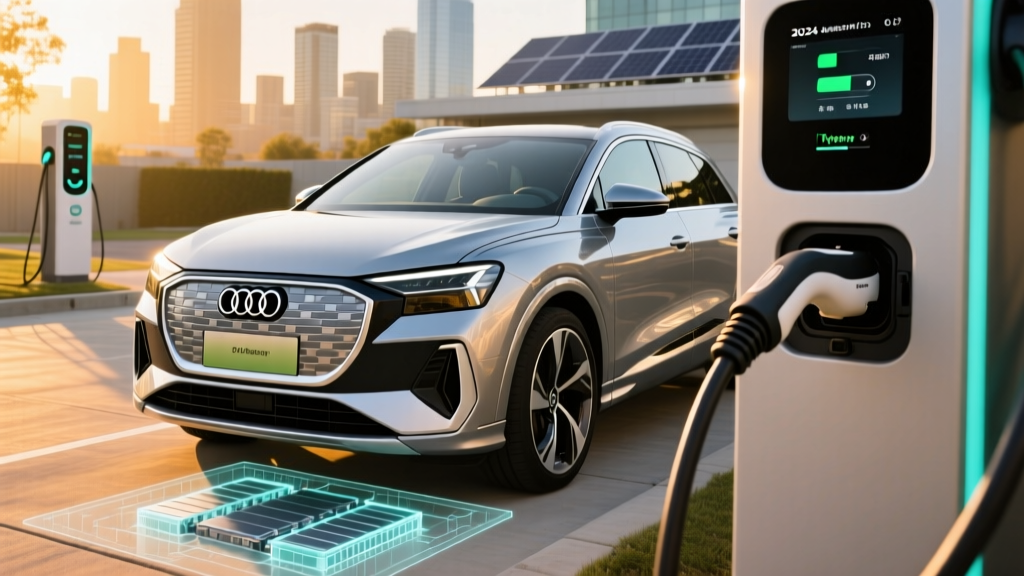
The compact luxury EV segment is crowded, but the 2024 Audi Q4 e-tron occupies a specific niche: premium badge, practical packaging, and a starting price that undercuts the BMW iX while offering comparable interior volume. Built on Volkswagen Group's MEB platform — the same architecture underpinning the VW ID.4 — the Q4 e-tron wraps that hardware in a more refined cabin with Audi's signature build quality. But refinement doesn't always translate to best-in-class efficiency or charging speed. Here's the data-driven breakdown every prospective buyer needs before signing a lease or purchase agreement.
At-a-Glance Specifications
| Specification | Q4 40 e-tron (RWD) | Q4 50 e-tron quattro (AWD) |
|---|---|---|
| EPA Range | 265 miles | 242 miles |
| Usable Battery | 77 kWh (NMC) | 77 kWh (NMC) |
| Max DC Fast Charge | 175 kW | 175 kW |
| 10–80% DC Time | ~28 minutes | ~28 minutes |
| Level 2 Home Charge (AC) | 11 kW (~30 mi/hr) | 11 kW (~30 mi/hr) |
| 0–60 mph | 7.1 seconds | 5.0 seconds |
| Horsepower | 201 hp | 295 hp |
| Drivetrain | Rear-Wheel Drive | Dual-Motor AWD |
| MPGe (Combined) | 103 MPGe | 95 MPGe |
| Efficiency | 33 kWh/100 mi | 36 kWh/100 mi |
| Base MSRP | $49,800 | $58,200 |
Source: EPA fueleconomy.gov
Real-World Range: What the EPA Sticker Doesn't Tell You
Q4 40 e-tron (RWD): EPA 265 mi → Expect ~235–245 mi mixed highway/city; ~200–215 mi sustained 75 mph highway; ~180–195 mi in sub-30°F winter conditions.
Q4 50 e-tron quattro (AWD): EPA 242 mi → Expect ~215–225 mi mixed; ~185–200 mi sustained highway; ~165–180 mi in deep cold.
Based on independent testing and owner-reported data. Cold-weather range loss of 20–30% is typical for NMC chemistry without aggressive cabin preconditioning.
The Q4 e-tron's 77 kWh usable battery (82 kWh gross, NMC lithium-ion chemistry) is competitive for the class, but the vehicle's curb weight — roughly 4,700 lbs for the RWD and over 5,000 lbs for the quattro — works against highway efficiency. On a flat 70°F day at 65 mph, you'll see numbers close to the EPA sticker. Push to 75–80 mph on an interstate run, and aerodynamic drag pushes consumption into the 38–42 kWh/100 mi range, cutting effective range to roughly 200 miles.
Cold weather is the bigger concern for buyers in northern states. The Q4 e-tron uses a heat pump (standard on 2024 models), which helps preserve range compared to resistive heating, but battery chemistry still suffers in sub-freezing temperatures. Expect a 20–30% range reduction in sustained winter driving, bringing the RWD model down to roughly 180–195 real-world miles. Preconditioning the battery while plugged in — using the MMI navigation's charge-route planning — mitigates some of this loss and also improves DC fast-charge speeds upon arrival at a charger.
Charging Speed: Adequate, Not Class-Leading
| Charging Method | Power | Speed / Time |
|---|---|---|
| Level 1 (120V household) | ~1.4 kW | ~4 mi/hr |
| Level 2 (240V home, 48A) | 11 kW | ~30 mi/hr (full charge ~8 hrs) |
| DC Fast Charge (peak) | 175 kW | 10–80% in ~28 min |
| DC Fast Charge (sustained avg 10–80%) | ~110–120 kW avg | ~130 miles added in 28 min |
The Q4 e-tron peaks at 175 kW on DC fast chargers, but — and this is critical for road-trip planning — that peak is not sustained. Like most MEB-platform vehicles, the charge curve ramps quickly to ~170 kW between 10–30% State of Charge, then tapers progressively. By 60% SoC, you're looking at roughly 100 kW; by 80%, it drops below 50 kW. The 10–80% time of approximately 28 minutes is competitive with the VW ID.4 and Ford Mustang Mach-E but trails the Hyundai Ioniq 5's 800V architecture, which can sustain higher rates and achieve 10–80% in roughly 18 minutes.
For home charging, the onboard 11 kW AC charger is a strong point. On a properly installed 48-amp Level 2 circuit (NEMA 14-50 or hardwired wall connector), you'll add about 30 miles of range per hour — enough to fully replenish the battery overnight in roughly 8 hours. If your home electrical panel only supports a 32-amp circuit (7.7 kW), expect closer to 21 miles per hour, still adequate for most daily commutes.
The Q4 e-tron ships with a CCS1 connector. With the industry's shift to NACS (Tesla's connector), Audi has confirmed future models will adopt NACS natively, but 2024 Q4 e-tron owners will need a CCS-to-NACS adapter to access Tesla Supercharger stalls that don't have Magic Dock adapters. Audi provides access to the Electrify America network, which remains one of the largest CCS-compatible DC networks in the U.S.
Performance and Driving Dynamics
The Q4 40 e-tron's single rear motor delivers 201 hp and 229 lb-ft of torque, yielding a 7.1-second 0–60 mph time. It's adequate for merging and city driving but won't feel quick by EV standards. The Q4 50 e-tron quattro adds a front motor for a combined 295 hp and 339 lb-ft, dropping the 0–60 time to 5.0 seconds — noticeably more urgent and better suited to highway passing.
Ride quality is where the Audi badge justifies its premium. The suspension tuning is compliant without being floaty, and cabin insulation is a class above the ID.4. The steering is light and precise, though not sporty. Regenerative braking offers three levels via steering-wheel paddles, plus an "Auto" mode that uses radar and navigation data to modulate regen based on traffic and upcoming intersections. One-pedal driving is available but not as aggressive as Tesla or Hyundai's implementations — you'll still need the brake pedal for complete stops.
Interior, Cargo, and Technology
The Q4 e-tron's cabin uses premium materials — soft-touch surfaces, available leather, and Audi's typical attention to panel gaps. The 10.1-inch central touchscreen (10.9-inch on Prestige trims) runs Audi's MMI interface, which is responsive but menu-heavy compared to Tesla's minimalist approach. Wireless Apple CarPlay and Android Auto are standard. A 10.25-inch digital instrument cluster and available augmented-reality head-up display round out the tech suite.
Passenger and cargo dimensions:
- Rear legroom: 38.5 inches (class-leading; more than the Mach-E or Ioniq 5)
- Cargo behind rear seats: 24.8 cu ft
- Cargo with rear seats folded: 53.1 cu ft
- Frunk: None (MEB platform does not offer front trunk storage)
The lack of a frunk is a notable omission — competitors like the Ford Mustang Mach-E (4.7 cu ft frunk) and Hyundai Ioniq 5 (0.85 cu ft frunk) offer at least some under-hood storage for charging cables. The Q4 e-tron's rear cargo area is well-shaped and practical, but total storage volume trails some rivals when you factor in the missing front compartment.
Driver-assistance technology includes Audi's adaptive cruise assist (stop-and-go ACC with lane centering), which operates at SAE Level 2 — meaning the driver must remain attentive with hands on or near the wheel at all times. It is not a self-driving system. Automatic emergency braking, blind-spot monitoring, and rear cross-traffic alert are standard across all trims.
Pricing, Trims, and Federal Tax Credit Eligibility
| Trim | Drivetrain | MSRP | Est. After §30D Credit* |
|---|---|---|---|
| Premium | RWD (40) | $49,800 | ~$42,300 |
| Premium Plus | RWD (40) | $53,400 | ~$45,900 |
| Prestige | RWD (40) | $57,100 | ~$49,600 |
| Premium | AWD (50) | $58,200 | ~$50,700 |
| Premium Plus | AWD (50) | $61,800 | ~$54,300 |
| Prestige | AWD (50) | $64,800 | ~$57,300 |
*Federal tax credit estimates assume full eligibility. Actual credit depends on IRS §30D requirements.
- Vehicle MSRP cap: SUVs/vans/pickups must be ≤$80,000. The Q4 e-tron qualifies on all trims.
- Buyer income cap: AGI must not exceed $150,000 (single), $225,000 (head of household), or $300,000 (joint filing).
- Battery sourcing: Critical minerals and battery components must meet phased-in percentage thresholds from U.S. or FTA-partner countries. Sourcing requirements tighten annually.
- Point-of-sale transfer: As of 2024, buyers can transfer the credit to the dealer for an immediate price reduction at purchase.
- Final assembly: Must occur in North America. The Q4 e-tron is assembled in Zwickau, Germany — this may disqualify it from the §30D new-vehicle credit.
Source: IRS.gov — Clean Vehicle Credits. Consult a tax professional before relying on credit eligibility. Lease transactions may qualify under the separate commercial clean vehicle credit (§45W), which has no North American assembly requirement — ask your dealer about lease structuring.
This is the single most important caveat for Q4 e-tron buyers: because the vehicle is assembled in Germany, it does not meet the North American final-assembly requirement for the §30D new-vehicle purchase credit. However, leasing the Q4 e-tron may allow the lessor (Audi Financial Services) to claim the commercial clean vehicle credit and pass savings to the lessee in the form of reduced monthly payments or lease cash. Many Audi dealers advertise "lease cash" of $5,000–$7,500 that reflects this mechanism. Always confirm current incentive amounts with your dealer and tax advisor.
Battery Warranty and Long-Term Ownership
Audi provides an 8-year / 100,000-mile warranty on the high-voltage battery, covering defects and capacity loss below 70% of original capacity. This matches the industry standard set by most manufacturers and aligns with the federal minimum requirement.
The NMC (nickel-manganese-cobalt) chemistry in the Q4 e-tron offers higher energy density than LFP (lithium iron phosphate) batteries found in some competitors, but NMC is more sensitive to sustained high-State-of-Charge storage and extreme heat. For maximum longevity:
- Set daily charge limit to 80% (configurable in the MMI or myAudi app)
- Avoid leaving the vehicle at 100% SoC for extended periods in hot weather
- Use DC fast charging sparingly — rely on Level 2 home charging for daily needs
- Precondition the battery in cold weather before fast charging
Based on MEB-platform degradation data from VW ID.4 fleets, expect approximately 8–12% capacity loss over the first 100,000 miles under normal use. This translates to roughly 20–30 miles of range reduction from the original EPA figure over 8–10 years of ownership — manageable for most buyers.
Pros and Cons
- Premium cabin materials and quiet ride quality
- Class-leading rear legroom (38.5 in)
- Heat pump standard (better cold-weather efficiency)
- Strong Level 2 home charging rate (11 kW)
- Augmented-reality HUD available
- Competitive pricing for a luxury badge
- No frunk — less total storage than rivals
- DC fast charging peaks at 175 kW, trails 800V competitors
- German assembly may disqualify from §30D purchase credit
- RWD model's 7.1-sec 0–60 feels slow for an EV
- Infotainment menus are dense; no physical volume knob
- Real-world highway range ~200 mi (RWD) on road trips
Who Should Buy the 2024 Audi Q4 e-tron?
- You want a luxury badge with premium cabin quality under $60,000
- Rear-seat passenger space is a priority (family hauling, carpool duty)
- You primarily commute under 80 miles round-trip and charge at home
- You plan to lease (to capture the §45W commercial credit benefit)
- You value ride comfort and cabin quietness over sporty performance
- You frequently road-trip 300+ miles and need fastest possible DC charging (consider Ioniq 5 or Tesla Model Y)
- You need a frunk for charging cable storage
- You want to purchase outright and claim the §30D tax credit (consider U.S.-assembled models like the Tesla Model Y, Ford Mustang Mach-E, or VW ID.4)
- Performance driving matters — the Q4 50 is quick but not thrilling
Frequently Asked Questions
What is the real-world range of the 2024 Audi Q4 e-tron?
The Q4 40 e-tron (RWD) carries an EPA rating of 265 miles, but real-world mixed driving typically yields 235–245 miles. Sustained highway driving at 75 mph drops that to roughly 200–215 miles. In sub-30°F winter conditions, expect 180–195 miles. The AWD Q4 50 e-tron rates at 242 miles EPA and delivers roughly 215–225 miles in mixed real-world use.
How fast does the Q4 e-tron charge at home and on DC fast chargers?
On a Level 2 home charger (240V, 48A), the Q4 e-tron accepts up to 11 kW, adding approximately 30 miles of range per hour — a full charge takes about 8 hours. On DC fast chargers, it peaks at 175 kW and achieves a 10–80% charge in approximately 28 minutes, though the sustained average rate is closer to 110–120 kW due to charge-curve taper above 60% SoC.
Does the 2024 Audi Q4 e-tron qualify for the $7,500 federal EV tax credit?
It depends on how you acquire it. For outright purchase, the Q4 e-tron's German assembly likely disqualifies it from the IRS §30D new clean vehicle credit, which requires North American final assembly. However, leasing may allow the lessor to claim the §45W commercial clean vehicle credit and pass savings to you as lease cash (often $5,000–$7,500). Always verify with your dealer and a tax professional. Source: IRS.gov.
Is the Q4 e-tron worth buying over the Tesla Model Y or Hyundai Ioniq 5?
If cabin refinement, ride comfort, and a traditional luxury dealership experience are your priorities, the Q4 e-tron makes a strong case. However, the Tesla Model Y offers more range (up to 330 miles EPA), faster Supercharger access, and a frunk. The Hyundai Ioniq 5 delivers faster 800V DC charging (~18 min 10–80%) and more distinctive styling. The Q4 e-tron wins on rear-seat comfort and build quality but trails on efficiency and charging speed.
What battery chemistry does the Q4 e-tron use, and how long will it last?
The Q4 e-tron uses NMC (nickel-manganese-cobalt) lithium-ion chemistry with 77 kWh usable capacity. NMC offers high energy density but benefits from careful charging habits — set daily limits to 80% and avoid prolonged 100% storage. Audi warranties the battery for 8 years or 100,000 miles against capacity loss below 70%. Based on MEB-platform fleet data, expect roughly 8–12% degradation over 100,000 miles.
Does the Q4 e-tron have a frunk?
No. The MEB platform does not include a front trunk. All cargo storage is in the rear, offering 24.8 cu ft behind the rear seats and 53.1 cu ft with seats folded. This is a notable gap versus the Tesla Model Y (which offers a front trunk) and is a trade-off of the platform's packaging.