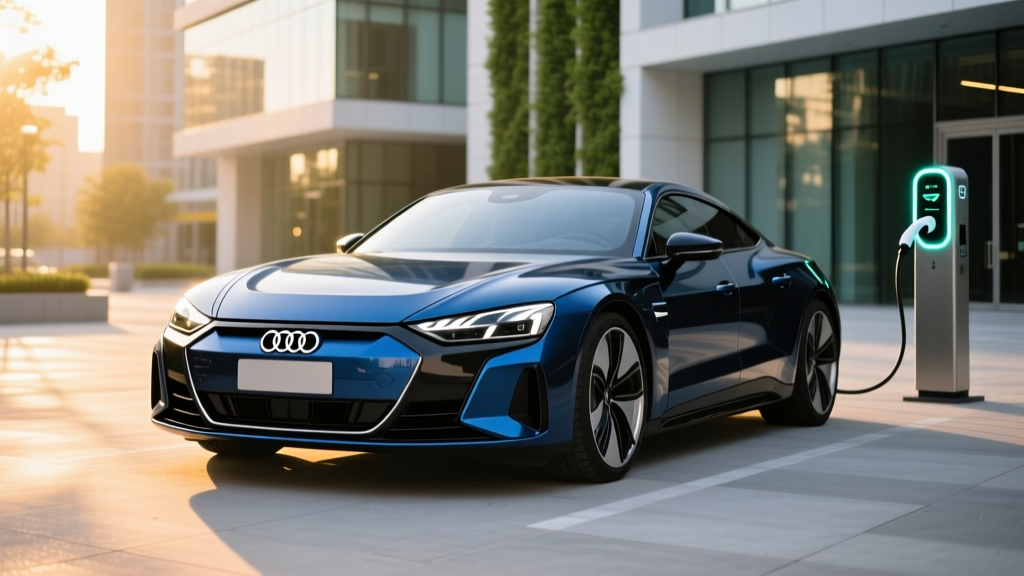
The 2024 Audi e-tron GT occupies a rare space in the electric-vehicle market: a luxury grand tourer that shares its J1 Performance Platform with the Porsche Taycan yet carves out its own identity through design, comfort, and daily usability. If you've been searching for detailed 2024 Audi e-tron GT specs to determine whether this $100,000+ EV earns its premium, this profile covers every number that matters — from EPA range and DC fast-charging curves to real-world ownership costs and federal tax credit eligibility.
For 2024, Audi streamlined the e-tron GT lineup into two trims: the standard e-tron GT quattro and the high-performance RS e-tron GT. Both share the same 93.4 kWh battery pack and 800-volt architecture, but diverge sharply on power output, acceleration, and pricing. (Note: Audi replaced the e-tron GT with the redesigned 2025 model lineup, so the 2024 is now available primarily through remaining dealer inventory and the pre-owned market.)
Range and Efficiency: EPA vs. the Real World
- e-tron GT quattro Premium Plus: 238 miles (EPA combined)
- RS e-tron GT: 232 miles (EPA combined)
Real-World Expectation: Plan for 195–215 miles on sustained highway driving at 70–80 mph. In cold weather (below 32°F), expect a further 15–25% reduction, dropping effective range to approximately 160–185 miles. City driving with regenerative braking can match or slightly exceed the EPA sticker.
The e-tron GT's 93.4 kWh battery (83.7 kWh usable) uses NMC (nickel-manganese-cobalt) pouch cells supplied by LG Energy Solution. Audi conservatively buffers the pack — roughly 10% is locked above and below the usable window — to protect long-term State of Health (SoH). This means you'll rarely see the full 93.4 kWh on a charge indicator, but the trade-off is slower degradation over the vehicle's lifespan.
Efficiency ratings from fueleconomy.gov place the e-tron GT quattro at 82 MPGe combined (roughly 41 kWh/100 mi), while the RS variant drops to 79 MPGe (43 kWh/100 mi). These figures trail the Tesla Model S Long Range (124 MPGe) and Lucid Air Pure (137 MPGe), reflecting the e-tron GT's heavier curb weight (~5,139 lbs) and performance-oriented drivetrain tuning.
Battery, Charging Speed, and the 800V Advantage
The e-tron GT's 800-volt electrical architecture is its most consequential technical advantage. While most EVs still use 400V systems, the higher voltage enables faster DC charging with lower current, reducing heat buildup and cable weight.
| Charging Level | Power / Rate | Speed | Notes |
|---|---|---|---|
| Level 1 (120V household) | 1.2 kW | ~3–4 mi/hr | Emergency trickle only; 0–100% in ~30+ hours |
| Level 2 (240V home/public) | 9.6 kW (onboard charger) | ~26–28 mi/hr | 0–100% in ~9.5 hours; ideal for overnight |
| DC Fast Charge (CCS) | Peak 270 kW | 10–80% in ~23 min | Requires 350 kW station; curve tapers above 80% |
Charging curve reality check: The e-tron GT peaks at 270 kW only briefly — typically between 5–25% State of Charge. From 25–60%, it sustains an impressive 175–200 kW. Above 80%, the rate drops sharply to protect the NMC cells, falling below 50 kW by 90%. This is why Audi quotes 10–80% rather than 0–100% times. On a road trip, plan charging stops around the 10–80% window for maximum efficiency.
At home on a Level 2 hardwired wallbox (48A circuit, 60A breaker), the e-tron GT's 9.6 kW onboard charger adds roughly 26–28 miles of range per hour. A full overnight charge from 20% to 100% takes approximately 8–9 hours. Installation costs for a Level 2 home charger typically run $800–$2,000 depending on panel capacity and conduit length — factor this into your purchase budget.
Performance: 0-60, Horsepower, and Drivetrain
| Specification | e-tron GT quattro | RS e-tron GT |
|---|---|---|
| Drivetrain | Dual-motor AWD | Dual-motor AWD |
| Horsepower (boost mode) | 522 hp | 637 hp |
| Torque (lb-ft) | 472 | 612 |
| 0–60 mph (manufacturer) | 3.9 seconds | 3.1 seconds |
| Top Speed | 152 mph | 155 mph |
| Curb Weight | ~5,139 lbs | ~5,170 lbs |
Both trims use a permanent-magnet synchronous motor on each axle with a two-speed transmission on the rear axle — a setup shared with the Taycan. First gear provides explosive launch acceleration; second gear optimizes highway efficiency. The result is a launch that feels relentless from a stoplight but doesn't run out of breath at triple-digit speeds.
The RS e-tron GT's 3.1-second 0–60 time places it in supercar territory, rivaling the Lamborghini Huracán. But unlike an ICE supercar, the e-tron GT delivers this performance silently, with zero gear hunting, and with the ability to repeat it multiple times without overheating the drivetrain — thanks to the J1 platform's sophisticated thermal management system with heat pump.
Interior Space, Cargo, and Daily Practicality
The e-tron GT is a grand tourer, not a family hauler, and its dimensions reflect that priority. Here's what you're working with:
- Front trunk (frunk): 3.5 cu ft — fits a charging cable bag or small duffel
- Rear cargo area: 10.1 cu ft — comparable to a midsize sedan trunk; hatchback-style liftgate improves loading
- Front headroom: 37.2 inches
- Front legroom: 41.5 inches
- Rear headroom: 36.5 inches (tight for passengers over 6'0")
- Rear legroom: 32.5 inches (cramped for adults on long trips)
- Seating capacity: 4 passengers (2+2 layout with center console in rear)
The cabin materials justify the price point: standard Valcona leather, available Nappa leather, aluminum or carbon-fiber inlays, and a 12.3-inch digital instrument cluster paired with a 10.1-inch MMI touchscreen. Wireless Apple CarPlay and Android Auto are standard. The Bang & Olufsen 3D sound system (710 watts, 16 speakers) is a highlight on long drives.
Notable drawback: the center-console-mounted touchscreen requires reaching forward, and the gloss-black surfaces attract fingerprints and dust. The rear seat is best suited for children or occasional adult passengers on short trips.
Pricing, Trims, and Federal Tax Credit Eligibility
| Trim | Base MSRP | As-Tested Range | §30D Federal Credit | Effective Price (with credit) |
|---|---|---|---|---|
| e-tron GT quattro Premium Plus | $106,395 | $106,395–$115,000 | Not eligible (MSRP cap) | $106,395+ |
| RS e-tron GT | $149,995 | $149,995–$165,000+ | Not eligible (MSRP cap) | $149,995+ |
Tax credit reality: Under current IRS §30D rules, the federal EV tax credit caps eligible sedans at an MSRP of $55,000. Both 2024 e-tron GT trims far exceed this threshold, making them ineligible for the $7,500 new-vehicle credit regardless of buyer income or battery sourcing. This is a significant factor for buyers comparing the e-tron GT to lower-priced luxury EVs that do qualify.
However, there are two offsetting considerations:
- Used EV credit (§25E): If purchasing a qualifying pre-owned 2024 e-tron GT (model year at least 2 years old, sold by a dealer for $25,000+ — unlikely at current resale values), a credit of up to $4,000 may apply, subject to income caps ($75K single / $150K joint).
- State incentives: Some states offer their own rebates or tax credits that are not MSRP-capped. Check your state's energy office or DMV for current programs.
For the latest federal credit rules, always consult the IRS §30D guidance page or a qualified tax professional, as regulations evolve.
Driver-Assistance Technology and Safety
The Audi e-tron GT's adaptive cruise assist and lane-centering features constitute an SAE Level 2 driver-assistance system. The driver must remain fully engaged, hands on or near the wheel, and eyes on the road at all times. This is NOT autonomous or self-driving capability.
Standard driver-assistance features include:
- Adaptive cruise control with stop-and-go
- Lane departure warning and lane-keeping assist
- Intersection assist with turn-across-traffic detection
- Surround-view camera system (360°)
- Park assist with steering automation
- Pre Sense front/rear collision mitigation
Optional (via the Prestige package on the quattro trim): Night vision assistant with pedestrian detection, head-up display, and remote park assist (move the car in/out of tight spaces via smartphone).
Neither the NHTSA nor the IIHS had published crash-test ratings for the 2024 e-tron GT at the time of this writing — a common gap for low-volume luxury EVs. The J1 platform's aluminum-steel mixed construction and low center of gravity (battery mounted beneath the floor) suggest strong structural fundamentals, but official data is absent.
Warranty and Long-Term Battery Outlook
| Component | Coverage |
|---|---|
| New Vehicle Limited Warranty | 4 years / 50,000 miles |
| High-Voltage Battery | 8 years / 100,000 miles (70% capacity retention threshold) |
| Powertrain (motors, inverters, reduction gears) | 8 years / 100,000 miles |
| Corrosion Perforation | 12 years, unlimited mileage |
| Roadside Assistance | 4 years / 50,000 miles |
Audi guarantees the battery will retain at least 70% of its original usable capacity within the 8-year/100,000-mile window. If it falls below this threshold (verified by dealer diagnostic), Audi will repair or replace the pack at no cost. Based on J1 platform data from the Taycan and early e-tron GT models, degradation has been modest — most owners report 93–97% State of Health after 30,000–50,000 miles, aided by the generous buffer and thermal management system.
Out-of-warranty battery replacement costs are estimated at $20,000–$30,000+ depending on labor and whether individual modules or the full pack are replaced. This is a long-term ownership risk worth factoring in, though most buyers will sell or trade the vehicle before the warranty expires.
Pros, Cons, and Who Should Buy
- 800V architecture enables best-in-class DC charging (270 kW peak, ~23 min 10–80%)
- Supercar-level acceleration (3.1s 0–60 in RS trim) with daily-driver comfort
- Exceptional build quality, cabin materials, and ride refinement
- Adaptive air suspension standard — smooth over rough surfaces
- Strong thermal management allows repeated hard launches without derating
- Striking design that stands out in a sea of crossover EVs
- EPA range (232–238 mi) trails Tesla Model S, Lucid Air, and Mercedes EQS
- No federal tax credit eligibility due to MSRP cap
- Rear seat is cramped; cargo space is limited for a vehicle this size
- Infotainment touchscreen is a reach; gloss-black surfaces show wear
- No official NHTSA/IIHS crash-test ratings available
- Insurance premiums run 15–25% higher than comparable ICE luxury sedans
- Choose it if: You want a dual-motor AWD grand tourer with explosive acceleration, 800V fast-charging, and Audi's build quality — and your typical daily drive is under 180 miles with home charging available.
- Look elsewhere if: Maximum range is your top priority (consider Lucid Air Pure at 419 mi EPA), you need rear-seat space for adults regularly (BMW i5, Mercedes EQE), or you want federal tax credit eligibility (Tesla Model S, BMW i4).
2024 Audi e-tron GT FAQ
What is the real-world range of the 2024 Audi e-tron GT?
The EPA rates the e-tron GT quattro at 238 miles and the RS e-tron GT at 232 miles. In real-world highway driving at 70–80 mph, expect 195–215 miles. Cold weather (below freezing) can reduce that to 160–185 miles. City driving with regenerative braking often matches the EPA figure.
How fast does the e-tron GT charge at home and on the road?
At home on a Level 2 (240V) charger, the e-tron GT accepts up to 9.6 kW, adding about 26–28 miles per hour — a full charge takes roughly 9.5 hours. On a DC fast charger, it peaks at 270 kW (on a 350 kW station), reaching 10–80% in approximately 23 minutes. The charge curve tapers significantly above 80% SoC.
Does the 2024 Audi e-tron GT qualify for the federal EV tax credit?
No. Under IRS §30D rules, new EV sedans must have an MSRP at or below $55,000 to qualify for the $7,500 federal tax credit. The e-tron GT starts at $106,395, making it ineligible regardless of buyer income or battery sourcing. State-level incentives may still apply — check your state's energy office.
Is the 2024 e-tron GT worth buying over the Porsche Taycan?
The e-tron GT and Taycan share the J1 platform, battery, and 800V architecture. The e-tron GT offers a slightly more comfort-oriented ride, a more distinctive exterior design, and a lower entry price (Taycan starts ~$92K but climbs quickly with options). The Taycan offers more trim variety, a Sport Turismo wagon body style, and marginally sharper handling. Test-drive both; the decision usually comes down to design preference and dealer experience.
What are the biggest pros and cons of the e-tron GT?
Pros: 270 kW DC fast charging, supercar acceleration (3.1s 0–60 in RS), premium interior, adaptive air suspension, strong thermal management. Cons: Below-average EPA range for the price, no federal tax credit, cramped rear seat, no official crash-test ratings, high insurance costs.
How long will the e-tron GT battery last?
Audi warranties the high-voltage battery for 8 years or 100,000 miles, guaranteeing at least 70% capacity retention. Real-world data from early J1-platform vehicles suggests degradation of 3–7% over the first 50,000 miles, aided by the conservative buffer and active thermal management. Out-of-warranty replacement is estimated at $20,000–$30,000+.
Can the e-tron GT use Tesla Superchargers?
The 2024 e-tron GT uses a CCS1 connector. As of 2024, Tesla Superchargers are not natively compatible with CCS vehicles, though Tesla has announced limited CCS access at select stations via an adapter. Audi does not include a NACS adapter. For the widest fast-charging network, rely on Electrify America, EVgo, and ChargePoint's DC fast stations. The 2025+ e-tron GT models are expected to adopt NACS natively.