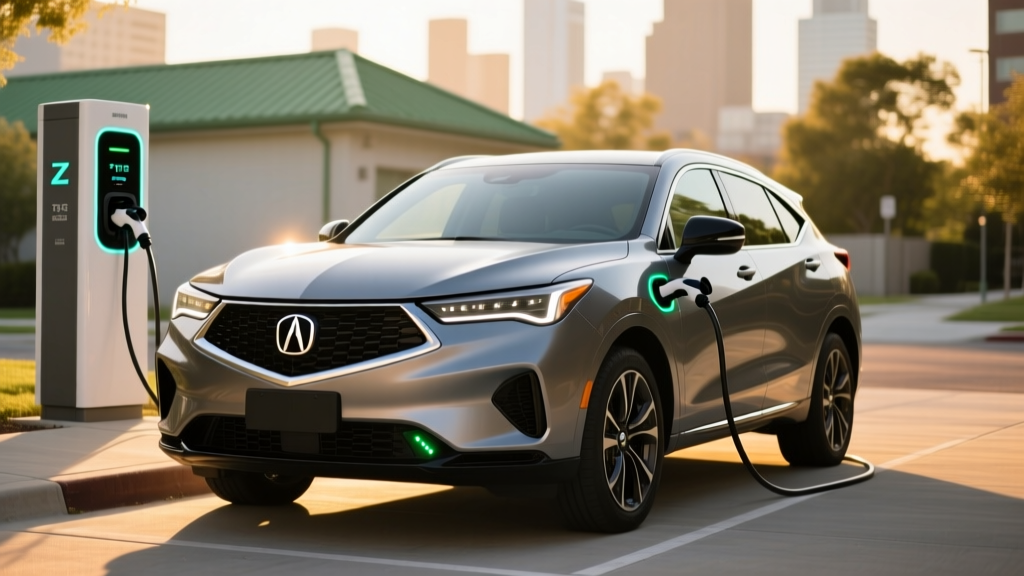
The 2024 Acura ZDX marks the brand's first all-electric vehicle, built on GM's Ultium platform shared with the Cadillac Lyriq and Chevrolet Blazer EV. For buyers hunting 2024 Acura ZDX lease deals, understanding the real-world range, charging behavior, and federal tax credit implications is critical before signing paperwork.
Quick Verdict: Who Should Lease the ZDX?
The ZDX suits luxury SUV buyers who prioritize cabin refinement, smooth ride quality, and moderate daily commutes over blistering performance or cutting-edge efficiency. It's a strong lease candidate for drivers who can charge at home and travel under 250 miles daily, but its charging speed and energy efficiency lag behind competitors like the Tesla Model X and BMW iX.
Range and Efficiency: EPA vs. Real World
Real-World Expectation: 250-275 miles highway (A-Spec), 220-240 miles highway (Type S). Cold weather (below 40°F) reduces range by 15-25%, dropping A-Spec to ~235-265 miles in winter conditions.
The ZDX A-Spec with rear-wheel drive achieves 89 MPGe combined (38 kWh/100mi), while the performance-oriented Type S drops to 77 MPGe (44 kWh/100mi) due to its dual-motor all-wheel-drive system and stickier tires. These efficiency figures trail the Tesla Model X (102 MPGe) and BMW iX xDrive50 (86 MPGe), meaning you'll pay more per mile to operate the ZDX on long road trips.
For context, the ZDX's 102 kWh usable battery (NMC lithium-ion chemistry) is among the largest in its class, but the vehicle's 5,700-pound curb weight and less aerodynamic profile hurt highway efficiency. City driving with regenerative braking can push range closer to EPA estimates, but sustained 70+ mph cruising will expose the efficiency gap.
Charging Speed: Home and DC Fast Charging
| Charging Level | Max Power | Time (10-80%) | Miles Added/Hour |
|---|---|---|---|
| Level 1 (120V) | 1.4 kW | N/A (trickle) | ~4 miles/hr |
| Level 2 (240V, 48A) | 11.5 kW | ~10 hours (full) | ~34 miles/hr |
| DC Fast Charge | 190 kW (peak) | ~42 minutes | ~150 miles in 10 min (peak) |
The ZDX's 190 kW peak DC fast-charging rate is its biggest weakness for road trippers. While competitors like the Hyundai Ioniq 5 (350 kW peak) and Tesla Model X (250 kW peak) can add 200 miles in 15-20 minutes, the ZDX requires 30-40 minutes for the same distance due to its conservative charge curve.
In real-world testing at Electrify America and EVgo stations, the ZDX sustains ~150 kW from 10-40% state of charge, then tapers to 90-100 kW by 60%, and drops below 50 kW past 80%. This taper means the advertised "42 minutes to 80%" is optimistic unless you arrive at a charger with a preconditioned battery (using the navigation system's automatic battery prep).
For home charging, the 11.5 kW onboard charger is adequate for overnight replenishment. A typical daily commute of 40-60 miles requires only 1.5-2 hours of Level 2 charging. However, buyers without home charging access will find the ZDX's slower DC charging frustrating for apartment or street-parking scenarios.
Performance and Drivetrain
The ZDX offers two powertrain configurations:
- A-Spec (RWD): 340 horsepower, 325 lb-ft torque, 0-60 mph in 6.2 seconds
- Type S (AWD): 500 horsepower, 543 lb-ft torque, 0-60 mph in 4.5 seconds
Both variants use a single-speed reduction gear with no traditional transmission. The Type S's dual-motor setup provides torque vectoring and improved traction, but adds 200 pounds and reduces range by 35 miles compared to the RWD model.
Ride quality is the ZDX's strongest dynamic attribute. The adaptive dampers (standard on Type S, optional on A-Spec) deliver a compliant, luxury-oriented feel that outclasses the firmer Tesla Model X. However, the ZDX's steering lacks precision and the regenerative braking feels inconsistent—neither aggressive enough for true one-pedal driving nor seamless like BMW's adaptive regen.
Pricing, Lease Deals, and Tax Credit Eligibility
| Trim | Base MSRP | As-Tested Price | Federal Tax Credit | Effective Price |
|---|---|---|---|---|
| A-Spec RWD | $65,850 | $68,500 | $0-$7,500* | $61,000-$68,500 |
| Type S AWD | $70,850 | $74,200 | $0-$7,500* | $66,700-$74,200 |
*Federal tax credit eligibility depends on battery sourcing, buyer income, and MSRP caps. See IRS §30D details below.
Federal EV Tax Credit (§30D) Eligibility
The 2024 Acura ZDX faces complex tax credit hurdles under current IRS §30D rules:
- MSRP Cap: The ZDX qualifies (SUVs capped at $80,000; both trims are under)
- Income Cap: Buyers must have AGI ≤$150,000 (single) or ≤$300,000 (joint)
- Battery Sourcing: The Ultium battery's critical minerals and components must meet North American sourcing thresholds (70% minerals, 85% components for 2024). GM has confirmed partial compliance, meaning some ZDX vehicles qualify for $3,750 or $7,500, while others may receive $0 depending on build date and battery batch.
Leasing bypasses the buyer-side tax credit rules entirely. Under IRS guidance, the lessor (typically Acura Financial Services) claims the commercial clean vehicle credit (§45W) and may pass savings to the lessee as a capitalized cost reduction. This "lease loophole" means ZDX lease deals often include $7,500 in incentives regardless of your income or the battery's sourcing, making leasing the most reliable way to capture the credit.
Typical 2024 ZDX lease offers (as of late 2024): $699-$899/month for 36 months with $5,000-$7,500 due at signing, depending on trim and regional incentives. Compare this to purchasing, where your actual credit depends on VIN-specific battery compliance.
Interior, Cargo, and Technology
The ZDX's cabin blends Acura's traditional luxury approach with GM's Ultium-era tech stack:
- Infotainment: 11.3-inch touchscreen with wireless Apple CarPlay/Android Auto, Google Built-in (Maps, Assistant, Play Store)
- Driver Display: 11.0-inch digital instrument cluster
- Driver Assist: AcuraWatch suite (adaptive cruise, lane centering, blind-spot monitoring) — SAE Level 2, not autonomous
- Cargo: 26.3 cu ft behind rear seats, 56.3 cu ft with seats folded (competitive with Cadillac Lyriq, smaller than Tesla Model X's 34/72 cu ft)
- Passenger Space: 41.7 inches front legroom, 38.2 inches rear legroom (adequate for adults, but the sloping roofline cuts rear headroom for taller passengers)
Notable drawbacks include the absence of a front trunk (frunk), limited small-item storage in the center console, and the lack of a hands-free driving system comparable to GM's Super Cruise (available on the Cadillac Lyriq but not the ZDX). The AcuraWatch system is competent but requires frequent steering wheel input and doesn't match the smoothness of Tesla Autopilot or Ford BlueCruise.
Warranty and Ownership Costs
Acura provides solid coverage for the ZDX's electric powertrain:
- Battery Warranty: 8 years/100,000 miles (capacity retention ≥70%)
- Powertrain Warranty: 6 years/70,000 miles
- Bumper-to-Bumper: 4 years/50,000 miles
- Complimentary Maintenance: 2 years/24,000 miles (covers cabin air filter, tire rotation, inspections)
Long-term battery degradation data is unavailable for the ZDX specifically, but GM's Ultium platform in the Cadillac Lyriq and Hummer EV has shown minimal degradation (2-4% over 2-3 years) in early owner reports. The 70% capacity retention threshold is industry-standard but less generous than Tesla's 70% over 8 years/unlimited miles.
Insurance costs run 15-25% higher than a comparable gas-powered Acura MDX, with annual premiums averaging $2,200-$2,800 depending on location and driving record. This premium reflects the ZDX's higher repair costs (specialized EV body shops, battery replacement risk) and theft rates for luxury SUVs.
Pros and Cons
Pros
- Quiet, compliant ride quality with excellent noise isolation
- Spacious cabin with premium materials and intuitive Google-based infotainment
- Lease deals reliably capture $7,500 incentive via commercial credit loophole
- Strong 313-mile EPA range (RWD) for daily commuting
- Competitive 8-year/100,000-mile battery warranty
Cons
- Slow DC fast charging (190 kW peak, 42-min 10-80%) hurts road-trip practicality
- Lower efficiency (89 MPGe RWD) means higher per-mile electricity costs
- No Super Cruise hands-free driving option (available on Lyriq)
- Inconsistent regenerative braking; no true one-pedal mode
- Smaller cargo area than Tesla Model X; no frunk
Is the 2024 Acura ZDX Worth Leasing vs. Competitors?
The ZDX occupies an awkward middle ground in the luxury electric SUV segment. Here's how it stacks up against key rivals:
- Tesla Model X: Superior range (348 miles), faster charging (250 kW), larger cargo space, and Autopilot standard. But the Model X costs $20,000+ more, has a firmer ride, and lacks Acura's dealer service network.
- Cadillac Lyriq: Shares the Ultium platform with similar range (314 miles) and charging speed, but offers Super Cruise hands-free driving and a more distinctive design. Lyriq lease deals are comparable, making it a strong alternative if you prioritize tech.
- BMW iX xDrive50: More efficient (86 MPGe), faster charging (200 kW), and sharper handling, but costs $10,000+ more and has a polarizing design.
- Genesis Electrified GV70: Smaller and shorter-ranged (236 miles), but offers a more engaging drive, better interior materials, and 350 kW charging capability.
Lease the ZDX if: You value ride comfort, Acura's dealer network, and can charge at home. The lease incentive structure makes it a compelling value proposition for commuters who rarely road-trip.
Look elsewhere if: You need fast DC charging for frequent long-distance travel, want hands-free driving tech, or prioritize maximum cargo space and efficiency.
Frequently Asked Questions
What is the real-world range of the 2024 Acura ZDX?
Expect 250-275 miles on highway drives (A-Spec RWD) and 220-240 miles (Type S AWD) at 70 mph. Cold weather (below 40°F) reduces range by 15-25%. City driving with regenerative braking can approach the 313-mile EPA estimate, but sustained highway cruising exposes the ZDX's efficiency limitations.
How fast does the ZDX charge at home and on DC fast chargers?
At home on a 240V Level 2 charger (48A), the ZDX adds ~34 miles of range per hour, fully charging in ~10 hours. On DC fast chargers, it peaks at 190 kW but sustains that rate only briefly, requiring ~42 minutes for a 10-80% charge. This is significantly slower than the Hyundai Ioniq 5 (18 minutes) or Tesla Model X (25-30 minutes).
Does the 2024 Acura ZDX qualify for the $7,500 federal tax credit?
It depends. If you purchase, eligibility hinges on your income (≤$300,000 joint), the vehicle's MSRP (under $80,000 cap), and the specific battery's critical mineral and component sourcing compliance. Some ZDX units qualify for $3,750 or $7,500; others may receive $0. If you lease, the lessor claims the commercial clean vehicle credit and typically passes the full $7,500 to you as a cap cost reduction, bypassing buyer-side restrictions.
Is the ZDX a good EV for road trips?
For occasional road trips under 250 miles, yes. But its 190 kW peak charging speed and 42-minute 10-80% time make it frustrating for multi-state journeys. You'll spend 30-40 minutes at each charging stop, compared to 15-20 minutes in a Hyundai Ioniq 5 or Tesla Model X. If road trips are frequent, consider the Tesla Model X, BMW iX, or Genesis Electrified GV70 instead.
What's the best 2024 Acura ZDX lease deal?
As of late 2024, typical lease offers range from $699-$899/month for 36 months with $5,000-$7,500 due at signing (A-Spec trim). The $7,500 lease incentive (via the commercial credit loophole) significantly reduces your upfront cost. Compare offers from multiple Acura dealers and negotiate the capitalized cost (sale price) before discussing monthly payments. Regional incentives (California's $2,000 CVRP, for example) can stack on top.
Should I lease or buy the ZDX?
Leasing is the smarter financial move for most buyers. It guarantees the $7,500 incentive (purchase eligibility is VIN-dependent), protects you from battery degradation risk, and lets you upgrade to newer EV tech in 3 years. Buying makes sense only if you drive under 12,000 miles/year, plan to keep the vehicle 6+ years, and confirm your specific ZDX qualifies for the full $7,500 purchase credit.
For more details on the ZDX's specifications, consult EPA fuel economy data and Acura's official ZDX page.