Quick Verdict: The Sensible Electric SUV for Families
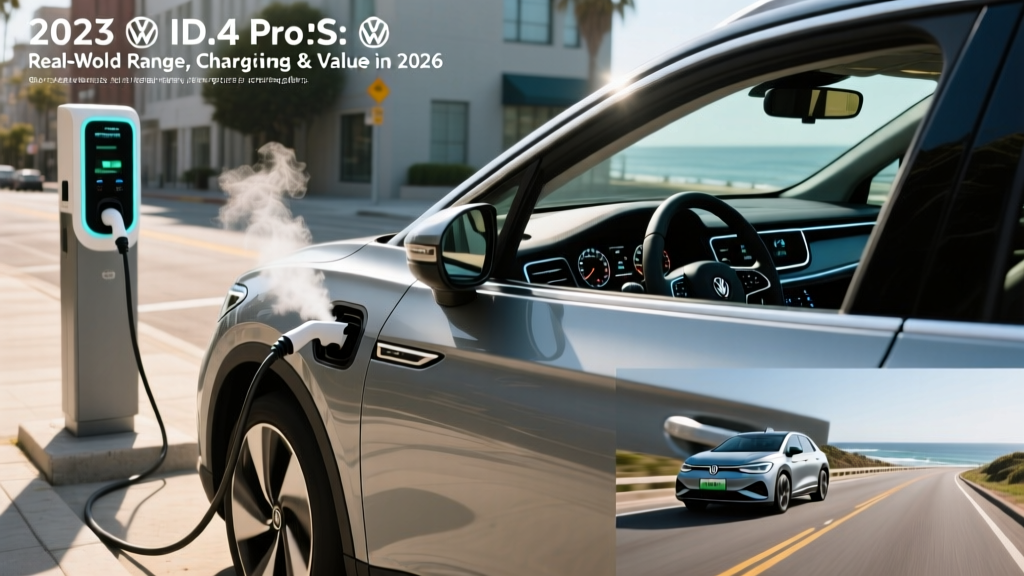
The 2023 Volkswagen ID.4 Pro S occupies a specific niche in the used EV market: a practical, comfortable, family-oriented electric crossover that prioritizes ride quality and interior space over blistering performance. With a 275-mile EPA range (RWD), a usable 82 kWh NMC battery, and Volkswagen's strong build quality, the Pro S trim remains a compelling option for buyers shopping the pre-owned EV market in 2026. It's not the fastest-charging or longest-range vehicle in its class, but its real-world comfort, generous cargo space, and strong safety credentials make it a rational choice for daily commuting and road trips alike.
Range and Efficiency: EPA Numbers vs. Reality
EPA Estimated: 275 miles (RWD Pro S) / 263 miles (AWD Pro S)
Real-World Expectation: ~230–250 miles highway (70–75 mph); ~200–220 miles in freezing temperatures with cabin heat
Efficiency: 104 MPGe combined (RWD) / 99 MPGe combined (AWD) — approximately 32–34 kWh/100 mi
The 2023 ID.4 Pro S is equipped with an 82 kWh gross battery pack (77 kWh usable) using NMC (nickel manganese cobalt) lithium-ion chemistry. This chemistry offers higher energy density than LFP alternatives, giving Volkswagen more range in a compact package, though it requires more careful thermal management and benefits from keeping state of charge between 20–80% for long-term longevity.
In mixed suburban and highway driving at moderate temperatures (60–80°F), owners consistently report achieving 250–265 miles on a full charge — close to the EPA sticker. However, sustained highway speeds above 70 mph reduce efficiency noticeably due to the ID.4's boxy aerodynamic profile (0.28 Cd). In cold weather (below 32°F), expect a 20–30% range reduction, bringing real-world range down to 190–220 miles depending on cabin heat usage and driving style. The ID.4 Pro S includes a heat pump as standard equipment on the AWD variant, which mitigates cold-weather losses compared to resistive heating — but RWD models from 2023 may lack this feature depending on production date.
According to fueleconomy.gov, the 2023 ID.4 Pro S RWD achieves 104 MPGe combined (city 104 / highway 93), while the AWD variant drops to 99 MPGe combined. These figures place it mid-pack among compact electric SUVs — behind the Hyundai Ioniq 5 and Tesla Model Y in efficiency, but competitive with the Ford Mustang Mach-E.
Charging Speed: DC Fast Charge and Home Level 2
| Charging Level | Max Power | Speed / Time | Connector |
|---|---|---|---|
| Level 1 (120V household) | 1.2 kW | ~3–4 mi/hr | J1772 |
| Level 2 (240V home/public) | 11 kW (onboard charger) | ~33 mi/hr; 0–100% in ~8 hrs | J1772 (CCS1 combo) |
| DC Fast Charging | 170 kW peak (RWD) / 175 kW peak (AWD) | 10–80% in ~30 min; 10–90% in ~38 min | CCS1 |
The 2023 ID.4 Pro S uses the CCS1 (Combined Charging System) connector standard, which was the dominant North American DC fast-charging standard at the time of production. Note that Volkswagen has since adopted the NACS (Tesla) connector for 2025+ models, but the 2023 model year retains CCS1. Adapters for Tesla Supercharger access were not yet widely available for CCS-equipped Volkswagens as of early 2026 — check with Volkswagen or third-party adapter manufacturers for current compatibility.
On a DC fast charger, the ID.4 Pro S peaks at 170 kW (RWD) or 175 kW (AWD). However, like most EVs, it does not sustain peak power throughout the session. The charge curve is strong from 10–50% SoC (sustaining roughly 130–160 kW), then tapers progressively above 70%. A 10–80% session takes approximately 30 minutes under ideal thermal conditions, but cold-soak or a battery that hasn't been preconditioned can add 5–10 minutes to that time. The ID.4 does support battery preconditioning when a DC fast charger is set as the navigation destination, which is essential for optimal charging speeds.
At home on a Level 2 charger (240V, 48A circuit), the ID.4's 11 kW onboard charger replenishes the battery at roughly 33 miles of range per hour, meaning a full 0–100% charge takes approximately 8 hours. Most owners installing a 48A home charger (like the ChargePoint Home Flex or Emporia Level 2) report $500–$1,200 in installation costs depending on panel proximity and whether a panel upgrade is needed. Always consult a licensed electrician for final installation specs.
Performance and Driving Dynamics
| Spec | RWD Pro S | AWD Pro S |
|---|---|---|
| Drivetrain | Rear-wheel drive (single motor) | Dual-motor all-wheel drive |
| Horsepower | 201 hp | 295 hp |
| Torque | 229 lb-ft | 339 lb-ft |
| 0–60 mph | 7.7 seconds | 5.4 seconds |
| Top Speed | 99 mph (electronically limited) | 112 mph (electronically limited) |
| Towing Capacity | 2,200 lbs (with factory hitch) | 2,700 lbs (with factory hitch) |
The ID.4 Pro S is not a performance EV, and that's by design. The RWD model's 201 hp and 7.7-second 0–60 time are adequate for merging and passing but won't impress anyone coming from a Tesla Model Y Performance. The AWD variant's 295 hp and 5.4-second sprint are noticeably more confident, particularly in wet or snowy conditions where the dual-motor torque distribution shines.
Where the ID.4 truly excels is ride comfort. The MEB platform delivers a compliant, well-damped ride that absorbs road imperfections better than most competitors in this segment. The steering is light and predictable, making it an easy vehicle to drive daily. Regenerative braking is adjustable via steering-wheel paddles (B-mode for stronger regen, though not true one-pedal driving at all speeds). Some owners note that the drum rear brakes — chosen for efficiency — can feel slightly different under hard braking compared to four-wheel disc setups, though NHTSA testing shows stopping distances are competitive.
Interior, Cargo, and Technology
The Pro S trim is the higher of the ID.4's two main trims (Pro and Pro S), adding premium features over the base Pro. Standard equipment on the 2023 Pro S includes:
- 12-inch infotainment touchscreen with wireless Apple CarPlay and Android Auto
- Panoramic fixed glass roof with power sunshade
- Heated front seats and heated steering wheel
- Power-adjustable driver's seat with memory
- Leatherette (V-Tex) upholstery
- 360-degree surround-view camera
- Adaptive cruise control with stop-and-go (Travel Assist)
- Lane-keeping assist and lane-centering
- Automatic emergency braking with pedestrian detection
Interior dimensions are generous for the compact SUV class:
- Front legroom: 41.1 inches
- Rear legroom: 37.6 inches
- Cargo volume (rear seats up): 30.3 cu ft
- Cargo volume (rear seats folded): 64.2 cu ft
- No front trunk (frunk) — the MEB platform's electronics occupy this space
The most common criticism of the 2023 ID.4's interior centers on its capacitive-touch controls for climate and volume, which lack tactile feedback and are frustrating to use while driving. The infotainment software (VW ID. Software 3.0 at launch) was also a pain point — sluggish response times and occasional glitches. Volkswagen issued over-the-air updates through 2024 and 2025 that improved responsiveness, but the interface still trails Hyundai/Kia and Tesla in usability. The instrument cluster is a small 5.3-inch display behind the steering wheel, supplemented by an available head-up display with augmented-reality navigation on the Pro S.
Driver assistance is comprehensive but firmly SAE Level 2 — meaning the driver must remain fully engaged with hands on the wheel and eyes on the road at all times. Travel Assist combines adaptive cruise and lane-centering for highway driving, and it performs competently, though it is not a "self-driving" system and should never be treated as one.
Pricing, Tax Credits, and Ownership Costs
| Trim / Configuration | Original MSRP (2023) | Est. Used Price (2026) | Federal Tax Credit |
|---|---|---|---|
| Pro S RWD | $46,870 | $24,000–$30,000 | $4,000 (used EV credit, §25E) |
| Pro S AWD | $50,270 | $27,000–$33,000 | $4,000 (used EV credit, §25E) |
| Pro S AWD w/ Gradient Pkg | $52,070 | $29,000–$35,000 | $4,000 (used EV credit, §25E) |
As a 2023 model year vehicle purchased in 2026, the ID.4 Pro S is no longer eligible for the new vehicle §30D federal tax credit ($7,500). However, buyers purchasing from a licensed dealer may qualify for the §25E Used Clean Vehicle Credit, which provides up to $4,000 or 30% of the sale price (whichever is less) for qualified used EVs priced at $25,000 or below. Income caps apply: modified adjusted gross income must not exceed $75,000 (single), $112,500 (head of household), or $150,000 (married filing jointly). Per IRS guidelines, the vehicle must be at least two model years old, purchased from a dealer, and the credit can only be claimed once per VIN every three years. Confirm eligibility with a tax professional before purchase.
Battery and powertrain warranty: Volkswagen provides an 8-year/100,000-mile warranty on the high-voltage battery, covering defects and capacity loss below 70% of original capacity. The general vehicle warranty is 4 years/50,000 miles. For a 2023 model purchased in 2026, approximately 5 years and significant mileage remain on the battery warranty — a meaningful safety net for used buyers.
Pros and Cons
✅ Pros
- Comfortable, compliant ride quality — best in class for daily driving
- Spacious interior with 30.3 cu ft cargo and generous rear legroom
- Strong safety ratings (IIHS Top Safety Pick+, 5-star NHTSA)
- Competitive 275-mile EPA range for the segment
- Standard heat pump on AWD models reduces cold-weather range loss
- Remaining factory battery warranty (8yr/100k) transfers to used owners
- Quiet cabin with excellent NVH (noise, vibration, harshness) isolation
❌ Cons
- 170 kW DC fast charging is slower than Hyundai Ioniq 5 (240 kW) and Tesla Model Y (250 kW)
- Capacitive-touch controls for climate/volume are frustrating and imprecise
- Infotainment software is dated compared to competitors, even after OTA updates
- No front trunk (frunk) — lost storage opportunity
- Regenerative braking is not strong enough for true one-pedal driving
- CCS1 connector may limit future Supercharger access without adapter
- RWD 0–60 time of 7.7 seconds feels sluggish for the price point
Who Should Buy the 2023 VW ID.4 Pro S?
Decision Framework
Choose the ID.4 Pro S if:
- You prioritize ride comfort and quietness over acceleration and sporty handling
- You need a family-sized EV with strong cargo capacity and rear-seat room
- You primarily charge at home (Level 2) and DC fast charge only occasionally
- Safety ratings and driver-assist features are your top priorities
- You want a mainstream-brand EV with dealer service network support
Look elsewhere if:
- You frequently take long road trips and need the fastest possible DC charging (consider Ioniq 5 or Model Y)
- You want cutting-edge infotainment and over-the-air feature updates (consider Tesla or Rivian)
- You need a frunk for additional cargo or want one-pedal driving (consider Ford Mach-E or Hyundai Ioniq 5)
- Performance and quick acceleration matter to you (consider Model Y Performance or Ioniq 5 dual-motor)
Competitor Comparison: ID.4 Pro S vs. the Class
| Vehicle | EPA Range | DC Fast Charge | 0–60 mph | Cargo (seats up) |
|---|---|---|---|---|
| VW ID.4 Pro S RWD | 275 mi | 170 kW / ~30 min 10–80% | 7.7 sec | 30.3 cu ft |
| Hyundai Ioniq 5 SEL RWD | 303 mi | 240 kW / ~18 min 10–80% | 7.4 sec | 27.2 cu ft |
| Tesla Model Y LR AWD | 330 mi | 250 kW / ~20 min 10–80% | 4.8 sec | 30.2 cu ft |
| Ford Mustang Mach-E Premium RWD | 312 mi | 150 kW / ~36 min 10–80% | 6.1 sec | 29.7 cu ft |
| Kia EV6 Wind RWD | 310 mi | 240 kW / ~18 min 10–80% | 7.2 sec | 24.4 cu ft |
The ID.4 Pro S holds its own in range and cargo space but falls behind the Hyundai/Kia E-GMP platform vehicles (Ioniq 5, EV6) and Tesla Model Y in DC fast-charging speed. That 170 kW peak versus 240–250 kW for competitors means 10–15 extra minutes at a fast charger on road trips — a meaningful difference for frequent travelers. However, the ID.4's ride comfort and cabin quietness are arguably best-in-class, and its IIHS Top Safety Pick+ rating provides peace of mind for family buyers.
Frequently Asked Questions
What is the real-world range of the 2023 VW ID.4 Pro S?
The EPA estimates 275 miles for the RWD Pro S and 263 miles for the AWD Pro S. In real-world driving, expect 230–250 miles on the highway at 70–75 mph, and 200–220 miles in freezing temperatures. City driving with frequent regenerative braking can match or slightly exceed the EPA figure.
How fast does the ID.4 Pro S charge?
On a DC fast charger, the ID.4 Pro S peaks at 170 kW (RWD) or 175 kW (AWD), reaching 10–80% in approximately 30 minutes under ideal conditions. At home on Level 2 (240V, 48A), the 11 kW onboard charger adds about 33 miles per hour, fully charging in roughly 8 hours.
Does the 2023 ID.4 Pro S qualify for a federal tax credit?
As a used vehicle purchased in 2026, it is not eligible for the $7,500 new-vehicle §30D credit. However, it may qualify for the §25E Used Clean Vehicle Credit of up to $4,000 if the sale price is $25,000 or less and buyer income is within IRS limits. Verify eligibility with your tax professional and the IRS §25E guidelines.
Is the 2023 VW ID.4 Pro S worth buying vs. competitors?
It depends on your priorities. If ride comfort, cabin quietness, and safety are paramount, the ID.4 Pro S is an excellent choice. If fast charging, modern infotainment, or strong acceleration matter more, the Hyundai Ioniq 5 or Tesla Model Y are stronger options. Used pricing in 2026 makes the ID.4 a strong value proposition, especially with remaining battery warranty coverage.
What battery chemistry does the ID.4 use, and how long will it last?
The 2023 ID.4 uses NMC (nickel manganese cobalt) lithium-ion chemistry with an 82 kWh gross / 77 kWh usable capacity. NMC offers high energy density but benefits from being kept between 20–80% state of charge for daily use. Volkswagen warranties the battery for 8 years/100,000 miles against capacity loss below 70%. Real-world degradation data from 2021–2022 ID.4 owners shows approximately 5–8% capacity loss over the first 60,000 miles — well within warranty thresholds.
Can the ID.4 Pro S use Tesla Superchargers?
The 2023 ID.4 Pro S has a CCS1 connector and cannot natively use Tesla's NACS Supercharger network. As of early 2026, Volkswagen has not officially released a CCS-to-NACS adapter for 2021–2024 ID.4 models, though third-party adapters may become available. Check with Volkswagen or adapter manufacturers for the latest compatibility information before relying on Supercharger access.