Quick Verdict: The Sensible Electric Crossover
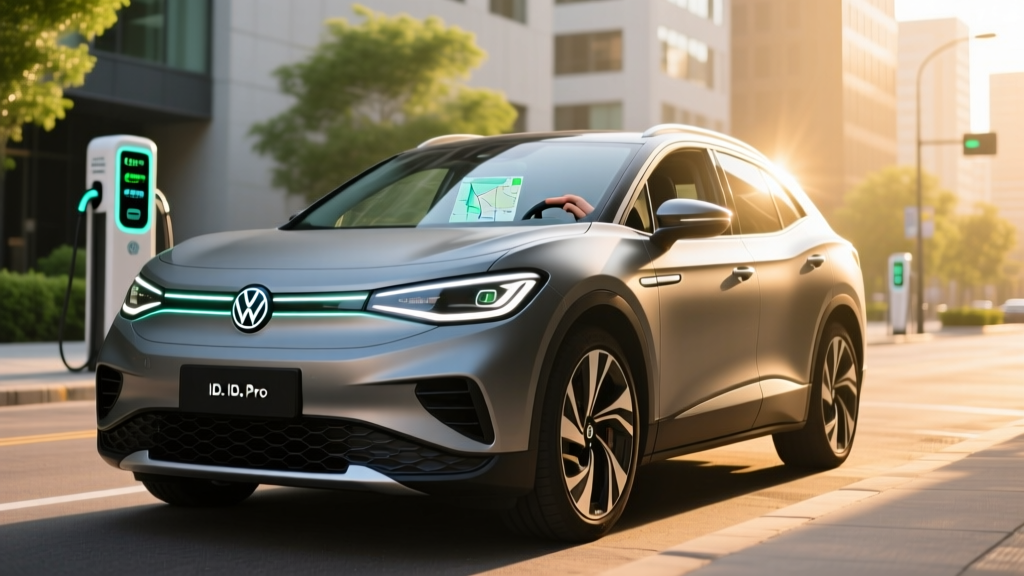
The 2023 Volkswagen ID.4 Pro occupies a specific niche in the EV market: it's the electric crossover for buyers who want something approachable, practical, and free of the tech-bro bravado that defines some competitors. With an EPA-estimated 275 miles of range, a usable 82 kWh battery, and a starting MSRP around $40,290 (before incentives), it targets families and commuters who need cargo space, decent efficiency, and a comfortable ride — without paying luxury premiums.
But the ID.4 Pro isn't without compromises. Its infotainment software drew widespread criticism at launch, its DC fast-charging speed trails rivals like the Hyundai Ioniq 5, and real-world highway range falls noticeably short of the EPA sticker. This review breaks down every number that matters — from sustained charging curves to cold-weather range loss — so you can decide if the ID.4 Pro fits your driving life.
Range, Battery & Efficiency
The rear-wheel-drive 2023 ID.4 Pro is equipped with an 82 kWh gross battery pack (approximately 77 kWh usable) using NMC (nickel-manganese-cobalt) lithium-ion chemistry. Volkswagen pairs this with a permanent-magnet synchronous motor on the rear axle producing 201 horsepower and 229 lb-ft of torque.
| Spec | Value |
|---|---|
| EPA Range (RWD Pro) | 275 miles |
| Battery (gross / usable) | 82 kWh / ~77 kWh |
| Battery Chemistry | NMC (Nickel-Manganese-Cobalt) |
| Motor / Drivetrain | Single rear motor / RWD |
| Horsepower / Torque | 201 hp / 229 lb-ft |
| 0–60 mph | ~7.7 seconds |
| EPA Efficiency | 104 MPGe combined (29 kWh/100 mi) |
| Cargo Volume (rear seats up / folded) | 30.3 / 64.2 cu ft |
| Rear Legroom | 37.6 inches |
| Battery Warranty | 8 years / 100,000 miles |
| Base MSRP (Pro RWD) | $40,290 |
The EPA's 275-mile estimate assumes a mix of city and moderate-speed driving. On sustained highway trips at 70–75 mph, expect approximately 230–250 miles before needing a charge. In cold weather (below 32°F), range can drop an additional 20–30%, putting winter highway range closer to 180–210 miles. If your commute is mostly city driving with regenerative braking opportunities, you'll land closer to or even above the EPA figure. Plan road trips around 200-mile charging intervals for a comfortable buffer.
The ID.4 Pro's efficiency of 104 MPGe combined (29 kWh per 100 miles) is competitive within the compact electric SUV segment, though it trails the more aerodynamic Tesla Model Y (approximately 122 MPGe combined). According to fueleconomy.gov, the ID.4 Pro's annual electricity cost is estimated at roughly $650 based on 15,000 miles of driving — a significant savings over a comparable gas-powered compact SUV averaging 28 MPG.
Charging Speed: DC Fast, Level 2 & Home Setup
Charging capability is where the 2023 ID.4 Pro shows its most notable limitation compared to segment leaders. The Pro trim with the standard battery supports a peak DC fast-charge rate of 135 kW, while the larger 82 kWh pack (Pro S and above, and the Pro with the larger battery option) supports up to 170 kW.
| Charging Level | Power | Speed / Time |
|---|---|---|
| Level 1 (120V household) | ~1.4 kW | ~3–4 miles per hour |
| Level 2 (240V, 32A) | ~7.7 kW | ~22 miles per hour |
| Level 2 (240V, 48A) | ~11 kW | ~32 miles per hour |
| DC Fast Charge (peak) | 135–170 kW | 10–80% in ~30 min (82 kWh pack) |
| DC Fast Charge (sustained avg) | ~90–110 kW | Varies by SoC and temperature |
Here's what the numbers mean in practice: at a 150 kW Electrify America station (VW includes three years of complimentary 30-minute charging sessions at EA), the ID.4 Pro with the 82 kWh pack will peak around 170 kW at low states of charge, then taper significantly above 60% SoC. The 10–80% charge takes approximately 29–34 minutes under ideal conditions (warm battery, low starting SoC). In cold weather without adequate preconditioning, add 5–10 minutes to that estimate.
The ID.4 Pro's onboard AC charger is 11 kW, which means a full Level 2 home charge from empty takes roughly 7.5–8 hours. For context, the Hyundai Ioniq 5 with its 800V architecture can hit 10–80% in about 18 minutes on a 350 kW charger — a meaningful advantage for frequent road-trippers. If most of your charging happens at home overnight, the ID.4's Level 2 speed is perfectly adequate.
Performance & Driving Dynamics
The single-motor RWD ID.4 Pro delivers 201 horsepower, reaching 60 mph in approximately 7.7 seconds. That's adequate for highway merging and daily driving, but it won't win any stoplight drag races against the dual-motor Tesla Model Y Long Range (4.8 seconds) or even the Ford Mustang Mach-E California Route 1 (5.8 seconds with extended range).
Where the ID.4 Pro earns its keep is ride quality. The suspension tuning prioritizes comfort over sportiness, absorbing road imperfections with a composure that feels more premium than its price suggests. The steering is light and predictable, the turning radius is tight (31.5 feet), and the cabin remains quiet at highway speeds. Regenerative braking offers adjustable levels via steering-wheel paddles, though the ID.4 does not offer true one-pedal driving in the way Nissan Leaf or Chevrolet Bolt owners might expect — the regen doesn't bring the car to a complete stop.
For buyers who need all-wheel drive, the ID.4 Pro AWD adds a front induction motor for a combined 295 hp and a 0–60 time of approximately 5.4 seconds, at the cost of about 20 miles of EPA range (245 miles for the AWD Pro with the 82 kWh pack).
Interior, Tech & Driver Assistance
The ID.4's cabin is minimalist and spacious. Rear-seat passengers enjoy 37.6 inches of legroom — comparable to the Toyota RAV4 and more than the Model Y's second row. Cargo space measures 30.3 cubic feet behind the rear seats and 64.2 cubic feet with them folded, which handles family gear, groceries, and weekend-trip luggage without issue. There is no front trunk (frunk) in the US-market ID.4, which is a missed opportunity for additional storage.
The infotainment system uses a 10-inch touchscreen (12-inch on higher trims) running VW's ID. Software 3.x at launch. This was the ID.4's most-criticized element: capacitive touch sliders for volume and temperature, sluggish response times, and an unintuitive menu structure frustrated many owners and reviewers. VW has pushed over-the-air updates to improve responsiveness, but the interface still lags behind the snappiness of Tesla's, Hyundai's, or Kia's systems. Wireless Apple CarPlay and Android Auto are standard.
On the driver-assistance front, the ID.4 Pro comes equipped with VW's IQ.DRIVE suite, which includes:
- Travel Assist (adaptive cruise + lane centering) — functional on highways
- Front Assist (automatic emergency braking with pedestrian detection)
- Blind Spot Monitor with Rear Traffic Alert
- Lane Assist (lane-keeping)
- Park Distance Control (front and rear)
Travel Assist is a Level 2 driver-assist system. It can manage steering, acceleration, and braking on marked highways, but the driver must remain fully engaged, keep hands on the wheel (or demonstrate attention), and monitor the road at all times. It is not self-driving. It does not handle complex urban intersections, construction zones, or unmapped routes autonomously.
Pricing, Tax Credits & Total Cost
The 2023 ID.4 Pro RWD launched with a base MSRP of approximately $40,290 (including destination). The Pro S with the larger battery and additional features pushed closer to $48,000, while the AWD Pro S topped out near $53,000.
| Trim | Base MSRP | §30D Credit (max) | Effective Price |
|---|---|---|---|
| Pro RWD | $40,290 | Up to $7,500* | ~$32,790* |
| Pro S RWD (82 kWh) | ~$45,290 | Up to $7,500* | ~$37,790* |
| Pro S AWD (82 kWh) | ~$49,290 | Up to $7,500* | ~$41,790* |
* Federal tax credit eligibility under IRS §30D depends on multiple requirements: the vehicle must meet battery-component and critical-mineral sourcing thresholds (which have phased in progressively since April 2023), the buyer's adjusted gross income must not exceed $150,000 (single) / $300,000 (joint), and the vehicle MSRP must be at or below $80,000 for SUVs. As of 2024 and into 2026, the VW ID.4 assembled in Chattanooga, Tennessee, has qualified for the full or partial credit depending on the specific battery-sourcing compliance at time of purchase. Starting January 1, 2024, buyers can elect to transfer the credit to the dealer as a point-of-sale price reduction. Always verify current eligibility on irs.gov and consult a tax professional before relying on the credit.
When the ID.4 Pro qualifies for the full $7,500 credit, the effective price drops into the low-to-mid $30,000s — making it one of the more affordable electric SUVs with this level of range and cargo space. Factor in lower fuel and maintenance costs (no oil changes, fewer brake replacements due to regen), and the five-year total cost of ownership undercuts comparable gas-powered compact SUVs for most drivers covering 12,000–15,000 miles annually.
Warranty & Long-Term Ownership
Volkswagen backs the ID.4's battery pack with an 8-year/100,000-mile warranty, guaranteeing a minimum of 70% capacity retention over that period. The basic vehicle warranty covers 4 years/50,000 miles, which is standard for the segment but trails Hyundai/Kia's 5-year/60,000-mile basic coverage.
NMC battery chemistry, as used in the ID.4, offers higher energy density (more range per kilogram) than LFP chemistry found in some Tesla Model 3 Standard Range vehicles, but it typically degrades slightly faster over very high cycle counts. For most owners charging primarily at home on Level 2 and avoiding frequent DC fast-charging to 100%, NMC packs have demonstrated 85–92% capacity retention at the 100,000-mile mark based on aggregated fleet data. The ID.4's liquid-cooled thermal management system helps preserve battery health in both hot and cold climates.
VW also includes three years of complimentary 30-minute DC fast-charging sessions at Electrify America stations — a tangible ownership perk that offsets the ID.4's slower peak charge rate for road-trippers who plan around EA's network.
How It Stacks Up Against Competitors
The ID.4 Pro competes directly with the Hyundai Ioniq 5, Kia EV6, Ford Mustang Mach-E, and Tesla Model Y. Each has trade-offs:
- Hyundai Ioniq 5 (SE/SEL RWD): 303 mi EPA range, 800V architecture enabling ~18-min 10–80% charges on 350 kW chargers, more distinctive styling. Slightly less cargo space. Similar pricing.
- Kia EV6 (Light/Wind RWD): 239–310 mi range depending on battery, shares the Ioniq 5's fast-charging advantage, sportier driving dynamics. Rear visibility is compromised by the design.
- Ford Mustang Mach-E (Select/California Route 1): 250–314 mi range, more engaging to drive, better infotainment (SYNC 4A). Tighter rear seat and less cargo volume than the ID.4.
- Tesla Model Y (Long Range AWD): 330 mi range, the fastest charging and most Supercharger access, best-in-class efficiency. Firm ride, minimal interior, higher base price, no federal credit eligibility for new purchases as of recent rule changes.
- You prioritize ride comfort and cabin quietness over sporty handling
- You need maximum rear-seat and cargo space in this price range
- Most charging happens at home, minimizing the slower DC fast-charge penalty
- You value straightforward, non-polarizing design
- You road-trip frequently and need the fastest possible DC charging (Ioniq 5/EV6)
- Infotainment responsiveness is a top priority (Model Y, Mach-E)
- You want one-pedal driving with full stop capability
- You need AWD with 300+ miles of range
Pros & Cons at a Glance
- Comfortable, quiet ride quality
- Spacious rear seat and cargo area (64.2 cu ft)
- Competitive pricing after $7,500 tax credit
- Standard IQ.DRIVE safety suite
- 3 years free Electrify America charging
- Tight turning radius, easy to park
- DC fast-charging slower than 800V rivals
- Infotainment software frustrating at launch
- No frunk for additional storage
- Regen braking doesn't enable full one-pedal driving
- Real-world highway range ~230–250 mi, not 275
- Base 4-year/50k warranty is merely average
Frequently Asked Questions
What is the real-world range of the 2023 VW ID.4 Pro?
The EPA rates the RWD Pro with the 82 kWh pack at 275 miles. In real-world highway driving at 70+ mph, expect 230–250 miles. In cold winter conditions, that can drop to 180–210 miles. City driving with regenerative braking recovers more energy, often matching or slightly exceeding the EPA estimate.
How fast does the ID.4 Pro charge at home and on the road?
At home on a 240V Level 2 charger (48A/11 kW), you'll add roughly 32 miles of range per hour, with a full charge taking about 7.5–8 hours. On DC fast chargers, the 82 kWh pack peaks at 170 kW and reaches 10–80% in approximately 30–34 minutes under ideal conditions. Slower than the Ioniq 5's 800V system, but adequate for planned road trips.
Does the 2023 ID.4 Pro qualify for the $7,500 federal tax credit?
The ID.4 is assembled in Chattanooga, Tennessee, and has qualified for the full or partial §30D credit depending on battery-sourcing compliance at the time of purchase. Buyer income must not exceed $150,000 (single) or $300,000 (joint filing), and the SUV MSRP cap is $80,000 — which all ID.4 trims fall under. Since January 2024, the credit can be transferred to the dealer at point of sale as an immediate price reduction. Verify current eligibility at fueleconomy.gov and irs.gov before purchasing.
Is the ID.4 Pro worth buying versus the Hyundai Ioniq 5 or Tesla Model Y?
It depends on your priorities. If fast DC charging and bold design matter, the Ioniq 5 wins. If range, Supercharger access, and efficiency are paramount, the Model Y leads. If you want the most comfortable ride, the best rear-seat space, and strong value after the federal credit, the ID.4 Pro is the strongest pick in its class.
What is the battery warranty and expected lifespan?
VW covers the battery for 8 years or 100,000 miles against defects and capacity loss below 70%. NMC chemistry in liquid-cooled packs like the ID.4's typically retains 85–92% capacity at 100,000 miles when charged primarily on Level 2. Full battery replacement, if ever needed out of warranty, currently costs in the range of $12,000–$18,000 including labor, though prices are expected to decline as battery costs continue to fall.