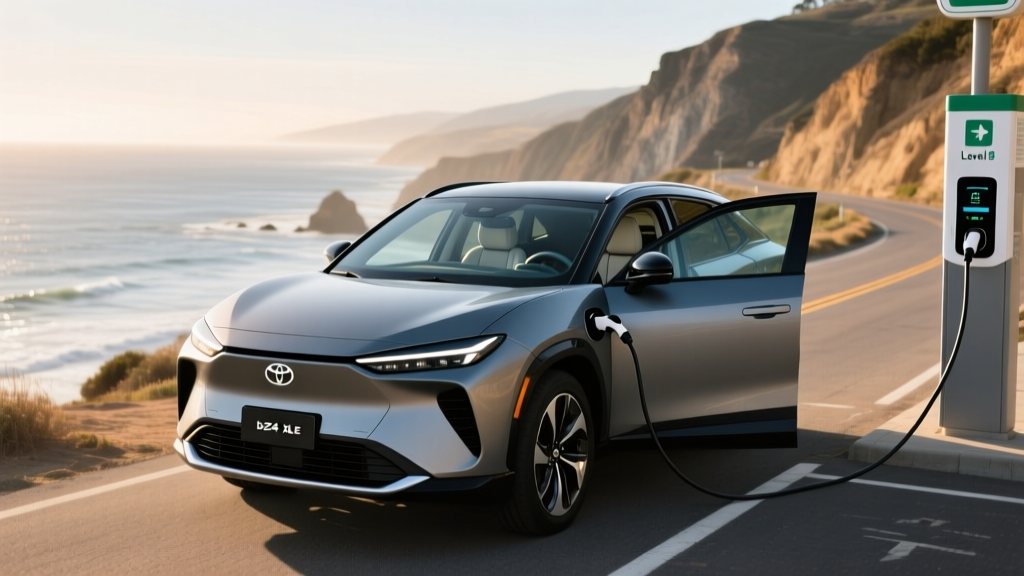
Quick Verdict: The 2023 Toyota bZ4X XLE at a Glance
The 2023 Toyota bZ4X XLE arrived as Toyota's first dedicated battery-electric vehicle, built on the e-TNGA platform co-developed with Subaru. For buyers researching the 2023 Toyota bZ4X XLE, the headline is a mainstream electric crossover from the world's largest automaker — but the execution reveals both Toyota's engineering caution and some genuine compromises. With an EPA-estimated 252 miles of range (FWD), a 71.4 kWh battery, and a starting MSRP around $42,000 before incentives, the bZ4X XLE targets pragmatic commuters who want Toyota reliability in an EV package. It's not the longest-range or fastest-charging option in its class, but it delivers predictable efficiency, a comfortable ride, and the brand's strong dealer network.
| EPA Range | 252 miles (FWD) / 236 miles (AWD) |
| Battery (Usable) | 71.4 kWh, Lithium-ion (NMC chemistry) |
| Efficiency | 114 MPGe combined (FWD) / 102 MPGe (AWD) |
| Peak DC Fast Charge | 150 kW (FWD) / 150 kW (AWD) |
| 10–80% DC Charge Time | ~30 minutes (manufacturer estimate) |
| Level 2 Home Charging | 6.6 kW onboard charger (~25 miles/hr) |
| 0–60 mph | 7.1 sec (FWD) / 6.5 sec (AWD) |
| Horsepower | 201 hp (FWD) / 214 hp (AWD) |
| Drivetrain | Single-motor FWD or dual-motor AWD |
| Base MSRP (XLE FWD) | $42,000 (2023 launch pricing) |
| Battery Warranty | 8 years / 100,000 miles (10 yr/150,000 mi in CA-emissions states) |
Range and Efficiency: EPA Sticker vs. the Real World
The front-wheel-drive 2023 bZ4X XLE carries an EPA-estimated 252 miles of range. The dual-motor AWD variant drops to 236 miles. These numbers place the bZ4X behind competitors like the Hyundai Ioniq 5 (303 miles) and Tesla Model Y Long Range (330 miles), but ahead of the base Volkswagen ID.4 (209 miles for the smaller-battery trim).
EPA 252 mi (FWD) is a blended-cycle estimate. In real-world driving, expect:
- City/suburban commuting: 245–260 mi — regenerative braking recovers energy in stop-and-go traffic.
- Sustained highway driving (70–75 mph): 210–230 mi — the bZ4X's aerodynamic drag and lack of a heat pump on FWD trims reduce efficiency at speed.
- Cold weather (below 32°F): 170–200 mi — lithium-ion chemistry loses efficiency in the cold, and cabin heating draws significant energy. Toyota does not include a standard heat pump on the FWD XLE; it's available on AWD trims and as part of the Weather Package.
On a 250-mile highway trip in mild conditions (65°F, 70 mph), owners have reported arriving with roughly 20–30 miles of remaining range — adequate but not generous. Plan charging stops for any trip exceeding 200 miles to maintain a comfort buffer.
The FWD bZ4X XLE achieves 114 MPGe combined (27 kWh/100 mi), per fueleconomy.gov. That translates to roughly $0.04–$0.06 per mile when charging at home on a national-average electricity rate of $0.16/kWh — significantly cheaper than a 28-MPG gas crossover at $3.50/gallon ($0.125/mile).
Charging Speed: DC Fast Charging and Home Level 2
Charging capability is where the 2023 bZ4X XLE draws the most scrutiny from EV-savvy buyers. Here are the exact figures:
| Charging Level | Power (kW) | Speed / Time | Connector |
|---|---|---|---|
| Level 1 (120V household) | ~1.4 kW | ~3–4 miles per hour | J1772 |
| Level 2 (240V home/public) | 6.6 kW (onboard charger limit) | ~25 miles per hour; full charge in ~11 hours | J1772 |
| DC Fast Charge | 150 kW peak | 10–80% in ~30 minutes | CCS1 |
DC fast charging reality check: The bZ4X peaks at 150 kW but does not sustain that rate throughout the session. Like all EVs, the charge curve tapers as the battery fills. Expect peak rates between 15–50% State of Charge (SoC), with speed dropping significantly above 70%. A 10–80% session takes approximately 30 minutes at a capable 150+ kW station, but on a 50 kW charger, that same session stretches to roughly 70–80 minutes.
Level 2 home charging: The 6.6 kW onboard charger means a full 0–100% charge takes about 11 hours. For daily use, plugging in overnight easily replenishes a day's worth of driving. If you install a 48-amp Level 2 home charger (hardwired, requiring a 60-amp circuit), you'll max out the bZ4X's onboard charger. A 32-amp unit on a 40-amp circuit delivers about 7.7 kW at the wall, but the car will only accept 6.6 kW — still perfectly adequate for overnight charging.
Connector note: The 2023 bZ4X uses the CCS1 connector for DC fast charging and J1772 for Level 1/2. With the industry's ongoing transition to NACS (Tesla's connector), adapters will be needed for Tesla Supercharger access. Toyota has confirmed future models will adopt NACS natively, but 2023 bZ4X owners should budget for a CCS-to-NACS adapter (~$200–$250) if Supercharger access matters in their area.
Performance and Driving Dynamics
The FWD bZ4X XLE uses a single front-mounted electric motor producing 201 horsepower and 196 lb-ft of torque. Toyota quotes a 0–60 mph time of 7.1 seconds — adequate for merging and passing but noticeably slower than the Hyundai Ioniq 5 (5.2 sec RWD) or Tesla Model Y (5.0 sec Long Range).
The AWD variant adds a rear motor for a combined 214 hp and 248 lb-ft, cutting the 0–60 time to 6.5 seconds. The AWD system, co-developed with Subaru, includes X-MODE for light off-road traction and snow/ice driving — a genuine differentiator if you face harsh winters.
On the road, the bZ4X prioritizes comfort over sportiness. The 4,100-pound curb weight is managed well by the suspension, and the low center of gravity (battery pack under the floor) keeps body roll controlled. Regenerative braking is adjustable via paddle shifters, though the bZ4X does not offer true one-pedal driving — the regen doesn't bring the car to a complete stop. You'll still use the friction brake pedal at low speeds. This is a deliberate Toyota choice aimed at drivers transitioning from gas cars, but EV veterans may find it frustrating.
Interior, Cargo, and Technology
The bZ4X cabin reflects Toyota's conservative approach. The XLE trim includes:
- 12.3-inch touchscreen with wireless Apple CarPlay and Android Auto
- Toyota Safety Sense 3.0 (adaptive cruise control, lane-keeping assist, pre-collision system, blind-spot monitoring)
- Heated front seats and heated steering wheel (on AWD and with Weather Package on FWD)
- Six-way power-adjustable driver seat
- Dual-zone automatic climate control
- 18-inch alloy wheels
Passenger space: Front legroom is generous at 42.1 inches. Rear legroom measures 35.3 inches — adequate for adults but tighter than the Hyundai Ioniq 5's 39.4 inches. The flat floor (no transmission tunnel) helps middle-seat comfort.
Cargo volume: 27.7 cubic feet behind the rear seats, expanding to 56.9 cubic feet with the rear seats folded. Notably, the bZ4X has no front trunk (frunk) — the space under the hood houses electronics and the HVAC system. For comparison, the Ioniq 5 offers 27.2 cu ft rear + 0.9 cu ft frunk, and the Model Y provides 30.2 cu ft rear + 4.1 cu ft frunk.
Driver assistance: Toyota Safety Sense 3.0 is a competent SAE Level 2 system. It handles adaptive cruise and lane centering on highways but requires continuous driver attention and hands on the wheel. This is not a hands-free system like GM's Super Cruise or Ford's BlueCruise, and it should never be treated as self-driving.
Pricing, Trim Levels, and Federal Tax Credit Eligibility
The 2023 bZ4X launched in two trims: XLE and Limited. Here's the pricing breakdown:
| Trim | Drivetrain | 2023 MSRP | Key Additions |
|---|---|---|---|
| XLE | FWD | $42,000 | Base EV with 252-mi range |
| XLE | AWD | $44,080 | Dual motor, X-MODE, heat pump |
| Limited | FWD | $46,700 | 20" wheels, SofTex seats, panoramic roof, 360° camera |
| Limited | AWD | $48,780 | All Limited features + AWD |
Note: Destination charge of $1,395 additional. Prices shown are original 2023 MSRP; used-market pricing varies.
Federal Tax Credit (§30D) Eligibility
The 2023 Toyota bZ4X's eligibility for the §30D federal tax credit depends on several factors that changed throughout 2023 under the Inflation Reduction Act:
- MSRP cap: The bZ4X (an SUV classification) must have an MSRP at or below $80,000 — all trims qualify.
- Buyer income cap: AGI must not exceed $150,000 (single), $225,000 (head of household), or $300,000 (joint).
- Battery sourcing: The credit splits into two halves ($3,750 each) — one for critical minerals sourcing and one for battery component manufacturing. The bZ4X's battery supply chain determined how much of the $7,500 was available, and this changed during the 2023 model year as Treasury issued new guidance.
- Point-of-sale transfer: Starting in 2024, buyers can transfer the credit to the dealer for an upfront price reduction. For 2023 purchases, the credit was claimed on your tax return (Form 8936).
Important: Tax credit eligibility is complex and changes with IRS guidance. Consult a tax professional and verify current rules at irs.gov before making a purchase decision.
Battery Longevity, Warranty, and Ownership Costs
The bZ4X uses a 71.4 kWh (usable capacity) lithium-ion battery pack with NMC (nickel-manganese-cobalt) chemistry. Toyota engineers designed the pack with a notable emphasis on longevity over maximum energy density — the battery management system maintains a larger buffer (the difference between gross and usable capacity) to reduce stress on the cells over time.
Battery warranty: Toyota covers the battery for 8 years or 100,000 miles, whichever comes first, against defects and capacity loss below 70%. In California-emissions states (CA, CO, CT, ME, MD, MA, NJ, NY, OR, RI, VT, WA), coverage extends to 10 years or 150,000 miles. This is competitive with the industry standard (Hyundai offers 10/100,000; Tesla offers 8/120,000).
Degradation expectations: Based on early owner data and Toyota's conservative BMS approach, expect approximately 5–8% capacity loss over the first 100,000 miles under normal use. Toyota's design target is 90% capacity retention after 10 years, though long-term real-world data is still accumulating given the vehicle's 2023 launch.
Five-year ownership cost estimate (FWD XLE, 15,000 mi/yr):
- Home electricity (at $0.16/kWh, 27 kWh/100 mi): ~$3,240 total
- Comparable gas vehicle (28 MPG at $3.50/gal): ~$9,375 total
- Fuel savings over 5 years: ~$6,135
- Maintenance savings (no oil changes, reduced brake wear from regen): ~$1,500–$2,000
- Insurance: EV premiums typically run 10–20% higher than gas equivalents — budget an extra $150–$300/year
✓ Pros
- Toyota reliability reputation and extensive dealer network
- Comfortable, quiet ride quality
- Standard Toyota Safety Sense 3.0 (comprehensive ADAS suite)
- AWD with X-MODE available (Subaru co-developed)
- Competitive battery warranty (10/150k in CARB states)
- Physical buttons for climate — no screen-only controls
✗ Cons
- 252-mile range trails key rivals (Ioniq 5, Model Y, EV6)
- 150 kW peak DC charging is slower than 800V competitors (Ioniq 5 at 240 kW)
- No frunk (front trunk)
- No true one-pedal driving
- Rear legroom is tight for the segment
- CCS1 connector — needs adapter for growing NACS/Supercharger network
- Infotainment UI is dated compared to Tesla/Hyundai
Who Should Buy the 2023 Toyota bZ4X XLE?
Choose the bZ4X XLE if:
- You want a mainstream-brand EV with a trusted dealer network for service
- Your daily commute is under 80 miles round-trip (range is more than sufficient)
- You value ride comfort and quiet over sporty acceleration
- You want AWD with genuine snow/ice capability (AWD trim)
- You plan to charge primarily at home and don't road-trip frequently
Look elsewhere if:
- You need 300+ miles of range for frequent road trips → Hyundai Ioniq 5, Tesla Model Y
- You want the fastest DC charging for highway travel → Ioniq 5 / Kia EV6 (800V architecture, 240 kW peak)
- You need maximum rear-seat and cargo space → Model Y, Ioniq 5
- You want hands-free highway driving → Ford Mustang Mach-E (BlueCruise), Chevy Equinox EV (Super Cruise)
- You rely on Tesla Superchargers and don't want to deal with adapters → Tesla Model Y
Frequently Asked Questions
What is the real-world range of the 2023 Toyota bZ4X XLE?
The EPA rates the FWD bZ4X XLE at 252 miles and the AWD at 236 miles. In real-world driving, expect 245–260 miles in city conditions, 210–230 miles on the highway, and as low as 170–200 miles in freezing temperatures without a heat pump. The gap between EPA and real-world is primarily driven by highway speeds, cold weather, and whether the heat pump is equipped.
How fast does the bZ4X charge at home and on DC fast chargers?
At home on a Level 2 (240V) charger, the bZ4X accepts up to 6.6 kW, adding roughly 25 miles of range per hour — a full charge takes about 11 hours. On a DC fast charger, it peaks at 150 kW and charges from 10–80% in approximately 30 minutes. This is slower than 800V competitors like the Ioniq 5 (10–80% in ~18 minutes at 240 kW) but adequate for drivers who charge at home most nights.
Does the 2023 Toyota bZ4X qualify for the federal EV tax credit?
Eligibility for the §30D federal tax credit (up to $7,500) depends on battery component and critical mineral sourcing requirements that evolved throughout 2023. The bZ4X meets the MSRP cap (under $80,000) and, if your income falls within limits ($150K single / $300K joint), you may qualify for partial or full credit. Verify current eligibility on fueleconomy.gov and consult a tax professional before relying on the credit in your purchase math.
Is the bZ4X worth buying versus the Hyundai Ioniq 5 or Tesla Model Y?
The bZ4X makes sense if Toyota's dealer network, conservative engineering, and AWD capability (via Subaru) are priorities. However, the Ioniq 5 offers 50 more miles of EPA range, significantly faster DC charging (800V architecture), and more rear-seat room. The Model Y delivers 330 miles of range, access to the Supercharger network, and a frunk. If range and charging speed are your top criteria, the bZ4X is outclassed. If Toyota brand trust and a comfortable, no-surprises commuter EV matter more, the bZ4X XLE is a reasonable choice.
Does the bZ4X have a heat pump?
The heat pump is standard on AWD trims and available on FWD models through the Weather Package. If you live in a cold climate and choose the FWD XLE, adding the Weather Package is strongly recommended — it includes the heat pump, heated front seats, heated steering wheel, and radiant cabin heater, all of which significantly reduce cold-weather range loss.
What connector does the bZ4X use, and can it charge at Tesla Superchargers?
The 2023 bZ4X uses CCS1 for DC fast charging and J1772 for Level 1/2 AC charging. It cannot natively use Tesla Superchargers (NACS connector). As Tesla opens its network to non-Tesla EVs, a CCS-to-NACS adapter (available from Tesla and third-party suppliers for approximately $200–$250) will enable Supercharger access at participating stations.