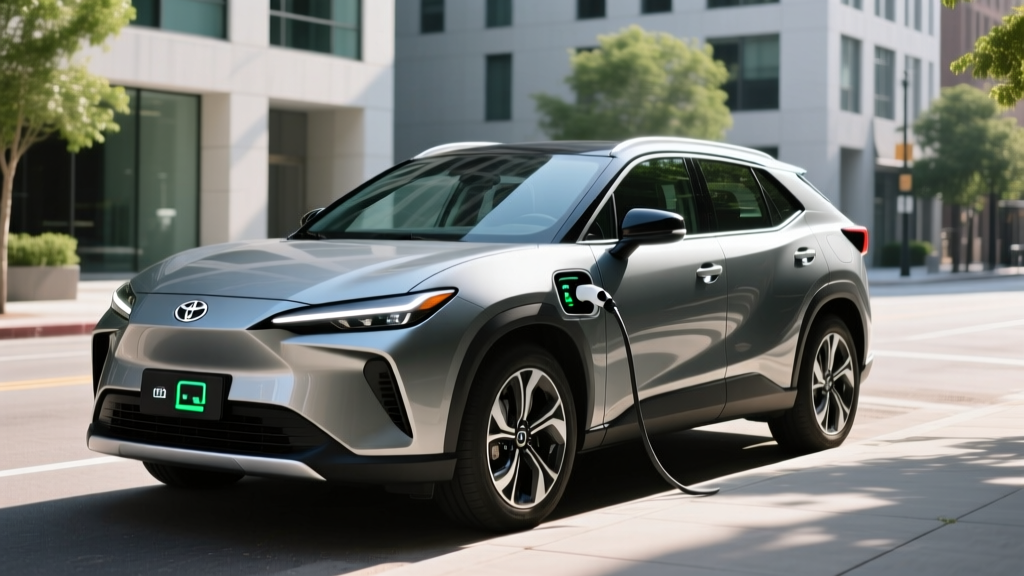
The 2023 Toyota bZ4X XLE AWD arrived as Toyota's first mass-market battery-electric vehicle, built on the e-TNGA platform co-developed with Subaru. For buyers eyeing a compact electric crossover from a legacy brand they trust, the bZ4X XLE AWD promises familiar Toyota ergonomics, standard all-wheel drive, and a competitive warranty. But with an EPA range that trails key rivals and a charging curve that demands patience above 80%, the real question is whether this EV's strengths outweigh its compromises in a crowded segment.
This review breaks down the 2023 bZ4X XLE AWD with exact numbers — EPA range, battery chemistry, DC fast-charge times, ownership costs, and federal tax credit eligibility under current IRS §30D rules. We'll also address what it's like to live with daily, including cold-weather range loss and highway efficiency.
2023 Toyota bZ4X XLE AWD: Core Specifications
| Specification | Value |
|---|---|
| EPA Range (AWD XLE) | 228 miles |
| Battery (Usable / Total) | ~65.6 kWh usable / 72.8 kWh total (NMC lithium-ion) |
| Drivetrain | Dual-motor AWD (80 kW front + 80 kW rear) |
| Horsepower / Torque | 214 hp / 248 lb-ft |
| 0–60 mph | 5.8 seconds |
| EPA Efficiency (Combined) | 101 MPGe / 33 kWh per 100 mi |
| Max DC Fast-Charge Rate | ~150 kW peak |
| Level 2 Home Charge Rate | 7.2 kW (onboard charger, ~26 mi/hr) |
| Cargo Volume (rear seats up / folded) | 27.7 / 56.9 cu ft |
| Rear Legroom | 35.3 inches |
| Battery Warranty | 8 years / 100,000 miles (70% capacity retention) |
| Base MSRP (XLE AWD, 2023) | $46,080 (incl. $1,335 destination) |
Real-World Range vs. EPA Estimate
Real-World Expectation: ~190–210 miles at sustained highway speeds (70–75 mph); ~160–180 miles in freezing temperatures with cabin heat. City driving with regenerative braking recovers closer to the EPA number, roughly 215–225 miles in mild conditions.
The 2023 bZ4X XLE AWD carries a 72.8 kWh battery pack (approximately 65.6 kWh usable) using NMC (nickel manganese cobalt) lithium-ion cells. Toyota's thermal management system is liquid-cooled, which helps preserve battery health but doesn't fully eliminate cold-weather range penalties.
In independent testing by outlets like fueleconomy.gov, the AWD variant with 18-inch wheels achieves 228 miles EPA. The Limited trim with 20-inch wheels drops to 222 miles. Front-wheel-drive versions push higher — up to 252 miles EPA — but if you need AWD for snow or inclement weather, 228 miles is your ceiling.
On a 300-mile highway road trip at 72 mph in 55°F weather, expect roughly one full charge plus a 20-minute DC top-up at the midpoint. In sub-30°F winter conditions, the battery's internal resistance increases and cabin heating draws significant energy, cutting practical range to around 160–180 miles. Plan charging stops accordingly.
Charging Speed: DC Fast, Level 2, and the 80% Taper
| Charging Level | Power / Rate | Time / Miles Added |
|---|---|---|
| Level 1 (120V household) | ~1.2 kW | ~4 miles per hour |
| Level 2 (240V, 32A home) | 7.2 kW | ~26 miles per hour; 0–100% in ~9.5 hours |
| DC Fast Charge (peak) | ~150 kW | 10–80% in approximately 30 minutes |
The bZ4X XLE AWD's peak DC fast-charge rate of roughly 150 kW is adequate but not class-leading. Competitors like the Hyundai Ioniq 5 and Kia EV6 (both on the E-GMP 800V architecture) can peak at 230–240 kW and complete a 10–80% charge in about 18 minutes. The bZ4X, by contrast, needs closer to 30 minutes for that same window.
A critical detail for road-trippers: the bZ4X charging curve tapers sharply above 80% State of Charge (SoC). While 10–80% takes roughly 30 minutes at a 150 kW station, pushing from 80–100% can add another 25–35 minutes. This is common across most EVs to protect battery longevity, but the bZ4X's taper is notably aggressive. For highway travel, plan your stops around the 10–80% window and skip topping off to full unless you have time to spare.
At home, the 7.2 kW onboard charger means a Level 2 wall unit (like a ChargePoint Home Flex or Tesla Universal Wall Connector) will replenish the battery at roughly 26 miles of range per hour. A full overnight charge from near-empty takes about 9.5 hours — perfectly manageable if you plug in each evening.
Performance, Ride, and Drivetrain
The dual-motor AWD system pairs an 80 kW (107 hp) front motor with an 80 kW (107 hp) rear motor for a combined 214 hp and 248 lb-ft of torque. The 0–60 mph sprint takes approximately 5.8 seconds, which is brisk for daily driving but trails the 3.5-second figure you'd get from a Tesla Model Y Long Range or the 5.0-second Ioniq 5 AWD.
The e-TNGA platform delivers a low center of gravity and composed ride quality. Steering is light and predictable — classic Toyota tuning that prioritizes comfort over sportiness. Regenerative braking is adjustable via paddle shifters behind the wheel, though it doesn't quite achieve true one-pedal driving. You'll still need the friction brakes for final stops, unlike the stronger regen found in Hyundai/Kia EVs or Teslas.
Ground clearance stands at 8.1 inches, which is generous for the segment and useful for light snow or gravel roads. Towing capacity is limited to 1,500 pounds — enough for a small utility trailer but not a camper.
Interior, Technology, and Driver Assistance
Inside, the bZ4X XLE features a 12.3-inch touchscreen running Toyota's Audio Multimedia system (developed with input from Subaru's Starlink architecture). Wireless Apple CarPlay and Android Auto are standard. A 7-inch digital instrument cluster sits above the steering wheel, positioned to mimic a head-up display without the cost.
Toyota Safety Sense 3.0 comes standard, bundling:
- Pre-Collision System with Pedestrian Detection
- Lane Departure Alert with Steering Assist
- Full-Speed Range Dynamic Radar Cruise Control
- Lane Tracing Assist (SAE Level 2 driver-assist — requires hands on wheel and active supervision)
- Road Sign Assist
- Proactive Driving Assist (gentle braking when approaching slower traffic or curves)
Important clarification: Toyota Safety Sense 3.0 is an SAE Level 2 system. It assists with steering and speed but requires continuous driver engagement. It is not autonomous or "self-driving." For comparison, GM's Super Cruise and Ford's BlueCruise also operate at Level 2 but offer hands-free operation on pre-mapped highways — a feature the bZ4X lacks.
Notable drawbacks include a yoke-style steering wheel option (standard round wheel on XLE) that drew mixed reviews, and rear visibility hampered by thick C-pillars. Rear-seat passengers get 35.3 inches of legroom — competitive with the RAV4 but less than the Ioniq 5's generous 39.4 inches.
Pricing, Tax Credits, and Ownership Economics
| Trim (2023) | MSRP (incl. destination) | Est. After §30D Credit* |
|---|---|---|
| XLE FWD | $44,080 | As low as $36,580 |
| XLE AWD | $46,080 | As low as $38,580 |
| Limited AWD | $50,480 | As low as $42,980 |
*Federal tax credit estimates assume full eligibility under IRS §30D. Actual credit depends on battery sourcing, buyer income, and MSRP caps. See eligibility checklist below.
The 2023 bZ4X XLE AWD started at $46,080 including destination. As a compact SUV, it falls under the $80,000 MSRP cap for SUVs/pickups/vans set by the Inflation Reduction Act. Buyers who meet income thresholds (modified AGI ≤ $150,000 single / $300,000 joint) may qualify for up to $7,500 under the §30D clean vehicle credit, depending on battery critical-mineral and component sourcing requirements that have tightened significantly since 2023.
As of the current tax year, the bZ4X's battery sourcing has been a moving target under IRS rules. Toyota has confirmed that certain model years and build dates qualify for partial or full credits, but buyers should verify eligibility using the fueleconomy.gov tax credit lookup and confirm with a tax professional before purchase. Beginning in 2024, the credit can be transferred to the dealer at point of sale as an upfront discount — a significant cash-flow advantage over waiting for a tax refund.
- Vehicle MSRP must not exceed $80,000 (SUVs/vans/pickups) — bZ4X qualifies ✓
- Buyer modified AGI: ≤ $150K single / $225K head of household / $300K joint
- Battery critical minerals: percentage must meet escalating annual thresholds (50%+ in 2024, increasing yearly)
- Battery components: percentage manufactured/assembled in North America must meet thresholds
- No battery components from a "foreign entity of concern" (FEOC) — phased in from 2024
- Credit can be applied at point of sale or claimed on tax return
Verify at IRS.gov before purchasing.
Warranty and Long-Term Battery Confidence
Toyota backs the bZ4X with a competitive warranty package:
- Basic Vehicle: 3 years / 36,000 miles
- Powertrain: 5 years / 60,000 miles
- Hybrid/EV Battery: 8 years / 100,000 miles (guaranteed to retain ≥ 70% of original capacity)
- Rust Perforation: 5 years / unlimited miles
- Roadside Assistance: 2 years / 25,000 miles
The 70% capacity retention threshold over 8 years is in line with industry norms (Hyundai/Kia offer 10 years/100,000 miles at the same threshold). Toyota's reputation for long-term reliability provides additional peace of mind, though the bZ4X is too new for long-term degradation data specific to this pack. Early owner reports and NHTSA filings have not flagged widespread battery issues.
How the bZ4X XLE AWD Compares to Key Rivals
At the $46,000 price point, the bZ4X XLE AWD competes directly with several strong alternatives. Here's how the numbers stack up:
| Vehicle | EPA Range | Peak DC Charge | 10–80% Time | 0–60 mph | AWD MSRP |
|---|---|---|---|---|---|
| 2023 Toyota bZ4X XLE AWD | 228 mi | ~150 kW | ~30 min | 5.8s | $46,080 |
| 2023 Hyundai Ioniq 5 SEL AWD | 266 mi | ~230 kW | ~18 min | 5.1s | $51,150 |
| 2023 Kia EV6 Wind AWD | 274 mi | ~233 kW | ~18 min | 5.1s | $52,400 |
| 2023 VW ID.4 AWD Pro | 275 mi | ~170 kW | ~28 min | 5.4s | $49,175 |
| 2023 Tesla Model Y LR AWD | 304 mi | ~250 kW | ~20 min | 4.8s | $52,990 |
The bZ4X trails rivals in range (40–75 fewer miles than competitors) and charging speed (10–12 minutes slower than the 800V Hyundai/Kia twins). Its advantages are a lower starting price than most AWD competitors, Toyota's dealer network and service infrastructure, and a familiar, non-intimidating driving experience for first-time EV buyers transitioning from a RAV4 or Highlander.
- Lower AWD starting price than Ioniq 5, EV6, and Model Y
- Standard Toyota Safety Sense 3.0 suite
- 8.1 inches of ground clearance for light off-pavement use
- Competitive 8-yr/100,000-mi battery warranty at 70% retention
- Comfortable ride quality; familiar Toyota interior ergonomics
- Eligible for §30D credit (subject to sourcing rules)
- EPA range of 228 mi trails rivals by 40–75 miles
- ~150 kW peak DC charge rate; 10–80% in ~30 min (slower than class leaders)
- Aggressive charge taper above 80% SoC
- No true one-pedal driving (regen is moderate)
- Rear visibility limited by thick C-pillars
- No hands-free highway driving assist (unlike BlueCruise/Super Cruise)
Who Should Buy the 2023 bZ4X XLE AWD?
Choose the bZ4X XLE AWD if:
- You're a current Toyota owner who values dealer familiarity and service convenience
- Your daily commute is under 80 miles round-trip and you charge at home nightly
- You need AWD for snow/rain but don't road-trip more than a few times per year
- You want a lower entry price than the Ioniq 5 or Model Y and can accept the range trade-off
Look elsewhere if:
- You regularly drive 200+ miles between charges (the Ioniq 5 or Model Y offers more buffer)
- Fast DC charging is critical to your lifestyle (the Hyundai/Kia 800V platform saves 10+ minutes per stop)
- You want hands-free highway driving assist (consider Ford with BlueCruise or GM with Super Cruise)
- Maximum cargo and rear-seat space are priorities (the Ioniq 5's flat floor and 39.4" rear legroom win here)
Frequently Asked Questions
What is the real-world range of the 2023 Toyota bZ4X XLE AWD?
The EPA rates the AWD XLE at 228 miles. In real-world highway driving at 70–75 mph in moderate temperatures, expect approximately 190–210 miles. In freezing conditions with cabin heat, that drops to roughly 160–180 miles. City driving with regenerative braking can return close to the EPA figure.
How fast does the bZ4X charge at home and on DC fast chargers?
At home on a Level 2 (240V) charger, the bZ4X accepts up to 7.2 kW, adding about 26 miles per hour — a full charge from near-empty in roughly 9.5 hours. On a DC fast charger, it peaks at approximately 150 kW, reaching 10–80% in about 30 minutes. Charging above 80% slows significantly due to an aggressive taper.
Does the 2023 bZ4X qualify for the $7,500 federal EV tax credit?
It can, but eligibility depends on several IRS §30D requirements: the buyer's modified AGI must not exceed $150,000 (single) or $300,000 (joint); the vehicle MSRP must be under $80,000 (the bZ4X qualifies); and the battery must meet critical-mineral and component-sourcing thresholds that change annually. Verify your specific eligibility on IRS.gov and at fueleconomy.gov before purchasing.
Is the bZ4X worth buying vs. the Hyundai Ioniq 5 or Tesla Model Y?
If you prioritize range and fast charging, the Ioniq 5 (266 mi EPA, 18-min 10–80%) and Model Y (304 mi, ~20-min) are objectively stronger EVs. However, the bZ4X undercuts both on price by several thousand dollars and offers a more traditional, approachable driving experience backed by Toyota's service network. For low-mileage commuters who charge at home, the bZ4X's trade-offs are manageable.
What battery chemistry does the bZ4X use?
The 2023 bZ4X uses NMC (nickel manganese cobalt) lithium-ion cells with a total capacity of 72.8 kWh (~65.6 kWh usable). NMC offers higher energy density than LFP (lithium iron phosphate) but typically has a shorter cycle life and different thermal characteristics. Toyota's 8-year/100,000-mile battery warranty at 70% capacity retention provides long-term assurance.
Can the bZ4X tow a trailer?
Yes, but capacity is limited to 1,500 pounds when properly equipped. This is sufficient for a small utility trailer or bike rack but not a travel trailer or boat. Most competitors in this segment offer similar or slightly higher ratings (the Model Y can tow up to 3,500 pounds).
Does the bZ4X have one-pedal driving?
Not fully. The bZ4X offers adjustable regenerative braking via steering-wheel paddles, but the regen isn't strong enough to bring the vehicle to a complete stop without using the friction brake. Drivers transitioning from Teslas or the Ioniq 5's i-Pedal mode will notice the difference.