Quick Verdict: The 2023 Model Y at Today's Used Prices
The 2023 Tesla Model Y remains one of the most practical electric SUVs on the used market in 2026. With EPA-rated range up to 330 miles, access to the largest fast-charging network in North America, and a starting used price that has settled significantly since its MSRP days, it's a compelling buy for families and commuters alike. But the 2023 model year carries specific quirks — including a transition in battery chemistry and interior build refinements — that buyers need to understand before signing paperwork.
This review breaks down the exact specs, real-world range data, charging behavior, and total cost of ownership for the 2023 Model Y, so you can decide if it's the right EV for your driveway.
| Spec | Long Range AWD | Performance AWD | RWD (Standard Range) |
|---|---|---|---|
| EPA Range | 330 mi | 303 mi | 260 mi |
| Battery (usable, est.) | ~75 kWh (NMC) | ~75 kWh (NMC) | ~60 kWh (LFP) |
| Drivetrain | Dual-Motor AWD | Dual-Motor AWD | Rear-Wheel Drive |
| Horsepower | ~384 hp | ~456 hp | ~295 hp |
| 0–60 mph | 4.8 sec | 3.5 sec | 6.6 sec |
| MPGe (combined) | 117 MPGe | 111 MPGe | 123 MPGe |
| Efficiency (kWh/100 mi) | 29 | 30 | 27 |
| Peak DC Charge Rate | 250 kW | 250 kW | 170 kW |
| 10–80% DC Charge | ~27 min | ~27 min | ~32 min |
| Level 2 Charge Rate | 11.5 kW (~44 mi/hr) | 11.5 kW (~44 mi/hr) | 11.5 kW (~44 mi/hr) |
| Original MSRP (2023) | $52,990 | $54,990 | $47,740 |
Range & Real-World Efficiency
Long Range AWD: EPA 330 miles. Expect ~275–295 miles on mixed highway driving at 70–75 mph. In freezing temperatures (below 32°F), plan for 220–250 miles of usable range before needing to charge.
Performance AWD: EPA 303 miles. Real-world highway: ~250–270 miles. Cold weather: ~200–225 miles.
RWD (Standard Range): EPA 260 miles. Real-world highway: ~215–235 miles. Cold weather: ~175–200 miles.
The 2023 Model Y Long Range's 117 MPGe combined rating, per fueleconomy.gov, translates to roughly 29 kWh per 100 miles — among the most efficient vehicles in its class. Tesla's thermal management system, which includes a heat pump as standard equipment on all 2023 trims, significantly reduces cabin-heating energy draw in cold weather compared to older resistive-heater EVs.
However, the heat pump does not eliminate cold-weather range loss entirely. Battery chemistry matters here: the RWD trim uses a lithium iron phosphate (LFP) cell, which tolerates 100% daily charging but suffers slightly more range loss in extreme cold than the nickel-manganese-cobalt (NMC) packs in the Long Range and Performance trims. If you live in the upper Midwest or Northeast and commute more than 60 miles daily in winter, the Long Range AWD is the safer bet.
Charging Speed & Network Access
| Charging Level | Power / Rate | Miles Added | Typical Use Case |
|---|---|---|---|
| Level 1 (120V household) | ~1.4 kW | ~3–4 mi/hr | Overnight trickle; emergency only |
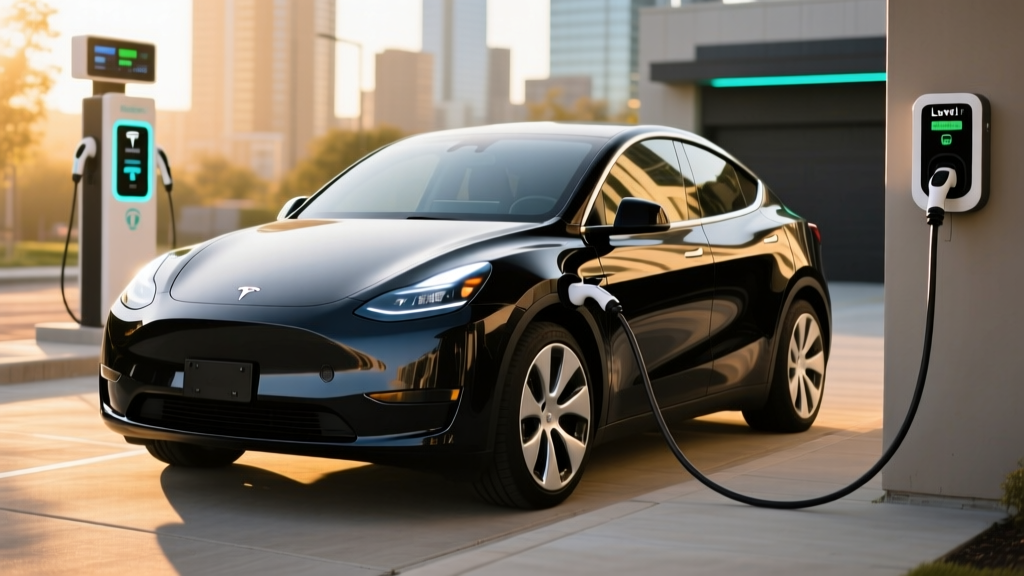
| Level 2 (240V home/public) | Up to 11.5 kW | ~44 mi/hr | Daily home charging; full charge in ~7–8 hrs |
| DC Fast Charge (V3 Supercharger) | Peak 250 kW (LR/Perf) Peak 170 kW (RWD) | ~162 mi in 15 min (LR) | Road trips; 10–80% in ~27–32 min |
The 2023 Model Y charges at a peak rate of 250 kW on Tesla's V3 Superchargers (Long Range and Performance trims). But peak rate is not sustained rate. The charging curve tapers significantly above 50% state of charge (SoC): you'll pull close to 250 kW between 10–30% SoC, then the rate steps down to ~150 kW around 50%, and further to ~75 kW by 70%. This is why Tesla quotes 10–80% times rather than 0–100%.
For home Level 2 charging, you'll need a 48-amp hardwired wall connector on a 60-amp circuit to achieve the full 11.5 kW rate. On a standard 40-amp NEMA 14-50 outlet, expect ~9.6 kW (~37 mi/hr). A full overnight charge from 20% to 80% takes roughly 5 hours at 11.5 kW — more than enough for any daily commute.
Supercharger network advantage: The 2023 Model Y ships with the proprietary Tesla connector (now called NACS). Tesla opened its Supercharger network to non-Tesla EVs starting in 2024, but Model Y owners still benefit from the most seamless plug-and-charge experience, with no adapter needed and automatic billing. As of early 2026, Tesla operates over 6,500 Superchargers across the U.S.
Performance & Driving Dynamics
The 2023 Model Y Performance trim delivers 456 hp and a 3.5-second 0–60 mph time — sports-car territory in an SUV body. The Long Range AWD, at 384 hp and 4.8 seconds, is still briskly quick and offers the better range tradeoff. The RWD model, at 6.6 seconds, is adequate for commuting but feels noticeably less urgent during highway merges.
All 2023 Model Y trims feature regenerative braking with a one-pedal driving mode that is non-adjustable (unlike competitors that let you dial regen strength). The low center of gravity from the under-floor battery pack keeps body roll minimal through corners, though the ride quality on 20-inch wheels (standard on Performance, optional on Long Range) is firm over rough pavement. The 19-inch Gemini wheels on the Long Range offer a noticeably more compliant ride and slightly better range due to lower rolling resistance.
Towing: When properly equipped, the 2023 Model Y Long Range and Performance can tow up to 3,500 lbs. Towing cuts range by roughly 30–40%, so a 330-mile Long Range drops to approximately 200–220 miles with a loaded trailer.
Interior, Cargo & Technology
The 2023 Model Y cabin is minimalist by design — a 15-inch center touchscreen handles all infotainment, climate, and vehicle settings. There is no instrument cluster behind the steering wheel; speed and navigation appear in the upper-left corner of the main screen. This layout polarizes buyers: some find it clean and distraction-free, others miss dedicated physical controls for volume and climate.
Cargo space: With the second row upright, the Model Y offers 30.2 cubic feet behind the rear seats. Fold the 60/40 split rear bench, and you get 72.1 cubic feet — competitive with midsize gas SUVs. The front trunk (frunk) adds 4.1 cubic feet for charging cables or a small bag.
Passenger space: Front legroom is 41.8 inches; rear legroom is 41.6 inches. Headroom is generous in front (41.0 in.) but tighter in the rear (37.7 in.) due to the sloping roofline — taller passengers may notice this on longer trips.
Driver assistance: All 2023 Model Y vehicles ship with Basic Autopilot (Traffic-Aware Cruise Control and Autosteer). Full Self-Driving (FSD) Capability was a $15,000 add-on at the time (now reduced and offered as a subscription). FSD Supervised is a SAE Level 2 system — it requires continuous driver supervision and does not make the vehicle autonomous. It handles highway lane changes, on-ramp-to-off-ramp navigation, and some city-street driving, but disengagements and interventions are still regularly needed.
Tesla's Full Self-Driving (Supervised) is a Level 2 driver-assistance system per SAE International. The driver must keep hands on the wheel and eyes on the road at all times. It is not a Level 4 autonomous system like Waymo's driverless robotaxi. Never rely on FSD in construction zones, unmapped areas, or adverse weather without heightened vigilance.
Pricing, Tax Credits & Ownership Costs
The 2023 Model Y is no longer sold new, so pricing depends entirely on the used market. As of early 2026, well-maintained 2023 Model Y Long Range examples with 25,000–40,000 miles typically list between $29,000 and $35,000, depending on condition, mileage, and region. Performance trims command a $2,000–$4,000 premium. The RWD Standard Range, which had limited availability, tends to land in the $26,000–$30,000 range.
| Trim | Typical Used Price (2026) | Used EV Tax Credit (§25E) | Effective Price |
|---|---|---|---|
| RWD Standard Range | $26,000–$30,000 | Up to $4,000 (30% of sale price, capped) | ~$22,000–$26,000 |
| Long Range AWD | $29,000–$35,000 | Up to $4,000 | ~$25,000–$31,000 |
| Performance AWD | $31,000–$39,000 | Up to $4,000 | ~$27,000–$35,000 |
Federal tax credit — used EV rules (§25E): Because the 2023 Model Y is purchased as a used vehicle in 2026, it qualifies for the Previously-Owned Clean Vehicle Credit under IRS §25E — not the new-vehicle §30D credit. The §25E credit equals 30% of the sale price, up to a maximum of $4,000. Eligibility requirements, per IRS.gov, include:
- Sale price must be $25,000 or less to receive the full $4,000 (30% × $25,000 = $7,500, but the cap is $4,000; vehicles priced above ~$13,334 will hit the $4,000 cap)
- Buyer income limits: $75,000 single / $112,500 head of household / $150,000 joint (modified AGI)
- Vehicle must be at least 2 model years old (2023 qualifies in 2026)
- Vehicle battery capacity must be at least 7 kWh (all Model Y trims qualify)
- Must purchase from a licensed dealer (private-party sales do not qualify)
- Credit is non-refundable and can only be claimed once per vehicle (check the VIN's credit history)
Important caveat: Not every used 2023 Model Y will be priced at or below $25,000 in 2026. Long Range and Performance examples above $25,000 will receive less than the maximum $4,000 — or potentially no credit if the price is too high. Always confirm the dealer's reported sale price and consult a tax professional before relying on this credit.
Warranty & Battery Longevity
Tesla's warranty on the 2023 Model Y includes:
- Basic Vehicle Limited Warranty: 4 years / 50,000 miles (whichever comes first)
- Battery & Drive Unit Warranty: 8 years / 120,000 miles for Long Range and Performance (AWD); 8 years / 100,000 miles for RWD
- Battery capacity retention: Tesla warrants that the battery will retain at least 70% of its original capacity during the warranty period
For a 2023 Model Y purchased used in 2026, most examples will have 25,000–50,000 miles on the odometer, meaning the battery and drive unit warranty has approximately 4–5 years and 70,000–95,000 miles of coverage remaining. This is a significant advantage over buying a 2020 or 2021 model, where warranty runway is shorter.
Real-world degradation data from fleet aggregators and Tesla owner surveys suggests the NMC packs in the Long Range and Performance trims lose roughly 5–8% capacity in the first 50,000 miles, then the degradation curve flattens considerably. LFP packs (RWD) show even slower degradation but may lose more range in cold weather due to the chemistry's lower energy density. Battery replacement outside warranty, should it ever be needed, is estimated at $12,000–$16,000 including labor — but full replacements remain rare for vehicles under 100,000 miles.
2023 Tesla Model Y: Pros & Cons
- Class-leading efficiency (27–30 kWh/100 mi) and strong real-world range
- Access to Tesla Supercharger network — most reliable DC fast-charging in the U.S.
- Spacious cargo area (72.1 cu ft max) with practical frunk
- Standard heat pump for better cold-weather efficiency
- Over-the-air software updates continue adding features years after purchase
- Strong used-EV tax credit potential under §25E
- No physical controls for climate/volume — everything on the touchscreen
- Firm ride on 20-inch wheels; road noise noticeable at highway speeds
- FSD (Level 2) still requires full driver attention; not a hands-off system
- Rear headroom is tight for passengers over 6'2"
- Used §25E credit has strict income and price caps — not all buyers qualify
- Insurance premiums run 15–25% higher than comparable gas SUVs
Who Should Buy the 2023 Model Y in 2026?
Choose the 2023 Model Y Long Range AWD if: You need 275+ real-world miles of range for highway commutes or regular road trips, want dual-motor AWD for snow-belt winters, and value the Supercharger network for cross-country travel.
Choose the 2023 Model Y Performance if: Acceleration and handling are top priorities, you'll mostly drive in fair weather, and you're willing to trade ~30 miles of range and ride comfort for 3.5-second sprints.
Choose the 2023 Model Y RWD if: Your daily commute is under 80 miles round-trip, you live in a mild climate, you want the lowest purchase price, and you plan to charge to 100% daily (LFP batteries tolerate this better than NMC).
Look elsewhere if: You need a third row (consider the Rivian R1S or Kia EV9), you want physical dashboard controls, or you frequently tow more than 3,500 lbs.
Compared to the 2023 Hyundai Ioniq 5 (EPA 303 mi, 235 kW peak charge) and the 2023 Ford Mustang Mach-E (EPA 312 mi extended range), the Model Y still edges out both on combined cargo volume and Supercharger network convenience. The Ioniq 5 charges faster on non-Tesla networks thanks to its 800V architecture, and the Mach-E offers a more traditional interior layout. But for total ecosystem integration and range-per-dollar on the used market, the 2023 Model Y remains hard to beat.
Frequently Asked Questions
What is the real-world range of the 2023 Tesla Model Y?
The Long Range AWD achieves approximately 275–295 miles in real-world mixed driving at highway speeds. In freezing weather, expect 220–250 miles. The Performance trim delivers roughly 250–270 miles real-world, and the RWD about 215–235 miles.
How fast does the 2023 Model Y charge at home and on the road?
At home on a Level 2 (240V, 48A) charger, the Model Y adds about 44 miles of range per hour at 11.5 kW, reaching a full charge overnight in 7–8 hours. On a Tesla V3 Supercharger, the Long Range and Performance peak at 250 kW, charging from 10–80% in roughly 27 minutes. The RWD peaks at 170 kW with a 10–80% time of about 32 minutes.
Does a used 2023 Model Y qualify for a federal tax credit in 2026?
Yes, but under the used-vehicle credit (§25E), not the new-vehicle credit (§30D). The credit is 30% of the sale price up to $4,000, subject to buyer income limits ($75K single / $150K joint) and a $25,000 maximum sale price for the full benefit. You must buy from a licensed dealer, and the credit can only be claimed once per VIN. Consult a tax professional and verify eligibility at IRS.gov.
Is the 2023 Model Y worth buying vs. newer competitors?
At 2026 used prices of $26,000–$39,000, the 2023 Model Y offers excellent range-per-dollar and Supercharger access. Newer competitors like the 2025 Hyundai Ioniq 5 and Kia EV6 offer 800V fast-charging and more conventional interiors, but typically cost more on the used market. If Supercharger convenience and cargo space are priorities, the 2023 Model Y holds up well.
What is the biggest drawback of the 2023 Model Y?
The touchscreen-only interface is the most common complaint — adjusting climate, mirrors, or glovebox requires navigating menus rather than turning a knob. Road noise on 20-inch wheels and the sloping rear roofline (tight headroom for tall passengers) are also notable compromises. Insurance costs tend to be higher than average for the segment.
How long will the 2023 Model Y battery last?
Tesla warrants the battery for 8 years / 120,000 miles (Long Range/Performance) or 8 years / 100,000 miles (RWD), guaranteeing at least 70% capacity retention. Real-world data from high-mileage Tesla fleets suggests NMC packs retain 85–92% capacity at 100,000 miles. With proper care (avoiding frequent 100% charges on NMC, using scheduled departure preconditioning), most owners should see well over 150,000 miles before any significant range loss.