Quick Verdict: Still the Benchmark for Electric SUV Performance
Three years after its launch, the 2023 Tesla Model Y Performance remains the default choice for buyers who want sports-car acceleration in a practical electric crossover. With a 3.5-second 0-60 mph time, 303 miles of EPA-estimated range, and access to Tesla's 60,000-plus Supercharger network, it sets a bar that competitors like the Ford Mustang Mach-E GT and Hyundai Ioniq 5 N are still chasing. But the 2023 model year also brought meaningful changes — including a redesigned interior, a 75 kWh (usable) LFP-free battery pack, and revised pricing — that shift the ownership calculus. Here's exactly what you get, what it costs, and where the real-world experience diverges from the spec sheet.
Range & Efficiency: EPA vs. the Real World
| Metric | Value |
|---|---|
| EPA Estimated Range | 303 miles |
| Battery Capacity (Usable) | ~75 kWh (NMC) |
| Combined MPGe | 111 MPGe |
| Energy Consumption | 30 kWh / 100 mi |
| Drivetrain | Dual-Motor AWD |
Efficiency is where the Model Y Performance punches above its weight class. At 30 kWh per 100 miles, it's slightly thirstier than the Long Range variant (28 kWh/100mi) but far more efficient than the Mach-E GT (37 kWh/100mi). That efficiency translates directly to lower charging costs and more miles per minute at a DC fast charger.
Charging Speed: Supercharger Dominance and Home Setup
| Charging Level | Max Power | Speed / Time |
|---|---|---|
| Level 1 (120V) | 1.4 kW | ~3-4 miles per hour |
| Level 2 (240V, 48A) | 11.5 kW | ~37 miles per hour |
| DC Fast Charge (V3 Supercharger) | 250 kW peak | 10-80% in ~20 minutes |
| DC Fast Charge (V4 Supercharger) | 250 kW peak | 10-80% in ~18 minutes |
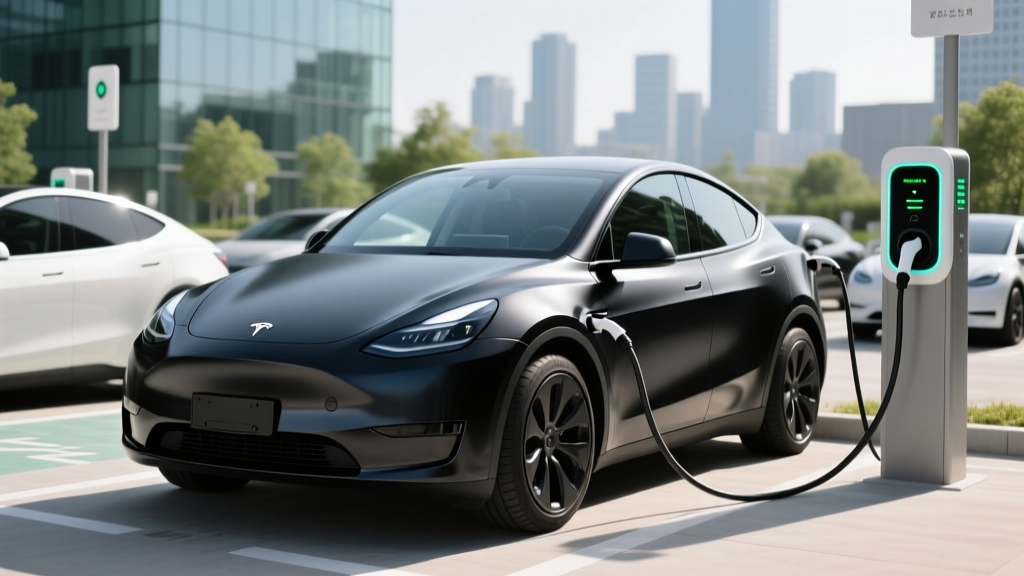
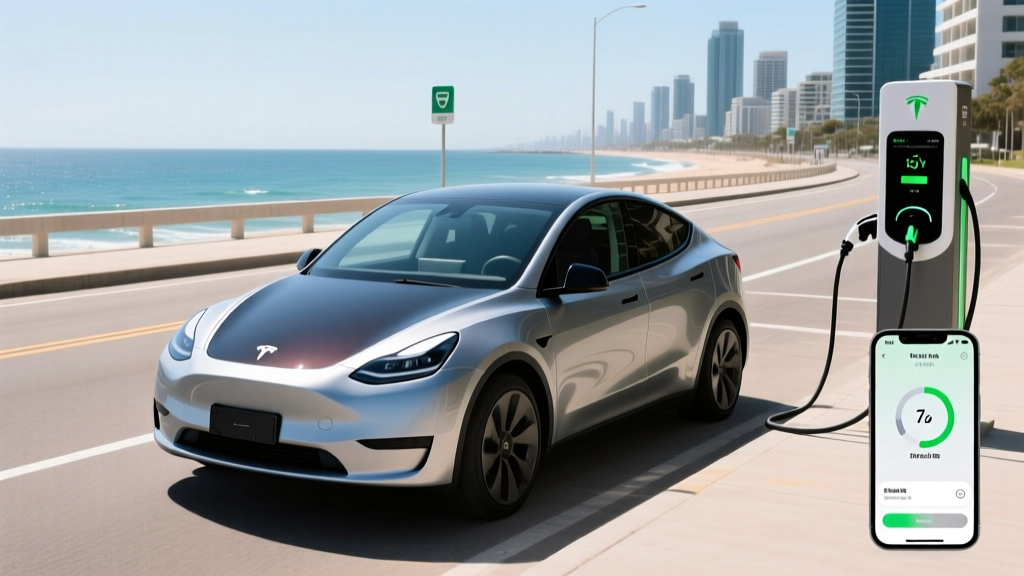
The 2023 Model Y Performance supports up to 250 kW on DC fast charging, but — as with all EVs — peak power is not sustained power. The charge curve is aggressive: you'll see 250 kW briefly between 10-20% SoC, tapering to roughly 150 kW by 50% and dropping below 75 kW past 80%. This is why the 10-80% metric matters more than peak kW. On a V3 Supercharger, 10-80% takes approximately 20 minutes; on the newer V4 stations with improved thermal management, that drops to roughly 18 minutes under optimal battery preconditioning.
Preconditioning is essential. If you navigate to a Supercharger using the car's built-in navigation, the battery thermal management system begins heating or cooling the pack ahead of arrival. Skip this step (e.g., by navigating with a third-party app or arriving at a cold charger without preconditioning) and your first 5-10 minutes of charging will be significantly slower.
For home charging, the onboard charger accepts up to 11.5 kW (48 amps) on a 240V Level 2 circuit. A full charge from 10% to 100% takes roughly 7-8 hours on a Tesla Wall Connector or any J1772 adapter-equipped Level 2 station. Most owners installing a home charger should budget for a 60-amp dedicated circuit; a panel upgrade to 200A may be required in older homes, adding $1,500-$3,000 to installation costs.
Performance: Supercar Numbers, Daily-Driver Practicality
| Performance Metric | Value |
|---|---|
| 0-60 mph | 3.5 seconds |
| Horsepower | 456 hp (combined) |
| Torque | 497 lb-ft |
| Top Speed | 155 mph |
| Quarter Mile | 11.9 seconds @ 115 mph |
The dual-motor all-wheel-drive powertrain delivers 456 horsepower and 497 lb-ft of torque, launching the 4,398-pound crossover to 60 mph in 3.5 seconds. That puts it in the territory of a Porsche Cayenne S or BMW X5 M Competition — vehicles costing two to three times as much. The instant torque delivery and low center of gravity (battery pack mounted under the floor) give the Model Y Performance a planted, responsive feel that belies its crossover proportions.
Track Mode, accessible via the touchscreen, allows adjustable front/rear torque distribution and regenerative braking intensity. It's a genuinely useful feature for track-day enthusiasts, not just a marketing gimmick. However, repeated hard launches will trigger thermal management interventions, temporarily limiting power to protect the battery and motors — a reality of any high-output EV.
Interior, Cargo & Technology
The 2023 model year brought a refreshed interior with ventilated front seats, ambient lighting, a rear-seat touchscreen, and an updated "light" headliner. The minimalist cabin remains polarizing: no physical buttons, no instrument cluster, and all climate/media/navigation controls funneled through the 15-inch center touchscreen. The steering-wheel-mounted turn signals (introduced in 2025 on newer models) are not present on the 2023 — you get a conventional stalk.
| Dimension | Measurement |
|---|---|
| Cargo (rear seats up) | 30.2 cu ft |
| Cargo (rear seats folded) | 72.0 cu ft |
| Frunk (front trunk) | 4.1 cu ft |
| Rear Legroom | 38.4 inches |
| Front Headroom | 41.0 inches |
| Seating Capacity | 5 (7-seat option available) |
The optional third-row seat ($3,000 when available) is best suited for children — adults will find it cramped. With five passengers, the 30.2 cu ft rear cargo area is competitive with a Honda CR-V but trails the Hyundai Ioniq 5 (35.7 cu ft). Fold the rear seats and the 72 cu ft of flat-load space is genuinely van-like.
Standout tech: Tesla's infotainment system remains the class leader for responsiveness, over-the-air update frequency, and integrated trip planning with charging stops. The 17-speaker audio system delivers impressive clarity. Wireless phone charging, USB-C ports (front and rear), and a HEPA air filtration system (Bioweapon Defense Mode) are all standard.
Notable drawbacks: No Apple CarPlay or Android Auto — Tesla's proprietary system is the only option. Panel gap quality, while improved from 2020-2021 production, still draws complaints from some owners. The absence of a traditional instrument cluster forces drivers to glance at the center screen for speed, which remains a point of contention and a potential distraction.
Autopilot & Driver Assistance
The 2023 Model Y Performance comes standard with Basic Autopilot: adaptive cruise control and lane-centering on highways. Enhanced Autopilot ($6,000) adds automatic lane changes, Navigate on Autopilot (off-ramp suggestions), and Summon. Full Self-Driving (Supervised) at $8,000 (or $99/month subscription as of 2025) adds traffic light and stop sign recognition, and the much-debated "city streets" capability.
In real-world use, Autopilot excels on well-marked highways but can struggle in construction zones, faded lane markings, and complex intersections. FSD Supervised has improved dramatically through 2024-2025 software updates, but it still requires vigilant supervision and occasional intervention. It is a convenience feature, not a replacement for an attentive driver. According to NHTSA, Tesla vehicles operating on Autopilot have been involved in a documented number of incidents, underscoring the supervision requirement.
Pricing, Tax Credits & Ownership Costs
| Item | Amount |
|---|---|
| 2023 Model Y Performance Base MSRP | ~$52,490 (at time of sale) |
| Federal §30D Tax Credit (if eligible) | Up to $7,500 |
| Estimated Price After Credit | ~$44,990 |
| Current Used Market (2026) | $32,000 - $42,000 |
The 2023 Model Y Performance originally started at approximately $52,490 before destination fees. Buyers who took delivery in 2023 and met all IRS requirements could claim the full $7,500 federal tax credit under IRS §30D.
- MSRP Cap: SUVs/vans/pickups must have MSRP under $80,000 — Model Y Performance qualifies.
- Buyer Income Cap: AGI must not exceed $300,000 (joint), $225,000 (head of household), or $150,000 (single).
- Battery Sourcing: Critical minerals and battery components must meet phased percentage thresholds from US/free-trade-agreement countries. The 2023 Model Y's US-built battery pack generally met the $3,750 critical minerals threshold and the $3,750 components threshold for a total of $7,500.
- Point-of-Sale Transfer: Beginning January 1, 2024, the credit can be transferred to the dealer at purchase. For 2023 deliveries, it was claimed on the buyer's tax return.
Used buyers in 2026: If you're purchasing a used 2023 Model Y Performance today, you may qualify for the Used Clean Vehicle Credit of up to $4,000 (30% of sale price, capped at $4,000) under §25E, provided the sale price is under $25,000, your income falls below $75,000 (single) / $150,000 (joint), and you purchase from a licensed dealer. Verify current rules with a tax professional and the IRS §25E page.
| 5-Year Ownership Cost | Model Y Performance | BMW X3 M40i (ICE Comp) |
|---|---|---|
| Purchase Price (after credit) | ~$44,990 | ~$56,000 |
| Fuel / Electricity | ~$3,200 | ~$9,500 |
| Maintenance | ~$1,800 | ~$4,200 |
| Insurance (avg) | ~$9,500 | ~$7,800 |
| Depreciation (est.) | ~$18,000 | ~$22,000 |
| Total 5-Year Cost | ~$77,490 | ~$99,500 |
Electricity costs assume $0.14/kWh national average and 12,000 miles/year. Insurance for the Model Y Performance tends to run 15-25% higher than comparable ICE crossovers due to repair costs and parts pricing — get quotes before committing.
Warranty & Battery Longevity
| Coverage | Terms |
|---|---|
| Basic Vehicle Warranty | 4 years / 50,000 miles |
| Battery & Drive Unit Warranty | 8 years / 120,000 miles |
| Battery Capacity Retention | Minimum 70% over warranty period |
Tesla's 8-year/120,000-mile battery and drive unit warranty guarantees that the pack will retain at least 70% of its original capacity during the coverage period. If degradation exceeds 30%, Tesla will repair or replace the battery at no cost. Real-world data from Tesla's fleet shows that NMC packs in Model Y vehicles typically lose 5-8% capacity over the first 100,000 miles, with degradation slowing significantly after the initial break-in period.
The NMC chemistry in the 2023 Performance variant trades some cycle-life longevity for higher energy density compared to LFP. To maximize lifespan: avoid prolonged storage at 100% SoC, minimize repeated DC fast charging to 100%, and use scheduled charging to finish at 80-90% for daily use. According to fueleconomy.gov, the Model Y Performance carries a 111 MPGe combined rating, reflecting its efficiency relative to other performance SUVs.
Competitor Comparison: Is It Still Worth It?
| Spec | 2023 Model Y Performance | Ford Mach-E GT | Hyundai Ioniq 5 N |
|---|---|---|---|
| EPA Range | 303 mi | 263 mi | 221 mi |
| 0-60 mph | 3.5 sec | 3.5 sec | 3.4 sec |
| Battery (usable) | 75 kWh | 88 kWh | 84 kWh |
| Peak DC Charge | 250 kW | 150 kW | 238 kW |
| 10-80% Time | ~20 min | ~38 min | ~18 min |
| Cargo (rear up) | 30.2 cu ft | 29.7 cu ft | 27.2 cu ft |
| Base MSRP (new) | ~$52,490 | ~$59,995 | ~$66,100 |
Choose the Ioniq 5 N if: You want a track-focused driving experience, don't mind lower range, and value Hyundai's 10-year/100,000-mile powertrain warranty.
Choose the Mach-E GT if: You prefer Ford's dealer network, want BlueCruise hands-free highway driving, and don't mind slower DC charging speeds.
Pros & Cons
- 303-mile EPA range — best in the performance EV SUV class
- 250 kW DC fast charging with ~20-minute 10-80% time
- 3.5-second 0-60 mph with daily-driver comfort
- Tesla Supercharger network — 60,000+ stalls, highest reliability
- Over-the-air updates continuously add features
- Class-leading efficiency (30 kWh/100mi)
- Spacious cargo area with optional 7-seat configuration
- No Apple CarPlay or Android Auto
- Insurance premiums 15-25% above ICE equivalents
- Minimalist interior not for everyone — no physical controls
- Panel gap quality inconsistent across production batches
- FSD (Supervised) remains Level 2 — requires constant attention
- Regenerative braking not adjustable (no traditional "low" mode)
- Ride quality firm on 21-inch Überturbine wheels
Who Is the 2023 Model Y Performance For?
Daily commuters and road trippers: With 303 miles of range and Supercharger access spanning all 50 states, the Model Y Performance is one of the most capable long-distance EVs available. A Los Angeles-to-Las Vegas trip requires no charging stop; Denver-to-Aspen requires one brief 15-minute stop.
Families needing space and speed: The optional third row, flat-load cargo floor, and frunk make it genuinely practical for family duty, while the 3.5-second acceleration ensures merging onto freeways is effortless.
Performance enthusiasts who need practicality: If you've cross-shopped a Porsche Macan GTS or BMW X3 M but want zero tailpipe emissions and $3,200 annual "fuel" costs instead of $9,500 in premium gas, the math is compelling.
Not ideal for: Buyers who want Apple CarPlay, physical buttons, or a traditional luxury interior experience. Also consider that the Performance trim's 21-inch wheels and sport-tuned suspension produce a firmer ride than the Long Range variant — test-drive both before committing.
Frequently Asked Questions
What is the real-world range of the 2023 Model Y Performance?
The EPA rates it at 303 miles, but real-world highway driving at 70-75 mph yields approximately 250-270 miles. In cold weather below 30°F, expect 210-230 miles on the highway. City driving with regenerative braking can approach or exceed the EPA estimate.
How fast does the 2023 Model Y Performance charge?
On a V3 or V4 Tesla Supercharger, it peaks at 250 kW and charges from 10-80% in approximately 18-20 minutes with battery preconditioning. On a home Level 2 charger (11.5 kW), a full charge takes about 7-8 hours.
Does the 2023 Model Y Performance qualify for the federal EV tax credit?
For 2023 deliveries, the Model Y Performance generally qualified for the full $7,500 under §30D, provided the buyer met income caps ($150K single / $300K joint) and the MSRP was under $80,000 (it was). Used buyers in 2026 may qualify for the $4,000 used-EV credit under §25E if the sale price is under $25,000. Always verify with a tax professional and IRS guidelines.
Is the 2023 Model Y Performance worth buying over competitors?
For most buyers prioritizing range, charging speed, practicality, and total cost of ownership, yes — it remains the segment benchmark. If you prioritize track-day driving dynamics, the Ioniq 5 N is more engaging. If you want hands-free highway driving through a traditional automaker, the Mach-E GT with BlueCruise is an alternative, though with notably slower charging.
What battery chemistry does the 2023 Model Y Performance use?
The Performance variant uses NMC (nickel manganese cobalt) chemistry, which offers higher energy density than LFP but requires more careful state-of-charge management for long-term longevity. Tesla recommends daily charging limits of 80-90% for NMC packs.
Is Tesla's Autopilot self-driving?
No. Autopilot and FSD (Supervised) are SAE Level 2 driver-assistance systems. The driver must remain fully engaged, with hands on the wheel and eyes on the road, at all times. Only Level 4 robotaxi services like Waymo operate without a human driver — and those are available only in limited geofenced areas.
How much does it cost to charge a Model Y Performance at home?
At the national average of $0.14/kWh, a full 75 kWh charge costs approximately $10.50, providing roughly 250 real-world miles. That works out to about $0.042 per mile — compared to $0.13-$0.16 per mile for a comparable gasoline performance SUV at $3.50/gallon.