2023 Tesla Model Y Performance AWD: The Enthusiast's EV Crossover
The 2023 Tesla Model Y Performance All-Wheel Drive remains one of the most compelling electric crossovers on the used and certified-pre-owned market heading into 2026. It pairs a 3.5-second 0-60 mph time with practical cargo space and access to the Supercharger network — a combination that still holds up against newer rivals. For owners and buyers researching this specific model year, there's also a growing aftermarket scene, including popular upgrades like the 2023 Tesla Model Y Performance all-wheel drive tail light kit, which we'll cover alongside the hard numbers on range, charging, and ownership costs.
Before diving into specs, a critical note: the 2023 Model Y is no longer sold new. Tesla refreshed the Model Y for 2025 (the "Juniper" update), so this review focuses on what you'll find on the pre-owned market and what it means for your wallet today.
| Spec | 2023 Model Y Performance AWD |
|---|---|
| EPA Range | 303 miles |
| Battery Capacity | ~75 kWh usable (NMC) |
| Drivetrain | Dual-Motor AWD |
| Horsepower | 456 hp (combined) |
| 0-60 mph | 3.5 seconds |
| Top Speed | 155 mph |
| Max DC Fast Charge | 250 kW (peak) |
| 10-80% DC Fast Charge | ~15 minutes (peak conditions) |
| Level 2 Home Charge | 11.5 kW (~44 mi/hr) |
| MPGe (combined) | 122 MPGe |
| Efficiency | 28 kWh/100 mi |
| Cargo Volume | 30.2 cu ft (rear seats up) / 72.1 cu ft (folded) |
| Original Base MSRP | $53,990 (before incentives) |
| Battery Warranty | 8 years / 120,000 miles (70% min retention) |
Real-World Range vs. the EPA Sticker
EPA Estimated Range: 303 miles
Real-World Expectation: 250-270 miles at sustained highway speeds (70-80 mph); 220-240 miles in freezing temperatures with cabin heat.
The EPA rates the 2023 Model Y Performance at 303 miles on its combined cycle. In practice, Tesla's battery management and heat pump system deliver strong city and moderate-temperature results — many owners report 290-300 miles in mixed suburban driving at 45-65 mph.
However, the Performance trim's larger 21-inch Überturbine wheels (standard on this variant) carry a range penalty compared to the Long Range's 19- or 20-inch options. At highway speeds above 75 mph, expect consumption to climb to 32-35 kWh/100 mi, which translates to roughly 215-240 miles of practical range between charges on a road trip. In sub-30°F weather, lithium-ion chemistry resistance and cabin heating demands can reduce range by 20-30%, bringing realistic winter highway range to around 200-220 miles.
The 2023 Model Y uses an NMC (nickel manganese cobalt) battery pack with approximately 75 kWh of usable capacity. Unlike LFP (lithium iron phosphate) packs found in some Standard Range models, NMC offers higher energy density but Tesla recommends daily charging to 80-90% rather than 100% for long-term health — reserving full charges for road trips.
Charging Speed: DC Fast and Home Level 2
Charging performance is where the 2023 Model Y Performance still holds its ground against newer competitors.
| Charging Level | Power | Speed (Miles Added) | Notes |
|---|---|---|---|
| Level 1 (120V) | 1.4 kW | ~5 mi/hr | Emergency/trickle only |
| Level 2 (240V, 48A) | 11.5 kW | ~44 mi/hr | Full charge in ~7 hours |
| DC Fast (V3 Supercharger) | 250 kW peak | ~1,000 mi/hr peak | 10-80% in ~15 min |
| DC Fast (CCS adapter, 150 kW station) | ~150 kW | ~500 mi/hr | Non-Tesla networks |
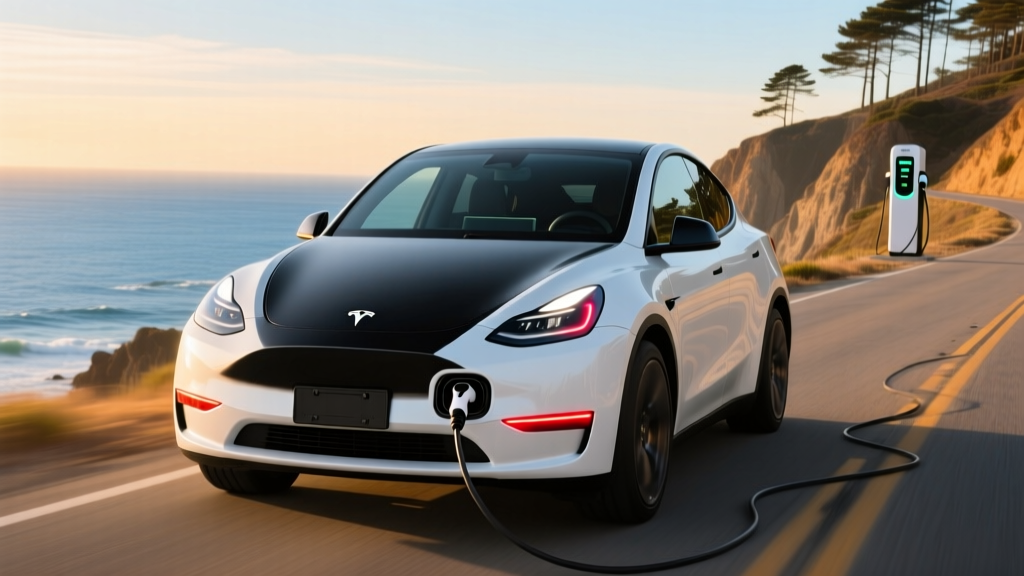
DC Fast Charging: The Model Y Performance supports up to 250 kW on Tesla V3 Superchargers. The charge curve peaks near 250 kW between 10-25% State of Charge (SoC), then tapers progressively — holding around 150 kW through 50%, and dropping to 50-70 kW above 80%. A 10-80% session takes approximately 15 minutes under ideal thermal conditions. If you arrive at a Supercharger with a cold battery and haven't preconditioned via navigation routing, expect that time to stretch to 25-30 minutes.
Preconditioning matters. When you navigate to a Supercharger using the car's built-in navigation, the thermal management system begins warming the battery 10-20 minutes before arrival. This is essential for achieving peak charge rates — skipping it (e.g., navigating via phone app or driving to a charger without routing) can cut peak speeds by 30-50%.
Home Level 2: The onboard charger accepts up to 11.5 kW (48 amps) on a 240V/60A circuit. A Wall Connector installation typically costs $500-$1,500 for the unit plus $800-$2,500 for electrician labor, depending on panel proximity and whether a 200A panel upgrade is needed. With an 11.5 kW connection, you'll add roughly 44 miles of range per hour — enough to fully replenish overnight.
Performance and Driving Dynamics
The Performance variant earns its name. Dual electric motors produce a combined 456 horsepower and an estimated 497 lb-ft of torque, delivered instantly with no turbo lag or transmission shift. The 3.5-second 0-60 mph time places it in sports-car territory, and the all-wheel-drive system provides confident traction in rain and light snow.
The Performance trim includes lowered sport suspension, performance brakes, and the 21-inch Überturbine wheels. The ride is noticeably firmer than the Long Range — you'll feel sharp pavement imperfections, but body roll is minimal and cornering confidence is high for a 4,400-lb crossover. Track Mode allows adjustable torque distribution and regenerative braking intensity for closed-course driving.
Regenerative braking is aggressive in the standard setting, enabling effective one-pedal driving in most city scenarios. The 2023 Model Y does not include a driver-adjustable regen toggle in the main UI — Tesla removed that option in favor of a single calibrated setting.
Tax Credits, Pricing, and Ownership Costs
Since the 2023 Model Y is no longer sold new, the federal §30D new vehicle tax credit no longer applies to fresh purchases. However, if you buy one through the used-EV market, you may qualify for the used clean vehicle credit — up to $4,000 or 30% of the sale price (whichever is lower), subject to income caps and dealer requirements.
| Cost Factor | Details |
|---|---|
| Original 2023 MSRP | $53,990 (Performance AWD) |
| Typical 2026 Used Price | $32,000 - $40,000 (mileage/condition dependent) |
| Used EV Tax Credit (IRC §25E) | Up to $4,000 (sale price ≤ $25,000; income caps apply) |
| Income Caps (Used Credit) | $75K single / $112.5K HOH / $150K joint MAGI |
| Dealer Requirement | Must purchase from a licensed dealer (not private party) |
According to IRS guidelines on the used clean vehicle credit, the vehicle's sale price must not exceed $25,000 to qualify — which means many 2023 Model Y Performance examples on the used market will fall above the threshold. Check current pricing and eligibility carefully before counting on this credit.
For reference, when sold new in 2023, the Model Y Performance qualified for the full $7,500 federal credit under §30D rules at the time (before battery sourcing requirements tightened in 2024). The original MSRP cap for SUVs was $80,000, and income caps were $150K single / $300K joint.
Running costs remain a key advantage. At the U.S. average electricity rate of ~$0.16/kWh, charging a Model Y costs approximately $4.48 per 100 miles of driving. Compare that to a 25-MPG gas crossover at $3.50/gallon — $14.00 per 100 miles. Over 15,000 annual miles, that's roughly $1,430 in electricity versus $2,100 in gasoline — a savings of about $670/year before factoring in reduced maintenance (no oil changes, fewer brake replacements due to regen).
Interior, Tech, and Cargo Practicality
The 2023 Model Y's minimalist interior centers on a 15-inch landscape touchscreen that handles all vehicle controls, navigation, media, and climate. There is no instrument cluster — speed and range information appear in the upper-left corner of the main display. Build quality on 2023 Fremont and Austin-built examples improved notably over 2020-2021 models, with tighter panel gaps and better interior materials.
Cargo space: 30.2 cubic feet behind the second row, expanding to 72.1 cubic feet with the 60/40 split rear seats folded. The rear trunk features a power liftgate, a deep sub-trunk well, and the front trunk (frunk) adds approximately 4.1 cubic feet for charging cables or a small bag.
Passenger space: Front legroom is generous at 41.8 inches; rear legroom measures 37.3 inches — adequate for adults on shorter trips but tighter than a Hyundai Ioniq 5 or Ford Mustang Mach-E for taller rear passengers. The optional third-row seat (rare on Performance trims) is best suited for small children only.
Tech highlights:
- Tesla Autopilot (SAE Level 2) — adaptive cruise, lane centering, automatic emergency braking
- Full Self-Driving (Supervised) — optional $15,000 add-on or $199/month; adds automated lane changes, Navigate on Autopilot, Smart Summon, and traffic light recognition. This remains a Level 2 system requiring constant driver supervision.
- Over-the-air software updates that add features post-purchase
- Sentry Mode dashcam recording, Dog Mode climate control, and theater-mode streaming
Tail Light Kits and Aftermarket Customization
The search for a 2023 Tesla Model Y Performance all-wheel drive tail light kit reflects a growing trend among Tesla owners seeking visual differentiation. The stock Model Y tail lights are functional but understated — a single continuous LED bar across the rear.
Popular aftermarket tail light kits for the 2023 Model Y include:
- Sequential turn signal kits: Replace the standard flash pattern with a sweeping sequential animation, similar to Audi or Mustang styling. Typically $200-$500 for a plug-and-play harness.
- Smoked or tinted overlays: Film or replacement lenses that darken the tail light appearance. Note: check your state's DOT regulations — some states prohibit tinted rear lighting below minimum luminosity standards.
- Full LED replacement assemblies: Aftermarket units with animated startup sequences, custom DRL patterns, or integrated reverse lights. Prices range from $400-$1,200 per pair. Brands like EVANNEX, RPM Tesla, and various AliExpress/Amazon sellers offer options, but quality and waterproofing vary significantly.
- Yoke-style or Model S-inspired tail light conversions: Some kits attempt to replicate the Model S Plaid's more angular tail light design on the Model Y housing.
Installation considerations: Most tail light kits are plug-and-play, connecting to the existing harness behind the trunk trim. However, some animated or sequential kits require a CAN bus decoder module to prevent error codes. Tesla's software updates can occasionally reset or interfere with aftermarket lighting modules — a known issue in the Tesla community. Always choose a kit with a warranty and verify compatibility with your specific software version.
Warranty warning: Modifying exterior lighting may affect your remaining factory warranty on the electrical system. Tesla service centers have discretion to deny claims related to modified wiring. If your 2023 Model Y is still within its 4-year/50,000-mile basic warranty or 8-year/120,000-mile battery warranty, weigh customization against potential coverage risk.
Pros, Cons, and Competitive Position
Pros
- 3.5s 0-60 — genuine sports-car acceleration in a crossover body
- Supercharger network access — still the most reliable DC fast-charging ecosystem in North America
- OTA updates continuously improve the vehicle
- Strong cargo practicality (30.2 cu ft + frunk)
- Low running costs vs. gas competitors
- Robust used market availability heading into 2026
Cons
- Firm ride quality on Performance suspension with 21-inch wheels
- 21-inch wheels reduce range vs. Long Range's 19-inch option
- No Apple CarPlay or Android Auto
- Rear seat comfort trails competitors (Ioniq 5, Mach-E, EV6)
- Phantom braking incidents reported with Autopilot
- Aftermarket modifications (including tail light kits) may affect warranty
Is it worth buying vs. key competitors? Against the Ford Mustang Mach-E GT (3.5s 0-60, 282-mi EPA range), the Model Y Performance offers better range and Supercharger access but a less engaging steering feel. The Hyundai Ioniq 5 N (601 hp, 2.2s 0-60 with rollout) is more thrilling but costs significantly more on the used market and has a smaller charging network advantage. The BMW iX M60 offers luxury refinement the Tesla can't match, but at nearly double the price. For the balance of performance, range, practicality, and charging infrastructure, the 2023 Model Y Performance remains hard to beat at its 2026 used pricing.
Warranty Coverage and Battery Longevity
Tesla covers the 2023 Model Y Performance with:
- Basic Vehicle Warranty: 4 years / 50,000 miles
- Battery & Drive Unit Warranty: 8 years / 120,000 miles (minimum 70% capacity retention)
The NMC battery in the Performance variant has demonstrated strong longevity data. According to Tesla's 2023 Impact Report, Model Y batteries retain approximately 92% of original capacity at 150,000 miles. The 70% retention threshold in the warranty is conservative — most owners will never approach it under normal use. To maximize battery health: avoid frequent 100% charges, minimize DC fast charging when Level 2 is available, and use the car's scheduled charging feature to reduce time spent at high SoC.
If battery replacement becomes necessary out of warranty, expect costs of $12,000-$16,000 for a refurbished or new pack at a Tesla service center, though third-party EV battery specialists are beginning to offer more competitive pricing.
Who Should Buy the 2023 Model Y Performance?
Choose the 2023 Model Y Performance if:
- You want sub-4-second acceleration without sacrificing daily practicality
- You have access to home Level 2 charging
- You take regular road trips and value Supercharger network reliability
- You're shopping the used EV market and want strong value retention
Look elsewhere if:
- Ride comfort is your top priority (consider the Long Range with 19-inch wheels)
- You need maximum range — the Long Range AWD offers 330 miles EPA
- You want Apple CarPlay/Android Auto integration
- You frequently carry rear-seat adults on long trips
Frequently Asked Questions
What is the real-world range of the 2023 Tesla Model Y Performance?
The EPA rates it at 303 miles combined. In real-world highway driving at 70-80 mph, expect 250-270 miles. In freezing winter conditions with cabin heat, plan for 200-220 miles of usable range between charges.
How fast does it charge at home and on the road?
On a Tesla V3 Supercharger, it peaks at 250 kW and charges from 10-80% in approximately 15 minutes under ideal conditions. At home on a 240V/48A Level 2 charger, it adds about 44 miles of range per hour, fully charging overnight in roughly 7 hours.
Does the 2023 Model Y Performance qualify for any tax credits in 2026?
As a used vehicle, it may qualify for the IRS §25E used clean vehicle credit — up to $4,000 if purchased from a licensed dealer for $25,000 or less, subject to buyer income caps ($75K single / $150K joint). Many used Model Y Performance examples exceed the $25,000 sale price cap, so verify current market pricing before counting on this credit.
Can I install a tail light kit without voiding my Tesla warranty?
Plug-and-play tail light kits that don't modify the vehicle's wiring harness carry lower risk, but Tesla service centers may deny electrical-system warranty claims if aftermarket lighting is detected. If your basic warranty (4yr/50,000mi) has expired, the risk is lower. The battery and drive unit warranty (8yr/120,000mi) is generally unaffected by exterior lighting modifications.
Is Autopilot or FSD actually self-driving?
No. Both Autopilot and Full Self-Driving (Supervised) are SAE Level 2 driver-assistance systems. The driver must keep hands on the wheel, eyes on the road, and remain fully responsible for vehicle operation at all times. True driverless operation (SAE Level 4) is only available in limited robotaxi services like Waymo, not in consumer Tesla vehicles.
How does the Model Y Performance compare to the Long Range?
The Performance gains 456 hp (vs. 384 hp), a 3.5s 0-60 (vs. 4.8s), sport suspension, and 21-inch wheels. The trade-off is 27 fewer miles of EPA range (303 vs. 330), a firmer ride, and typically higher tire replacement costs. For most buyers, the Long Range offers better daily comfort; the Performance is for driving enthusiasts.
Sources: EPA Fuel Economy, IRS Used Clean Vehicle Credit, Tesla Warranty Information.