The 2023 Tesla Model Y remains one of the best-selling electric vehicles in the United States for good reason: it packages crossover utility, strong range, and access to the Supercharger network into a relatively accessible price point. But beyond the spec sheet, how does the 2023 Tesla Model Y interior hold up in daily use, and do the real-world charging and range figures match the EPA sticker? This profile breaks down every number that matters for buyers considering a 2023 Model Y on the used market or comparing it against newer rivals.
2023 Tesla Model Y Interior: Design, Space, and Daily Livability
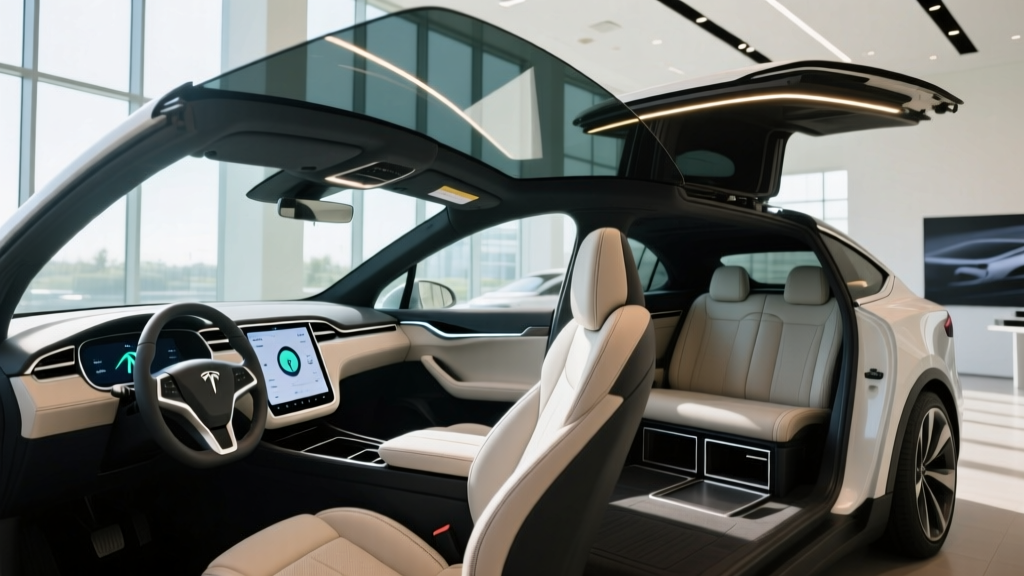
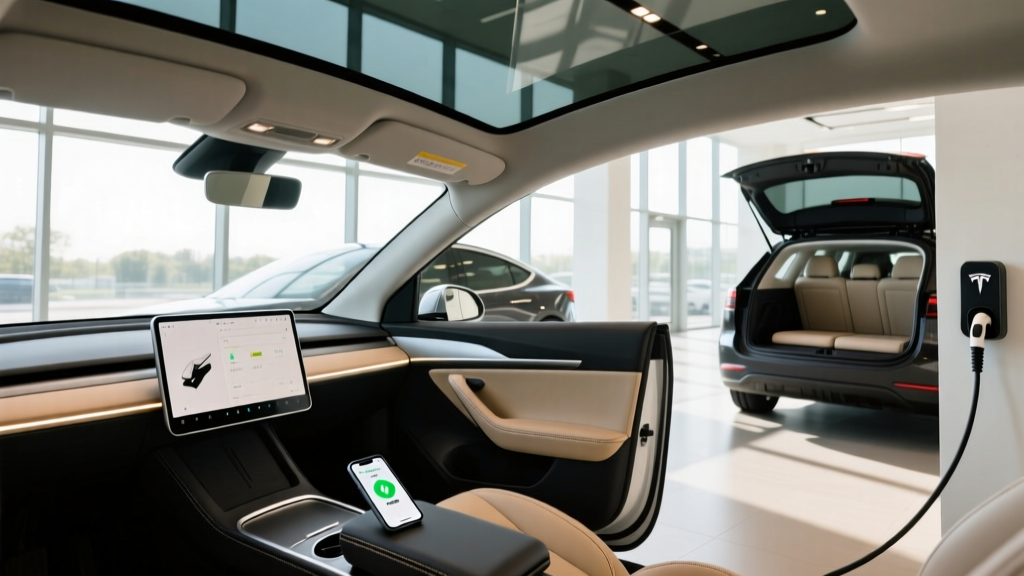
The 2023 Model Y interior follows Tesla's minimalist playbook: a single 15-inch center touchscreen handles virtually every vehicle function, from climate control to glovebox release. There is no traditional instrument cluster — speed and navigation data appear on the upper-left corner of the main display. The cabin uses vegan leather (synthetic) upholstery across all trims, with heated front and rear seats standard. A panoramic glass roof stretches from the windshield header to the rear hatch, flooding the cabin with light but contributing to noticeable solar heat gain in summer months.
Front headroom measures 41.0 inches, with 41.8 inches of front legroom. Rear passengers get 37.3 inches of headroom and 38.4 inches of legroom — adequate for adults on shorter trips but tighter than a Hyundai Ioniq 5 or Ford Mustang Mach-E for tall rear occupants. The rear seat cushion sits relatively low to the floor, creating a knees-up seating position that some passengers find fatiguing on long drives.
Cargo volume behind the second row is 30.2 cubic feet, expanding to 72.1 cubic feet with the 60/40 split rear seats folded. The rear trunk floor is flat and wide, and a modest front trunk (frunk) adds approximately 4.1 cubic feet for charging cables or a small bag. Build quality on 2023 models improved over earlier Fremont-built cars, with tighter panel gaps and fewer reported rattles, though some owners still note wind noise from the frameless door glass at highway speeds above 70 mph.
EPA Range vs. Real-World Expectations
EPA Estimated: 330 miles (Long Range AWD) / 303 miles (Performance) / 260 miles (Standard Range RWD)
Real-World Highway (65-75 mph, moderate temps): ~265-285 miles (Long Range)
Cold Weather (below 32°F, highway): ~215-240 miles (Long Range) — expect 20-30% reduction
The Model Y Long Range's EPA figure assumes mixed driving. Sustained highway speeds and cold temperatures significantly reduce usable range. Plan road-trip charging stops at ~200-mile intervals for a comfortable buffer.
The 2023 Model Y Long Range AWD carries an EPA rating of 330 miles, placing it among the most efficient electric crossovers in its class. According to fueleconomy.gov, the Long Range achieves 122 MPGe combined (127 city / 117 highway), consuming approximately 28 kWh per 100 miles.
In real-world testing, sustained highway driving at 70-75 mph typically yields 265-285 miles before the battery buffer warning activates. Cold weather is the Model Y's Achilles heel — the heat pump (standard on 2023 models) helps mitigate cabin energy draw, but battery chemistry itself becomes less efficient below freezing. Owners in northern climates should budget a 20-30% range reduction in winter. City driving with frequent regenerative braking opportunities can actually exceed the EPA combined figure, with some drivers reporting 340+ miles in stop-and-go conditions at moderate temperatures.
Battery, Chemistry, and Powertrain Specifications
| Spec | Long Range AWD | Performance AWD | Standard Range RWD |
|---|---|---|---|
| Battery (usable) | ~75 kWh (NMC) | ~75 kWh (NMC) | ~57.5 kWh (LFP) |
| EPA Range | 330 mi | 303 mi | 260 mi |
| Drivetrain | Dual-motor AWD | Dual-motor AWD | Single-motor RWD |
| Horsepower | 384 hp | 456 hp | 295 hp |
| 0-60 mph | 4.8 sec | 3.5 sec | 6.6 sec |
| Top Speed | 135 mph | 155 mph | 135 mph |
| MPGe (combined) | 122 MPGe | 115 MPGe | 128 MPGe |
| Cargo (rear up / folded) | 30.2 / 72.1 cu ft | 30.2 / 72.1 cu ft | 30.2 / 72.1 cu ft |
| Towing Capacity | 3,500 lbs | 3,500 lbs | Not rated |
The Long Range and Performance trims use NMC (nickel manganese cobalt) battery chemistry, which offers higher energy density and better cold-weather performance than LFP, but Tesla recommends daily charging to 80-90% for long-term battery health. The Standard Range RWD variant uses LFP (lithium iron phosphate) chemistry, which Tesla states can be charged to 100% regularly without degradation concerns — a practical advantage for commuters who need maximum daily range from a smaller pack.
LFP cells are heavier and less energy-dense, explaining the Standard Range's lower EPA figure despite the chemistry's longevity advantages. NMC owners should use the built-in charge-limit setting and reserve 100% charges for road trips. All 2023 Model Y variants use Tesla's structural battery pack design, where the battery serves as a stressed chassis member, improving torsional rigidity.
Charging Speed: DC Fast Charging and Home Level 2
| Level | Max Rate | Speed / Time | Notes |
|---|---|---|---|
| Level 1 (120V) | ~1.4 kW | ~3-4 mi/hr | Emergency/trickle only |
| Level 2 (240V, 48A) | 11.5 kW | ~37 mi/hr (0-100% in ~8 hrs) | Tesla Wall Connector or equivalent |
| DC Fast (Supercharger V3) | 250 kW peak | 10-80% in ~27 min | Tapers above 60%; preconditioning required |
| DC Fast (CCS adapter) | ~170 kW peak | 10-80% in ~35 min | Third-party networks; speed varies by station |
The 2023 Model Y's peak DC fast-charge rate is 250 kW on a Tesla V3 Supercharger, though this peak is only sustained briefly at low states of charge (roughly 5-20%). The charge curve tapers progressively — by 60% SoC, the rate drops to approximately 100-120 kW, and above 80%, it slows further to protect the battery. A realistic 10-80% session takes approximately 27 minutes at a V3 Supercharger stall delivering full power.
Preconditioning is critical. If you navigate to a Supercharger using the car's built-in navigation, the Model Y will automatically warm the battery en route, enabling peak charge rates upon arrival. Without preconditioning — for example, pulling into a charger with a cold-soaked battery — peak rates may be limited to 100-150 kW, extending the session by 10-15 minutes.
At home, the Model Y accepts up to 11.5 kW on a 240V Level 2 circuit (48 amps), adding roughly 37 miles of range per hour of charging. A full overnight charge from 10% to 90% takes approximately 8 hours. Tesla's Wall Connector ($475) is the recommended home unit, though any J1772 Level 2 charger will work with the included adapter. Buyers should budget $500-$1,500 for professional Level 2 installation depending on panel capacity and conduit runs — consult a licensed electrician for a site-specific quote.
As of late 2024, Tesla began opening the Supercharger network to non-Tesla EVs via a CCS adapter. The 2023 Model Y ships with Tesla's proprietary NACS connector; a CCS adapter (approximately $175 from Tesla) enables charging on Electrify America, EVgo, and other CCS networks, though at slightly reduced peak speeds due to adapter overhead.
Pricing, Trims, and Federal Tax Credit Eligibility
| Trim | Original MSRP | Est. Used (2026) | Federal Credit (New) |
|---|---|---|---|
| Standard Range RWD | $47,740 | $28,000-$33,000 | $7,500 (§30D, if eligible) |
| Long Range AWD | $52,990 | $32,000-$38,000 | $7,500 (§30D, if eligible) |
| Performance AWD | $56,990 | $35,000-$41,000 | $7,500 (§30D, if eligible) |
When new, the 2023 Model Y qualified for the full $7,500 federal EV tax credit under IRS §30D, as all trims fell below the $80,000 MSRP cap for SUVs/crossovers and Tesla's battery sourcing met critical-mineral and component requirements for that model year. However, eligibility depends on the buyer's adjusted gross income: single filers must earn ≤$150,000, heads of household ≤$225,000, and joint filers ≤$300,000. The credit is non-refundable, meaning it can only reduce your tax liability to zero — it cannot generate a refund beyond taxes owed. See IRS.gov §30D guidelines for complete current-year rules.
For 2026 buyers purchasing a used 2023 Model Y, the Used Clean Vehicle Credit (§25E) may apply: up to $4,000 or 30% of the sale price (whichever is lower), with lower income caps ($75,000 single / $150,000 joint) and a requirement that the vehicle be purchased from a licensed dealer for under $25,000. Given current used pricing, most 2023 Model Ys exceed the $25,000 cap, making the used credit unavailable in many cases. Verify eligibility with a tax professional before purchase.
Tech, Driver Assistance, and Ownership Experience
Every 2023 Model Y includes Tesla's Basic Autopilot, which provides SAE Level 2 lane-centering and adaptive cruise control on highways. This is a driver-assist system — not self-driving — and requires continuous hands-on-wheel supervision and visual attention. Tesla's optional Full Self-Driving (Supervised) package ($12,000 new, now available as a $99/month subscription) adds features like automatic lane changes, traffic-light recognition, and Navigate on Autopilot, but remains a Level 2 system that can make errors requiring immediate driver takeover.
Tesla Autopilot and FSD (Supervised) are SAE Level 2 systems. The driver must remain fully engaged, hands on wheel, eyes on road, at all times. These systems do not make the vehicle autonomous. Misuse has resulted in NHTSA investigations and fatal crashes. Never use FSD as a substitute for attentive driving.
The infotainment system is among the fastest and most responsive in the EV segment, with over-the-air updates adding features regularly. The 2023 Model Y supports Bluetooth audio but lacks Apple CarPlay and Android Auto — a notable omission for buyers accustomed to phone projection. Navigation is Tesla-native, with real-time Supercharger availability and routing integrated into trip planning. A premium audio system with 14 speakers, immersive sound processing, and a subwoofer is standard on Long Range and Performance trims.
Tesla's warranty covers the battery and drive unit for 8 years or 120,000 miles (Long Range/Performance) and 8 years or 100,000 miles (Standard Range), with a minimum 70% capacity retention threshold. The basic vehicle limited warranty is 4 years or 50,000 miles. Tesla's service model relies on mobile rangers and a limited service-center network — owners in rural areas may face long wait times for body or hardware repairs.
Who Should Buy the 2023 Tesla Model Y?
✅ Choose the Model Y If:
- You prioritize Supercharger network access for road trips
- You need 300+ miles of EPA range in an AWD crossover
- You value OTA updates and a fast, responsive infotainment system
- You want strong cargo capacity (72 cu ft) for a compact EV crossover
- You can install Level 2 home charging for daily convenience
❌ Look Elsewhere If:
- You require Apple CarPlay / Android Auto integration
- You want physical buttons for climate and volume controls
- Maximum rear-seat comfort is a priority (Ioniq 5 is roomier)
- You live in a region with no Tesla Service Center nearby
- You want a traditional dealer purchase and service experience
Best use case: The 2023 Model Y Long Range AWD excels as a daily commuter and family road-trip vehicle for households with home Level 2 charging access. Its combination of range, cargo space, and Supercharger infrastructure makes it one of the most practical EVs for multi-state travel. The Performance trim suits driving enthusiasts who want sports-car acceleration in a practical package, while the Standard Range RWD works for budget-conscious urban commuters with short daily drives and reliable home charging.
2023 Tesla Model Y vs. Key Competitors
Against the Hyundai Ioniq 5 (EPA 303 mi Long Range, 800V architecture enabling 10-80% in ~18 min), the Model Y wins on range and Supercharger access but loses on charging speed, rear-seat space, and CarPlay support. The Ford Mustang Mach-E (EPA 312 mi Extended Range AWD) offers a more conventional interior with physical controls and a sportier driving feel, but its public charging experience is less reliable than Tesla's network. The Kia EV6 matches the Ioniq 5's 800V fast-charging advantage and offers a more driver-focused cockpit, though with slightly less cargo volume.
The Model Y's strongest competitive advantage remains the Supercharger network — even as Tesla opens it to rivals, native integration (automatic routing, plug-and-charge billing, real-time stall status) provides a frictionless experience that third-party networks have yet to match consistently.
Frequently Asked Questions
What is the real-world range of the 2023 Tesla Model Y Long Range?
Expect approximately 265-285 miles on the highway at 70-75 mph in moderate temperatures, and 215-240 miles in cold weather (below 32°F). City driving with regenerative braking can approach or slightly exceed the 330-mile EPA estimate. Plan road-trip charging at 200-mile intervals for comfort.
How fast does the 2023 Model Y charge at home and on the road?
At home on a 240V Level 2 charger (48A), it charges at 11.5 kW, adding ~37 miles per hour (full charge in ~8 hours). On a Tesla V3 Supercharger, it peaks at 250 kW and charges from 10-80% in approximately 27 minutes, though preconditioning the battery via navigation routing is essential for achieving peak speeds.
Does a used 2023 Model Y qualify for any tax credit in 2026?
The Used Clean Vehicle Credit (§25E) offers up to $4,000, but the vehicle must be purchased from a dealer for under $25,000. Most used 2023 Model Ys currently sell above this threshold, making the credit unavailable in many cases. Consult a tax professional and check IRS §25E rules before purchasing.
Is the 2023 Model Y still worth buying in 2026 vs. newer EVs?
Yes, if you value Supercharger access, strong range, and proven software. The 2023 Model Y depreciated significantly, making it a strong used-EV value. However, newer competitors like the Ioniq 5, EV6, and refreshed Model Y (2025+) offer faster DC charging, CarPlay support, and improved interiors. Test-drive both before deciding.
What are the biggest complaints about the 2023 Model Y interior?
The most common criticisms are the lack of Apple CarPlay/Android Auto, absence of physical climate/volume controls, low rear-seat cushion height causing a knees-up seating position, and solar heat gain through the panoramic glass roof in summer. Build quality improved for 2023 but still falls short of luxury-brand fit and finish.
What is the battery warranty on the 2023 Model Y?
Tesla covers the battery and drive unit for 8 years or 120,000 miles (Long Range/Performance) and 8 years or 100,000 miles (Standard Range), guaranteeing a minimum of 70% capacity retention. The basic vehicle warranty is 4 years or 50,000 miles.