The 2023 Tesla Model X at a Glance
The 2023 Tesla Model X occupies a rare position in the EV market: a three-row, all-electric luxury SUV with supercar-rivaling acceleration and access to the most reliable DC fast-charging network in North America. For buyers cross-shopping the BMW iX, Rivian R1S, or Mercedes EQS SUV, the Model X brings a combination of range, charging infrastructure, and over-the-air software evolution that remains difficult to match. But at a starting MSRP above $80,000, the math has to work — and that means understanding real-world range, actual charging speeds, and current federal tax credit eligibility before signing.
This review breaks down the 2023 Model X with the exact numbers that matter: EPA range versus what you'll actually see on a highway road trip, the battery chemistry and usable capacity, DC fast-charging curve behavior, Level 2 home charging rates, and a detailed look at whether the §30D federal tax credit applies. We'll also cover where the Model X wins, where it falls short, and who should actually buy one in 2026.
| Spec | Long Range (Dual Motor) | Plaid (Tri-Motor) |
|---|---|---|
| EPA Range | 348 miles | 333 miles |
| Battery (usable) | ~100 kWh, NMC | ~100 kWh, NMC |
| Drivetrain | Dual Motor AWD | Tri-Motor AWD |
| Horsepower | 670 hp | 1,020 hp |
| 0–60 mph | 3.8 seconds | 2.5 seconds |
| Top Speed | 155 mph | 163 mph |
| Peak DC Fast Charge | 250 kW | 250 kW |
| 10–80% DC Charge | ~30 minutes | ~30 minutes |
| Level 2 Charge Rate | 11.5 kW (~34 mi/hr) | 11.5 kW (~34 mi/hr) |
| MPGe (combined) | 102 MPGe | 98 MPGe |
| kWh/100 mi | 33 kWh | 34 kWh |
| Towing Capacity | 5,000 lbs | 5,000 lbs |
| Cargo (behind 3rd row) | 15.3 cu ft | 15.3 cu ft |
| Cargo (max, seats folded) | 88.1 cu ft | 88.1 cu ft |
| Seating | 5, 6, or 7 passengers | 5, 6, or 7 passengers |
| Base MSRP (2023) | $89,990 | $109,990 |
| Battery Warranty | 8 yr / 150,000 mi | 8 yr / 150,000 mi |
Sources: EPA fueleconomy.gov, Tesla Model X specs.
Real-World Range: What the EPA Sticker Doesn't Tell You
EPA Estimated Range: 348 miles (Long Range) / 333 miles (Plaid)
Real-World Expectation: Expect 270–310 miles on mixed highway driving at 70–75 mph. In cold weather (below 30°F), plan for 220–260 miles of usable range before needing a charge stop. City and suburban driving with regenerative braking recovers closer to the EPA sticker — often 320–340 miles in mild conditions.
The 2023 Model X uses a ~100 kWh usable NMC (nickel manganese cobalt) battery pack. Tesla does not publish exact usable capacity figures, but teardown data and owner telemetry consistently place it in the 98–100 kWh range. NMC chemistry offers higher energy density than LFP (lithium iron phosphate), which is why Tesla reserves LFP for the standard-range Model 3 and Model Y rear-wheel-drive trims. The trade-off: NMC degrades slightly faster over thousands of cycles and prefers not to sit at 100% state of charge for extended periods. Daily charging to 80–90% is recommended for longevity.
Efficiency in the real world depends heavily on speed and temperature. At a steady 65 mph on a flat interstate in 70°F weather, the Long Range trim can achieve roughly 3.0–3.2 miles per kWh, yielding 300–320 miles. Push that to 80 mph and efficiency drops to around 2.6–2.8 mi/kWh, cutting range to approximately 260–280 miles. Cold weather compounds this: battery internal resistance increases, cabin heating draws 3–5 kW continuously (the Model X uses a highly efficient heat pump, which mitigates some loss), and the result is typically a 20–30% range reduction versus the EPA figure.
For context, the EPA combined rating is 102 MPGe for the Long Range trim, translating to 33 kWh per 100 miles. That's competitive with the BMW iX xDrive50 (86 MPGe combined) and significantly better than the Mercedes EQS 580 SUV (79 MPGe combined), both of which are heavier and less aerodynamic.
Charging Speed: DC Fast Charging and Home Level 2
Charging speed is where the Model X's Tesla ecosystem advantage becomes tangible. The 2023 Model X supports up to 250 kW peak DC fast charging via the NACS (North American Charging Standard) connector — Tesla's proprietary plug that has since been adopted by Ford, GM, Rivian, and most major automakers for 2025+ models.
| Charging Level | Power / Rate | Miles Added per Hour | Typical Use Case |
|---|---|---|---|
| Level 1 (120V) | ~1.4 kW | ~4 mi/hr | Emergency / overnight trickle |
| Level 2 (240V, 48A) | 11.5 kW | ~34 mi/hr | Home Wall Connector, overnight |
| DC Fast (V3 Supercharger) | Peak 250 kW | ~175 mi in 15 min | Road trips, highway corridors |
DC Fast Charging: The Real Charge Curve
Tesla's peak 250 kW rate is just that — a peak, not a sustained average. In real-world V3 Supercharger testing, the 2023 Model X with a preconditioned battery (navigate to a Supercharger and the car automatically warms the pack) hits 250 kW briefly between approximately 10–20% state of charge. The curve then tapers progressively: around 170 kW at 40% SoC, 120 kW at 60%, and drops below 50 kW above 85%. A 10–80% charge takes roughly 30 minutes under optimal conditions.
That 30-minute 10–80% time is respectable but not class-leading. The Hyundai Ioniq 5 and Kia EV6, with their 800V architectures, can achieve 10–80% in approximately 18 minutes at a 350 kW charger. The Model X's 400V architecture limits its peak charge rate relative to battery size. For road trips, this means slightly longer stops — but the trade-off is that Tesla's Supercharger network remains the most reliable and widespread DC fast-charging infrastructure in the U.S., with over 5,000 stations and 50,000+ stalls as of 2026.
Home Level 2 Charging
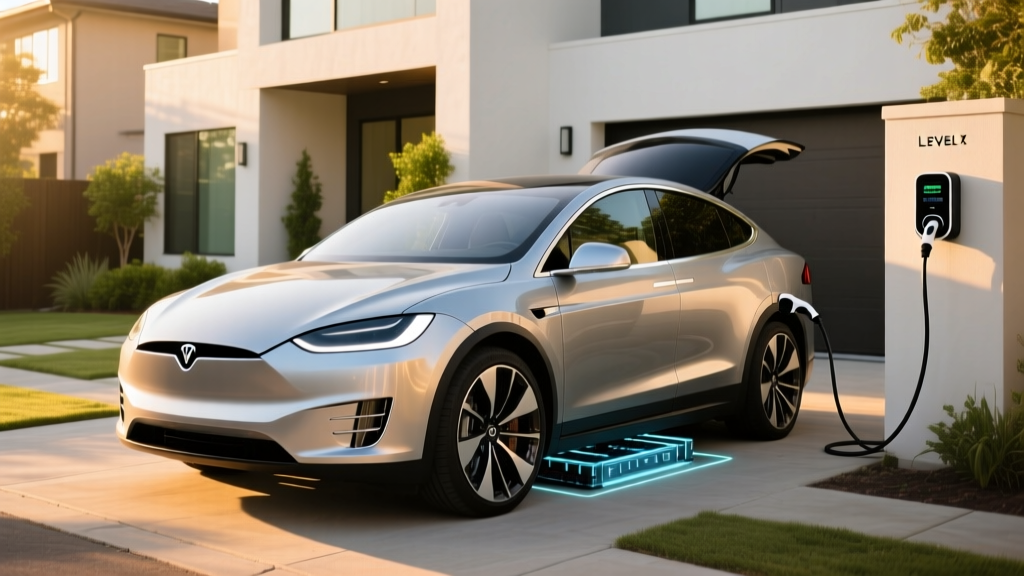
The onboard charger accepts up to 11.5 kW (48 amps) on a 240V circuit. Using the Tesla Wall Connector on a 60-amp dedicated circuit, you'll add roughly 34 miles of range per hour, meaning a full 0–100% charge takes about 10 hours. Most owners charge overnight from 20–80% daily, which takes roughly 5–6 hours — easily accomplished while sleeping. Installation of a 60-amp circuit with a Wall Connector typically costs $800–$2,000 depending on panel proximity and local electrician rates. If your home's electrical panel is at or near capacity (common in older homes with 100-amp service), a panel upgrade to 200 amps can add $1,500–$3,000.
Performance and Driving Dynamics
The 2023 Model X Long Range delivers 670 horsepower from its dual-motor all-wheel-drive powertrain, launching to 60 mph in 3.8 seconds. That's quicker than a Porsche Cayenne Turbo and nearly matches a BMW X5 M — in a seven-seat electric SUV weighing over 5,100 pounds.
The Plaid trim escalates to 1,020 horsepower via three motors (one front, two rear), achieving a 2.5-second 0–60 time. This puts it in hypercar territory, though the Plaid's real value proposition is less about drag-strip numbers and more about the effortless, instant torque available at any speed. Highway passing requires zero downshift wait — you press the pedal and the car surges forward with linear, silent acceleration.
Ride quality improved significantly with the 2022 refresh and carries into the 2023 model year. The adaptive air suspension smooths out highway imperfections and allows ride-height adjustment for off-road clearance or aerodynamic efficiency at speed. Steering is precise and weighted appropriately, though the yoke steering wheel (standard on Plaid, optional on Long Range) remains polarizing — it works well on highways and open roads but requires hand-over-hand adjustment for low-speed parking maneuvers, which is genuinely inconvenient.
Interior, Tech, and Cargo Capacity
The Model X interior is minimalist in the Tesla tradition: a 17-inch landscape touchscreen dominates the dashboard, handling everything from navigation and media to climate control and vehicle settings. A second 8-inch screen serves rear-seat passengers for entertainment and climate adjustment. The 2023 model year features an AMD Ryzen processor, which keeps the interface responsive and snappy — a meaningful improvement over the older Intel Atom-based units.
Cargo capacity is a genuine strength. With all three rows in use, you get 15.3 cubic feet behind the third row — enough for a few carry-on bags or groceries. Fold the third row and capacity jumps to 44.1 cubic feet. Fold both rear rows and you unlock 88.1 cubic feet, rivaling a midsize minivan. The front trunk (frunk) adds 6.5 cubic feet of sealed storage, useful for charging cables or a small bag.
Legroom is generous: 41.2 inches in the front row, 38.4 inches in the second row, and 32.7 inches in the third row. The third row is best suited for children or shorter adults on trips under an hour. The six-seat configuration (with second-row captain's chairs) provides the most comfortable long-distance experience and easier third-row access.
Autopilot and Full Self-Driving (Supervised)
SAE Automation Level: Level 2
Tesla's Autopilot (standard) and Full Self-Driving Supervised ($15,000 option in 2023) are Level 2 driver-assistance systems. This means the vehicle can manage steering, acceleration, and braking under certain conditions, but the driver must remain fully engaged, hands on or near the wheel, and eyes on the road at all times. FSD does NOT make the Model X a self-driving car. The "Supervised" designation Tesla adopted in 2024 reinforces this: you are the supervisor, and liability remains with the driver.
In practice, Autopilot's adaptive cruise and lane-centering are among the smoothest in the industry for highway use. FSD adds capabilities like automatic lane changes, navigate-on-autopilot for highway interchanges, and traffic light/stop sign recognition. It's impressive technology, but it makes errors — phantom braking, misread construction zones, hesitancy at complex intersections — and requires constant vigilance. Compare this to GM's Super Cruise or Ford's BlueCruise, which use driver-monitoring cameras and operate only on pre-mapped divided highways, offering a more constrained but arguably safer operational envelope.
Pricing, Trims, and Federal Tax Credit Eligibility
The 2023 Model X launched with two trims:
| Trim | Base MSRP | As-Tested (typical options) | §30D Federal Credit Eligible? |
|---|---|---|---|
| Long Range (Dual Motor) | $89,990 | $95,000–$105,000 | No — exceeds SUV MSRP cap |
| Plaid (Tri-Motor) | $109,990 | $115,000–$130,000 | No — exceeds SUV MSRP cap |
Why the 2023 Model X Does NOT Qualify for the §30D Federal Tax Credit
Under current IRS rules for the §30D New Clean Vehicle Credit, SUVs must have an MSRP at or below $80,000 to be eligible. Both the Model X Long Range ($89,990) and Plaid ($109,990) exceed this cap. Additionally, the buyer must meet income thresholds ($300,000 joint / $150,000 single modified adjusted gross income), and the vehicle's battery must meet critical-mineral and battery-component sourcing requirements that have tightened each year since 2023.
The bottom line: if you're buying a 2023 Model X new or used in 2026, do not count on the $7,500 federal credit. Consult a tax professional regarding your specific situation, and check the IRS Clean Vehicle Credit page for the latest rules. Some state-level incentives (such as California's CVRP or Colorado's innovative motor vehicle credit) may still apply, but these vary by jurisdiction and income.
Warranty and Long-Term Battery Health
Tesla covers the 2023 Model X battery and drive unit with an 8-year / 150,000-mile warranty, whichever comes first, with a guaranteed minimum 70% capacity retention over that period. The vehicle limited warranty is 4 years / 50,000 miles bumper-to-bumper.
For the NMC pack in the Model X, real-world degradation data from owner fleets suggests approximately 8–12% capacity loss over the first 100,000 miles, with the curve flattening significantly after that. Many high-mileage Tesla owners report 85–90% state of health at 150,000 miles. Best practices for longevity include:
- Set daily charge limit to 80–90% (avoid routine 100% charges)
- Minimize repeated DC fast charging when Level 2 is available
- Use preconditioning (built-in when navigating to a Supercharger)
- Avoid letting the battery sit at very low SoC (<10%) for extended periods
If a battery replacement is needed out of warranty, Tesla service centers and third-party EV shops currently quote $18,000–$25,000 for a Model X pack replacement — a figure that has decreased as the remanufactured battery market matures.
Pros, Cons, and Who Should Buy the 2023 Model X
Pros
- Class-leading EPA range (348 mi) for a three-row electric SUV
- Access to Tesla Supercharger network — most reliable DC fast-charging in the U.S.
- Exceptional performance: 3.8s 0–60 (Long Range), 2.5s (Plaid)
- Generous cargo space (88.1 cu ft max) with functional frunk
- Over-the-air software updates add features and improve performance over time
- Heat pump standard — better cold-weather efficiency than resistive heating
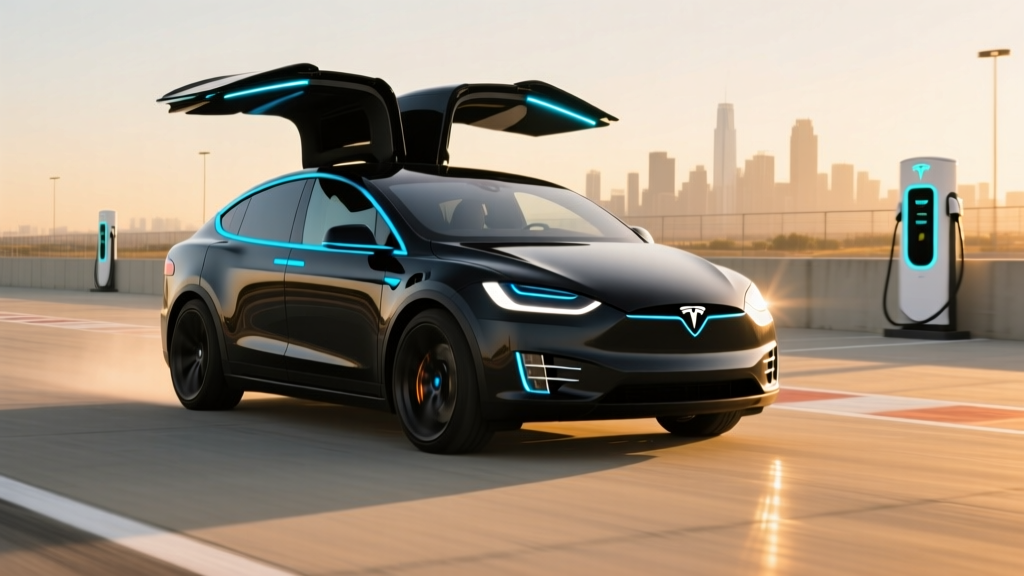
- Falcon-wing rear doors provide wide opening in tight parking spaces
Cons
- MSRP starts at $89,990 — no federal tax credit eligibility (exceeds $80K SUV cap)
- 400V architecture limits DC fast-charge speed vs 800V rivals (30 min vs ~18 min 10–80%)
- Falcon-wing doors can be slow to open/close and have had reliability complaints
- Yoke steering is impractical for low-speed maneuvers and parking
- Third-row legroom (32.7 in) is tight for adults
- No Apple CarPlay or Android Auto — Tesla's proprietary infotainment only
- Panel gaps and interior fit/finish trail German luxury competitors
Who Is the 2023 Model X For?
Choose the Model X if: You need three rows, prioritize range and charging-network reliability for road trips, want supercar-level acceleration in a family SUV, and your budget clears $90,000+ without needing a federal tax credit.
Look elsewhere if: You need the $7,500 federal credit to justify the purchase (consider the Model Y, Rivian R1S with qualifying battery, or the BMW iX below the MSRP cap). If third-row space is a priority, the Rivian R1S and Kia EV9 offer more usable room. If interior luxury and build quality matter most, the BMW iX and Mercedes EQS SUV are more refined.
2023 Model X vs. Key Competitors
| Spec | Tesla Model X LR | BMW iX xDrive50 | Rivian R1S Dual | Mercedes EQS 580 SUV |
|---|---|---|---|---|
| EPA Range | 348 mi | 324 mi | 316 mi | 305 mi |
| Battery | ~100 kWh NMC | 111.5 kWh NMC | 128.9 kWh NMC | 108.4 kWh NMC |
| 0–60 mph | 3.8s | 4.6s | 5.0s | 4.4s |
| Peak DC Charge | 250 kW | 195 kW | 200 kW | 200 kW |
| Seating | 5/6/7 | 5 only | 7 | 5/7 |
| Cargo (max) | 88.1 cu ft | 77.9 cu ft | 104.7 cu ft | 74.0 cu ft |
| Base MSRP | $89,990 | $87,100 | $78,000 | $104,400 |
| §30D Eligible? | No | No (exceeds cap) | Yes (select configs) | No |
The Model X wins on range and acceleration. The Rivian R1S wins on cargo space, off-road capability, and potential tax credit eligibility. The BMW iX offers a more luxurious interior at a similar price but sacrifices the third row. The Mercedes EQS SUV is the comfort benchmark but trails in range and efficiency.
Frequently Asked Questions
What is the real-world range of the 2023 Tesla Model X?
The EPA rates the Long Range at 348 miles and the Plaid at 333 miles. In real-world highway driving at 70–75 mph, expect 270–310 miles. In cold weather below 30°F, plan for 220–260 miles. City driving with regenerative braking can approach the EPA figure in mild weather.
How fast does the 2023 Model X charge?
On a Tesla V3 Supercharger (250 kW peak), the Model X charges from 10–80% in approximately 30 minutes with a preconditioned battery. At home on a Level 2 Wall Connector (11.5 kW), it adds about 34 miles of range per hour, fully charging overnight in roughly 10 hours.
Does the 2023 Model X qualify for the federal EV tax credit?
No. The §30D federal tax credit has an $80,000 MSRP cap for SUVs, and both Model X trims exceed this ($89,990 Long Range, $109,990 Plaid). State incentives may still apply depending on your jurisdiction and income. Always verify current rules on IRS.gov.
Is the 2023 Model X worth buying versus competitors?
It depends on priorities. If range, Supercharger access, and acceleration matter most in a three-row EV, the Model X is the strongest choice. If you need tax credit eligibility, the Rivian R1S qualifies in certain configurations. If interior luxury is paramount, the BMW iX is more refined. Test-drive all three before deciding.
What battery chemistry does the 2023 Model X use?
The 2023 Model X uses NMC (nickel manganese cobalt) lithium-ion cells in a ~100 kWh usable pack. NMC offers higher energy density than LFP, enabling the Model X's 348-mile range, but benefits from daily charging limits of 80–90% for long-term health.
How much does it cost to charge a Model X at home vs. Superchargers?
At the U.S. average residential electricity rate of ~$0.16/kWh, a full home charge costs approximately $16. Tesla Supercharger rates vary by location and time of day but average $0.25–$0.35/kWh, making a full charge $25–$35. For comparison, fueling an equivalent gas SUV at 20 MPG and $3.50/gallon costs roughly $60 for the same 348-mile range.