The 2023 Tesla Model S remains a benchmark in the luxury electric sedan segment even as newer rivals close the gap. With an EPA-estimated 405 miles of range, a 250 kW DC fast-charging peak, and dual-motor all-wheel drive, it set the template that competitors like the Lucid Air and Mercedes EQS are still chasing. But specs on a sticker don't tell the whole story. This review breaks down real-world range, charging-curve behavior, ownership costs, and whether a 2023 Model S — new-old-stock or certified pre-owned — still makes sense for buyers shopping in 2026.
Quick Verdict: Who Should Buy the 2023 Model S?
Choose the 2023 Tesla Model S if:
- You need a 400+ mile range sedan for frequent long-distance road trips
- Supercharger network access and reliability are top priorities
- You want flagship performance (3.1s 0-60) without sacrificing daily practicality
- You value over-the-air updates and a mature software ecosystem
Look elsewhere if:
- You prioritize rear-seat luxury and ride comfort (consider Lucid Air or Mercedes EQS)
- You need the latest interior materials — the Model S cabin is minimalist to a fault
- You want a vehicle that qualifies for the full $7,500 federal tax credit on a new purchase
2023 Tesla Model S: Key Specifications at a Glance
| Specification | Model S Long Range | Model S Plaid |
|---|---|---|
| EPA Range | 405 miles | 396 miles |
| Battery Capacity (usable) | ~95 kWh (NMC) | ~95 kWh (NMC) |
| Drivetrain | Dual-Motor AWD | Tri-Motor AWD |
| Horsepower | 670 hp | 1,020 hp |
| 0-60 mph | 3.1 seconds | 1.99 seconds |
| Top Speed | 155 mph | 200 mph |
| Max DC Fast Charge | 250 kW | 250 kW |
| 10-80% DC Charge Time | ~27 minutes | ~27 minutes |
| Level 2 Charge Rate | 11.5 kW (44 mi/hr) | 11.5 kW (44 mi/hr) |
| MPGe (combined) | 120 MPGe | 116 MPGe |
| Efficiency | 28 kWh/100 mi | 29 kWh/100 mi |
| Cargo Volume | 28 cu ft (rear) + frunk | 28 cu ft (rear) + frunk |
| Base MSRP (2023) | $89,990 | $108,490 |
| Battery Warranty | 8 yr / 150,000 mi | 8 yr / 150,000 mi |
Real-World Range: What the EPA Number Doesn't Tell You
The EPA rates the 2023 Model S Long Range at 405 miles and the Plaid at 396 miles — figures sourced from fueleconomy.gov. Those are class-leading numbers, but real-world conditions change the calculus significantly.
EPA Sticker: 405 miles (Long Range) / 396 miles (Plaid)
Real-World Highway (70-80 mph, moderate temps): Expect 320-350 miles. Aerodynamic drag at sustained highway speeds reduces efficiency by roughly 15-20% compared to the EPA's mixed-cycle test.
Cold Weather (below 32°F): Plan for 260-300 miles. Lithium-ion batteries lose efficiency in cold temperatures, and cabin heating draws additional power. The Model S uses a heat pump (standard since the 2021 refresh), which mitigates some loss compared to resistive heating, but a 25-30% range reduction in deep cold is typical.
City/Commuting (stop-and-go with regen): 380-410 miles. Regenerative braking recovers energy, and lower speeds reduce aero losses — this is where the Model S gets closest to its EPA number.
The ~95 kWh usable battery pack uses NMC (nickel manganese cobalt) chemistry, which offers high energy density — critical for hitting 405 miles in a sedan form factor. NMC cells are more sensitive to sustained high states of charge, so Tesla recommends daily charging to 80-90% for routine use, reserving 100% for road trips. This is a key difference from LFP (lithium iron phosphate) packs found in the base Model 3, which can be charged to 100% daily without accelerated degradation.
Charging Speed: DC Fast Charging and Home Setup
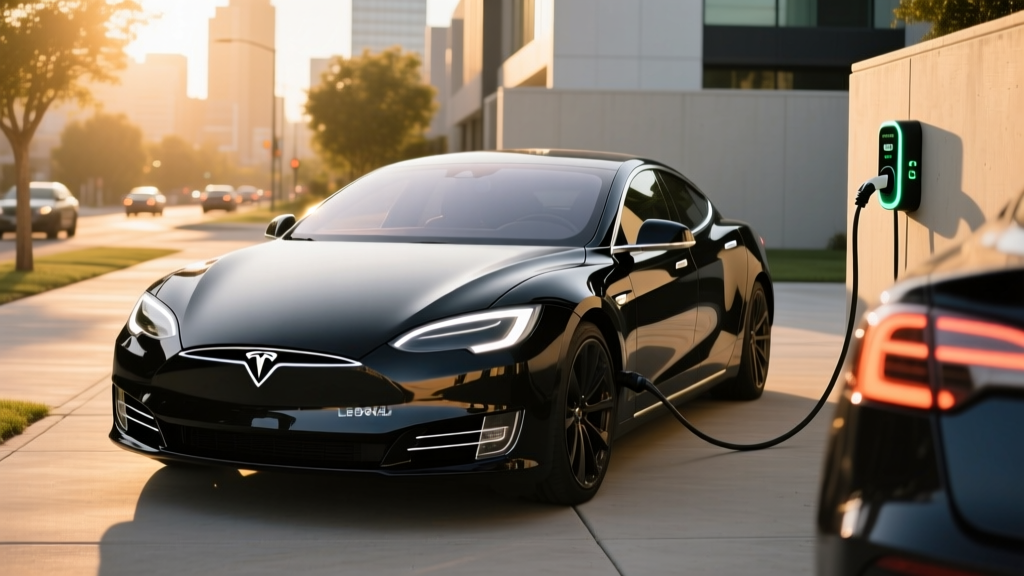
Charging infrastructure is where Tesla's ecosystem advantage is most pronounced. The 2023 Model S uses the proprietary Tesla connector (now transitioning to NACS industry-wide) and has full access to the Supercharger network — the most reliable and extensive DC fast-charging network in North America.
| Charging Level | Power | Speed (miles added) | Notes |
|---|---|---|---|
| Level 1 (120V household) | ~1.4 kW | ~5 miles/hour | Emergency/trickle only; full charge takes 3+ days |
| Level 2 (240V home) | 11.5 kW max | ~44 miles/hour | Full 0-100% in ~10 hours; ideal for overnight |
| DC Fast (V3 Supercharger) | 250 kW peak | ~200 miles in 15 min | 10-80% in ~27 min; tapers above 80% |
| DC Fast (V2 Supercharger) | 150 kW peak | ~150 miles in 15 min | Older stations; still widely available |
Charging-curve reality check: The 250 kW peak rate is not sustained across the entire session. The Model S hits peak power between roughly 10-30% state of charge, then progressively tapers. From 50-80%, expect an average of ~120-140 kW. This is why the 10-80% time of approximately 27 minutes is the meaningful metric — not the peak kW number. Above 80%, charging slows dramatically to protect battery health, adding perhaps 15-20 minutes for that final 20%. For road trips, plan stops around the 10-80% window to minimize total charging time.
For home Level 2 charging, a Tesla Wall Connector on a 60-amp circuit delivers the full 11.5 kW (48 amps continuous), adding roughly 44 miles per hour of charging. A typical overnight session (8 hours) replenishes approximately 350 miles — more than enough for daily use. Installation costs range from $800-$2,500 depending on panel capacity and run length; a 200-amp panel is usually sufficient, but older homes may need a panel upgrade ($1,500-$3,000 additional).
Performance and Driving Dynamics
The Long Range's dual-motor setup produces 670 horsepower and achieves a 3.1-second 0-60 mph time — performance that would have been supercar territory a decade ago. The Plaid's tri-motor configuration pushes 1,020 horsepower and a claimed 1.99-second 0-60, making it one of the quickest production cars ever built.
Beyond straight-line speed, the 2023 Model S benefits from a low center of gravity (battery pack mounted under the floor), adaptive air suspension, and torque-vectoring across the front and rear motors. The result is composed handling for a 4,500+ lb sedan. Ride quality improved significantly with the 2021 refresh — the adaptive dampers absorb highway imperfections well, though the large 19- or 21-inch wheels can transmit sharper impacts into the cabin.
One-pedal driving via regenerative braking is well-calibrated. Tesla removed the driver-selectable regen level in recent software updates, defaulting to a strong regen setting that enables true one-pedal operation in most conditions. Some drivers appreciate the simplicity; others miss the option to coast.
Interior, Tech, and Cargo
The 2023 Model S interior is a study in minimalism. A 17-inch landscape touchscreen dominates the center stack, running Tesla's proprietary infotainment system — widely regarded as the most responsive and feature-rich in the EV segment. Navigation, media, climate controls, and vehicle settings all route through this screen. A 12.3-inch digital instrument cluster sits behind the yoke-style steering wheel (a conventional round wheel is available at no cost).
Notable tech features:
- 22-speaker, 960-watt audio system
- Wireless phone charging (two pads)
- HEPA air filtration with "Bioweapon Defense Mode"
- Rear-seat 8-inch touchscreen for climate and media
- Over-the-air software updates adding features post-purchase
- Gaming-capable processor (Cyberpunk 2077 playable while parked)
Drawbacks worth noting:
- No Apple CarPlay or Android Auto — Tesla's system is proprietary
- Build quality inconsistencies (panel gaps, trim alignment) have improved but still lag German competitors
- Yoke steering wheel requires adaptation, especially for low-speed maneuvers and parking
- Rear seat comfort is adequate but not luxurious — headroom is tight for passengers over 6 feet due to the sloping roofline
Cargo dimensions: The rear trunk offers 28 cubic feet with the rear seats upright, expanding to approximately 79 cubic feet with the 60/40 split rear seats folded. The front trunk (frunk) adds roughly 3.1 cubic feet — enough for a charging cable bag or small duffel. Total passenger volume is 94 cubic feet, with 42.7 inches of front legroom and 35.4 inches of rear legroom.
Pricing, Trims, and Federal Tax Credit Eligibility
The 2023 Model S launched with two trims:
| Trim | 2023 Base MSRP | Typical As-Tested | Federal Tax Credit (§30D) |
|---|---|---|---|
| Long Range | $89,990 | $92,000-$95,000 (with FSD, paint, wheels) | Not eligible (exceeds MSRP cap) |
| Plaid | $108,490 | $112,000-$118,000 | Not eligible (exceeds MSRP cap) |
Federal tax credit reality: Under IRS §30D rules (see irs.gov), the new clean vehicle credit has an MSRP cap of $55,000 for sedans. Both Model S trims exceed this limit significantly, making them ineligible for the $7,500 federal tax credit when purchased new. Additionally, buyer income caps apply ($150,000 single / $300,000 joint AGI), and battery component/critical mineral sourcing requirements must be met. Even if the MSRP cap weren't a disqualifier, these sourcing rules have eliminated many vehicles from eligibility.
Used Model S consideration: If purchasing a 2023 Model S as a used vehicle (model year 2023 qualifies as at least two years old from a 2026 perspective), the used clean vehicle credit under §25E may apply — up to $4,000 or 30% of the sale price (whichever is lower), with a $25,000 maximum sale price cap. However, most 2023 Model S vehicles on the used market still sell well above $25,000, making this credit unavailable for most transactions. Always consult a tax professional for your specific situation.
Autopilot, FSD, and Driver Assistance
SAE Automation Level: Level 2
Tesla's Autopilot and Full Self-Driving (Supervised) are Level 2 driver-assistance systems, not autonomous driving. The driver must remain actively engaged — hands on the wheel, eyes on the road — at all times. Tesla's steering-wheel torque monitoring and cabin camera enforce this requirement. No consumer Tesla vehicle offers Level 3 or higher automation. True driverless operation (Level 4) is currently available only through robotaxi services like Waymo in limited metro areas.
Standard Autopilot includes Traffic-Aware Cruise Control and Autosteer (lane centering on divided highways). The optional FSD (Supervised) package — approximately $8,000 as a one-time purchase or $99/month in 2026 — adds Navigate on Autopilot (automatic highway interchanges), Auto Lane Change, Autopark, Summon, and Traffic Light/Stop Sign Control. While FSD capability has improved substantially through neural-network-based software updates, it remains a driver-supervision system that can make errors requiring immediate human intervention.
Warranty and Long-Term Ownership
Tesla provides the following warranty coverage for the 2023 Model S:
- Basic Vehicle: 4 years / 50,000 miles
- Battery & Drive Units: 8 years / 150,000 miles (whichever comes first), with a minimum 70% capacity retention threshold
- Rust-Through Perforation: 12 years / unlimited miles
The 8-year/150,000-mile battery warranty is generous by industry standards and reflects confidence in NMC cell longevity. Real-world data from Tesla's fleet suggests typical degradation of approximately 10-12% over 150,000 miles for NMC packs — meaning most owners will retain well above the 70% warranty threshold. A full battery replacement outside of warranty currently runs approximately $12,000-$15,000 at a Tesla Service Center, though this cost is expected to decrease as battery technology matures.
Maintenance costs are minimal compared to internal combustion vehicles — no oil changes, no spark plugs, no transmission fluid. Brake pad replacement is infrequent thanks to regenerative braking (many owners report 80,000+ miles on original pads). The primary recurring costs are tire replacement (the Model S is heavy and torque-rich, wearing tires faster than typical sedans — expect $1,200-$1,800 for a set of four every 25,000-35,000 miles), cabin air filter replacement, and windshield washer fluid.
How the 2023 Model S Stacks Up Against Competitors
The luxury EV sedan market has grown considerably. Here's how the Model S compares to its closest rivals:
| Metric | 2023 Tesla Model S LR | 2023 Lucid Air Pure | 2023 Mercedes EQS 450+ | 2023 BMW i7 xDrive60 |
|---|---|---|---|---|
| EPA Range | 405 mi | 410 mi | 350 mi | 318 mi |
| 0-60 mph | 3.1s | 5.2s | 5.9s | 4.5s |
| Max DC Charge | 250 kW | 200 kW | 200 kW | 195 kW |
| Base MSRP | $89,990 | $87,400 | $104,400 | $119,300 |
| Charging Network | Supercharger (best) | Electrify America | Electrify America | Electrify America |
The Lucid Air Pure matches or slightly exceeds the Model S on range at a comparable price, but its charging network access (via Electrify America) is less reliable than Tesla's Supercharger network. The EQS and i7 offer substantially more luxurious interiors and quieter rides but sacrifice range and performance. For pure road-trip capability and charging convenience, the Model S still holds the edge.
Pros and Cons
Pros
- 405-mile EPA range — among the longest of any EV sedan
- Supercharger network access — unmatched reliability and coverage
- 250 kW DC fast charging with proven charge-curve management
- 670 hp dual-motor AWD as standard — exceptional performance
- Best-in-class infotainment and OTA update ecosystem
- Generous 8-yr/150,000-mi battery warranty
- 28 cu ft cargo + frunk — practical for a sedan
- Heat pump standard for improved cold-weather efficiency
Cons
- Does not qualify for $7,500 federal tax credit (MSRP cap)
- No Apple CarPlay or Android Auto
- Interior materials and build quality lag German rivals at this price point
- Yoke steering requires significant adaptation
- Rear headroom tight for tall passengers
- NMC battery requires charge-limit discipline for longevity
- FSD is Level 2, not autonomous — marketing can mislead buyers
- Tire wear is accelerated due to vehicle weight and torque
Frequently Asked Questions
What is the real-world range of the 2023 Tesla Model S?
The EPA rates it at 405 miles (Long Range). In real-world highway driving at 70-80 mph, expect 320-350 miles. In cold weather below freezing, plan for 260-300 miles. City driving with regenerative braking can approach the EPA number at 380-410 miles.
How fast does the 2023 Model S charge?
On a V3 Supercharger, it peaks at 250 kW and charges from 10-80% in approximately 27 minutes. At home on a Level 2 Wall Connector (11.5 kW), it adds about 44 miles per hour, fully charging overnight in roughly 10 hours.
Does the 2023 Model S qualify for the federal EV tax credit?
No. The IRS §30D new clean vehicle credit has an MSRP cap of $55,000 for sedans. Both the Long Range ($89,990) and Plaid ($108,490) exceed this limit. The used EV credit (§25E) has a $25,000 sale price cap, which most used 2023 Model S vehicles also exceed. Consult a tax professional for your specific eligibility.
Is the 2023 Model S worth buying versus the Lucid Air?
It depends on priorities. The Model S wins on charging network (Supercharger vs. Electrify America), software ecosystem, and performance-per-dollar. The Lucid Air wins on interior space, rear-seat comfort, and slightly better range. For frequent road trippers, the Supercharger advantage is decisive. For luxury-focused daily driving, the Air may be the better fit.
How long will the 2023 Model S battery last?
Tesla warranties the battery for 8 years/150,000 miles with a 70% capacity retention minimum. Fleet data suggests NMC packs in the Model S typically degrade 10-12% over 150,000 miles. With proper charging habits (daily charge to 80-90%, avoid prolonged 100% storage), the pack should last 200,000+ miles before approaching the warranty threshold.
What does it cost to charge a Model S at home vs. Superchargers?
At the US average residential electricity rate of ~$0.16/kWh, a full 95 kWh charge costs approximately $15.20 — roughly $0.04 per mile. Supercharger rates vary by location but average $0.25-$0.35/kWh, putting a full charge at $24-$33, or about $0.06-$0.08 per mile. Both are significantly cheaper than gasoline at $3.50/gallon for a comparable 25 MPG sedan (~$0.14/mile).
Is Tesla's FSD actually self-driving?
No. FSD (Supervised) is an SAE Level 2 driver-assistance system. It can handle highway lane changes, navigate interchanges, and respond to traffic lights, but the driver must remain fully engaged and ready to intervene at any moment. It is not autonomous driving.