Quick Verdict: A Capable AWD EV With Range Caveats
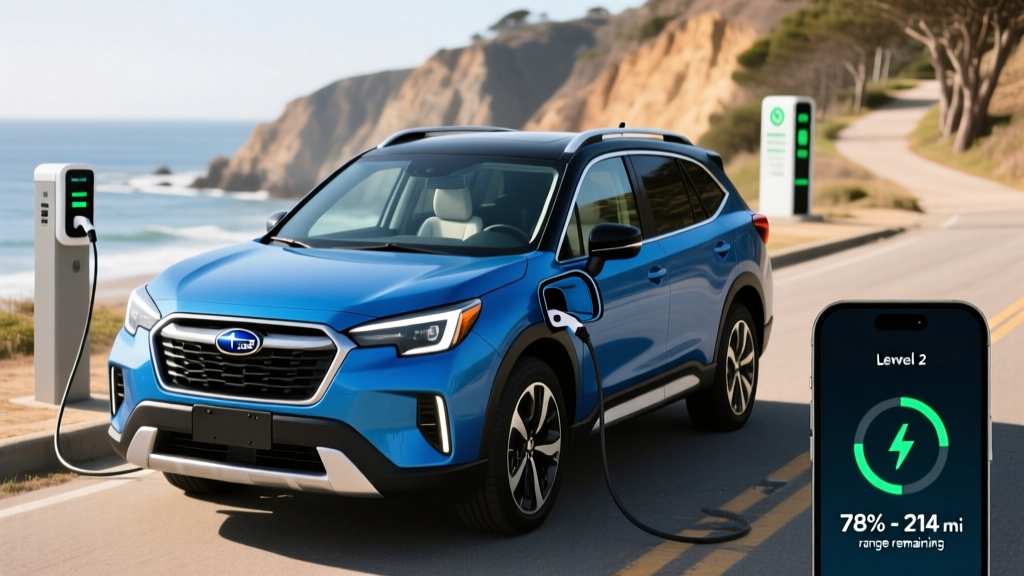
The 2023 Subaru Solterra Touring is the brand's first battery-electric vehicle, co-developed with Toyota (which sells the mechanically identical bZ4X). It delivers genuine Subaru all-weather credibility with standard dual-motor AWD, 8.3 inches of ground clearance, and a well-tuned suspension for rough roads. But the headline number — 222 miles of EPA-estimated range on the Touring trim — puts it at a disadvantage against rivals like the Hyundai Ioniq 5 (303 mi), Ford Mustang Mach-E (250–312 mi), and Volkswagen ID.4 (275 mi).
If your daily commute is under 80 miles round-trip and you value all-weather traction, off-pavement capability, and Subaru's safety reputation, the Solterra Touring is a solid pick. If road trips and maximum range top your priority list, competitors offer significantly more buffer.
EPA Estimate: 222 miles (Touring trim, 20" wheels)
Real-World Highway (70 mph, mild weather): ~185–200 miles
Real-World Cold Weather (below 32°F): ~155–175 miles
City/Mixed Driving: ~200–215 miles
The Solterra's boxy shape, 20-inch alloy wheels on the Touring trim, and relatively small 71.4 kWh battery pack conspire to limit range. Subaru includes a usable battery buffer that protects long-term health but reduces the window you can actually access. Expect meaningful range loss on sustained highway drives and in freezing temperatures — a pattern common to all EVs, but more acute here given the starting EPA figure.
Spec Table: 2023 Subaru Solterra Touring at a Glance
| Specification | Value |
|---|---|
| EPA Range | 222 miles (Touring, 20" wheels) |
| Battery Capacity (Usable) | 71.4 kWh |
| Battery Chemistry | NMC (Nickel Manganese Cobalt) lithium-ion |
| Drivetrain | Dual-motor AWD (X-MODE) |
| Horsepower | 215 hp combined |
| Torque | 248 lb-ft |
| 0–60 mph | 6.5 seconds |
| EPA Efficiency | 111 MPGe combined (30 kWh/100 mi) |
| Max DC Fast-Charge Rate | ~100 kW (peak, CCS1 connector) |
| 10–80% DC Fast Charge | ~56 minutes (estimated) |
| Level 2 Home Charging | 6.6 kW onboard charger (~25 mi/hr) |
| Ground Clearance | 8.3 inches |
| Cargo Volume (behind rear seats) | 23.8 cu ft |
| Cargo Volume (rear seats folded) | 56.9 cu ft |
| Rear Legroom | 35.7 inches |
| Battery Warranty | 8 years / 100,000 miles |
| Base MSRP (Touring) | $53,220 (including destination) |
Source: EPA fueleconomy.gov, Subaru of America
Charging: Where the Solterra Falls Short
Charging speed is arguably the Solterra Touring's most significant limitation for road-trip use. The DC fast-charging system peaks at approximately 100 kW under ideal thermal conditions — but real-world testing by multiple outlets shows the charge curve tapers aggressively. The battery management system prioritizes battery longevity over charging speed, which means:
- Peak rate (~100 kW) is only sustained briefly in the 10–30% state-of-charge window
- Average rate across a 10–80% session drops closer to 55–65 kW
- 10–80% time stretches to roughly 56 minutes — compared to 18 minutes in an Ioniq 5 or 25 minutes in a Mach-E
| Charging Level | Power | Approx. Miles Added Per Hour | Notes |
|---|---|---|---|
| Level 1 (120V household) | 1.2 kW | ~4 miles/hr | Emergency/trickle only |
| Level 2 (240V home) | 6.6 kW | ~25 miles/hr | Full charge in ~11 hours |
| DC Fast Charge (CCS1) | ~100 kW peak | N/A | 10–80% in ~56 min; heavy taper |
For home charging, the 6.6 kW onboard charger is adequate — plug in overnight and you'll wake up with a full battery. But on the road, the slow DC charge curve means longer stops at Electrify America, EVgo, or ChargePoint stations. Subaru includes one year of complimentary charging with EVgo (up to $300 credit), which helps offset the inconvenience but doesn't change the physics.
Preconditioning note: The Solterra does not offer a manual battery preconditioning toggle for DC fast charging. The vehicle will warm the battery automatically when a DC charger is set as a navigation destination, but the system is less aggressive than competitors like Tesla or Hyundai/Kia, contributing to the slower charge speeds — especially in cold weather.
Performance and Driving Impressions
The Solterra Touring's dual-motor AWD powertrain produces 215 horsepower and 248 lb-ft of torque. The 0–60 mph sprint takes approximately 6.5 seconds — adequate for merging and passing, but noticeably slower than the Mustang Mach-E Premium AWD (5.1 sec) or Ioniq 5 AWD (5.0 sec).
Where the Solterra genuinely excels is off-pavement and in adverse conditions. Subaru's X-MODE with Hill Descent Control, 8.3 inches of ground clearance, and a well-calibrated torque-vectoring AWD system give it legitimate light-trail credibility that no other mainstream EV crossover matches. Snow, gravel, and muddy forest roads are where this vehicle makes its strongest case.
Ride quality is firm but controlled. The Touring trim's 20-inch wheels trade some ride compliance for style; the lower trims with 18-inch wheels ride slightly better over broken pavement. Steering is light and accurate, and the regenerative braking system offers adjustable levels via paddle shifters — though it doesn't achieve true one-pedal driving at low speeds the way a Nissan LEAF or Chevrolet Bolt does.
Interior, Tech, and Cargo
The Touring trim is the Solterra's top-tier offering, and it shows in the materials and features list. Standard equipment includes:
- 12.3-inch touchscreen infotainment with wireless Apple CarPlay and Android Auto
- Harman Kardon 9-speaker premium audio
- Heated and ventilated front seats; heated rear seats
- Heated steering wheel
- Panoramic fixed glass roof
- SofTex/leatherette upholstery (no genuine leather option)
- Wireless phone charging pad
- 360-degree surround-view camera
- Digital rearview mirror
The infotainment system, shared with the Toyota bZ4X, is functional but unremarkable. Menu structures are logical, but response times lag behind Tesla's or Hyundai's interfaces. Physical knobs for climate control are a welcome inclusion.
Cargo space is a weak point. At 23.8 cubic feet behind the rear seats and 56.9 cu ft with seats folded, the Solterra trails the Ioniq 5 (27.2 / 59.3 cu ft) and the Mach-E (29.7 / 59.7 cu ft). There is no front trunk (frunk) — the space under the hood houses power electronics. For a vehicle with a 104.5-inch wheelbase, interior packaging is surprisingly tight.
Rear-seat legroom of 35.7 inches is acceptable for adults on shorter trips but falls short of the Ioniq 5's class-leading 39.4 inches. The flat floor (no transmission tunnel) helps middle-seat comfort.
Pricing, Trims, and Federal Tax Credit Eligibility
The 2023 Subaru Solterra was offered in three trims. Here's the MSRP breakdown at launch (prices include $1,220 destination charge):
| Trim | MSRP | §30D Credit Eligibility | Effective Price (if eligible) |
|---|---|---|---|
| Premium | $46,220 | Up to $7,500* | ~$38,720 |
| Limited | $49,920 | Up to $7,500* | ~$42,420 |
| Touring | $53,220 | Up to $7,500* | ~$45,720 |
*Federal §30D tax credit eligibility is subject to multiple requirements per IRS rules:
- MSRP cap: SUVs must be at or below $80,000 — the Solterra qualifies.
- Buyer income cap: AGI must not exceed $150,000 (single), $225,000 (head of household), or $300,000 (joint).
- Battery sourcing: Critical minerals and battery component requirements phase in annually. The Solterra's battery, manufactured by Panasonic in Japan with globally sourced minerals, has faced evolving compliance status. Check the latest fueleconomy.gov tax credit list for the current determination.
- Point-of-sale transfer: Beginning in 2024, buyers can transfer the credit to the dealer at purchase for an immediate price reduction. For 2023 model-year purchases made in 2023, the credit was claimed on the buyer's tax return.
Important: Tax credit eligibility changes frequently as battery-sourcing rules tighten. Consult a tax professional and verify on IRS.gov before making a purchase decision based on the credit.
Warranty and Ownership Costs
Subaru provides the following warranty coverage for the Solterra:
- Battery: 8 years / 100,000 miles (capacity retention threshold: 70%)
- Powertrain: 5 years / 60,000 miles
- Bumper-to-bumper: 3 years / 36,000 miles
- Roadside assistance: 3 years / 36,000 miles
The 70% capacity retention threshold over 8 years is industry-standard, matching Hyundai, Toyota, and most competitors. Tesla offers a slightly better 70% over 8 years/120,000 miles for the Model Y.
Insurance costs for the Solterra Touring tend to run 10–20% higher than the average compact SUV, reflecting the EV premium and repair-cost patterns for battery-electric vehicles. Get quotes before purchasing — your mileage will vary by state, driving record, and carrier.
Maintenance is minimal compared to gas vehicles: no oil changes, no spark plugs, no transmission fluid. Cabin air filter replacement, tire rotation, brake fluid checks, and wiper fluid are the primary scheduled items. Subaru recommends service intervals every 12 months or 12,000 miles.
Pros and Cons
- Standard dual-motor AWD with genuine off-pavement capability (X-MODE, 8.3" ground clearance)
- Excellent safety features (standard EyeSight, IIHS Top Safety Pick+ when tested)
- Comfortable, well-built interior on Touring trim with premium features
- Competitive pricing for a fully loaded AWD EV before tax credit
- Strong cold-weather drivetrain performance and traction
- Physical climate control knobs and straightforward infotainment
- EPA range of 222 mi trails most competitors by 50–80 miles
- DC fast charging peaks at ~100 kW with heavy taper; 10–80% takes ~56 min
- No front trunk (frunk) for additional storage
- Cargo volume (23.8 cu ft) below segment average
- Rear legroom tight for the class at 35.7 inches
- No manual battery preconditioning for faster DC charging
- 215 hp feels modest at this price point
Who Should Buy the Solterra Touring?
The 2023 Subaru Solterra Touring is best suited for:
- Snow-belt commuters who prioritize AWD traction and cold-weather confidence over maximum range
- Outdoor enthusiasts who need ground clearance for forest roads, trailheads, and ski-resort parking lots
- Subaru loyalists transitioning to electric who value brand continuity, dealer relationships, and EyeSight safety tech
- Two-car households where the Solterra handles daily commuting (under 80 miles round-trip) while a second vehicle covers long road trips
It is not the right choice for:
- Single-vehicle households that frequently drive 200+ miles between charges
- Buyers who prioritize fast DC charging for road-trip efficiency
- Those who need maximum cargo and rear-seat space for growing families
Frequently Asked Questions
What is the real-world range of the 2023 Subaru Solterra Touring?
In mixed real-world driving, expect 185–215 miles depending on conditions. Highway driving at 70+ mph reduces range to approximately 185–200 miles. In freezing temperatures (below 32°F), range can drop to 155–175 miles due to battery chemistry limitations and cabin heating demand. The EPA estimate of 222 miles is achievable primarily in mild-weather city driving with regenerative braking.
How fast does the Solterra charge at home and on the road?
On a Level 2 home charger (240V, 6.6 kW), the Solterra gains roughly 25 miles of range per hour, taking about 11 hours for a full charge — ideal for overnight charging. On DC fast chargers, the peak rate is approximately 100 kW, but the charge curve tapers heavily, resulting in a 10–80% session of roughly 56 minutes. This is significantly slower than the Hyundai Ioniq 5 (~18 min) or Kia EV6 (~18 min) on 350 kW chargers.
Does the 2023 Subaru Solterra qualify for the $7,500 federal EV tax credit?
The Solterra's MSRP is below the $80,000 SUV cap, so it clears the price requirement. However, the §30D credit also depends on buyer income limits (AGI caps of $150K–$300K depending on filing status) and battery component/critical mineral sourcing rules that have evolved since 2023. The Solterra's Panasonic battery, manufactured in Japan, has faced changing compliance determinations. Always verify current eligibility on IRS.gov and consult a tax professional.
Is the Solterra Touring worth buying over the Hyundai Ioniq 5 or Ford Mustang Mach-E?
If all-weather AWD capability and off-pavement confidence are your top priorities, the Solterra has no direct rival. But if range, charging speed, and interior space matter more, the Ioniq 5 (303 mi range, 18-min DC charging, 39.4" rear legroom) and the Mach-E (up to 312 mi range, faster charging) are objectively more practical EVs. The Solterra wins on snow and trails; it loses on road trips and cargo.
Does the Solterra have a frunk (front trunk)?
No. The space under the hood is occupied by power electronics and the front motor. All cargo must go in the rear hatch area (23.8 cu ft) or the cabin. This is a notable omission compared to the Ioniq 5, Mach-E, and Tesla Model Y, all of which offer front storage.
What is the battery warranty on the Solterra?
Subaru covers the high-voltage battery for 8 years or 100,000 miles, whichever comes first, against defects and capacity loss below 70% of original capacity. This matches the industry standard set by most mainstream automakers.