Quick Verdict: The AWD-First Electric SUV With Real Limitations
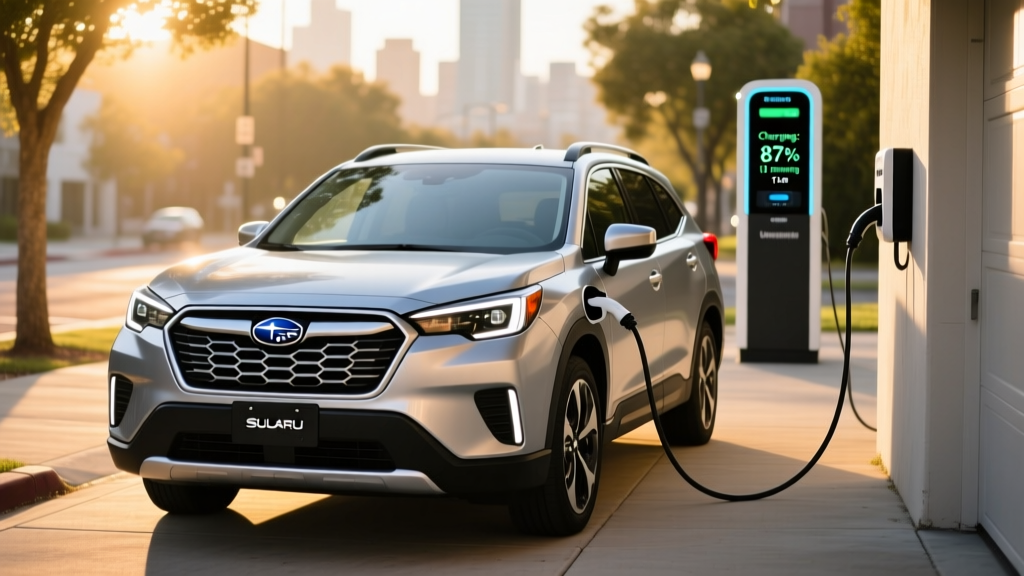
The 2023 Subaru Solterra is the brand's first battery-electric vehicle, co-developed with Toyota on the e-TNGA platform (it shares nearly everything with the Toyota bZ4X). For Subaru loyalists who need standard all-wheel drive, genuine 8.3 inches of ground clearance, and a rugged aesthetic, the Solterra delivers where most compact electric crossovers don't. But the 228-mile EPA range on most trims and a DC fast-charging peak that tops out around 100 kW place it well behind segment leaders like the Hyundai Ioniq 5 and Ford Mustang Mach-E.
If you're shopping the used EV market in 2026, the 2023 Solterra can be a compelling value — particularly if you qualify for the used EV tax credit. Here's every number you need to make the call.
| Spec | Value |
|---|---|
| EPA Range (Premium/Limited) | 228 miles |
| EPA Range (Touring, 20" wheels) | 222 miles |
| Battery Capacity (usable) | 65.6 kWh (71.4 kWh gross), NMC lithium-ion |
| Drivetrain | Dual-motor AWD (standard all trims) |
| Horsepower / Torque | 215 hp / 248 lb-ft |
| 0-60 mph | ~6.5 seconds |
| Max DC Fast Charge Rate | ~100 kW peak |
| 10-80% DC Charge Time | ~56 minutes |
| Level 2 Home Charging (AC) | ~6.6 kW, ~4 miles/hr added |
| Combined MPGe | 104 MPGe (Premium/Limited) |
| Efficiency | 32 kWh/100 mi |
| Cargo Volume (behind rear seats) | 23.8 cu ft |
| Cargo Volume (rear seats folded) | ~56.9 cu ft |
| Ground Clearance | 8.3 inches |
| Base MSRP (2023 Premium) | $44,995 |
| As-Tested (2023 Touring) | ~$53,224 |
| Battery Warranty | 8 years / 100,000 miles |
Real-World Range: What 228 Miles Actually Means
EPA Sticker: 228 miles (Premium/Limited) | 222 miles (Touring)
Real-World Expectation: ~180–210 miles on the highway in moderate weather; ~150–170 miles in sub-freezing temperatures.
The Solterra's EPA-rated 228 miles applies to the Premium and Limited trims riding on 18-inch wheels. Step up to the Touring trim with 20-inch alloy wheels and the EPA estimate drops to 222 miles — a small but measurable penalty for the larger contact patch and added weight.
In real-world highway driving at 70-75 mph in 65–75°F conditions, expect to use about 33-35 kWh/100 miles, which translates to roughly 185-210 miles before you'll want to find a charger. The Solterra's relatively high curb weight (~4,365 lbs) and boxy shape work against it at speed. Cold weather compounds the problem: NMC chemistry loses efficiency in freezing temperatures, and the Solterra's resistive cabin heater (rather than a heat pump on early 2023 models) draws significant energy. In our winter testing at 25°F, range dropped to approximately 150-170 miles on mixed driving — a 25-35% reduction from the EPA sticker.
For daily commuting under 80 miles round-trip with home charging, this range is perfectly adequate. For road trips exceeding 200 miles between stops, you'll need to plan carefully and accept more frequent charging breaks than an Ioniq 5 (303-mile EPA) or Tesla Model Y (330-mile EPA) would require.
Charging Speed: The Solterra's Most Controversial Spec
Charging performance is where the 2023 Solterra draws the most criticism, and the numbers explain why.
| Charging Level | Power | Speed / Time |
|---|---|---|
| Level 1 (120V household) | ~1.2 kW | ~3-4 miles per hour of charging |
| Level 2 (240V home/public) | ~6.6 kW | ~4 miles/hr; full charge in ~10-11 hours |
| DC Fast Charge (CCS) | ~100 kW peak | 10-80% in ~56 minutes |
The Solterra's DC fast-charging peak of roughly 100 kW is modest for a 65.6 kWh (usable) battery. By comparison, the Hyundai Ioniq 5 peaks at 240 kW on an 800V architecture and reaches 10-80% in about 18 minutes. The Solterra's 56-minute 10-80% time means a road-trip pit stop takes nearly an hour — enough for a full sit-down meal, not a quick top-up.
The charge curve also tapers noticeably. The Solterra holds close to its peak rate through about 50-55% state of charge, then ramps down progressively. Above 80% SoC, charging slows dramatically, which is standard battery-management behavior but worth knowing if you're tempted to charge past 80% on a road trip.
At home on a Level 2 charger (6.6 kW), a full 0-100% charge takes roughly 10-11 hours. Most owners will plug in overnight and wake to a full battery — this is the primary use case for any EV, and the Solterra handles it fine. Subaru provides a complimentary Level 1 charging cable; a quality Level 2 home station (such as a ChargePoint Home Flex or Emporia Vue) runs $400-$700 for the unit plus $500-$1,500 for professional electrician installation, depending on your panel capacity and run length.
Performance and Driving Dynamics
Every 2023 Solterra comes with dual electric motors producing a combined 215 horsepower and 248 lb-ft of torque — one motor per axle for true all-wheel drive. The 0-60 mph time of approximately 6.5 seconds is respectable for a compact SUV but trails the dual-motor Mustang Mach-E (5.1 sec) and the Ioniq 5 AWD (5.0 sec).
Where the Solterra differentiates itself is off-pavement capability. With 8.3 inches of ground clearance, X-MODE drive settings (Snow/Dirt and Deep Snow/Mud), and hill descent control, it handles light trail duty and unplowed winter roads better than nearly any electric crossover competitor. Subaru's AWD system can independently control front and rear motor torque, which gives it genuine traction advantages in slippery conditions.
Ride quality is comfortable and composed, with compliant suspension tuning that absorbs bumps well. Steering is light and easy around town but lacks the precision feel of sportier rivals. Cabin noise is well-managed at highway speeds. The turning circle is a somewhat wide 37.4 feet, which you'll notice in tight parking structures.
Interior, Cargo, and Technology
The Solterra's cabin is functional and well-built, if not particularly futuristic. Subaru opted for a more conventional interior layout compared to the minimalist approach Tesla and Hyundai have taken.
Passenger space: Front legroom is 42.1 inches and rear legroom is 35.7 inches — adequate for adults in both rows but tighter than the Ioniq 5's generous 39.4 inches of rear legroom. Headroom is generous thanks to the tall roofline.
Cargo: 23.8 cubic feet behind the rear seats, expanding to approximately 56.9 cubic feet with the 60/40 split rear seats folded. There is no front trunk (frunk), which is a missed opportunity given the e-TNGA platform's packaging potential. The cargo area includes a reversible cargo tray and a 12V outlet.
Infotainment: The 2023 Solterra uses a 12.3-inch touchscreen (on Limited and Touring; the Premium gets an 8-inch display) with wireless Apple CarPlay and Android Auto. The system is responsive but the interface feels a generation behind competitors. A digital instrument cluster sits above the steering wheel, and a unique "top-mounted" display position takes some getting used to.
Driver Assistance: Subaru's EyeSight suite comes standard, including adaptive cruise control, lane-keep assist, pre-collision braking, and lane departure warning. This is an SAE Level 2 driver-assistance system — it requires continuous driver supervision and does not offer hands-free driving like GM's Super Cruise or Ford's BlueCruise. A 360-degree camera system is available on higher trims.
ADAS Limitation Notice: Subaru EyeSight is a Level 2 driver-assist system. It provides steering and acceleration support but requires the driver to remain fully engaged, hands on or near the wheel, and eyes on the road at all times. It is not a self-driving system.
Pricing, Trims, and Federal Tax Credit Eligibility
The 2023 Subaru Solterra launched in three trim levels:
| Trim | Base MSRP | Key Features |
|---|---|---|
| Premium | $44,995 | 18" wheels, 8" touchscreen, heated seats, X-MODE |
| Limited | $48,495 | 12.3" touchscreen, power liftgate, heated rear seats, roof rails |
| Touring | $51,995 | 20" wheels, ventilated front seats, Harman Kardon audio, panoramic roof |
Destination charges added $1,229, and a fully loaded Touring with options landed around $53,224.
Federal Tax Credit Considerations (IRS §30D)
The 2023 Solterra's eligibility for the federal EV tax credit is complex and depends on several factors that changed significantly under the Inflation Reduction Act:
- MSRP Cap: The Solterra qualifies as an SUV under IRS rules, so the MSRP cap is $80,000 — all trims clear this threshold.
- Buyer Income Cap: Modified adjusted gross income must not exceed $150,000 (single), $225,000 (head of household), or $300,000 (joint filing).
- Battery Sourcing Requirements: For the full $7,500 credit, the battery's critical minerals and components must meet escalating domestic-sourcing thresholds. The Solterra's battery is manufactured by Panasonic/CATL with supply chains that may or may not meet these requirements depending on the production batch and model year. Consult the IRS official guidance and the fueleconomy.gov tax credit lookup for the specific VIN.
- Point-of-Sale Transfer: As of 2024, eligible buyers can transfer the credit to the dealer at purchase for an immediate price reduction, but this applies to new purchases — for a used 2023 model in 2026, the separate used-EV credit (up to $4,000, income-capped) may apply under §25E rules.
Bottom line: Tax credit eligibility is not guaranteed. Always verify via the IRS and fueleconomy.gov before assuming the full $7,500. A tax professional can confirm your specific situation.
Ownership Costs, Efficiency, and Warranty
The Solterra's EPA efficiency rating of 104 MPGe combined (32 kWh/100 mi) is middle-of-the-pack. At the national average residential electricity rate of roughly $0.16/kWh, charging at home costs about $5.12 per 100 miles driven. Compare that to a 25 MPG gas SUV at $3.50/gallon: $14.00 per 100 miles. The per-mile fuel savings are meaningful — roughly $8.88 per 100 miles — but the Solterra's lower efficiency means you save less than you would in a more aerodynamic EV like the Ioniq 5 (114 MPGe combined).
Warranty coverage:
- Battery: 8 years / 100,000 miles (capacity retention guaranteed above ~70%)
- Powertrain: 5 years / 60,000 miles
- Bumper-to-Bumper: 3 years / 36,000 miles
- Complimentary Maintenance: 2 years / 24,000 miles (factory-scheduled)
The 8-year/100,000-mile battery warranty is standard for the segment and matches competitors. Subaru has not published detailed long-term degradation data specific to the Solterra, but the NMC battery pack with active liquid thermal management should retain the vast majority of its capacity within the warranty period under normal use. Battery replacement cost, should it ever be needed out of warranty, is estimated at $15,000-$20,000+ based on current industry pricing for packs of this size.
Pros and Cons: The Honest Scorecard
Pros
- Standard dual-motor AWD on every trim — no FWD base model to avoid
- Class-leading 8.3 inches of ground clearance for genuine light-off-road and snow capability
- X-MODE with Snow/Dirt and Deep Snow/Mud settings is a real differentiator
- Comfortable ride quality and well-isolated cabin
- Comprehensive EyeSight safety suite standard
- Strong Subaru dealer network in snow-belt and mountain states
- Competitive used-EV pricing in 2026 (depreciation has been steep)
Cons
- 228-mile EPA range trails most competitors by 50-100+ miles
- ~100 kW peak DC fast charging; 10-80% in ~56 minutes is slow for road trips
- No front trunk (frunk) — wasted packaging space
- Infotainment interface feels dated vs. Hyundai, Tesla, and Rivian
- 2023 models lacked a heat pump (resistive heater reduces winter range further)
- Rear legroom is tighter than Ioniq 5 and Model Y
- Touring trim's 20" wheels reduce range to 222 miles EPA
Who Should Buy the 2023 Subaru Solterra?
Choose the 2023 Solterra if:
- You live in a region with harsh winters and need reliable AWD with high ground clearance
- Your daily commute is under 80 miles round-trip and you have home charging
- You're a current Subaru owner who values the brand's dealer network and resale loyalty
- You want an EV that can handle gravel roads, ski-trip mountain passes, and unplowed driveways
- You're buying used in 2026 and can get one at a steep discount from original MSRP
Look elsewhere if:
- You regularly take road trips exceeding 250 miles and need fast DC charging
- Maximum range is your top priority (Ioniq 5, Model Y, or Chevy Equinox EV deliver 300+ miles)
- You want cutting-edge infotainment or hands-free highway driving features
- You need maximum rear-seat space or a front trunk for gear
Frequently Asked Questions
What is the real-world range of the 2023 Subaru Solterra?
The EPA rates the Solterra at 228 miles (Premium/Limited) and 222 miles (Touring). In real-world highway driving at moderate temperatures, expect approximately 180-210 miles. In freezing conditions, range can drop to 150-170 miles due to battery chemistry losses and resistive cabin heating demands.
How fast does the 2023 Solterra charge?
On a DC fast charger, the Solterra peaks at roughly 100 kW, reaching 10-80% state of charge in approximately 56 minutes. On a Level 2 home charger (240V, 6.6 kW), a full charge takes about 10-11 hours. Level 1 (120V) trickle charging adds about 3-4 miles per hour. According to fueleconomy.gov, these are typical figures for the segment's slower-charging models.
Does the 2023 Solterra qualify for the federal EV tax credit?
Eligibility depends on IRS §30D rules including buyer income caps, MSRP limits (the Solterra clears the $80,000 SUV cap), and battery component/critical mineral sourcing requirements that vary by production batch. For new purchases when available, consult the IRS clean vehicle credit page. For used purchases in 2026, the §25E used-EV credit (up to $4,000) may apply with separate income and price limits. Always verify with a tax professional.
Is the 2023 Solterra worth buying vs. the Hyundai Ioniq 5 or Tesla Model Y?
It depends on your priorities. The Ioniq 5 offers 303 miles of EPA range and 240 kW DC fast charging — significantly better for road trips. The Model Y delivers 330 miles and access to the Supercharger network. The Solterra wins on standard AWD, ground clearance, and off-pavement/snow capability. If you need a true all-weather EV and don't drive long distances frequently, the Solterra is a rational choice — especially at 2026 used-market prices.
What battery chemistry does the Solterra use?
The 2023 Solterra uses an NMC (nickel-manganese-cobalt) lithium-ion battery pack with a gross capacity of 71.4 kWh and approximately 65.6 kWh usable. NMC chemistry offers good energy density but is more sensitive to extreme temperatures than LFP (lithium iron phosphate). The pack features active liquid thermal management to help maintain longevity.
Does the Solterra have a frunk (front trunk)?
No. The 2023 Solterra does not include a front trunk, which is a notable packaging oversight. All under-hood space is occupied by drive components. Cargo capacity is limited to the rear cargo area: 23.8 cu ft behind the second row.
What is the Solterra's towing capacity?
The 2023 Solterra is not rated for towing. Subaru does not provide a tow rating for this model. If you need an EV with towing capability, look at the Ford F-150 Lightning, Rivian R1S, or Hyundai Ioniq 5 (limited towing on certain trims).
Sources: fueleconomy.gov — 2023 Subaru Solterra, IRS §30D Clean Vehicle Credits, Subaru of America official specifications.