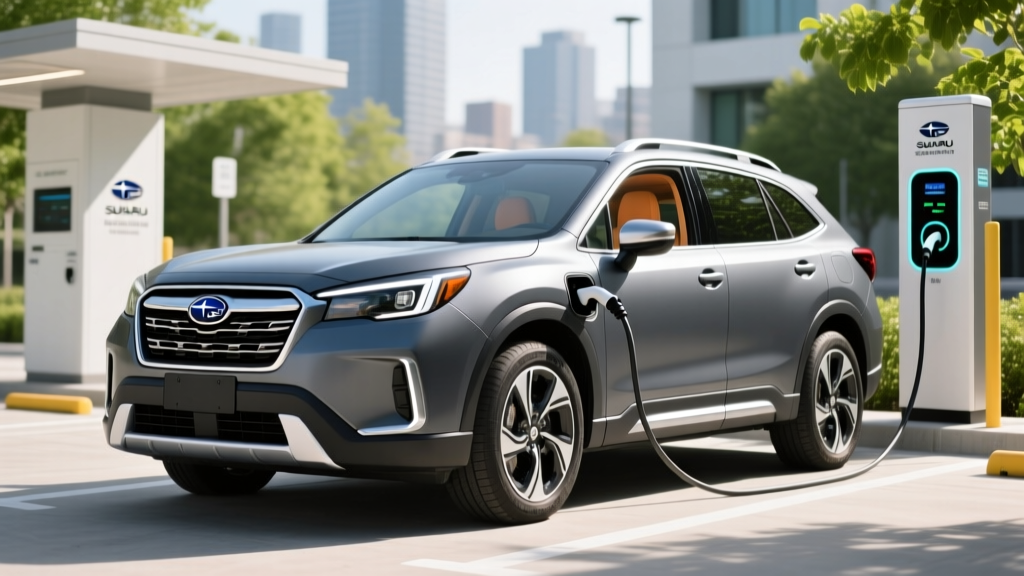
The 2023 Subaru Solterra Limited arrived as the brand's first ground-up battery-electric vehicle, co-developed with Toyota on the e-TNGA platform (its twin is the Toyota bZ4X). For a company built on all-weather credibility and outdoorsy loyalty, the Solterra carries heavy expectations. The Limited trim — the top of a two-trim lineup — bundles premium features like a panoramic fixed-glass roof, heated and ventilated front seats, a 360-degree camera, and Subaru's full EyeSight driver-assist suite. But how does it stack up where EV buyers actually decide: range, charging speed, and total cost?
This review breaks down every spec that matters, reconciles the EPA sticker with real-world driving, and clarifies the federal tax credit picture under current IRS §30D rules. If you're evaluating a used or remaining-new 2023 Solterra Limited in 2026, here's the data you need.
Range, Battery, and Efficiency: The Numbers That Matter
The 2023 Solterra Limited uses a 71.4 kWh usable lithium-ion battery pack with NMC (nickel manganese cobalt) chemistry. Subaru rates the Limited trim — which rides on 20-inch alloy wheels — at 222 miles EPA estimated range. The lower Premium trim, on 18-inch wheels, ekes out 228 miles EPA. Both figures trail the EV compact-SUV segment average, which has climbed toward 260-300 miles for competitors like the Hyundai Ioniq 5 and Volkswagen ID.4.
- EPA sticker: 222 miles
- Real-world highway (65-75 mph, moderate weather): ~185-200 miles
- Real-world city/mixed driving: ~200-215 miles
- Cold weather (below 32°F, cabin heat on): ~150-175 miles (25-35% reduction)
The Solterra's efficiency penalty comes from its standard all-wheel-drive system (all trims are dual-motor AWD), relatively heavy curb weight of ~4,365 lbs, and the 20-inch wheels on the Limited that increase rolling resistance. If your daily commute is under 60 miles round-trip and you charge at home, the range is workable. For road trips exceeding 180 miles, plan one DC fast-charge stop.
Efficiency is rated at 104 MPGe combined (111 city / 97 highway), which translates to roughly 32 kWh per 100 miles. That's on the thirstier side of the segment — the Ioniq 5 RWD achieves 132 MPGe combined, for comparison. Source: fueleconomy.gov.
| Spec | Value |
|---|---|
| EPA Range | 222 miles |
| Battery (usable) | 71.4 kWh, NMC chemistry |
| Drivetrain | Dual-motor AWD (X-MODE) |
| Horsepower | 215 hp combined |
| Torque | 248 lb-ft |
| 0-60 mph | 6.5 seconds (est.) |
| Max DC Fast Charge | 100 kW (peak) |
| 10-80% DC Charge Time | ~56 minutes |
| Level 2 Charge Rate | 6.6 kW (onboard charger) |
| Efficiency | 104 MPGe / 32 kWh/100mi |
| Cargo Volume | 23.8 cu ft (rear seats up) / 56.9 cu ft (folded) |
| Base MSRP (Limited) | $53,295 (2023 launch MSRP) |
| Battery Warranty | 8 years / 100,000 miles |
Charging Speed: DC Fast, Level 2, and the Curve Reality
Charging is where the 2023 Solterra draws the most criticism from EV analysts, and the data bears it out. The maximum DC fast-charge rate is 100 kW peak — a figure that was middling at launch and looks increasingly dated as competitors push 150-350 kW architectures.
| Charging Level | Power (kW) | Speed (miles of range per hour) | Typical Use Case |
|---|---|---|---|
| Level 1 (120V household) | ~1.2 kW | ~3-4 mi/hr | Emergency/trickle top-off |
| Level 2 (240V, 32A) | 6.6 kW | ~20-22 mi/hr | Home overnight, workplace |
| DC Fast Charge (CCS) | 100 kW peak | ~180-200 mi/hr (at peak) | Road trips, public stations |
The 10-80% DC fast-charge time is approximately 56 minutes, which is slow by 2026 standards. The Hyundai Ioniq 5 (800V architecture) does 10-80% in roughly 18 minutes; the Tesla Model Y on V3 Superchargers achieves it in about 25-27 minutes. The Solterra's charge curve is relatively flat — it sustains near-peak power longer than some rivals, but the low peak ceiling is the bottleneck.
For home Level 2 charging on a 240V/32A circuit, the 6.6 kW onboard charger replenishes the full 71.4 kWh battery in roughly 11 hours. Most owners charging overnight from 20-80% daily will find this perfectly adequate. However, if your electrical panel supports a 48A circuit, the Solterra won't take advantage of it — the 6.6 kW onboard charger is the limit.
One practical note: the Solterra uses the CCS1 connector for DC fast charging and J1772 for Level 2. As the industry shifts toward NACS (Tesla's connector), Subaru has not announced a retrofit adapter for 2023 models as of early 2026, though third-party CCS-to-NACS adapters are becoming available. Check with your local Subaru dealer for compatibility updates.
Performance and Driving Dynamics
Every 2023 Solterra comes with dual electric motors producing a combined 215 horsepower and 248 lb-ft of torque. The front motor contributes 107 hp and the rear motor 107 hp (they're identical units). Subaru estimates 0-60 mph in approximately 6.5 seconds — adequate for merging and passing, but noticeably behind the Tesla Model Y Long Range (4.8s) and Ioniq 5 AWD (5.1s).
Where the Solterra earns its Subaru badge is low-traction confidence. The X-MODE system — adapted from the Outback and Forester — provides selectable Snow/Dirt and Deep Snow/Mud modes, plus Hill Descent Control. Ground clearance is 8.3 inches, which exceeds most electric crossovers and makes light trail use genuinely viable. In winter testing, the Solterra's AWD traction and stability control calibration proved among the best in the EV segment for unplowed roads.
Ride quality is firm but compliant, and the low center of gravity keeps body roll controlled through corners. Steering is light and numb by enthusiast standards, but predictable. The 2,200-pound towing capacity (when properly equipped) is modest but useful for a small utility trailer or bike rack — though towing will cut range by roughly 30-40%.
Interior, Cargo, and Technology
The Solterra Limited's cabin is well-appointed but shows its Toyota-shared roots in some material choices. Standard on the Limited:
- 12.3-inch touchscreen infotainment with wireless Apple CarPlay and Android Auto
- Navigation with EV-specific route planning (incorporates charging stops)
- Harman Kardon 9-speaker premium audio
- Panoramic fixed-glass roof (no shade — a notable drawback in hot climates)
- Heated and ventilated front seats, heated rear seats, heated steering wheel
- Wireless phone charging pad
- 360-degree surround-view camera
- Power liftgate with hands-free operation
Cargo space measures 23.8 cubic feet behind the rear seats and 56.9 cubic feet with the 60/40 split rear seats folded. That's competitive with the Toyota bZ4X but trails the VW ID.4 (30.3 / 64.2 cu ft) and Hyundai Ioniq 5 (27.2 / 59.3 cu ft). There is no front trunk (frunk), which is a missed opportunity given the packaging flexibility of a dedicated EV platform.
Passenger space is generous: 42.1 inches of front legroom and 35.7 inches of rear legroom. The flat floor (no transmission tunnel) makes the rear middle seat usable for adults on shorter trips.
The EyeSight Driver Assist Technology suite is standard and includes adaptive cruise control, lane-centering assist, pre-collision braking, lane-departure warning, and rear automatic braking. This is an SAE Level 2 system — meaning it assists with steering and speed but requires the driver to remain fully engaged and hands on the wheel at all times. It is not autonomous driving.
Pricing, Tax Credit Eligibility, and Total Cost
The 2023 Solterra launched with two trims. The Limited, as the top trim, carried a base MSRP of $53,295 (including destination). With options and dealer accessories, as-tested prices commonly reached $55,000-$57,000.
| Item | Amount |
|---|---|
| Premium Trim MSRP (2023) | $46,295 |
| Limited Trim MSRP (2023) | $53,295 |
| Federal §30D Tax Credit (max) | Up to $7,500 |
| Limited After Max Credit | ~$45,795 |
Federal tax credit eligibility requires careful verification. Under IRS §30D rules (current for the 2023 model year), the Solterra could qualify for up to $7,500, split between a $3,750 critical-minerals component and a $3,750 battery-components component. However, eligibility depends on several buyer- and vehicle-specific factors:
- MSRP cap: SUVs must have an MSRP at or below $80,000 — the Solterra qualifies.
- Buyer income cap: Modified AGI must not exceed $150,000 (single), $225,000 (head of household), or $300,000 (joint). Source: IRS §30D.
- Battery sourcing: Critical minerals and battery components must meet phased-in percentages from US or FTA-partner countries. Subaru confirmed 2023 Solterra battery components met partial requirements, but the exact credit amount ($3,750 vs. $7,500) varied by production batch and model year. Always verify the specific VIN with the IRS portal or a tax professional before purchase.
- Point-of-sale transfer: Beginning in 2024, buyers can transfer the credit to the dealer for an immediate price reduction. For 2023 models purchased in 2023, the credit was claimed on the buyer's federal tax return.
Important for 2026 buyers: If you're purchasing a remaining-new or used 2023 Solterra in 2026, the new-vehicle §30D credit may still apply for unused new inventory, but the used EV credit (up to $4,000 or 30% of sale price, whichever is lower) may be more relevant. Used-EV credit has its own income caps ($75,000 single / $150,000 joint) and requires the vehicle to be at least two model years old and sold by a licensed dealer for $25,000 or less.
Warranty and Long-Term Ownership
Subaru backs the Solterra with competitive warranty coverage:
- Battery warranty: 8 years / 100,000 miles (capacity retention guaranteed above 70%)
- Powertrain warranty: 5 years / 60,000 miles
- Bumper-to-bumper: 3 years / 36,000 miles
- Roadside assistance: 3 years / 36,000 miles
- Complimentary maintenance: 2 years / 24,000 miles (factory scheduled)
The 70% battery capacity retention threshold over 8 years is standard for the industry, though some competitors (like Hyundai/Kia) guarantee 70% over 10 years/100,000 miles. NMC battery degradation data from early Solterra owners suggests typical loss of 5-8% over the first two years, settling into a slower decline — consistent with industry norms for liquid-cooled NMC packs.
Pros, Cons, and the Competition
- Standard AWD with genuine off-road capability (X-MODE, 8.3" ground clearance)
- Excellent winter traction and cold-weather drivability
- Comprehensive EyeSight safety suite standard on all trims
- Comfortable ride quality and spacious cabin
- Strong Subaru dealer network for service in rural/mountain regions
- Panoramic roof and premium features on Limited trim
- Below-average EPA range (222 mi) for the segment and price point
- Slow DC fast charging (100 kW peak, ~56 min 10-80%)
- No front trunk (frunk)
- Panoramic glass roof lacks a sunshade — cabin heat buildup in summer
- Infotainment can feel dated vs. Tesla, Rivian, or Hyundai interfaces
- Higher energy consumption (32 kWh/100mi) raises charging costs
Who Should Buy the 2023 Solterra Limited?
- You live in a cold/snowy climate where AWD traction and ground clearance matter daily
- Your commute is under 80 miles round-trip and you have reliable home Level 2 charging
- You value Subaru's brand reputation, dealer network, and safety engineering
- You want premium features (ventilated seats, Harman Kardon audio, 360° camera) without stepping to a luxury badge
- Light off-road or unpaved-road use is part of your routine
- Road trips over 250 miles are frequent — the range and charge speed will frustrate
- You prioritize maximum range per dollar (consider the Ioniq 5, ID.4, or Tesla Model Y)
- You want the fastest DC charging available for minimal stop times
- You need a frunk or maximum cargo volume for gear-heavy lifestyles
Frequently Asked Questions
What is the real-world range of the 2023 Subaru Solterra Limited?
The EPA rates it at 222 miles, but real-world highway driving at 70 mph typically yields 185-200 miles. In cold weather below freezing, expect 150-175 miles with cabin heating active. City and mixed driving in moderate temperatures gets closest to the EPA figure, around 200-215 miles.
How fast does the 2023 Solterra charge at home and on the road?
At home on a Level 2 (240V) charger, the 6.6 kW onboard charger adds about 20-22 miles of range per hour, fully replenishing the battery in roughly 11 hours. On DC fast chargers, it peaks at 100 kW and takes approximately 56 minutes from 10-80%. This is significantly slower than competitors like the Ioniq 5 (~18 min) or Model Y (~25 min).
Does the 2023 Subaru Solterra qualify for the federal EV tax credit?
It can qualify for up to $7,500 under IRS §30D, but eligibility depends on battery sourcing compliance (which varied by production batch), buyer income limits ($300,000 joint / $150,000 single), and the $80,000 SUV MSRP cap (which the Solterra meets). Always verify the specific vehicle's credit status through the IRS or a tax professional before purchase. For used 2023 models bought in 2026, the separate used-EV credit (up to $4,000) may apply instead.
Is the 2023 Solterra Limited worth buying vs. competitors?
It depends on your priorities. Against the Hyundai Ioniq 5 (303 mi range, 235 kW charging, ~$52K AWD Limited), the Solterra loses on range and charging speed but wins on off-road capability and winter confidence. Against the Tesla Model Y Long Range (330 mi, Supercharger network, ~$48K), the gap in efficiency and charging infrastructure is wide, but the Solterra offers a more traditional driving experience and Subaru's safety reputation. Against the Toyota bZ4X (its platform twin), specs are nearly identical — choose based on brand preference and dealer proximity.
What are the biggest drawbacks of the 2023 Solterra?
The three most-cited limitations are: (1) below-segment range at 222 miles EPA, which shrinks further in cold weather; (2) slow DC fast charging at 100 kW peak, making road trips longer; and (3) the absence of a frunk and a sunshade for the panoramic glass roof. These aren't deal-breakers for a commuter with home charging, but they matter for road-trip-heavy buyers.
What is the battery warranty on the 2023 Solterra?
Subaru provides an 8-year / 100,000-mile battery warranty guaranteeing the pack retains at least 70% of its original capacity. The powertrain is covered for 5 years / 60,000 miles, and bumper-to-bumper coverage runs 3 years / 36,000 miles.
Sources: EPA fueleconomy.gov, IRS §30D Clean Vehicle Credits, Subaru of America.