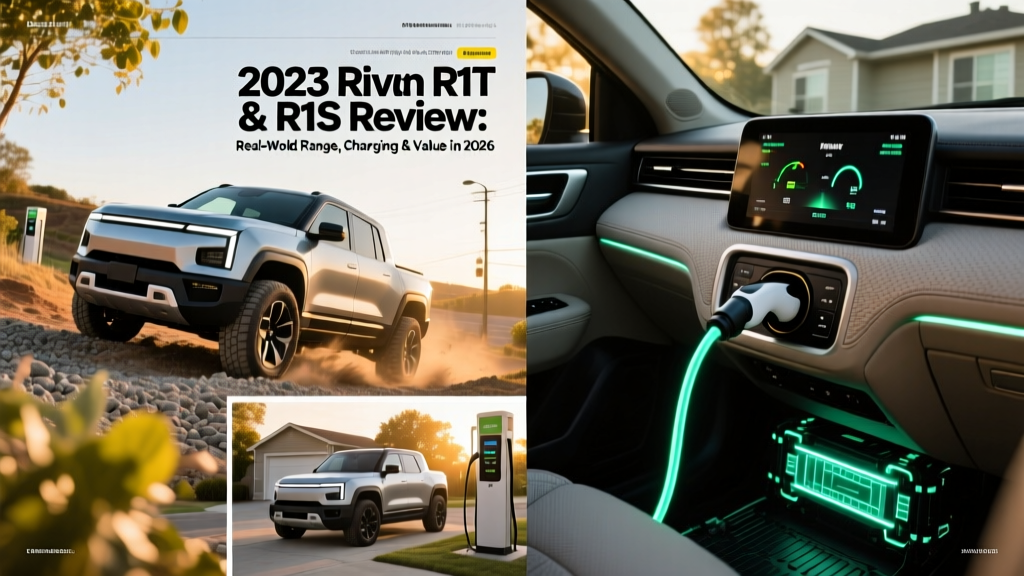
If you searched for a 2023 Rivian today, you are most likely looking at the used-EV market or evaluating whether a 2023 R1T or R1S still holds up against a rapidly evolving 2025–2026 competition set. The 2023 model year was a pivotal one for Rivian: it was the first full calendar year of R1T pickup and R1S SUV production, shipped with the company's original quad-motor and dual-motor powertrains, and carried the large-pack (128.9 kWh) and standard-pack (106 kWh) NMC batteries before the 2025 architecture refresh. This review breaks down exactly what a 2023 Rivian delivers in range, charging, performance, and ownership economics from a 2026 vantage point — including what has aged well and what hasn't.
2023 Rivian Lineup: R1T Pickup and R1S SUV at a Glance
The 2023 Rivian lineup consisted of two vehicles sharing the same skateboard platform: the R1T (a four-door, five-passenger electric pickup with a 4.5-foot bed and Gear Tunnel) and the R1S (a three-row, seven-passenger SUV). Both were offered in Adventure and Exploration packages, with dual-motor and quad-motor configurations, and Standard (106 kWh) or Large (128.9 kWh) battery packs. A Max Pack (149 kWh) was offered on the R1T only.
| Spec | R1T Dual-Motor Large | R1T Quad-Motor Large | R1S Dual-Motor Large | R1S Quad-Motor Large |
|---|---|---|---|---|
| EPA Range | 352 mi | 328 mi | 352 mi | 321 mi |
| Battery (usable) | 128.9 kWh NMC | 128.9 kWh NMC | 128.9 kWh NMC | 128.9 kWh NMC |
| Horsepower | 533 hp | 835 hp | 533 hp | 835 hp |
| 0–60 mph | 4.5 sec | 3.0 sec | 4.6 sec | 3.1 sec |
| Drivetrain | AWD (dual-motor) | AWD (quad-motor) | AWD (dual-motor) | AWD (quad-motor) |
| Max DC Charge Rate | ~200 kW peak | ~220 kW peak | ~200 kW peak | ~220 kW peak |
| 10–80% DCFC Time | ~42 min | ~40 min | ~42 min | ~40 min |
| Level 2 Home Rate | 11.5 kW (~25 mi/hr) | 11.5 kW (~25 mi/hr) | 11.5 kW (~25 mi/hr) | 11.5 kW (~25 mi/hr) |
| Towing Capacity | 11,000 lb | 11,000 lb | 7,700 lb | 7,700 lb |
| Base MSRP (2023) | $73,000 | $87,000 | $78,000 | $92,000 |
Real-World Range: What the EPA Number Doesn't Tell You
Real-World Highway (70 mph, 65°F): ~270–295 miles
Cold-Weather Highway (30°F, cabin heat): ~220–250 miles
Towing (5,000 lb trailer, R1T): ~150–180 miles
The 2023 R1T and R1S carry large NMC lithium-ion packs, but their boxy aerodynamics (the R1T has a Cd around 0.38) and 6,000+ lb curb weights mean efficiency drops sharply at sustained highway speeds. On fueleconomy.gov, the R1T Dual-Motor Large Pack is rated at 70 MPGe combined, which translates to roughly 48 kWh per 100 miles — meaning you'll use more energy per mile than lighter, sleeker EVs like the Tesla Model X or Hyundai Ioniq 5.
In real-world mixed driving (city + suburban + some highway), expect to land within 10% of your EPA sticker. On a pure 70–75 mph interstate run, plan for 80–85% of EPA. In winter conditions with resistive cabin heat (the 2023 models use a heat pump, but it still draws power), expect a 25–35% range reduction at highway speeds. If you plan to tow with the R1T, cut your effective range nearly in half — this is physics, not a Rivian-specific flaw, and applies to every electric pickup on the market.
Charging Speed and Infrastructure
The 2023 Rivian uses the CCS1 connector (Rivian adopted NACS for 2025+ models, so 2023 vehicles require a CCS-to-NACS adapter for Tesla Supercharger access — Rivian has offered these to owners). DC fast-charging peaks around 200–220 kW on the Large Pack, but the charge curve tapers significantly above 80% state of charge, which is typical for NMC chemistry to preserve long-term battery health.
| Level | Power | Miles Added per Hour | Notes |
|---|---|---|---|
| Level 1 (120V) | 1.4 kW | ~3 mi/hr | Emergency/trickle only |
| Level 2 (240V, 48A) | 11.5 kW | ~25 mi/hr | Full overnight charge in ~11–13 hr |
| DC Fast Charge | 200–220 kW peak | ~140 mi in 20 min (10–40%) | Tapers above 80%; 10–80% in ~40 min |
At home on a 48-amp Level 2 charger (the most common residential setup requiring a 60-amp circuit), the 128.9 kWh Large Pack will recharge from near-empty to full in roughly 11–13 hours. For daily use, most owners only need to replenish 50–100 miles overnight, which takes 2–4 hours. Rivian's Wall Connector retailed for around $750, but any J1772/CCS Level 2 unit from ChargePoint, Emporia, or Grizzl-E works identically. Home installation with a 60-amp circuit typically runs $800–$2,000 depending on panel proximity and local permitting.
Performance: Quad-Motor vs Dual-Motor
The 2023 quad-motor Rivians remain some of the quickest production vehicles ever sold. The R1T Quad-Motor hits 60 mph in 3.0 seconds with 835 hp — faster than a Porsche 911 Carrera. The dual-motor variants (533 hp, 4.5 sec to 60) are still genuinely quick and represent the better value proposition for most buyers. Both configurations use a single-speed reduction gear with torque vectoring across axles (quad-motor vectors to individual wheels).
Off-road, the 2023 Rivian offers up to 14.9 inches of ground clearance in Max mode via its air suspension, approach/departure angles that rival dedicated off-roaders, and a wading depth of roughly 3 feet. The quad-motor's individual wheel torque control provides exceptional traction in low-grip scenarios. On pavement, the air suspension delivers a compliant ride, though the R1S's solid rear axle (vs. independent on some competitors) can be felt over sharp bumps at low speed.
Pricing, Trims, and 2026 Federal Tax Credit Eligibility
When new, 2023 Rivians started at $73,000 (R1T Dual-Motor Standard Pack) and climbed past $96,000 for fully optioned Quad-Motor R1S models. On the used market in early 2026, expect to pay roughly $48,000–$72,000 for a 2023 R1T and $52,000–$78,000 for a 2023 R1S, depending on mileage, pack size, and condition.
| Scenario | Approx. Price | Tax Credit Available | Effective Cost |
|---|---|---|---|
| New (original 2023 purchase) | $73,000–$96,000 | Up to $7,500 (§30D, if eligible) | $65,500–$88,500 |
| Used 2023 (dealer, 2026) | $48,000–$78,000 | Up to $4,000 (§25E used-EV credit) | $44,000–$74,000 |
Tax credit rules for buying a used 2023 Rivian in 2026: The IRS §25E used-EV credit offers up to $4,000 (or 30% of the sale price, whichever is less) for qualifying used EVs purchased from a dealer. Key requirements include:
- Sale price must be $25,000 or less to qualify for the full $4,000 (most 2023 Rivians exceed this, so expect a reduced credit or no credit)
- Buyer AGI limits: $75,000 single / $112,500 head of household / $150,000 joint
- Vehicle must be at least 2 model years old (a 2023 model qualifies in 2025+)
- Must purchase from a licensed dealer (private-party sales do not qualify)
- Credit is non-refundable unless transferred at point of sale
Realistically, most 2023 Rivians on the used market in 2026 sell above the $25,000 price cap, meaning many buyers will not qualify for the used-EV credit. If you find one under $25,000 (high-mileage or salvage-title), the credit applies. Consult a tax professional and verify current IRS rules before purchasing.
Cargo, Passenger Space, and Daily Practicality
The R1T's 4.5-foot bed is shorter than a traditional half-ton pickup, but the lockable Gear Tunnel (11.7 cu ft, running between the cab and bed behind the rear seats) adds versatile enclosed storage that no competitor matches. Total cargo volume with the bed and tunnel is roughly 54 cu ft of enclosed space. The R1T also includes a front trunk (frunk) of approximately 11 cu ft.
The R1S offers three rows with seating for seven. Behind the third row: 10.4 cu ft. With the third row folded: 46.7 cu ft. With both rear rows folded: 104.7 cu ft. Second-row legroom is a generous 38.5 inches; third-row legroom is 30.1 inches — suitable for children or short trips but tight for adults on long drives.
Warranty, Battery Longevity, and Ownership Costs
Rivian provides an 8-year/175,000-mile battery and drive unit warranty for 2023 models, which is among the best in the industry (most competitors offer 8-year/100,000-mile). The bumper-to-bumper warranty is 5 years/60,000 miles. The battery warranty guarantees the pack will retain at least 70% of its original capacity during the coverage period.
NMC battery degradation data for Rivian's Large Pack is still maturing — most 2023 models have under 50,000 miles as of 2026. Early owner reports on forums suggest 3–5% degradation in the first 30,000 miles, which is in line with industry norms for liquid-cooled NMC packs. To maximize longevity, Rivian recommends daily charging to 85–90% and only charging to 100% before long trips.
Insurance costs for the 2023 Rivian are higher than average for the EV segment — expect $2,400–$3,600 annually depending on your profile, driven by high repair costs for the aluminum body and proprietary components.
Standout Tech and Notable Drawbacks
The 2023 Rivian ships with a 15.6-inch center touchscreen running Rivian's proprietary OS, a 12.3-inch digital instrument cluster, and a 6.8-inch rear touchscreen for climate controls. The infotainment system is well-designed but does not support Apple CarPlay or Android Auto — a deliberate choice by Rivian that remains a dealbreaker for some buyers. Over-the-air updates have continuously improved the system since launch, adding features like enhanced navigation, camp mode, and pet mode.
Driver assistance is branded as Rivian Driver+, which includes adaptive cruise control, lane centering, and automatic emergency braking. This is a SAE Level 2 system — the driver must remain fully engaged with hands on the wheel and eyes on the road. It is not autonomous driving. Driver+ performs competently on highways but trails Tesla Autopilot and GM Super Cruise in lane-centering smoothness and confidence.
Pros
- Class-leading off-road capability with air suspension and quad-motor torque vectoring
- 8-year/175,000-mile battery warranty exceeds most competitors
- Gear Tunnel (R1T) is a genuinely innovative storage solution
- 328–352 mile EPA range on Large Pack covers most road trips
- Quad-motor 3.0-sec 0–60 is supercar territory in a pickup
- Continuous OTA updates have meaningfully improved the vehicle since delivery
Cons
- No Apple CarPlay or Android Auto support
- CCS connector requires adapter for Tesla Supercharger access
- DC fast-charging peaks at ~220 kW, slower than Hyundai E-GMP (350 kW) or 2025+ Rivian Gen 2
- Third-row space in R1S is tight for adults
- High insurance premiums relative to segment
- Used prices remain elevated; most do not qualify for the $4,000 used-EV credit
Is a 2023 Rivian Worth Buying in 2026?
Buy the 2023 R1T if: You need an electric pickup with genuine off-road chops, towing capability, and the Gear Tunnel for gear-heavy lifestyles (skiing, biking, camping). The Large Pack Dual-Motor offers the best range-to-price ratio.
Buy the 2023 R1S if: You want a three-row electric SUV with more personality and off-road ability than a Tesla Model X, and you don't need best-in-class third-row space.
Look elsewhere if: CarPlay/Android Auto is non-negotiable, you want the fastest possible DC charging, or your budget is under $50,000 (consider a used Tesla Model Y or Ford Mustang Mach-E instead).
Compared to the 2025–2026 Rivian R1T/R1S (Gen 2 with NACS connector, up to 420-mile Max Pack, and ~300 kW peak charging), the 2023 model is a generation behind on charging infrastructure convenience. But it remains an exceptionally capable, well-built vehicle that has aged gracefully thanks to OTA updates. For buyers who can access home Level 2 charging and don't rely exclusively on Tesla Superchargers, the 2023 Rivian is a compelling used-EV option at the right price.
Frequently Asked Questions
What is the real-world range of a 2023 Rivian?
Expect 270–295 miles on the highway (70 mph) with the Large Pack, and 220–250 miles in cold winter conditions. The EPA sticker of 328–352 miles is achievable in mixed city/suburban driving at moderate speeds.
How fast does the 2023 Rivian charge?
On a DC fast charger, the Large Pack peaks at 200–220 kW and charges from 10–80% in approximately 40–42 minutes. At home on Level 2 (11.5 kW), a full charge takes 11–13 hours.
Does a 2023 Rivian qualify for the federal EV tax credit in 2026?
The new-vehicle §30D credit no longer applies to 2023 purchases made in 2026. The used-EV §25E credit (up to $4,000) may apply if the sale price is $25,000 or less, the buyer meets income caps, and the purchase is through a licensed dealer. Most 2023 Rivians sell above the $25,000 threshold.
Is the 2023 Rivian reliable?
Early build-quality issues (panel gaps, software glitches) have been largely addressed through OTA updates and service campaigns. The powertrain and battery have proven robust, and the 8-year/175,000-mile battery warranty provides strong protection. Long-term reliability data beyond 60,000 miles is still limited.
Can a 2023 Rivian use Tesla Superchargers?
Yes, but only with a CCS-to-NACS adapter. Rivian has provided adapters to registered owners, and third-party adapters are also available. Native NACS ports were introduced on the 2025 model year.
How does the 2023 Rivian compare to the Ford F-150 Lightning?
The R1T is more expensive, more powerful (in quad-motor form), and significantly more capable off-road. The F-150 Lightning offers a larger bed (5.5 ft), Pro Power Onboard for job-site use, and generally lower used pricing. Choose the Rivian for adventure and performance; choose the Lightning for work and value.