The 2023 Rivian R1S remains one of the only all-electric three-row SUVs that can genuinely handle off-road trails, tow 7,700 pounds, and still deliver sub-4-second 0-60 times. As a used-EV prospect in 2026, it occupies a unique niche: luxury family hauler with adventure credentials that no Tesla Model X or Hyundai Ioniq 9 can fully match. But with EPA ranges spanning 321 to 400 miles depending on configuration, complex battery chemistries, and evolving federal tax credit rules, buying a 2023 R1S requires precise homework. Here's the data-driven breakdown.
2023 Rivian R1S at a Glance: Specs by Configuration
Rivian offered the 2023 R1S in two battery sizes and two motor configurations, creating four distinct range/performance combinations. The table below captures the exact EPA figures, powertrain specs, and pricing for each variant as originally sold.
| Configuration | Battery (kWh usable) | Chemistry | EPA Range | HP / lb-ft | 0-60 mph | Base MSRP (2023) |
|---|---|---|---|---|---|---|
| Dual-Motor Standard | ~106 kWh (Standard) | NMC (Samsung SDI) | 260 mi | 533 / 610 | 4.5 sec | $78,000 |
| Dual-Motor Large | ~128 kWh (Large) | NMC (Samsung SDI) | 352 mi | 533 / 610 | 4.5 sec | $84,000 |
| Dual-Motor Max Pack | ~149 kWh (Max) | NMC (Samsung SDI) | 400 mi | 533 / 610 | 4.5 sec | $94,000 |
| Quad-Motor Large | ~128 kWh (Large) | NMC (Samsung SDI) | 321 mi | 835 / 908 | 3.0 sec | $99,000 |
All 2023 R1S models use NMC (nickel manganese cobalt) lithium-ion cells supplied by Samsung SDI. Rivian did not offer LFP (lithium iron phosphate) batteries in the R1S lineup for this model year. NMC chemistry provides higher energy density — critical for fitting 149 kWh in the Max Pack — but requires more careful charge management than LFP, which tolerates routine 100% charges better.
Real-World Range: What the EPA Sticker Doesn't Tell You
The Quad-Motor variant's 321-mile EPA rating suffers more noticeably on the highway because four independently driven motors carry a weight penalty (~7,100 lbs curb weight) and parasitic drag. Real-world highway range lands around 265-285 miles in mild conditions. For road-trippers who regularly cover 300+ miles between stops, the Dual-Motor Large or Max Pack is the pragmatic choice — the Quad-Motor trades range for performance and off-road torque vectoring.
According to fueleconomy.gov, the Dual-Motor Large Pack R1S achieves a combined 69 MPGe (equivalent), consuming approximately 49 kWh per 100 miles. That's higher than a Tesla Model X (102 MPGe combined), reflecting the R1S's boxy aerodynamics and heavier curb weight. If efficiency is a priority, the R1S is not the segment leader — but it wasn't designed to be.
Charging Speed: DC Fast, Level 2, and the Curve Reality
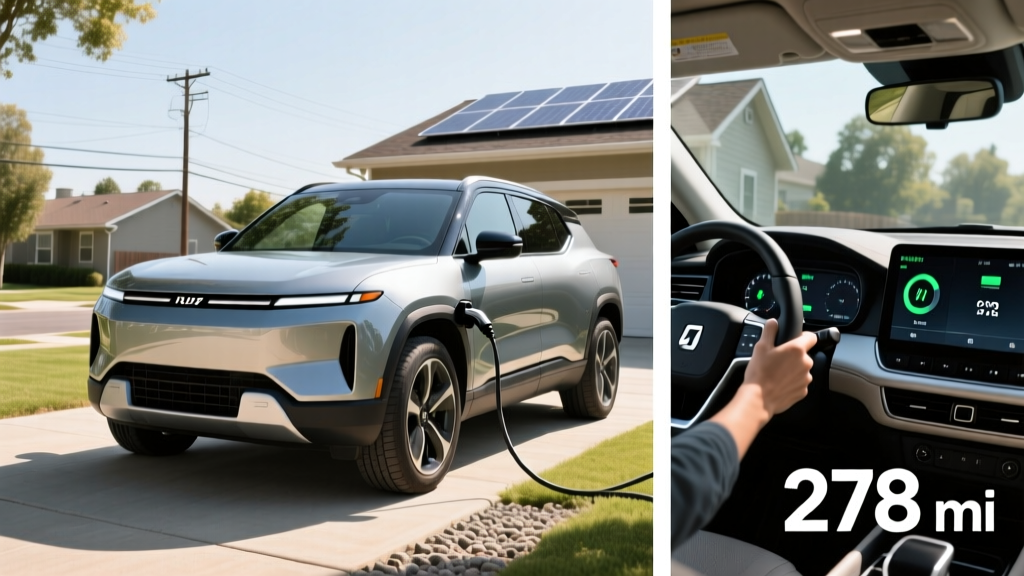
Charging performance is where 2023 R1S owners need realistic expectations. Rivian's DC fast-charging architecture peaks at 200 kW on the Large Pack and approximately 180 kW on the Standard Pack. The Max Pack, despite its enormous 149 kWh capacity, also peaks near 200 kW due to cell C-rate limitations.
| Charging Level | Power / Rate | Speed (miles per hour of charging) | Notes |
|---|---|---|---|
| Level 1 (120V household) | ~1.4 kW | ~3-4 mi/hr | Emergency/trickle only; ~5 days for full charge on Large Pack |
| Level 2 (240V, 48A Wall Connector) | 11.5 kW | ~25-28 mi/hr | Full charge overnight (~12-14 hrs for Large Pack); requires NEMA 14-50 or hardwire |
| Level 2 (240V, 32A mobile) | 7.7 kW | ~17-19 mi/hr | Portable Rivian charger included; slower but more flexible |
| DC Fast Charge (CCS) | Peak 200 kW | ~500+ mi/hr at peak | 10-80% in ~30-43 min depending on pack size; tapers significantly above 80% |
The charge curve matters more than peak kW. The R1S Large Pack sustains roughly 180-200 kW from 10% to about 40% State of Charge (SoC), then gradually tapers to ~120 kW by 60%, and drops below 50 kW past 80%. A 10-80% session on a 350 kW CCS station takes approximately 30-35 minutes for the Large Pack and 40-43 minutes for the Max Pack. The Standard Pack, with its smaller battery, completes 10-80% in roughly 25-28 minutes but has less total range to work with.
One ownership advantage: Rivian's Adventure Network — a proprietary DC fast-charging network near popular outdoor destinations — delivers reliable 200+ kW speeds with NACS connectors on newer deployments, though 2023 R1S models shipped with CCS1 ports. Rivian provides a NACS adapter for access to Tesla Superchargers, expanding the available public charging footprint significantly.
Performance and Drivetrain: Dual vs. Quad Motor
The 2023 R1S Dual-Motor uses a two-motor setup (one front, one rear) producing 533 horsepower and 610 lb-ft of torque with Performance Dual-Motor tuning available. It's the volume seller for good reason: 4.5-second 0-60 mph is brisk for a 6,900-lb SUV, and efficiency gains over the Quad-Motor are meaningful on long drives.
The Quad-Motor is a different animal entirely. With an independent motor at each wheel, it delivers 835 horsepower and 908 lb-ft, hitting 60 mph in just 3.0 seconds — supercar territory in a three-row SUV. More importantly for off-road use, the Quad-Motor enables true torque vectoring: each wheel receives precisely the torque it needs, giving the R1S traction capabilities that rival dedicated off-roaders. Tank turns (rotating the vehicle in place by spinning wheels on opposite sides in opposing directions) were announced but remained limited in availability through 2023 OTA updates.
All 2023 R1S models feature standard all-wheel drive, air suspension with adjustable ride height (up to 14.9 inches of ground clearance in Off-Road mode), and a maximum towing capacity of 7,700 pounds when properly equipped. That towing figure is best-in-class among electric SUVs and competitive with many body-on-frame gas trucks.
Interior Space, Cargo, and Family Practicality
The R1S seats up to seven passengers across three rows. Second-row captain's chairs (standard on most trims) reduce capacity to six but improve third-row access. Here's how the space breaks down:
- Cargo behind 3rd row: 10.5 cu ft (tight for groceries with a full cabin)
- Cargo behind 2nd row (3rd row folded): 46.7 cu ft
- Cargo behind 1st row (all rear rows folded): 78.0 cu ft
- Front trunk (frunk): 11.0 cu ft — a significant bonus for gear, charging cables, or groceries
- Second-row legroom: 38.5 inches
- Third-row legroom: 30.4 inches (best for children or short trips)
The third row is genuinely usable for adults on shorter trips, which distinguishes the R1S from many three-row crossovers. However, with all three rows in use, the 10.5 cu ft of rear cargo space is limiting. Families planning road trips with seven passengers will need a roof box or trailer — fortunately, the 7,700-lb tow rating handles both easily.
The interior materials are premium but not quite German-luxury level: standard vegan leather, available Nappa leather, real wood trim, and a minimalist design anchored by a 15.6-inch center touchscreen and a 12.3-inch digital instrument cluster. The infotainment system runs Rivian's proprietary OS — responsive and well-designed, but lacking Apple CarPlay and Android Auto. This omission frustrates some buyers accustomed to phone projection, though Rivian's native navigation, media, and vehicle controls are robust.
Pricing, Trim Levels, and Federal Tax Credit Eligibility
The 2023 R1S launched with an Adventure trim (the primary offering) and an optional Ascend trim package for higher-end interior materials. Pricing ranged from roughly $78,000 for the Dual-Motor Standard Pack to over $100,000 for a fully optioned Quad-Motor Max Pack. A typical well-equipped Dual-Motor Large Pack — the most popular configuration — landed around $88,000-$92,000 after destination and common options (20-inch All-Terrain wheels, Forest Green paint, tow package).
| Configuration | Base MSRP | Typical As-Tested | §30D Credit Eligibility (2023 rules) | Effective Price (if eligible) |
|---|---|---|---|---|
| Dual-Motor Standard | $78,000 | $80,000-$82,000 | Up to $3,750 (partial — sourcing dependent) | ~$76,250-$78,250 |
| Dual-Motor Large | $84,000 | $88,000-$92,000 | Up to $3,750 (partial — sourcing dependent) | ~$84,250-$88,250 |
| Dual-Motor Max Pack | $94,000 | $98,000-$102,000 | Up to $3,750 (partial — sourcing dependent) | ~$94,250-$98,250 |
| Quad-Motor Large | $99,000 | $103,000-$107,000 | Up to $3,750 (partial — sourcing dependent) | ~$99,250-$103,250 |
Tax credit reality check: Under IRS §30D rules, the 2023 R1S qualifies as an SUV with an MSRP cap of $80,000. This means only the base Dual-Motor Standard Pack at $78,000 MSRP clears the cap cleanly. Higher trims exceeding $80,000 MSRP are ineligible for the new-vehicle credit. Additionally, buyer income caps apply ($300,000 joint / $225,000 head of household / $150,000 individual), and the credit is split into two halves: $3,750 for battery component sourcing and $3,750 for critical minerals sourcing. The 2023 R1S's Samsung SDI cells, manufactured in South Korea, typically qualified for the battery component half but not always the critical minerals half, yielding a partial credit of up to $3,750 rather than the full $7,500.
For 2026 buyers looking at the used 2023 R1S market, the Used Clean Vehicle Credit (§25E) offers up to $4,000 or 30% of the sale price (whichever is less) on vehicles priced at $25,000 or below — a threshold the R1S does not meet in current used-market pricing. Used R1S models typically list between $55,000 and $85,000 depending on mileage and configuration, making the used credit inaccessible. Consult a tax professional for your specific situation.
Warranty Coverage and Battery Longevity
Rivian backs the 2023 R1S with the following warranty structure:
- Battery pack: 8 years / 175,000 miles (whichever comes first), with a capacity retention threshold of 70% or greater
- Drive unit (motor/gearbox): 8 years / 175,000 miles
- Vehicle (bumper-to-bumper): 5 years / 60,000 miles
- Corrosion perforation: 12 years, unlimited miles
The 175,000-mile battery warranty is generous and exceeds the industry-standard 100,000-mile threshold. The 70% capacity retention guarantee means Rivian will repair or replace the pack if it degrades below that level within the warranty period. For a 128 kWh Large Pack, 70% retention still yields roughly 90 kWh of usable capacity — enough for approximately 245 miles of real-world range, which remains practical for most owners.
NMC batteries in the R1S have shown moderate degradation patterns in early owner data: approximately 5-8% capacity loss over the first 30,000-50,000 miles, with the curve flattening thereafter. To maximize longevity, Rivian recommends setting daily charge limits to 85-90% and reserving 100% charges for road trips. The vehicle's thermal management system actively conditions the battery during charging and driving, which helps mitigate degradation in extreme climates.
Driver Assistance and Standout Technology
The R1S ships with Rivian's Driver+ suite, which includes adaptive cruise control, lane-keeping assist, automatic emergency braking, blind-spot monitoring, and rear cross-traffic alert. The system is competent for highway cruising but doesn't match the hands-free capabilities of GM's Super Cruise or Ford's BlueCruise on mapped highways. Rivian has been developing enhanced highway assist features via over-the-air updates, but as of the 2023 model year, hands-on-wheel supervision is mandatory.
Standout technology features include:
- Camp Kitchen accessory: A slide-out galley system that integrates with the vehicle's power supply (available as a dealer-installed accessory)
- Powered tonneau-style cargo cover and gear tunnel (on R1T; R1S uses traditional cargo area)
- Over-the-air (OTA) updates: Regular software improvements to performance, range optimization, and infotainment
- Vehicle-to-everything connectivity: Built-in LTE with remote climate control, location sharing, and OTA delivery
- Eight drive modes: All-Purpose, Sport, Snow, Off-Road, Soft Sand, Towing, Conserve (range-extending), and Pet Mode
Who Should Buy the 2023 Rivian R1S?
- You need three rows of seating and genuine off-road capability in an EV
- You tow a boat, camper, or horse trailer regularly (7,700-lb capacity)
- You want adventure-oriented features (air suspension, ground clearance, Camp Kitchen compatibility)
- You prioritize performance alongside utility (Quad-Motor's 3.0-sec 0-60 is unmatched in the segment)
- You can charge at home with Level 2 and have access to DC fast charging for road trips
- Maximum efficiency and lowest cost per mile are your priorities (Tesla Model X is more efficient; Hyundai Ioniq 9 will be cheaper)
- You need Apple CarPlay/Android Auto integration
- You live far from a Rivian service center and cannot tolerate potential repair delays
- Your budget is under $60,000 (even used R1S models command premium pricing)
- You need more than 10.5 cu ft of cargo with all three rows in use on a regular basis
Frequently Asked Questions
What is the real-world range of the 2023 Rivian R1S?
It depends on configuration and conditions. The Dual-Motor Large Pack (352 mi EPA) delivers roughly 290-310 highway miles in mild weather and 240-270 in winter. The Max Pack (400 mi EPA) achieves 330-350 highway miles in fair conditions. The Quad-Motor (321 mi EPA) returns approximately 265-285 highway miles. City driving with regenerative braking can exceed EPA estimates in all configurations.
How fast does the 2023 R1S charge at home and on the road?
At home on a Level 2 (240V, 48A) charger, the R1S adds approximately 25-28 miles of range per hour, fully charging a Large Pack overnight in 12-14 hours. On a DC fast charger, it peaks at 200 kW and charges from 10-80% in roughly 30-35 minutes (Large Pack) or 40-43 minutes (Max Pack). Charging speed tapers significantly above 80% SoC.
Does the 2023 Rivian R1S qualify for the federal EV tax credit?
Under 2023 IRS §30D rules, only the base Dual-Motor Standard Pack (MSRP $78,000) fell under the $80,000 SUV MSRP cap. Higher trims exceeded the cap and were ineligible for the new-vehicle credit. Qualifying buyers could receive up to $3,750 (partial credit based on battery component sourcing). Income limits apply: $300K joint / $225K head of household / $150K individual. The used EV credit (§25E) does not apply because used R1S prices exceed the $25,000 sale-price cap. Always verify current rules at IRS.gov and consult a tax professional.
Is the 2023 R1S worth buying over a Tesla Model X or Kia EV9?
The R1S wins on off-road capability, towing (7,700 lbs vs. Model X's 3,500 lbs), and adventure-oriented design. The Model X wins on efficiency (102 MPGe vs. 69 MPGe), Supercharger network access, and third-row cargo flexibility (falcon-wing doors). The Kia EV9 (introduced for 2024) undercuts both on price ($54,900 base) but offers less range, lower towing capacity, and no off-road credentials. If you tow and explore off-pavement, the R1S is the clear choice. If you prioritize efficiency and charging infrastructure, the Model X leads.
What are the biggest pros and cons of the 2023 R1S?
- Class-leading 7,700-lb tow rating among electric SUVs
- Genuine off-road capability with air suspension and 14.9" ground clearance
- Quad-Motor's 3.0-sec 0-60 mph is extraordinary for a three-row SUV
- 11 cu ft frunk adds practical cargo flexibility
- 8-year/175,000-mile battery warranty exceeds industry norm
- Regular OTA updates continue to improve the vehicle post-purchase
- No Apple CarPlay or Android Auto
- Only 10.5 cu ft cargo with all three rows up
- Efficiency lags competitors (69 MPGe combined)
- Service center network still expanding in rural regions
- High insurance costs relative to gas-powered alternatives
- Most configurations ineligible for full $7,500 federal tax credit due to MSRP cap
What battery chemistry does the 2023 R1S use, and how should I maintain it?
All 2023 R1S models use NMC (nickel manganese cobalt) lithium-ion cells from Samsung SDI. For daily use, set your charge limit to 85-90% to reduce stress on the cells. Reserve 100% charges for road trips where you'll drive the range down promptly. Avoid letting the battery sit at very low SoC (below 10%) for extended periods. The R1S's active thermal management system handles temperature regulation automatically during charging and driving.