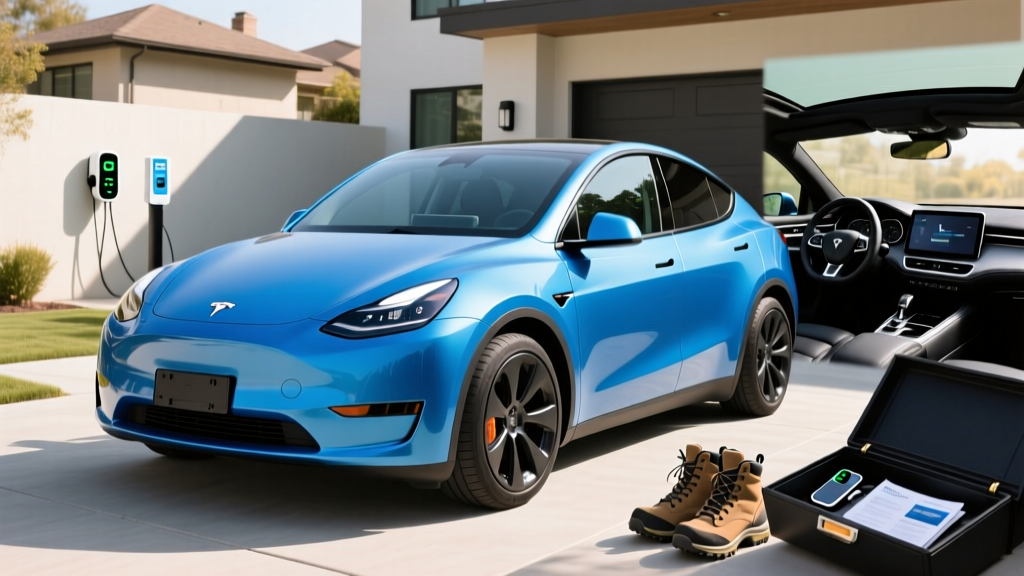
The 2023 Tesla Model Y Performance occupies a rare position in the EV market: it delivers supercar-rivaling acceleration in a practical crossover body that qualifies for the full federal tax credit. With a 3.5-second 0-60 mph time, 303 miles of EPA-estimated range, and access to Tesla's Supercharger network, it remains one of the most compelling performance EVs available — even as newer competitors have entered the segment. This review covers every number that matters for real ownership, from sustained highway range to DC fast-charging taper behavior.
2023 Model Y Performance: Quick Specs at a Glance
| Specification | 2023 Model Y Performance |
|---|---|
| EPA Range | 303 miles |
| Battery (Usable) | ~75 kWh, NMC (2170 cells) |
| 0-60 mph | 3.5 seconds |
| Horsepower | 456 hp (combined) |
| Drivetrain | Dual-motor AWD |
| Top Speed | 155 mph |
| Max DC Fast Charge | 250 kW (peak) |
| 10-80% DC Charge Time | ~27 minutes |
| Level 2 Home Charge Rate | 11.5 kW (~44 mi/hr) |
| EPA Efficiency | 122 MPGe combined / 28 kWh/100 mi |
| Cargo Volume (rear seats up) | 30.2 cu ft |
| Cargo Volume (rear seats folded) | 72.1 cu ft |
| Base MSRP (2023) | $52,990 |
| Battery Warranty | 8 years / 120,000 miles |
Sources: EPA Fuel Economy, Tesla specifications.
0-60 in 3.5 Seconds: What Performance Buyers Get
The headline figure for the 2023 Model Y Performance is a 3.5-second 0-60 mph sprint, powered by Tesla's dual-motor all-wheel-drive system producing 456 combined horsepower and an estimated 497 lb-ft of torque. The front induction motor and rear permanent-magnet synchronous motor work in concert, with torque vectoring that directs power to the wheels with the most grip.
In real-world testing, the 3.5-second claim holds up under favorable conditions — dry pavement, moderate temperatures, and a battery state of charge above 50%. Tesla's launch control is straightforward: hold the brake, press the accelerator fully, release the brake. The result is immediate, relentless torque with no turbo lag or gear-shift interruption. At highway speeds, passing power remains strong through 80 mph, though acceleration tapers noticeably above 100 mph as is typical for single-speed EV drivetrains.
Compared to the Long Range AWD variant (4.8 seconds to 60 mph), the Performance trim's advantage comes from higher-output motors, a lowered sport suspension, and 21-inch Überturbine wheels. The trade-off: those larger wheels and stickier tires reduce range by approximately 30 miles versus the Long Range with 19-inch wheels.
Range and Efficiency: EPA vs. Real World
Real-World Expectation: 250–275 miles highway (70-80 mph); 280–300 miles mixed city; 210–240 miles highway in sub-30°F cold weather.
Efficiency: 122 MPGe combined / 28 kWh per 100 miles.
The 2023 Model Y Performance carries an EPA-estimated 303 miles of range. That figure assumes a blend of city and highway driving at moderate speeds in temperate conditions. Real-world range depends heavily on speed, temperature, and elevation.
At sustained highway speeds of 70-80 mph on flat terrain in 65-75°F weather, expect between 250 and 275 miles before the battery reaches 0%. The Model Y's aerodynamic efficiency (0.23 Cd drag coefficient) helps, but air resistance scales with the square of speed — driving 80 mph versus 65 mph costs roughly 15-20% of range. In stop-and-go city traffic with frequent regenerative braking opportunities, range can approach or even exceed the EPA sticker, often reaching 280-300 miles.
Cold weather is the larger variable. In temperatures below 30°F, battery chemistry slows, cabin heating draws significant power (even with the heat pump standard on 2023 models), and range drops to approximately 210-240 miles on the highway. Preconditioning the battery while plugged in — using the Tesla app to warm the cabin and battery before departure — recovers some of this loss, typically 15-25 miles of range in freezing conditions.
For context, the EPA's fueleconomy.gov listing rates the Model Y Performance at 122 MPGe combined, which translates to 28 kWh consumed per 100 miles driven. That efficiency figure is competitive with the segment — the Ford Mustang Mach-E GT, for comparison, rates at 84 MPGe combined.
Charging Speeds: DC Fast Charging and Home Setup
Understanding charging speed requires distinguishing between kW (power, the rate of energy transfer) and kWh (energy, the total capacity of the battery). The Model Y Performance's battery holds approximately 75 kWh of usable energy. The rate at which you can refill it depends on the charger type:
| Charging Level | Power | Miles of Range Added Per Hour | Notes |
|---|---|---|---|
| Level 1 (120V household) | ~1.4 kW | ~3-5 mi/hr | Emergency/trickle only |
| Level 2 (240V home) | 11.5 kW max | ~44 mi/hr | Full charge in ~7-8 hours |
| DC Fast Charge (V3 Supercharger) | 250 kW peak | ~162 mi in 15 min | 10-80% in ~27 minutes |
| DC Fast Charge (CCS adapter) | ~150-170 kW typical | Varies | Non-Tesla networks |
On a Tesla V3 Supercharger (250 kW capable), the Model Y Performance peaks at approximately 250 kW when arriving at a low state of charge (10-15%) with a preconditioned battery. However, that peak rate is not sustained. The charge curve tapers progressively: around 170 kW by 40% SoC, 120 kW by 60%, and below 50 kW once you pass 80%. A 10-80% session takes roughly 27 minutes. Pushing from 80-100% adds another 25-30 minutes — the reason Tesla (and most EV makers) quote the 10-80% window.
For home charging, the onboard charger accepts up to 11.5 kW on a 48-amp Level 2 circuit. That requires a 60-amp dedicated breaker. A full 0-100% charge takes approximately 7-8 hours — easily overnight. Most owners who drive 30-50 miles daily only need to replenish 8-14 kWh per night, which a Level 2 charger handles in under 90 minutes.
Home installation cost: Expect $500-$1,500 for a Tesla Wall Connector plus professional electrical work if your panel has capacity and the run is short (under 30 feet). Longer runs, panel upgrades (from 100A to 200A service), or conduit requirements can push costs to $2,000-$4,000. Always get a quote from a licensed electrician before purchasing equipment.
As of 2024, Tesla opened its Supercharger network to non-Tesla EVs via the NACS standard, and Tesla provides a CCS adapter for Model Y owners to access Electrify America, EVgo, and other networks. However, Superchargers remain the most reliable DC fast-charging option, with plug-and-charge billing and real-time stall availability in the Tesla app.
Pricing, Trims, and Federal Tax Credit Eligibility
The 2023 Model Y Performance launched with a base MSRP of $52,990 (before destination). Key options included:
| Item | Cost |
|---|---|
| Base MSRP (Performance) | $52,990 |
| Destination fee | $1,390 |
| Premium paint (non-white) | $1,000 - $2,000 |
| Full Self-Driving (Supervised) | $15,000 (or $199/mo) |
| As-tested (typical) | $55,000 - $58,000 |
Does the 2023 Model Y Performance Qualify for the Federal Tax Credit?
Under the IRS §30D Clean Vehicle Credit rules, the 2023 Model Y Performance did qualify for the full $7,500 federal tax credit for eligible buyers, because:
- MSRP cap: SUVs/crossovers must be under $80,000. The Model Y Performance at ~$53,000-$58,000 clears this easily.
- Income cap: Modified adjusted gross income (MAGI) must not exceed $150,000 (single), $225,000 (head of household), or $300,000 (joint filers).
- Battery sourcing: As of 2023, the Model Y's battery components and critical minerals met the phased-in sourcing thresholds for that tax year.
- Final assembly: Assembled in Fremont, California — North American final assembly requirement met.
Starting January 1, 2024, the point-of-sale transfer option allowed buyers to apply the credit directly at purchase rather than waiting for tax filing. For 2023 purchases, the credit was claimed on IRS Form 8936 with your annual tax return. Always consult a tax professional and check current rules at IRS.gov, as critical mineral and battery component sourcing requirements tighten annually.
Interior, Cargo, and Daily Practicality
The Model Y's cabin follows Tesla's minimalist design language: a single 15-inch landscape touchscreen handles virtually all vehicle controls, navigation, media, and climate functions. There is no traditional instrument cluster — speed and driving information appear in the upper-left corner of the main display. Build quality on 2023 Fremont-built examples improved over earlier years, though panel gaps and interior material quality still lag behind German luxury competitors at this price point.
Practicality is where the Model Y Performance justifies its crossover designation over a sedan:
- Cargo (behind second row): 30.2 cubic feet
- Cargo (seats folded): 72.1 cubic feet
- Front trunk (frunk): 4.1 cubic feet
- Rear legroom: 40.5 inches
- Front headroom: 41.0 inches (with glass roof)
- Seating: 5 passengers standard (7-seat option was discontinued for Performance trim)
The flat load floor and wide hatch opening make the cargo area genuinely useful for large items — a full-size bicycle fits with the front wheel removed, and groceries for a family of four load without Tetris. The glass roof creates an airy cabin but offers no retractable shade; cabin temperatures can rise significantly when parked in direct sun, making the app-based climate preconditioning a practical necessity in hot climates.
Technology, Driver Assistance, and Safety
Every 2023 Model Y Performance includes Tesla's Autopilot suite as standard, which provides adaptive cruise control, lane-centering steering, and automatic emergency braking. This is a SAE Level 2 driver-assistance system — it does not make the vehicle self-driving. The driver must keep hands on the steering wheel and eyes on the road at all times. Tesla monitors engagement via a torque sensor on the wheel.
The infotainment system is among the most responsive in the industry, with over-the-air updates that add features incrementally. Notable tech includes:
- Sentry Mode (360° camera recording when parked)
- Dashcam with four-camera recording
- Dog Mode and Camp Mode (climate presets for parked scenarios)
- Phone-as-key with Bluetooth proximity unlock
- Integrated trip planner with real-time Supercharger routing
- Streaming media (Netflix, YouTube, Spotify) while parked
Safety ratings are strong: the Model Y earned a 5-star overall rating from NHTSA and a Top Safety Pick+ designation from IIHS. Standard safety features include automatic emergency braking, side-collision warning, blind-spot monitoring, and eight airbags.
Warranty Coverage
| Coverage | Term |
|---|---|
| Basic vehicle | 4 years / 50,000 miles |
| Battery & drive units | 8 years / 120,000 miles |
| Battery capacity retention | Minimum 70% over warranty period |
Tesla guarantees the battery will retain at least 70% of its original capacity over the 8-year/120,000-mile warranty period. In practice, NMC-based 2170 cells in the Model Y have shown strong longevity — fleet data suggests approximately 5-8% degradation at 100,000 miles for vehicles that avoided frequent 100% charges and excessive DC fast charging. Daily charging to 80-90% and occasional 100% charges before road trips is the recommended practice for long-term battery health.
Pros and Cons: The Honest Assessment
- 3.5-second 0-60 mph — genuine sports-car acceleration
- 303-mile EPA range covers most daily and road-trip needs
- Supercharger network reliability remains best-in-class
- Spacious cargo area (72.1 cu ft) with flat load floor
- OTA updates continuously add features
- Strong safety ratings (NHTSA 5-star, IIHS TSP+)
- Qualified for $7,500 federal tax credit (2023 purchase)
- 21-inch wheels reduce range vs. Long Range trim
- No physical buttons — all controls via touchscreen
- No Apple CarPlay or Android Auto
- FSD ($15,000) remains Level 2 despite the name
- Sport suspension is firm — ride quality on rough roads is compromised
- Panel gap consistency still lags luxury competitors
- No HUD (head-up display)
Should You Buy the 2023 Model Y Performance?
The 2023 Model Y Performance is best suited for drivers who want serious acceleration without sacrificing daily practicality, who have reliable home charging access, and who value the Supercharger network for road trips. It's a compelling choice for performance-oriented commuters, small families, and tech-forward buyers who appreciate OTA feature updates.
If your priority is maximum range over acceleration, the Long Range AWD variant (330 miles EPA, 4.8-second 0-60) is the more rational pick. If you need three rows of seating or a more traditional luxury interior, competitors like the Kia EV6 GT (3.4-second 0-60, 206-mile range) or the BMW iX M60 offer different trade-offs — though neither matches the Model Y's combination of performance, range, charging infrastructure, and price.
From a 2026 used-market perspective, a well-maintained 2023 Model Y Performance with under 30,000 miles represents strong value, particularly if the original owner did not purchase FSD (which rarely adds proportional resale value). Check battery health via the Tesla app's energy graph, verify Supercharger access transfers with the vehicle, and confirm the 8-year battery warranty start date before purchasing.
Frequently Asked Questions
What is the real-world range of the 2023 Model Y Performance?
The EPA rates it at 303 miles, but real-world highway driving at 70-80 mph yields approximately 250-275 miles in moderate temperatures. City driving with regenerative braking can reach 280-300 miles. In cold weather (below 30°F), expect 210-240 miles on the highway.
How fast does the 2023 Model Y Performance charge?
On a Tesla V3 Supercharger, it peaks at 250 kW and charges from 10-80% in approximately 27 minutes. At home on a Level 2 (240V/48A) charger, it adds about 44 miles of range per hour, with a full charge taking 7-8 hours.
How much does a 2023 Model Y Performance cost after tax credits?
The original MSRP was $52,990 plus destination. Eligible 2023 buyers received a $7,500 federal tax credit, bringing the effective cost to approximately $46,880. On the 2026 used market, prices typically range from $30,000-$40,000 depending on mileage and condition, potentially eligible for the $4,000 used-EV credit if the sale price is under $25,000 and buyer income qualifies.
Is the Model Y Performance worth buying over the Long Range?
If acceleration matters to you and you can accept ~30 miles less range, the Performance's 3.5-second 0-60, sport suspension, and 21-inch wheels deliver a meaningfully more engaging drive. If range and ride comfort are priorities, the Long Range AWD (330 miles, 4.8 seconds) is the better value.
Does the 2023 Model Y Performance have Apple CarPlay?
No. Tesla uses its proprietary infotainment system exclusively. There is no Apple CarPlay or Android Auto support in any Tesla vehicle. The built-in navigation, media apps, and phone integration via Bluetooth are capable, but CarPlay users will notice the difference.
What is the battery warranty on the 2023 Model Y Performance?
Tesla covers the battery and drive units for 8 years or 120,000 miles (whichever comes first), with a guarantee that the battery will retain at least 70% of its original capacity during that period. This is competitive with industry norms, though some competitors offer 10-year/100,000-mile battery coverage.