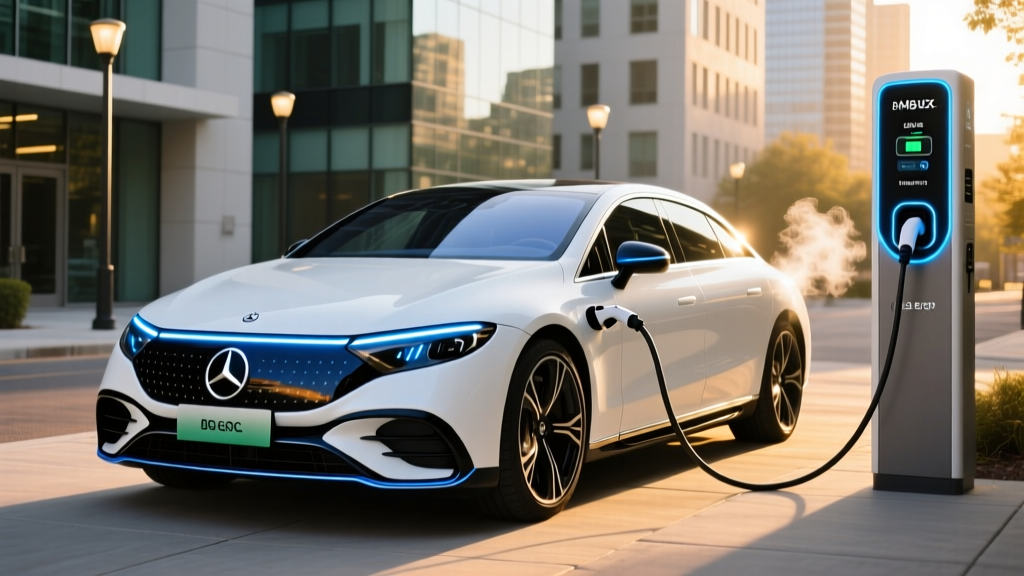
The 2023 Mercedes-Benz EQS 450+ arrived as the German automaker's flagship electric sedan, promising S-Class luxury with a battery-electric powertrain and a headline-grabbing EPA range figure. Now that this model has been on the road for a few years, we have real-world data on what it's actually like to live with — from highway range and charging-curve behavior to ownership costs and how the federal tax credit applies. If you're shopping the used or certified pre-owned market for a luxury EV sedan, this deep-dive covers every number that matters.
Range and Efficiency: The 350-Mile Promise vs. Reality
The EQS 450+ carries a 107.8 kWh usable battery (120 kWh gross, NMC lithium-ion chemistry) powering a single rear-mounted electric motor. The EPA rates it at 350 miles of combined range, with an efficiency of 97 MPGe combined (roughly 35 kWh per 100 miles). That made it one of the most efficient large luxury sedans on the market when it launched.
EPA Combined: 350 miles
Highway (70 mph, 75°F): Expect ~290–310 miles. The EQS 450+ is a large, heavy sedan, and aerodynamic drag at sustained highway speeds reduces efficiency noticeably.
City / Stop-and-Go: ~340–360 miles. Regenerative braking recovers energy effectively in urban driving.
Cold Weather (30°F or below): ~240–270 miles. The EQS uses a heat pump for cabin heating, which mitigates some loss, but battery chemistry and cabin demand still cut range by 20–30%.
Mountainous Terrain: Varies heavily; expect 250–280 miles on sustained climbs with partial recovery on descents.
The EQS 450+ achieves its strong efficiency partly through a class-leading drag coefficient of Cd 0.20, one of the lowest of any production car. That slippery shape pays dividends especially at moderate speeds. However, the vehicle's ~5,600-pound curb weight works against it in stop-and-go scenarios compared to lighter EVs.
| Specification | Value |
|---|---|
| EPA Range (combined) | 350 miles |
| Battery (usable / gross) | 107.8 kWh / 120 kWh (NMC) |
| EPA Efficiency | 97 MPGe combined (35 kWh/100 mi) |
| Motor / Drivetrain | Single rear motor / RWD |
| Horsepower / Torque | 329 hp / 406 lb-ft |
| 0–60 mph | 5.9 seconds |
| Max DC Fast Charge | 200 kW (CCS1) |
| 10–80% DC Charge Time | ~31 minutes |
| Level 2 Charge Rate | 9.6 kW (~28 mi/hr) |
| Cargo Volume | 22.0 cu ft (trunk) |
| Rear Legroom | 41.7 inches |
| Base MSRP (2023) | $104,400 |
| Battery Warranty | 10 years / 155,000 miles |
Charging Speed: DC Fast Charging and Home Setup
The EQS 450+ uses a CCS1 connector and supports a peak DC fast-charge rate of 200 kW. On a compatible 350 kW charger (such as Electrify America or EVgo stations), Mercedes-Benz quotes a 10–80% charge time of approximately 31 minutes. In practice, the charging curve is the key detail: the EQS sustains close to its peak rate up to roughly 40–50% State of Charge, then tapers progressively. From 80–100%, charging slows dramatically to protect the NMC cells — plan to unplug at 80% on road trips unless you genuinely need the last 20%.
For home Level 2 charging, the onboard charger accepts up to 9.6 kW on a 240V/48A circuit. That translates to roughly 28 miles of range per hour of charging, meaning a full 0–100% replenishment takes about 11–12 hours overnight. A standard NEMA 14-50 outlet (240V/40A) delivers about 7.7 kW, adding roughly 22 miles per hour — still sufficient for most daily needs.
| Level | Power | Rate | Full Charge Time |
|---|---|---|---|
| Level 1 (120V) | ~1.4 kW | ~4 mi/hr | ~80+ hours |
| Level 2 (240V/48A) | 9.6 kW | ~28 mi/hr | ~11–12 hours |
| DC Fast (peak) | 200 kW | ~180 mi in 15 min (peak) | 10–80% in ~31 min |
Charging-curve insight: The 200 kW peak is impressive, but sustained average from 10–80% is closer to ~140–150 kW. This is typical for large NMC packs — thermal management is excellent in the EQS, but physics limits how fast a 107.8 kWh battery can absorb energy without degradation. Preconditioning the battery (via the vehicle's navigation-routed preconditioning) is essential to hit peak rates at DC stations.
Performance and Driving Dynamics
The single-motor EQS 450+ produces 329 horsepower and 406 lb-ft of torque, routed to the rear wheels. The 0–60 mph sprint takes 5.9 seconds — respectable for a 5,600-pound luxury sedan but not sports-sedan territory. If you want more urgency, the dual-motor EQS 450 4MATIC (355 hp, 5.3 sec) or the EQS 580 4MATIC (516 hp, 4.1 sec) are the upgrades to consider.
The driving character is quintessential Mercedes: quiet, cosseting, and tuned for comfort over sportiness. Air suspension is standard, and the ride quality over rough pavement is exceptional. Rear-axle steering (standard on the EQS, up to 10 degrees) makes this 17-foot sedan surprisingly maneuverable in parking lots and city streets — a 35-foot turning circle is remarkable for its size.
Regenerative braking offers multiple modes selectable via steering-wheel paddles: coasting (D Auto), moderate regen (D+), and strong regen approaching one-pedal driving (D−). However, the EQS does not offer true one-pedal driving to a full stop like some competitors — you'll still need the brake pedal at very low speeds.
Interior, Tech, and Cargo Space
The EQS cabin is dominated by the available MBUX Hyperscreen — a 56-inch curved glass panel spanning the entire dashboard, housing a 12.3-inch instrument cluster, 17.7-inch central OLED touchscreen, and 12.3-inch passenger display. It's visually stunning, though the touch-capacitive climate controls and lack of physical buttons draw mixed reviews from owners. The standard layout uses a 12.8-inch central OLED screen, which many find more practical.
Driver assistance includes the full suite of Mercedes-Benz Driver Assistance Package: adaptive cruise control with stop-and-go, active lane-keeping, evasive steering assist, and PRE-SAFE. The available Drive Pilot system is an SAE Level 3 conditional automated driving feature (approved in Nevada and California for speeds up to 40 mph in heavy traffic on suitable highways) — a genuine differentiator, though its operational design domain is narrow.
Cargo space: The EQS uses a traditional trunk (not a hatchback or liftback), yielding 22.0 cubic feet — generous for a sedan and enough for four carry-on suitcases. However, the trunk opening is relatively narrow, and there is no front trunk (frunk), as the space is occupied by HVAC components and the HEPA filtration system.
Passenger space: Rear legroom measures 41.7 inches, and headroom is adequate despite the sloping roofline. The cabin seats four comfortably (five in a pinch), and the available Executive Rear Seat package adds recline, massage, and heated neck pillows.
Pricing, Tax Credit Eligibility, and Ownership Costs
The 2023 EQS 450+ launched with a base MSRP of $104,400 (including destination). Commonly optioned examples with the Hyperscreen, AMG Line package, and Driver Assistance Package land between $115,000–$125,000.
| Item | Detail |
|---|---|
| Base MSRP (450+) | $104,400 |
| As-Tested (typical options) | $115,000–$125,000 |
| New-Vehicle §30D Credit (2023) | Not eligible — exceeds $55,000 sedan MSRP cap |
| Used EV Credit (§25E, from 2024) | Up to $4,000 (30% of sale price, max $4,000) if sold under $25,000 by a dealer — unlikely for EQS in near term |
| Commercial Clean Vehicle Credit (§45W) | Fleet/lease entities may qualify for up to $7,500 — consult a tax professional |
Critical tax credit note: The new-vehicle federal EV tax credit under IRS §30D has an MSRP cap of $55,000 for sedans. At $104,400, the EQS 450+ far exceeds this limit and does not qualify for the $7,500 new-vehicle credit, regardless of buyer income or battery sourcing. This is one of the most significant ownership-cost considerations for luxury EV sedans. Some buyers structured lease deals to leverage the commercial clean vehicle credit (§45W), which has no MSRP cap — but this depends on the lessor passing savings through. Always verify current rules at IRS.gov and consult a tax professional for your situation.
Estimated 5-year ownership costs: Electricity for the EQS 450+ averages roughly $0.04–$0.06 per mile at home (depending on local rates), compared to $0.12–$0.16 per mile for a comparable S-Class on premium fuel. Over 5 years and 75,000 miles, fuel savings can reach $6,000–$9,000. However, insurance premiums for the EQS run 20–40% higher than the gas S-Class, and tire replacement (the EQS uses specialized EV-rated tires) costs more. Depreciation has been steep — expect 40–55% value loss over three years, which benefits used buyers but hurts original purchasers.
Warranty and Battery Longevity
Mercedes-Benz backs the EQS 450+ with a strong warranty package:
- New-vehicle limited warranty: 4 years / 50,000 miles
- Battery warranty: 10 years / 155,000 miles (guarantees minimum 70% capacity retention)
- Powertrain warranty: 4 years / 50,000 miles
- Corrosion warranty: 4 years / 50,000 miles (perforation)
The 10-year/155,000-mile battery warranty is among the most generous in the luxury segment and reflects confidence in the NMC cell chemistry and thermal management system. Early owner reports and fleet data suggest degradation of roughly 5–8% over the first 60,000 miles, which is consistent with well-managed NMC packs. The EQS's liquid-cooled thermal system and conservative buffer (roughly 12 kWh reserved above and below the usable window) help preserve long-term State of Health.
Replacement cost context: An out-of-warranty EQS battery replacement is estimated at $20,000–$30,000+ based on current luxury EV pack pricing. This is a worst-case scenario that the warranty is designed to prevent, but it's worth knowing for long-term ownership planning beyond the 10-year window.
Pros, Cons, and Who Should Buy
- Class-leading 350-mile EPA range
- Exceptionally quiet, refined ride quality
- Rear-axle steering for superb maneuverability
- 10-year / 155,000-mile battery warranty
- Low Cd 0.20 aerodynamics aid real-world efficiency
- Available SAE Level 3 Drive Pilot (limited markets)
- Generous rear-seat legroom (41.7 in)
- No federal new-vehicle tax credit (MSRP cap)
- Trunk only — no hatchback or frunk
- Hyperscreen can be distracting; touch climate controls
- 5,600-lb weight affects tire wear and handling agility
- 200 kW peak DC charge is behind 800V competitors (350 kW)
- Steep depreciation hurts first owners
- No true one-pedal driving to a full stop
Choose the EQS 450+ if: You prioritize ride comfort, cabin silence, and maximum range over sporty handling. You mostly charge at home and take occasional road trips where 350 miles of range means fewer stops. You value S-Class prestige with EV powertrain benefits.
Look elsewhere if: You need hatchback cargo versatility (consider the EQE SUV or Tesla Model S). You want the fastest DC charging available (Porsche Taycan and Hyundai Ioniq 5 use 800V architecture for 350 kW peaks). You depend on the $7,500 federal tax credit to justify the purchase. You want engaging driving dynamics (BMW i7 or Porsche Taycan are sharper).
How It Compares: EQS 450+ vs. Key Rivals
The EQS 450+ competes against a small but growing field of luxury electric sedans:
- Tesla Model S Long Range: 405-mile EPA range, faster charging (250 kW), hatchback practicality, and a lower starting price — but interior quality and ride refinement don't match Mercedes.
- BMW i7 eDrive50: 318-mile EPA range, similar luxury positioning, more engaging to drive, but less range and a higher starting price.
- Lucid Air Pure: 419-mile EPA range, 480 hp, and a starting price around $87,400 — a strong range-and-value rival, though with a smaller service network.
- Porsche Taycan: Far sportier but much less range (225–282 miles EPA depending on spec) and less rear-seat space.
For buyers cross-shopping these options, the EQS 450+ occupies a unique niche: the most range and comfort per dollar in the traditional luxury-sedan segment, at the cost of some cargo versatility and charging speed versus 800V competitors.
Frequently Asked Questions
What is the real-world range of the 2023 Mercedes-Benz EQS 450+?
The EPA rates it at 350 miles combined. In real-world highway driving at 70 mph, expect 290–310 miles. City driving can approach or slightly exceed the EPA figure thanks to regenerative braking. In cold weather (below 30°F), plan for 240–270 miles even with the heat pump running.
How fast does the EQS 450+ charge at home and on the road?
At home on a Level 2 charger (240V/48A), it charges at 9.6 kW, adding roughly 28 miles per hour — a full charge takes about 11–12 hours. On DC fast chargers, it peaks at 200 kW, reaching 10–80% in approximately 31 minutes. The charge curve tapers significantly above 80%.
Does the 2023 EQS 450+ qualify for the federal EV tax credit?
No. The new-vehicle §30D credit has an MSRP cap of $55,000 for sedans, and the EQS 450+ starts at $104,400. Some lessees may benefit if the leasing company passes through the commercial clean vehicle credit (§45W). Check IRS.gov for current rules and consult a tax professional.
Is the EQS 450+ worth buying versus the Tesla Model S or BMW i7?
It depends on your priorities. The EQS 450+ wins on range (350 mi), ride comfort, and cabin luxury. The Model S offers more range (405 mi), a hatchback, and faster charging but less refinement. The BMW i7 is more engaging to drive but offers less range (318 mi) at a higher price. For pure luxury-EV comfort and efficiency, the EQS 450+ is the segment benchmark.
What is the battery warranty, and how long will the battery last?
Mercedes-Benz provides a 10-year / 155,000-mile battery warranty guaranteeing at least 70% capacity retention. Early data suggests 5–8% degradation over 60,000 miles, which projects to roughly 85–90% capacity at 150,000 miles — well within the warranty threshold. Out-of-warranty replacement would cost an estimated $20,000–$30,000+.
Does the EQS have a frunk (front trunk)?
No. The space under the hood houses HVAC components, the HEPA air filtration system, and power electronics. All cargo goes in the 22.0-cubic-foot rear trunk.
Sources: EPA Fuel Economy – 2023 Mercedes-Benz EQS 450+; Mercedes-Benz USA – EQS Sedan; IRS – Clean Vehicle Credits.