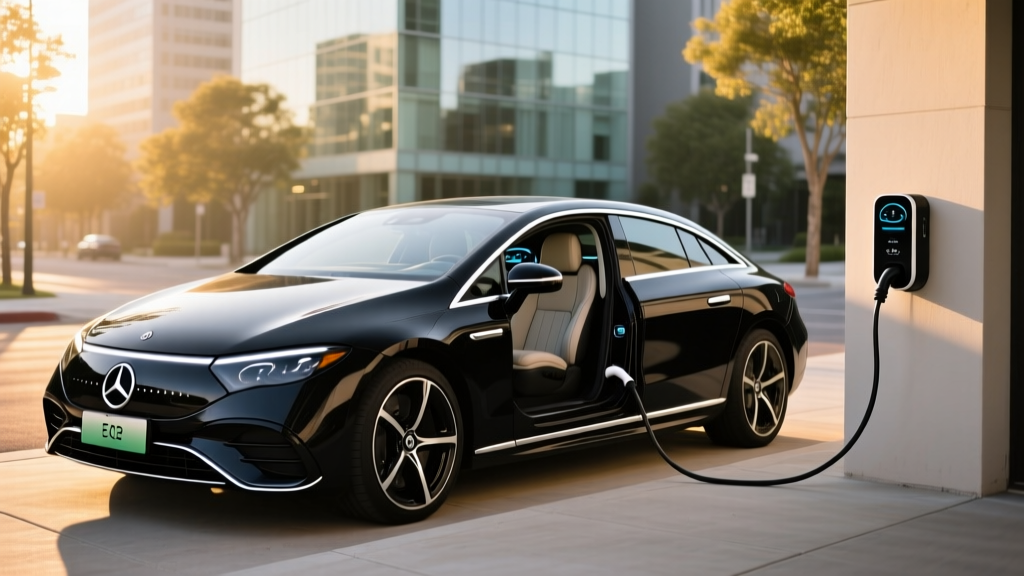
The 2023 Mercedes-Benz EQE arrived as the brand's electric executive sedan — a mid-size luxury EV built on the dedicated EVA2 platform, slotted between the compact EQA/EQB and the flagship EQS. For buyers cross-shopping the Tesla Model S, BMW i5, and Lucid Air, the EQE offers a distinctly Mercedes approach: quiet refinement, advanced driver assists, and a tech-heavy cabin. But with EPA range figures that trail some rivals and a price that climbs quickly, the 2023 EQE demands a close look at the numbers before you sign.
Now that the 2023 model year has settled into the used and certified-pre-owned market — and with 2024–2025 updates shifting the lineup — this review breaks down what the original EQE 350+ and EQE 350 4MATIC actually deliver in range, charging speed, daily usability, and total cost.
Range, Battery, and Efficiency: What the EPA Says vs. Reality
The 2023 EQE 350+ (rear-wheel drive) carries a 90.6 kWh usable lithium-ion battery pack using NMC (nickel manganese cobalt) chemistry. Mercedes does not offer an LFP variant for the EQE. The EPA rates the EQE 350+ sedan at 260 miles of range on its standard 19-inch wheels, though the AMG-Line package with 20-inch wheels drops that to approximately 235 miles. The EQE 350 4MATIC (dual-motor AWD) is rated at roughly 230 miles EPA.
EPA sticker: 260 mi (EQE 350+). In mixed highway driving at 70–75 mph, expect 220–240 miles before needing a charge. In cold weather (below 32°F), range can drop an additional 15–25%, putting real winter highway range closer to 180–200 miles. City driving with regenerative braking recovers more energy and can push range near or slightly above the EPA estimate. The EQE's heat pump (standard equipment) helps mitigate winter HVAC losses compared to resistive heating systems.
Efficiency is rated at approximately 73 MPGe combined (EQE 350+), which translates to roughly 46 kWh per 100 miles. That's competitive with the BMW i5 eDrive40 but trails the more aerodynamic Lucid Air Pure (which achieves over 100 MPGe). The EQE's weight — approximately 5,300 lbs — works against it on the highway.
| Spec | EQE 350+ (RWD) | EQE 350 4MATIC (AWD) |
|---|---|---|
| EPA Range | 260 mi (19" wheels) | 230 mi |
| Battery (usable) | 90.6 kWh, NMC | 90.6 kWh, NMC |
| MPGe (combined) | 73 MPGe | 68 MPGe |
| Horsepower | 288 hp | 288 hp (combined) |
| Torque | 391 lb-ft | 564 lb-ft |
| 0-60 mph | 6.2 sec | 5.8 sec |
| Max DC Charge Rate | 170 kW | 170 kW |
| 10-80% DC Time | ~32 min | ~32 min |
| Level 2 (AC) Rate | 9.6 kW (onboard charger) | 9.6 kW |
| Base MSRP (2023) | $74,900 | $77,900 |
Charging Speed: DC Fast Charging and Home Level 2
The 2023 EQE supports a peak DC fast-charge rate of 170 kW via its CCS1 connector. In practice, the charge curve peaks near 170 kW at low states of charge (10–20%) and tapers progressively, averaging closer to 120–130 kW across a full 10–80% session. Mercedes estimates approximately 32 minutes for a 10–80% charge on a capable 175+ kW DC fast charger (such as those at Electrify America or EVgo stations).
That 170 kW peak is adequate but not class-leading. The Hyundai Ioniq 5 and Kia EV6 peak at 240 kW on their 800V architectures, and the Tesla Model S leverages the Supercharger network at up to 250 kW. The EQE's 400V electrical architecture limits its ceiling.
| Charging Level | Power (kW) | Miles of Range Added per Hour | Notes |
|---|---|---|---|
| Level 1 (120V household) | ~1.4 kW | ~3 mi/hr | Emergency/top-up only |
| Level 2 (240V, 40A circuit) | 9.6 kW | ~22 mi/hr | Full charge in ~10 hours |
| DC Fast Charge (peak) | 170 kW | ~150 mi in ~15 min (at peak) | Tapers above 50% SoC |
Home charging setup: With a 48-amp Level 2 home charger (hardwired, on a 60-amp circuit), the EQE's 9.6 kW onboard charger will fully replenish the 90.6 kWh pack in roughly 9.5–10 hours. That's sufficient for overnight charging. Installation costs for a Level 2 home setup typically run $800–$2,000 depending on your panel capacity and conduit distance — budget extra if your electrical panel needs a 200-amp upgrade.
The EQE uses the CCS1 connector for DC fast charging. It does not natively accept NACS (Tesla's connector), though Mercedes-Benz has committed to NACS adoption for future model years and offers adapter solutions for access to Tesla Superchargers in later models. For 2023 models, CCS networks (Electrify America, EVgo, ChargePoint) remain the primary DC fast-charging option.
Performance and Driving Impressions
The EQE 350+ delivers 288 horsepower and 391 lb-ft of torque to the rear wheels, reaching 60 mph in approximately 6.2 seconds. That's relaxed by luxury-EV standards — the Tesla Model S Plaid exists in another universe at under 2 seconds, and even the base Model S Long Range hits 60 in about 3.1 seconds. But the EQE was never engineered for drag strips.
The 4MATIC dual-motor variant adds all-wheel grip and bumps torque to 564 lb-ft, trimming the 0-60 time to roughly 5.8 seconds. The AMG EQE (a separate, higher-priced model with up to 677 hp) is the performance variant, but it sacrifices range significantly.
Where the EQE earns its keep is ride quality. The available AIRMATIC air suspension delivers a pillowy, composed ride that absorbs highway imperfections with genuine authority. Rear-axle steering (optional, up to 10 degrees) transforms the EQE's maneuverability in tight urban settings, shrinking its turning circle to that of a compact car. Cabin isolation is outstanding — road and wind noise are suppressed to near-EQS levels.
Interior, Cargo, and Technology
The EQE cabin centers on Mercedes' MBUX infotainment system, displayed on a 12.8-inch central touchscreen (or the available Hyperscreen, which spans the full dashboard width with three displays under a single glass panel). The Hyperscreen is a $8,000+ option and visually stunning, though some drivers find the touch-capacitive climate controls less intuitive than physical buttons.
Passenger space: Front legroom measures approximately 41.5 inches; rear legroom comes in at 37.6 inches. That rear figure is tighter than the EQS and competitive with the BMW i5 but less generous than a Tesla Model S. The floor hump from the EVA2 platform's battery tray slightly compromises foot space under the front seats.
Cargo: The trunk provides approximately 15.0 cubic feet of cargo volume. There is no front trunk (frunk) — the space under the hood houses ancillary electronics and the HVAC system. For a vehicle at this price point, the absence of a frunk is a notable omission, especially when competitors like the Tesla Model S (31 cu ft rear + 3 cu ft frunk) offer substantially more utility.
Driver assistance: The EQE comes standard with Mercedes' Driver Assistance Package, which includes adaptive cruise control, active lane-keeping assist, active blind-spot monitoring, and evasive steering assist. The optional DRIVE PILOT system is a SAE Level 3 conditional automation system approved in certain U.S. states (notably Nevada and California) for speeds up to 40 mph in heavy traffic on suitable highways. This is genuinely advanced — the driver can legally disengage from the driving task under specific conditions, unlike Level 2 systems such as Tesla Autopilot or GM Super Cruise that require continuous supervision. However, DRIVE PILOT's operational design domain is narrow: it does not function at high speeds, in construction zones, or in poor weather.
Pricing, Trims, and Federal Tax Credit Eligibility
The 2023 Mercedes-Benz EQE launched with the following base MSRPs:
| Trim | Base MSRP | Typical As-Tested | §30D Federal Credit |
|---|---|---|---|
| EQE 350+ Premium | $74,900 | $78,000–$85,000 | Not eligible (MSRP cap exceeded*) |
| EQE 350+ Exclusive | $76,500 | $80,000–$88,000 | Not eligible |
| EQE 350+ Pinnacle | $79,500 | $85,000–$95,000 | Not eligible |
| EQE 350 4MATIC | $77,900 | $82,000–$90,000 | Not eligible |
*Under IRS §30D rules, the federal EV tax credit caps sedan eligibility at an MSRP of $55,000. The 2023 EQE's base price of $74,900 exceeds this threshold, making it ineligible for the new-vehicle credit regardless of buyer income or battery sourcing. See IRS.gov §30D guidelines for current rules.
However, buyers purchasing a 2023 EQE on the used market in 2026 may qualify for the Used Clean Vehicle Credit (up to $4,000 or 30% of the sale price, whichever is lower), subject to income caps ($75,000 single / $150,000 joint filers) and a sale price not exceeding $25,000. Given that 2023 EQE values on the used market often exceed $40,000, this credit is also unlikely to apply in most transactions. Consult a tax professional for your specific situation.
Battery Warranty and Long-Term Ownership
Mercedes-Benz backs the EQE's high-voltage battery with an 8-year/100,000-mile warranty against defects and excessive capacity loss (defined as dropping below 70% state of health). The standard vehicle limited warranty is 4 years/50,000 miles.
NMC battery chemistry, which the EQE uses, typically degrades at a rate of approximately 1.5–2.5% per year under normal use conditions. Owners who frequently DC fast-charge to 100% or regularly expose the pack to extreme heat may see slightly accelerated degradation. Mercedes recommends setting the charge limit to 80% for daily use and using preconditioning (available via the Mercedes me app) before fast-charging sessions to optimize battery temperature.
If out-of-warranty battery replacement becomes necessary, industry estimates for a 90+ kWh NMC pack currently range from $15,000 to $25,000 including labor — a figure worth considering for long-term ownership planning, though most packs outlast the vehicle's practical lifespan.
How the 2023 EQE Compares to Key Rivals
| Metric | Mercedes EQE 350+ | Tesla Model S LR | BMW i5 eDrive40 | Lucid Air Pure |
|---|---|---|---|---|
| EPA Range | 260 mi | 405 mi | 295 mi | 419 mi |
| 0-60 mph | 6.2 sec | 3.1 sec | 5.7 sec | 5.2 sec |
| Peak DC Charge | 170 kW | 250 kW | 205 kW | 200+ kW |
| Cargo Volume | 15.0 cu ft | 28 cu ft (rear) | 17.3 cu ft | 32 cu ft |
| Base MSRP (2023) | $74,900 | $74,990 | $66,800 | $87,400 |
The EQE trades range and cargo space for ride comfort, cabin quietness, and the prestige of the three-pointed star. If maximizing miles per charge is your priority, the Model S and Lucid Air win decisively. If you want a more traditional luxury sedan experience with modern electrification, the EQE delivers — but you pay a premium for the badge and accept real compromises in utility.
- Exceptional ride quality with available AIRMATIC suspension
- Whisper-quiet cabin isolation
- Rear-axle steering makes parking remarkably easy
- MBUX Hyperscreen is visually impressive
- DRIVE PILOT offers genuine Level 3 automation (limited conditions)
- Strong build quality and materials
- EPA range trails key competitors (260 mi vs. 400+ mi)
- No front trunk (frunk)
- Tight rear seat legroom for the class
- 170 kW DC charging is below segment leaders
- Not eligible for federal EV tax credit (MSRP too high)
- Hyperscreen option adds $8,000+ to price
- Touch-sensitive controls can frustrate while driving
Who Should Buy the 2023 Mercedes-Benz EQE?
- You prioritize ride comfort and cabin silence over maximum range
- You primarily commute and take moderate road trips (under 200 miles between stops)
- You have reliable home Level 2 charging and don't depend on public DC fast-charging
- You value Mercedes brand prestige and dealer service experience
- You want available Level 3 automation (DRIVE PILOT) for heavy-traffic commutes
- You need 350+ miles of range for frequent long-distance travel
- Cargo space is a priority (no frunk, modest trunk)
- You want the fastest DC charging speeds available
- Federal tax credit eligibility is important to your purchase math
- Rear-seat passenger space is critical (consider the EQS or Model S)
Frequently Asked Questions
What is the real-world range of the 2023 Mercedes-Benz EQE?
The EPA rates the EQE 350+ at 260 miles. In real-world highway driving at 70–75 mph, expect 220–240 miles. Cold weather (below freezing) can reduce that further to 180–200 miles. City driving with regenerative braking recovers energy and can approach or slightly exceed the EPA figure.
How fast does the 2023 EQE charge at home and on DC fast chargers?
On a DC fast charger, the EQE peaks at 170 kW and takes approximately 32 minutes for a 10–80% charge. At home on a Level 2 (240V, 48-amp) charger, the 9.6 kW onboard charger adds roughly 22 miles of range per hour, fully charging the 90.6 kWh battery in about 10 hours overnight.
Does the 2023 EQE qualify for the federal EV tax credit?
No. Under IRS §30D rules, new sedans must have an MSRP at or below $55,000 to qualify. The 2023 EQE starts at $74,900, well above the cap. A used EQE purchased for $25,000 or less may qualify for the used-vehicle credit (up to $4,000), but market prices for 2023 EQEs typically exceed that threshold. Always consult a tax professional.
Is the 2023 EQE worth buying versus the Tesla Model S or BMW i5?
It depends on priorities. The Model S offers dramatically more range (405 mi), faster charging (250 kW), more cargo space, and better performance — at a similar starting price. The BMW i5 is newer, slightly more efficient, and starts lower. The EQE wins on ride comfort, cabin quietness, and available Level 3 DRIVE PILOT. If comfort and prestige outrange range anxiety, the EQE makes sense. If maximizing range and value matters more, the Model S or i5 are stronger picks.
What connector does the 2023 EQE use for charging?
The 2023 EQE uses a CCS1 connector for DC fast charging and a J1772 connector for Level 1/Level 2 AC charging. It does not natively support NACS (Tesla's connector). Mercedes-Benz has announced NACS adoption for future model years, and CCS-to-NACS adapters may be available for accessing Tesla Superchargers, though compatibility should be confirmed with Mercedes before use.
What is the battery warranty on the 2023 EQE?
Mercedes-Benz provides an 8-year/100,000-mile high-voltage battery warranty covering defects and capacity loss below 70% state of health. The standard vehicle warranty is 4 years/50,000 miles.
Sources: EPA Fuel Economy, Mercedes-Benz USA, IRS §30D Clean Vehicle Credits. Specifications reflect 2023 model year data; verify with dealer for specific vehicle configuration.