Quick Verdict: The 2023 Mach-E as a Used-EV Value Play
The 2023 Ford Mustang Mach-E arrived at a pivotal moment — Ford had just slashed prices mid-year, extended-range battery packs were finally shipping at scale, and the NACS (Tesla Supercharger) adapter roadmap had been announced. Now, from a 2026 vantage point, the 2023 Mach-E represents one of the strongest values on the used EV market. With EPA ranges up to 312 miles, DC fast charging that peaks around 150 kW, and eligibility for the up-to-$4,000 used-EV tax credit under IRS §25E, it undercuts newer rivals on price while holding its own on capability.
This review breaks down every number that matters: real-world range in highway and cold-weather driving, the actual charging curve you'll see at a public DC fast charger, trim-level pricing, and whether the 2023 model year's battery sourcing qualifies for federal incentives. If you're cross-shopping the used EV market or evaluating a certified pre-owned listing, this is the data sheet you need.
Range, Efficiency, and Real-World Expectations
The 2023 Mach-E was offered with two battery packs — Standard Range (SR) and Extended Range (ER) — across rear-wheel-drive (RWD) and all-wheel-drive (AWD/eAWD) configurations. Here's how the EPA numbers break down by trim:
| Trim / Config | Battery (Usable kWh) | EPA Range (mi) | MPGe (City/Hwy/Comb) | kWh/100 mi |
|---|---|---|---|---|
| Select SR RWD | 68 kWh (LFP) | 250 | 105 / 93 / 100 | 34 |
| Select/Premium ER RWD | 88 kWh (NMC) | 312 | 104 / 90 / 97 | 34 |
| Premium ER eAWD | 88 kWh (NMC) | 290 | 101 / 87 / 94 | 36 |
| GT ER eAWD | 88 kWh (NMC) | 270 | 90 / 77 / 84 | 40 |
| GT Perf. Upgrade eAWD | 88 kWh (NMC) | 260 | 86 / 74 / 80 | 42 |
Source: EPA Fuel Economy
The EPA sticker tells only part of the story. In real-world highway testing at 70-75 mph, expect the ER RWD to deliver roughly 260–280 miles before you need to plan a stop — that's a 10–15% reduction from the 312-mile sticker, typical for most EVs at sustained highway speeds. The eAWD trims lose another 10–15 miles to the front motor's parasitic drag.
Cold-weather impact: In sub-freezing temperatures (20–32°F), plan for a 20–30% range reduction. The ER RWD that posts 312 miles EPA in mild weather may deliver as little as 220–250 miles in a Midwestern winter. The Mach-E's liquid thermal management and available heat pump (standard on Premium and GT trims) help mitigate this, but preconditioning the battery while plugged in is essential for maximizing winter range.
For daily commuting under 60 miles round-trip, even the SR model with cold-weather losses leaves substantial buffer. The ER variants comfortably handle 200+ mile road-trip legs with strategic DC fast-charging stops.
Charging Speed: DC Fast, Level 2, and Level 1
Charging speed was one of the 2023 Mach-E's most debated specs. Ford upgraded the DC fast-charge capability over the 2021–2022 models, but it still trails the Hyundai Ioniq 5 and Kia EV6 on peak rate. Here are the hard numbers:
| Charge Level | Connector | Max Power (kW) | Rate / Time |
|---|---|---|---|
| Level 1 (120V household) | J1772 | ~1.4 kW | ~3–4 mi/hr |
| Level 2 (240V home/public) | J1772 | 10.5 kW (48A) | ~30 mi/hr; full charge in ~9–10 hr (ER) |
| DC Fast Charge | CCS1 | 150 kW peak (ER) / 115 kW peak (SR) | 10–80% in ~45 min (ER); ~38 min (SR) |
The charging curve matters more than the peak number. The ER Mach-E hits its 150 kW peak only between roughly 15–35% state of charge (SoC). Above 50%, the rate tapers to ~100 kW, and past 80% it drops sharply to under 40 kW. This means a 10–80% session takes about 45 minutes at a capable 150+ kW station — not class-leading (the Ioniq 5 does it in ~18 minutes at 240 kW), but adequate for road-trip stops when paired with a meal or rest break.
Ford began shipping NACS adapters to Mach-E owners in early 2024, enabling access to Tesla Supercharger V3 stalls (up to 150 kW for the Mach-E, limited by the vehicle's onboard charge rate, not the stall). As of 2026, most Supercharger stations have opened to CCS-equipped Ford EVs via the adapter. This significantly expanded the 2023 Mach-E's road-trip charging network — a major ownership advantage over rivals still dependent solely on Electrify America or EVgo.
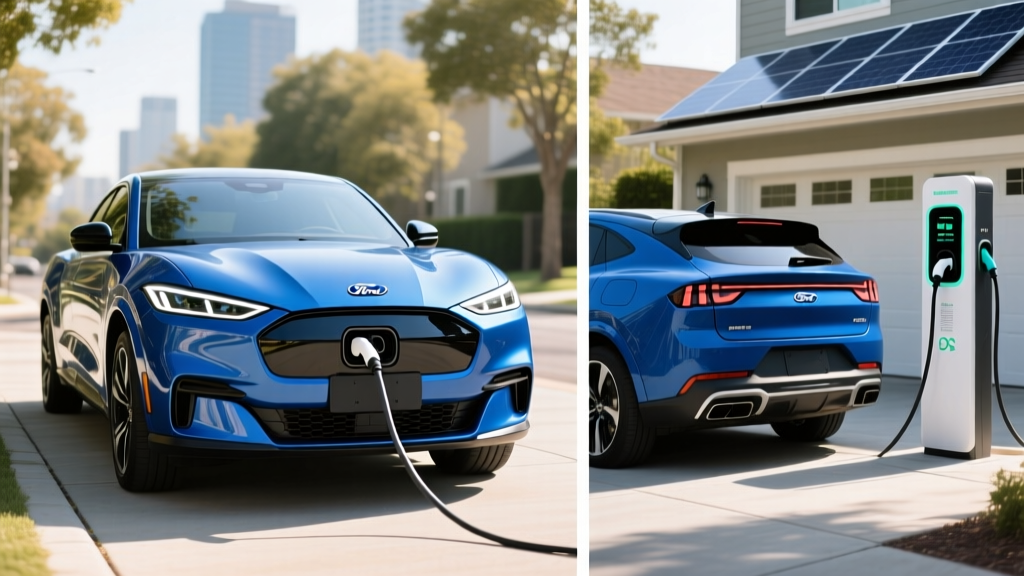
For home Level 2 charging, the Mach-E's onboard charger accepts up to 10.5 kW (48 amps). A full charge from empty on the 88 kWh ER pack takes roughly 9–10 hours. Most owners install a 48-amp hardwired Level 2 station (such as the Ford Charge Station Pro or a third-party unit like the Emporia Vue or Wallbox Pulsar Plus) on a 60-amp circuit. Expect $500–$1,500 for the charger unit plus $500–$2,000+ for professional electrician installation, depending on panel proximity and whether a panel upgrade is needed.
Performance, Drivetrain, and Driving Dynamics
The Mach-E lineup spans efficient commuter to legitimate performance EV. Here's the powertrain breakdown:
| Trim | Drivetrain | Horsepower | Torque (lb-ft) | 0–60 mph |
|---|---|---|---|---|
| Select SR RWD | RWD (single motor) | 266 hp | 317 | ~6.3 sec |
| Premium ER RWD | RWD (single motor) | 290 hp | 317 | ~5.8 sec |
| Premium ER eAWD | Dual-motor AWD | 346 hp | 428 | ~5.1 sec |
| GT ER eAWD | Dual-motor AWD | 480 hp | 600 | ~3.8 sec |
| GT Perf. Upgrade eAWD | Dual-motor AWD | 480 hp | 634 | ~3.5 sec |
The RWD models are the efficiency sweet spot — lighter, longer-ranged, and still quick enough for confident highway merging. The eAWD trims add a front AC induction motor for all-weather traction and a meaningful power bump. The GT with Performance Upgrade is genuinely fast, rivaling a Porsche Macan GTS on acceleration while undercutting it on price by tens of thousands.
Regenerative braking offers two modes: a mild setting that mimics a gas car's coasting feel, and a stronger one-pedal driving mode that can bring the Mach-E to a complete stop without touching the brake pedal. Most EV-commuter owners will prefer the one-pedal mode for city driving.
Pricing, Trim Levels, and Tax Credit Eligibility
Original MSRP for the 2023 Mach-E was revised mid-year after Ford's February 2023 price cuts. Here's where the trims landed (including mandatory destination charge):
| Trim | Original MSRP | Est. Used Price (2026) |
|---|---|---|
| Select SR RWD | ~$42,995 | $24,000–$28,000 |
| Premium ER RWD | ~$50,995 | $30,000–$36,000 |
| Premium ER eAWD | ~$53,995 | $32,000–$38,000 |
| GT ER eAWD | ~$61,995 | $38,000–$46,000 |
| GT Perf. Upgrade eAWD | ~$67,995 | $42,000–$50,000 |
Used prices are approximate market averages as of early 2026 and vary by mileage, condition, and region.
Federal Tax Credits: §30D (New) and §25E (Used)
If you purchased a new 2023 Mach-E in 2023, it was eligible for the full $7,500 §30D federal tax credit (before the stricter battery-sourcing rules took effect April 18, 2023). After that date, the ER models with NMC batteries sourced partly from South Korea (LG/SK On) saw the credit split — some trims qualified for $3,750 (critical minerals half only), while later builds regained eligibility as Ford adjusted supply chains.
For 2026 buyers purchasing a used 2023 Mach-E, the more relevant incentive is the §25E Used Clean Vehicle Credit:
- Credit amount: 30% of the sale price, up to a maximum of $4,000
- Vehicle requirement: Must be purchased from a licensed dealer for $25,000 or less
- Buyer income caps: AGI ≤ $75,000 (single), ≤ $112,500 (head of household), ≤ $150,000 (joint)
- Transfer option: Credit can be transferred to the dealer as a point-of-sale discount
Many 2023 Select SR RWD and Premium ER RWD listings now fall under the $25,000 threshold at dealers, making them eligible. Always verify with your tax professional and check the IRS §25E guidance before finalizing a purchase.
Interior, Cargo, and Tech Features
The Mach-E's cabin is a departure from traditional Ford interiors — dominated by a vertically oriented 15.5-inch SYNC 4A touchscreen with a large rotary volume dial embedded at the bottom. The 10.2-inch digital instrument cluster sits behind the wheel, and a panoramic fixed glass roof is standard on Premium and GT trims, flooding the cabin with light (though it lacks a shade, which can cause heat buildup in summer).
Cargo and passenger space:
- Front legroom: 43.3 inches
- Rear legroom: 38.9 inches — adequate for adults, tighter than the Hyundai Ioniq 5's 41.7 inches
- Cargo behind rear seats: 29.7 cu ft
- Cargo with rear seats folded: 59.7 cu ft
- Front trunk (frunk): 4.7 cu ft with a drain plug — useful for wet gear or tailgate ice
Notable tech and driver assists:
- Ford Co-Pilot360 2.0: Standard automatic emergency braking, blind-spot monitoring, lane-keeping assist, rear parking sensors
- BlueCruise (available): Ford's Level 2 hands-free highway driving assist on pre-mapped divided highways. Requires an active subscription (~$75/month or $2,100 for a 3-year plan after the initial trial). The driver must remain attentive — this is SAE Level 2, not self-driving.
- Phone-as-a-Key: Unlocks and starts the vehicle via Bluetooth from your smartphone
- Over-the-air (OTA) updates: Ford has delivered meaningful OTA improvements to the Mach-E, including BlueCruise expansions and charging optimizations
- Wireless Apple CarPlay and Android Auto
- The 15.5-inch screen lacks physical climate controls — temperature and fan adjustments require tapping the touchscreen, which frustrates some drivers
- BlueCruise subscription cost adds up over ownership
- Rear-seat headroom can feel tight for passengers over 6 feet due to the sloping roofline
- CCS1 charge port location (front fender) is less convenient than rear-quarter placement for some parking scenarios
Warranty, Battery Longevity, and Ownership Costs
Ford backs the 2023 Mach-E with a competitive warranty package:
- Bumper-to-bumper: 3 years / 36,000 miles
- Powertrain: 5 years / 60,000 miles
- Battery (high-voltage): 8 years / 100,000 miles — covers defects and capacity loss below 70% of original capacity
- Roadside assistance: 5 years / 60,000 miles
The 70% retention threshold over 8 years is industry-standard (matching Hyundai, Kia, and VW). Real-world degradation data from early 2021–2022 Mach-E owners suggests most packs retain 92–96% capacity after 2–3 years and 30,000–50,000 miles, well within the warranty curve. The LFP pack in the SR model is expected to show even slower degradation due to LFP chemistry's superior cycle life, though long-term Mach-E LFP data is still maturing.
Estimated 5-year ownership costs (for a Premium ER RWD, 15,000 miles/year, national average electricity rates):
- Electricity (home + public charging): ~$3,200–$4,500
- Maintenance: ~$800–$1,200 (no oil changes; tire rotations, cabin air filter, brake fluid checks)
- Insurance: ~$9,000–$12,000 (EV premiums typically run 15–25% higher than comparable gas vehicles)
- Estimated 5-year total: ~$13,000–$17,700 in operating costs
Compared to a similarly priced gas SUV getting 25 MPG combined at $3.50/gallon, the Mach-E saves roughly $5,000–$7,500 in fuel costs alone over five years, partially offset by higher insurance premiums.
Who Should Buy the 2023 Mach-E (and Who Shouldn't)
Choose the 2023 Mach-E If:
- You want a used EV under $25K that qualifies for the $4,000 §25E credit
- BlueCruise hands-free highway driving is a priority
- You need Supercharger access via the NACS adapter for road trips
- You value American brand servicing and a widespread dealer network
- 312 miles EPA range (ER RWD) covers your longest regular drives
Look Elsewhere If:
- You need the fastest DC charging available (Ioniq 5/EV6 charge nearly 3x faster)
- Rear-seat space is critical (Ioniq 5 and Tesla Model Y offer more room)
- You tow regularly (the Mach-E is not rated for towing)
- You prefer physical buttons for climate and audio controls
- You need a third row (consider the Kia EV9 or Rivian R1S)
The 2023 Mach-E is best suited for commuters and small families who prioritize range, Supercharger access, and hands-free highway driving. It's a strong daily driver that handles occasional road trips well with the ER battery, especially now that the NACS adapter has unlocked Tesla's charging network.
Frequently Asked Questions
What is the real-world range of the 2023 Mach-E?
The EPA rates the Extended Range RWD at 312 miles, but expect 260–280 miles in real-world highway driving at 70+ mph, and as low as 220–250 miles in freezing temperatures. The SR RWD delivers roughly 210–225 real-world highway miles. Always plan charging stops with a 15–20% buffer.
How fast does the 2023 Mach-E charge?
On a DC fast charger, the ER model peaks at 150 kW and charges from 10–80% in approximately 45 minutes. The SR model peaks at 115 kW with a 10–80% time of about 38 minutes. At home on a 10.5 kW Level 2 charger, a full charge takes roughly 9–10 hours for the ER pack.
Does the 2023 Mach-E qualify for the federal EV tax credit?
As a new vehicle in 2023, it qualified for up to $7,500 under §30D (eligibility varied by delivery date and battery sourcing). As a used vehicle in 2026, it can qualify for up to $4,000 under §25E if the dealer sale price is ≤$25,000 and the buyer meets income caps ($75K single / $150K joint). Consult the IRS and a tax professional for your specific situation.
Is the 2023 Mach-E worth buying vs. the Tesla Model Y or Hyundai Ioniq 5?
It depends on your priorities. The Mach-E wins on BlueCruise availability, the NACS Supercharger adapter (now standard), and potentially lower used pricing. The Model Y offers more cargo space, faster Supercharging natively, and a more mature software ecosystem. The Ioniq 5 charges significantly faster (240 kW peak, 10–80% in ~18 min) and has a more spacious rear seat, but relies on CCS networks (or a third-party adapter for Superchargers). For the used market under $25K, the Mach-E SR is often the easiest to find at that price point.
What are the biggest pros and cons?
Pros
- Up to 312 mi EPA range (ER RWD)
- NACS adapter unlocks Tesla Superchargers
- BlueCruise hands-free driving on mapped highways
- Strong used-EV credit eligibility (§25E)
- Engaging driving dynamics, especially GT
- Drainable frunk for practicality
Cons
- DC charging slower than Ioniq 5 / EV6 rivals
- No physical climate controls
- Rear seat tighter than some competitors
- BlueCruise requires ongoing subscription
- No towing capability
- Panoramic glass roof lacks a sunshade
How long will the 2023 Mach-E battery last?
Ford warranties the high-voltage battery for 8 years / 100,000 miles against capacity loss below 70%. Early data from 2021–2022 models shows 92–96% retention at 30,000–50,000 miles. With proper care (avoiding frequent 100% charges on NMC packs, using Level 2 for daily charging, and preconditioning in cold weather), most owners should expect the battery to outlast the vehicle's useful life.
Sources: EPA Fuel Economy — 2023 Ford Mustang Mach-E, IRS Used Clean Vehicle Credit (§25E), Ford 2023 Mach-E Specifications