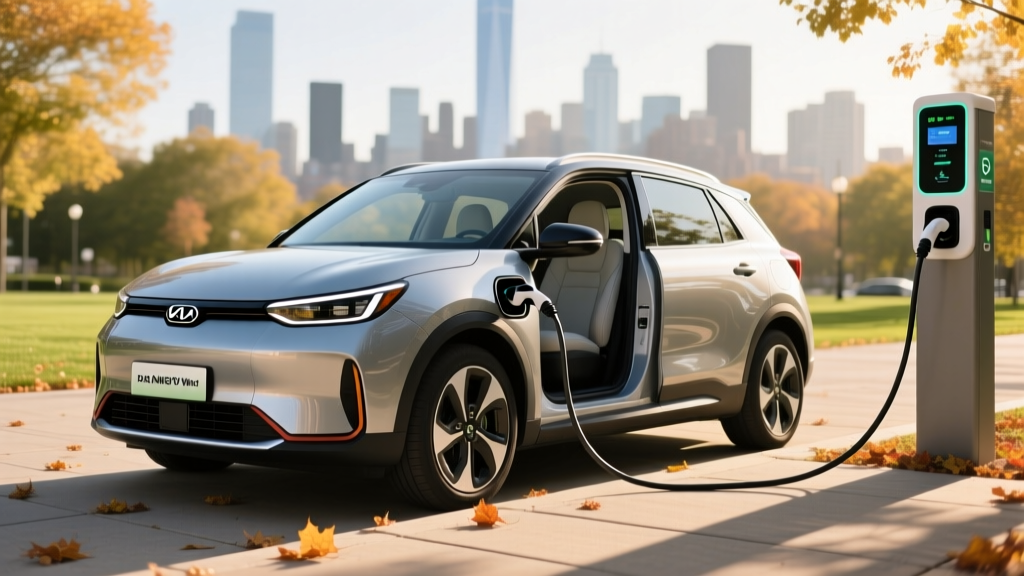
Quick Verdict: Is the 2023 Kia Niro EV Wind Worth It?
The 2023 Kia Niro EV Wind delivers an EPA-estimated 239 miles of range from a 64.8 kWh usable NMC battery, peaks at 85 kW DC fast charging (10–80% in ~44 minutes), and starts around $40,875 MSRP (before incentives). It earns a combined 113 MPGe. For commuters with home Level 2 charging and daily drives under 150 miles, it's a practical, efficient crossover. Its main limitation: DC charging speed lags rivals like the Hyundai Ioniq 5 and Chevy Bolt EUV, making road trips slower. As a used EV in 2026, it may qualify for the up-to-$4,000 used EV tax credit under IRS §25E if priced at or below $25,000 and buyer income falls within limits.
Range, Battery & Efficiency: The Numbers That Matter
The 2023 Niro EV Wind (the mid-tier trim, sitting between the base S and the top SX Prestige) shares a 64.8 kWh usable battery pack using NMC (nickel-manganese-cobalt) chemistry with a single front-mounted motor producing 201 horsepower and 188 lb-ft of torque. Kia rates 0–60 mph at approximately 7.0 seconds.
| Spec | 2023 Kia Niro EV Wind |
|---|---|
| EPA Range | 239 miles |
| Battery (usable) | 64.8 kWh, NMC |
| Efficiency | 113 MPGe combined (30 kWh/100 mi) |
| Motor Output | 201 hp / 188 lb-ft (FWD) |
| 0–60 mph | ~7.0 sec |
| DC Fast Charge (peak) | 85 kW (CCS1) |
| 10–80% DC Time | ~44 min |
| Level 2 Charge (max) | 11 kW (~9.5 hrs, 0–100%) |
| Base MSRP (Wind trim, 2023) | $40,875 |
| Battery Warranty | 10 yr / 100,000 mi |
Real-World Range Expectations
The EPA sticker says 239 miles, but real-world conditions shift that number significantly:
- Mild weather, city/suburban: 240–255 miles (regen braking helps in stop-and-go)
- Highway cruising (70–75 mph): ~195–215 miles
- Cold weather (below 30°F): ~155–185 miles (the Niro EV lacks a heat pump, relying on resistive cabin heating, which draws heavily from the pack)
- Mountainous terrain: Expect 15–25% range reduction on sustained climbs
Charging Speeds: Home vs. Public DC Fast Charging
Understanding the difference between kW (power, or how fast energy flows) and kWh (energy, or how much the battery stores) is critical. The Niro EV Wind's 64.8 kWh battery can accept a maximum of 85 kW on a DC fast charger — but it won't sustain that peak for the entire session.
| Charging Level | Power | Miles Added per Hour | Typical Use Case |
|---|---|---|---|
| Level 1 (120V outlet) | ~1.4 kW | ~4–5 mi/hr | Emergency/overnight trickle |
| Level 2 (240V, 48A) | ~11 kW | ~33–36 mi/hr | Home daily charging |
| DC Fast Charge (CCS1) | Peak 85 kW | ~170 mi/hr (at peak) | Road trips, public stations |
Charging curve reality: The Niro EV peaks near 85 kW only between roughly 10–40% state of charge (SoC). From 40–60%, it drops to ~65 kW, and above 80% it tapers sharply to under 20 kW. This means a 10–80% session takes around 44 minutes at a capable CCS1 charger (Electrify America, EVgo). Compared to the Hyundai Ioniq 5's 800V architecture that peaks at 235 kW and does 10–80% in ~18 minutes, the Niro EV is noticeably slower for road-trip charging.
Home charging math: If you drive 40 miles per day, you'll consume roughly 12 kWh. A Level 2 home charger replenishes that in about 1 hour and 10 minutes. Most owners plug in nightly and start every morning at 80–100% SoC, eliminating range anxiety for daily use.
EV vs. Gas: Cost Comparison With the Niro Hybrid
Kia also sells the Niro as a conventional hybrid (HEV) and a plug-in hybrid (PHEV). Here's how the EV stacks up against the gas Niro HEV over five years of ownership, assuming 12,000 miles/year:
| Factor | 2023 Niro EV Wind | 2023 Niro HEV (EX) |
|---|---|---|
| Base MSRP | $40,875 | $30,295 |
| EPA Efficiency | 113 MPGe (30 kWh/100 mi) | 53 MPG combined |
| Fuel/Energy Cost (5 yr, 60k mi) | ~$3,600 (at $0.15/kWh home) | ~$4,075 (at $3.50/gal) |
| Maintenance (5 yr est.) | ~$1,200 | ~$3,000 |
| Federal Tax Credit | Potential $4,000 used (§25E) | None |
| 5-Year Total Fuel + Maint. | ~$4,800 | ~$7,075 |
Key insight: The EV's higher purchase price is partially offset by dramatically lower fuel and maintenance costs. Over five years, the EV saves roughly $2,275 in fuel and maintenance alone. If you bought one used in 2026 for $25,000 or less and qualify for the §25E used EV credit, the effective purchase price drops to ~$21,000 — below the hybrid's new MSRP.
Maintenance savings come from eliminating oil changes, spark plugs, transmission fluid, and reducing brake wear (regenerative braking handles most deceleration, so brake pads often last 80,000+ miles).
Total Cost Breakdown: Purchase, Charging, Insurance & More
Let's model a realistic 5-year ownership scenario for a 2023 Niro EV Wind purchased used in 2026:
| Cost Category | 5-Year Estimate | Notes |
|---|---|---|
| Purchase Price (used, 2026) | $22,000–$26,000 | Based on current used-EV market depreciation |
| Federal Used EV Credit (§25E) | –$4,000 | If ≤$25,000 sale price + income within caps |
| Home Level 2 Charger Install | $800–$2,000 | 240V/48A outlet or hardwired; panel upgrade adds $1,500–$3,000 |
| Electricity (60k mi) | $2,700–$4,500 | $0.12–$0.20/kWh depending on utility; public DC adds cost |
| Insurance | $7,500–$10,000 | EV premiums run ~15–25% higher than gas equivalents |
| Maintenance & Repairs | $1,000–$1,500 | Cabin filters, wipers, tires, brake fluid check |
| Tire Replacement (1 set) | $600–$1,000 | EVs wear tires faster due to instant torque + weight |
Net 5-year cost (after credit): Roughly $30,600–$40,000 all-in including purchase, energy, insurance, and maintenance. Compare that to a new gas Niro HEV at $30,295 MSRP + $7,075 fuel/maintenance = $37,370 before insurance (which would be lower, ~$6,000–$7,500 for 5 years). The used Niro EV Wind is competitive on total cost, especially with the tax credit.
Common Misconceptions: Fact vs. Fiction
| Myth | Fact |
|---|---|
| "The battery will need replacing in a few years." | Kia's NMC battery is warranted for 10 years / 100,000 miles against dropping below ~70% capacity. Industry data shows NMC packs losing 8–12% capacity over 5 years with normal use. A replacement pack (if ever needed out of warranty) runs $10,000–$14,000, but most packs outlast the vehicle. |
| "I can't take road trips — charging takes too long." | At 85 kW peak, the Niro EV adds ~130 miles in 30 minutes of DC fast charging. Road trips require planning (use A Better Routeplanner or PlugShare), but the 239-mile range covers most segments between charging stops. It's slower than an Ioniq 5, but workable. |
| "EVs don't work in cold weather." | Range drops 20–35% below freezing (the Niro EV's resistive heater is the main culprit — it lacks a heat pump). Preconditioning the cabin while plugged in and using heated seats instead of blasting cabin air mitigates much of the loss. Owners in Minnesota and Maine drive these year-round. |
| "I'll save $7,500 on taxes if I buy one." | The $7,500 new EV credit (§30D) no longer applies to a 2023 model purchased new, as Kia Niro EVs did not meet battery-sourcing requirements even when new. However, buying one used from a dealer for ≤$25,000 in 2026 can qualify you for the up-to-$4,000 §25E used EV credit, subject to income caps ($75k single / $150k joint). See IRS §25E guidelines. |
| "Charging at home is too expensive to install." | A basic Level 2 setup (NEMA 14-50 outlet + quality EVSE) costs $800–$1,500 if your electrical panel has capacity. This pays for itself in public-charging savings within 6–12 months for most drivers. |
Real-World Ownership: What First-Time EV Buyers Need to Know
Home charging access is the single biggest ownership variable. If you can install a Level 2 charger at home (garage, carport, or driveway with panel access), the Niro EV Wind is a seamless daily driver — plug in at night, wake up with a full battery. If you rely solely on public charging, the 85 kW DC speed means longer stops, and public charging costs ($0.30–$0.50/kWh) can erase fuel savings.
Driving patterns matter. The Niro EV Wind shines as a commuter and suburban errand vehicle. If your daily round trip is under 100 miles, you'll use less than half the battery most days. If you regularly drive 200+ miles one-way or tow (it's not rated for towing), look elsewhere.
The CCS1 connector landscape. The 2023 Niro EV uses the CCS1 plug standard. As of 2026, Electrify America, EVgo, and ChargePoint all support CCS1 natively. Tesla Superchargers now offer CCS1 adapters at many locations through the Tesla Supercharger network opening, expanding your road-trip options — though you'll need Kia's CCS adapter or an aftermarket NACS-to-CCS adapter for seamless access.
Software and preconditioning. The Niro EV supports battery preconditioning when you set a DC fast charger as your navigation destination, warming the pack for faster charging in cold weather. Always use this feature — it can cut 10–80% charge times by 10–15 minutes in winter.
Decision Framework: Should You Buy the 2023 Niro EV Wind?
Choose the 2023 Kia Niro EV Wind if:
- You have (or can install) home Level 2 charging
- Your daily commute is under 120 miles round-trip
- You want a practical, efficient crossover with strong warranty coverage
- You're buying used in 2026 and can capture the $4,000 §25E credit
- You prioritize low running costs over DC fast-charging speed
Look elsewhere if:
- You frequently road-trip 300+ miles and need the fastest DC charging (consider Ioniq 5 or EV6)
- You live in extreme cold without a garage and can't precondition (the lack of a heat pump hurts)
- You need towing capability (Niro EV is not rated for towing)
- You lack any home or workplace charging access (public-only charging erodes savings and convenience)
- You need AWD (the Niro EV is front-wheel drive only; consider the Hyundai Ioniq 5 AWD or Subaru Solterra)
Frequently Asked Questions
Does the 2023 Kia Niro EV Wind qualify for the $7,500 federal tax credit?
No. The $7,500 new-vehicle credit (§30D) required North American assembly and battery-sourcing compliance that the Korea-built Niro EV did not meet, even in 2023. However, if you buy one used from a licensed dealer in 2026 for $25,000 or less, you may qualify for the §25E used clean vehicle credit of up to $4,000 (30% of sale price, capped at $4,000). Income limits apply: $75,000 single / $112,500 head of household / $150,000 joint filers. Always verify with a tax professional and the IRS used EV credit page.
How long does the Niro EV battery last?
Kia warranties the battery for 10 years or 100,000 miles against dropping below approximately 70% state of health. Real-world data from similar NMC packs suggests 8–15% degradation over 5–8 years depending on charging habits. Avoiding frequent 100% charges (daily charging to 80% is ideal for NMC) and minimizing DC fast charging in extreme heat extend longevity.
How much does it cost to charge a Niro EV at home?
At the U.S. average residential rate of ~$0.15/kWh, fully recharging the 64.8 kWh pack from 10% to 100% costs about $8.75, giving you roughly 215 real-world miles. That's approximately $0.04 per mile — versus $0.13–$0.15 per mile for a 30 MPG gas car at $3.50/gallon.
Is the Niro EV Wind better than the Niro PHEV?
It depends on your situation. The Niro PHEV offers 33 miles of electric-only range and 48 MPG combined on gas, making it ideal if you lack reliable home charging or take frequent long road trips. The EV offers lower running costs and zero tailpipe emissions but requires charging infrastructure. If you can charge at home and rarely drive over 200 miles in a day, the EV is cheaper to operate long-term.
Does the Niro EV have a heat pump?
No. The 2023 Niro EV uses a conventional resistive (PTC) heater for cabin warmth. This draws significantly more energy from the battery in cold weather compared to a heat pump system, contributing to the 20–35% range loss in freezing temperatures. Preconditioning while plugged in and relying on heated seats/steering wheel (standard on the Wind trim) helps minimize the hit.
What's the difference between the Wind trim and other Niro EV trims?
The Wind is the mid-tier trim. Compared to the base S trim, the Wind adds: heated front seats, heated steering wheel, wireless phone charging, a power-adjustable driver's seat, and smart power liftgate. The top SX Prestige adds ventilated front seats, a sunroof, Harman Kardon audio, and additional highway driving assist features. All trims share the same 64.8 kWh battery, 201 hp motor, and 239-mile EPA range.