Quick Verdict: The 2023 Kia EV6 Still Punches Above Its Weight
If you are shopping the used or remaining-new inventory of the 2023 Kia EV6, you are looking at one of the best-executed electric crossovers from the Hyundai Motor Group's E-GMP platform. The EV6 delivers class-leading 800-volt DC fast-charging, a spacious flat-floor cabin, and real-world efficiency that holds up outside the laboratory. It is not perfect — rear visibility is compromised, and the dual-screen layout can feel busy — but as a daily driver and road-trip companion, the 2023 EV6 remains a benchmark in the mid-size electric crossover segment.
| Spec | Light / Wind (RWD) | GT-Line (AWD) | EV6 GT |
|---|---|---|---|
| EPA Range | 232 mi (Light) / 310 mi (Wind) | 282 mi | 206 mi |
| Usable Battery | 74.0 kWh (NMC lithium-ion) | ||
| Horsepower | 225 hp | 320 hp | 576 hp |
| 0-60 mph | 7.2 sec | 5.1 sec | 3.4 sec |
| Max DC Fast Charge | ~239 kW (800V architecture) | ||
| 10-80% DCFC Time | ~18 minutes (peak conditions) | ||
| Level 2 Charge Rate | 10.9 kW (~37 mi/hr added) | ||
| MPGe (combined) | 134 MPGe (Wind RWD) | 106 MPGe | 85 MPGe |
| Base MSRP (2023) | $48,700 (Light) | $56,400 (GT-Line AWD) | $61,600 (GT) |
| Battery Warranty | 10 years / 100,000 miles | ||
Range and Efficiency: EPA vs. The Real World
The 2023 Kia EV6 lineup offers three distinct EPA range tiers depending on trim and drivetrain. The efficiency champion is the Wind RWD at 310 miles EPA, while the performance-oriented GT drops to just 206 miles. All trims share the same 74.0 kWh usable battery pack (77.4 kWh gross) using NMC (nickel-manganese-cobalt) cell chemistry — chosen for its higher energy density compared to LFP.
Real-World Range Expectations
EPA Sticker: 310 mi (Wind RWD) / 282 mi (GT-Line AWD) / 206 mi (GT)
Highway (70-80 mph): Expect roughly 250-275 mi from the Wind RWD, and 225-245 mi from the GT-Line AWD. The EV6's boxy crossover profile creates more drag at sustained highway speeds than a sleeker sedan like the Hyundai Ioniq 6.
Cold Weather (below 32°F): Plan for a 20-30% range reduction. The Wind RWD drops to approximately 215-250 mi in freezing conditions. The EV6 includes a battery preconditioning function and heat pump (standard on most trims), which mitigates but does not eliminate cold-weather losses.
Efficiency in practice: The Wind RWD achieves approximately 26 kWh/100 mi in mixed driving, translating to 134 MPGe per fueleconomy.gov. That is competitive with the Tesla Model Y Long Range but trails the Ioniq 6's more aerodynamic profile.
Charging Speed: The 800-Volt Advantage
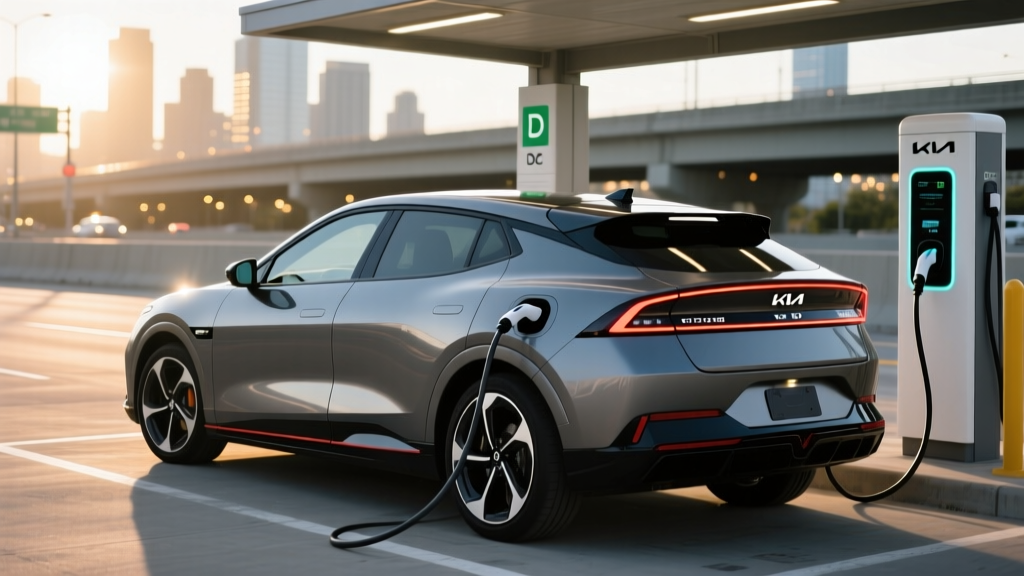
The EV6's headline technical feature is its 800-volt electrical architecture, shared with the Hyundai Ioniq 5 and Genesis GV60. This enables DC fast-charging at up to approximately 239 kW — among the fastest in its class. On a 350 kW Electrify America or compatible CCS station, the EV6 can add 10-80% state of charge in roughly 18 minutes under ideal thermal conditions.
| Charging Level | Power | Connector | Speed / Time |
|---|---|---|---|
| Level 1 (120V household) | ~1.4 kW | J1772 | ~5 mi/hr added |
| Level 2 (240V home) | 10.9 kW | J1772 | ~37 mi/hr; full charge ~7.5 hrs |
| DC Fast Charge | Peak ~239 kW | CCS1 | 10-80% in ~18 min; ~210 mi in 18 min |
Charging curve reality check: The 239 kW figure is a peak, not a sustained rate. In real-world testing, the EV6 typically holds above 200 kW from roughly 10-40% SoC, then tapers progressively. From 70-80%, expect speeds closer to 80-100 kW. The 18-minute claim assumes you arrive at a low state of charge, the battery is preconditioned, and ambient temperatures are moderate (60-80°F). In winter or after repeated fast-charge sessions, add 3-5 minutes.
Home charging: With a 48-amp Level 2 home charger on a 240V/60A circuit, the onboard 10.9 kW charger replenishes about 37 miles of range per hour. A full 0-100% charge takes approximately 7-8 hours, easily fitting an overnight session. The EV6 also supports Vehicle-to-Load (V2L), allowing you to power appliances or tools at up to 3.6 kW using an adapter plugged into the charge port or the interior V2L outlet.
Performance and Drivetrain
The 2023 EV6 offers three performance tiers. The Light and Wind trims use a single rear-mounted motor producing 225 hp and 258 lb-ft of torque, delivering a respectable 0-60 mph time of approximately 7.2 seconds. That is adequate for merging and passing, though it will not pin you to the seat.
The GT-Line AWD adds a front motor for dual-motor all-wheel drive, bumping output to 320 hp and 446 lb-ft. The 0-60 time drops to roughly 5.1 seconds — genuinely quick for a family crossover. The AWD system also improves traction in rain and light snow, though ground clearance (6.1 inches) limits any serious off-road ambitions.
At the top sits the EV6 GT, a performance beast with 576 hp and 545 lb-ft. Kia claims a 3.4-second 0-60 mph time, verified by multiple independent tests. The GT adds an electronic limited-slip differential, larger brakes, and a dedicated GT drive mode. The trade-off is range: just 206 miles EPA, and real-world highway driving may yield 160-180 miles.
Interior, Cargo, and Daily Livability
The EV6's flat E-GMP floor creates an airy, spacious cabin that feels larger than its exterior dimensions suggest. The dual 12.3-inch curved display cluster dominates the dash, running Kia's latest infotainment with wireless Apple CarPlay and Android Auto (on base trims; higher trims require wired connection for full functionality — a notable quirk).
Passenger space: Front legroom measures 41.7 inches, with rear legroom at 39.4 inches — competitive with the Tesla Model Y and Ford Mustang Mach-E. The rear floor is completely flat, making the middle seat genuinely usable for a fifth passenger on shorter trips.
Cargo volume: Behind the rear seats, you get 24.4 cubic feet of cargo space, expanding to 50.2 cubic feet with the rear seats folded. The front trunk (frunk) adds a modest 0.74 cubic feet on AWD models and 1.8 cubic feet on RWD — enough for a charging cable bag or a small backpack, but far less than the Ford F-150 Lightning's massive frunk.
Towing: The EV6 is rated to tow up to 2,300 pounds when properly equipped (AWD trims). That handles a small utility trailer or a pair of jet skis, but do not plan on hauling a large boat or camper.
Pricing, Trims, and Federal Tax Credit Eligibility
The 2023 Kia EV6 launched with four trim levels. Pricing below reflects original MSRP before any incentives:
| Trim | MSRP (2023) | Drivetrain | Federal Credit Eligibility |
|---|---|---|---|
| Light | $48,700 | RWD | Varies by sourcing/year |
| Wind | $52,900 | RWD / AWD (+$3,900) | Varies by sourcing/year |
| GT-Line | $56,400 | RWD / AWD (+$3,900) | Varies by sourcing/year |
| GT | $61,600 | AWD | Subject to MSRP cap rules |
Federal EV Tax Credit (§30D) — Critical Details
Under current IRS rules, the §30D Clean Vehicle Credit offers up to $7,500, but eligibility is not guaranteed. Key constraints include:
- MSRP cap: SUVs, vans, and pickups are capped at $80,000 MSRP; sedans and other vehicles at $55,000. The EV6 is classified as an SUV by the IRS (based on window sticker classification), so the $80,000 cap applies — all trims clear this threshold.
- Buyer income limits: Modified adjusted gross income (MAGI) cannot exceed $150,000 (single), $225,000 (head of household), or $300,000 (joint filing).
- Battery sourcing requirements: The credit splits into two halves — $3,750 for critical minerals and $3,750 for battery components — with percentages that increase annually. As of 2025-2026, the Kia EV6 (built in South Korea) has faced sourcing challenges that may reduce or eliminate the credit for new purchases.
- Point-of-sale transfer: As of 2024, qualifying buyers can transfer the credit to the dealer at purchase, receiving it as an immediate price reduction rather than waiting to claim it on a tax return.
Because the EV6 is manufactured in South Korea (not North America), it did not qualify for the full new-vehicle credit under the post-IRA sourcing rules for most of 2023-2024. Always verify current eligibility at irs.gov or consult a tax professional before relying on the credit in your purchase decision. If buying used, the separate §25E used EV credit (up to $4,000) may apply if the vehicle's sale price is under $25,000.
Safety, Tech, and Driver Assistance
The 2023 EV6 earned the IIHS Top Safety Pick+ rating, the highest honor from the Insurance Institute for Highway Safety. It scored "Good" across all crashworthiness tests. NHTSA awarded it a 5-star overall safety rating.
Standard driver-assistance features under Kia's DriveWise suite include:
- Highway Driving Assist 2 (HDA2) — adaptive cruise with lane centering and lane-change assist
- Forward collision-avoidance assist with pedestrian/cyclist detection
- Blind-spot collision-avoidance assist
- Rear cross-traffic collision-avoidance assist
- Safe Exit Assist (warns of approaching traffic when opening doors)
- Remote Smart Parking Assist (on higher trims — the car parks itself while you stand outside)
SAE Level 2 clarification: Highway Driving Assist 2 is an SAE Level 2 driver-assistance system. This means the vehicle controls steering and speed under certain conditions, but the driver must remain fully engaged, hands on or near the wheel, eyes on the road. This is not autonomous or self-driving capability. Kia does not currently offer a hands-free Level 2+ system comparable to GM's Super Cruise or Ford's BlueCruise on the EV6.
Notable tech drawbacks: The climate controls and media functions share a single touch panel that toggles between the two — a frustrating design choice that requires you to look away from the road to switch modes. The infotainment system is responsive but the menu structure takes a learning curve. Wireless CarPlay/Android Auto availability varies by trim in ways that feel arbitrary.
2023 Kia EV6: Pros and Cons
Pros
- Best-in-class DC fast-charging — 800V architecture delivers 10-80% in ~18 min at compatible stations
- Spacious flat-floor cabin with excellent rear legroom (39.4 in) and usable middle seat
- Top Safety Pick+ from IIHS with comprehensive standard driver assists
- V2L capability — power laptops, appliances, or tools from the vehicle's battery
- 10-year/100,000-mile battery warranty — among the longest in the industry
- EV6 GT variant offers supercar-rivaling 3.4-second 0-60 times
Cons
- Limited rear visibility — thick C-pillars and a small rear window compromise sightlines
- Small frunk — 0.74-1.8 cu ft depending on drivetrain
- Touch-panel climate/media toggle is distracting and unintuitive
- Federal tax credit eligibility has been inconsistent due to South Korean manufacturing and battery sourcing rules
- Real-world highway range falls 15-20% below EPA on the Wind RWD at sustained 75+ mph
- GT trim range of 206 mi EPA (potentially ~160 mi highway) limits road-trip practicality
Who Should Buy the 2023 Kia EV6?
Ideal for: Daily commuters with home Level 2 charging who value fast public charging for occasional road trips. The Wind RWD at 310 miles EPA covers most commutes for a full work week without charging. The AWD GT-Line suits families in four-season climates who need traction without sacrificing too much range. Tech-forward buyers who want V2L capability and a modern, spacious cabin will appreciate the E-GMP platform's packaging.
Look elsewhere if: You need maximum cargo volume (the Hyundai Ioniq 5 offers slightly more), hands-free highway driving (Ford BlueCruise or GM Super Cruise vehicles), or you regularly drive in extreme cold where the EV6's range loss becomes significant. If federal tax credit eligibility is a dealbreaker in your purchase math, verify current sourcing rules before committing — the Ioniq 5 (built in Georgia) has had more consistent credit qualification in recent model years.
Frequently Asked Questions
What is the real-world range of the 2023 Kia EV6?
The Wind RWD achieves 310 miles EPA, but expect approximately 250-275 miles on the highway at 70-80 mph and 215-250 miles in freezing weather. The GT-Line AWD delivers about 225-245 miles in real-world highway driving from its 282-mile EPA rating.
How fast does the 2023 EV6 charge at home and on the road?
On a Level 2 home charger (240V, 48A), the EV6 charges at 10.9 kW, adding roughly 37 miles of range per hour and completing a full charge in about 7.5 hours. At a 350 kW DC fast charger, it peaks at ~239 kW and charges from 10-80% in approximately 18 minutes under optimal conditions.
Does the 2023 Kia EV6 qualify for the $7,500 federal EV tax credit?
Eligibility has varied significantly. Because the 2023 EV6 was manufactured in South Korea and its battery components and critical minerals did not consistently meet the escalating thresholds of the Inflation Reduction Act, many buyers did not qualify for the full or partial new-vehicle credit. For a used EV6 purchased under $25,000, the §25E used EV credit (up to $4,000) may apply. Always check current rules at irs.gov.
Is the 2023 Kia EV6 worth buying vs. the Hyundai Ioniq 5 or Tesla Model Y?
The EV6 shares its platform with the Ioniq 5 but trades some cargo space for a sportier design and slightly better highway efficiency. Against the Tesla Model Y, the EV6 offers faster peak charging and a more traditional interior layout, but Tesla's Supercharger network remains the gold standard for reliability. If you prioritize charging speed and safety ratings, the EV6 is compelling. If you want maximum charging-network access, the Model Y (now with NACS) has an edge.
What is the battery warranty on the 2023 Kia EV6?
Kia covers the EV6's high-voltage battery for 10 years or 100,000 miles, whichever comes first. The warranty guarantees the battery will retain a minimum percentage of its original capacity (typically 70% based on Kia's terms). The basic vehicle warranty is 5 years/60,000 miles, and the powertrain warranty is 10 years/100,000 miles.
Does the EV6 support hands-free self-driving?
No. The EV6's Highway Driving Assist 2 is an SAE Level 2 system requiring constant driver supervision. It handles adaptive cruise control and lane centering simultaneously, but you must keep your hands on the wheel and eyes on the road. It does not support hands-free or eyes-off driving.