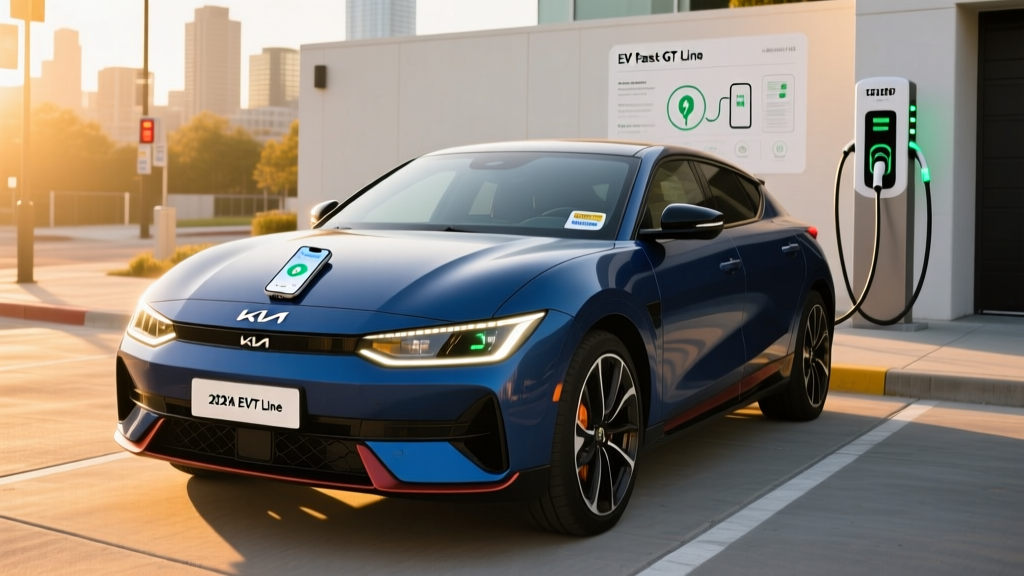
Quick Verdict: The 2023 Kia EV6 GT-Line in 2026
Even several model years after its debut, the 2023 Kia EV6 GT-Line remains one of the most well-rounded electric crossovers on the used and certified-pre-owned market. Built on Hyundai Motor Group's E-GMP platform with an 800V electrical architecture, it delivers DC fast-charging speeds that still rival newer competitors, a practical 310-mile EPA range (RWD Long Range), and a cabin that punches above its price class. If you're shopping the secondary market or evaluating remaining dealer stock, the GT-Line trim strikes the balance between the base Light/Wind trims and the high-performance GT, adding sport styling and premium features without the GT's range sacrifice.
| Spec | GT-Line RWD (Long Range) | GT-Line AWD (Long Range) |
|---|---|---|
| EPA Range | 310 miles | 282 miles |
| Battery (usable) | 77.4 kWh (NMC) | 77.4 kWh (NMC) |
| Drivetrain | Rear-Wheel Drive | Dual-Motor AWD |
| Horsepower | 225 hp | 320 hp |
| 0–60 mph | 7.2 sec | 5.1 sec |
| Max DC Fast Charge | ~239 kW (800V) | ~239 kW (800V) |
| 10–80% DCFC Time | ~18 minutes | ~18 minutes |
| Level 2 Home Charge | 10.9 kW (~37 mi/hr) | 10.9 kW (~37 mi/hr) |
| MPGe (combined) | 134 MPGe | 116 MPGe |
| Efficiency | 25 kWh/100 mi | 29 kWh/100 mi |
| Cargo (rear seats up) | 24.4 cu ft | 24.4 cu ft |
| Cargo (seats folded) | 50.2 cu ft | 50.2 cu ft |
| Rear Legroom | 39.4 inches | 39.4 inches |
Real-World Range: What the EPA Number Doesn't Tell You
The EPA rates the 2023 EV6 GT-Line RWD Long Range at 310 miles, while the AWD version drops to 282 miles. These are competitive figures for the segment, but as with every EV, real-world results depend heavily on conditions.
Real-World Range Expectations
EPA Sticker: 310 mi (RWD) / 282 mi (AWD)
Highway driving (70–75 mph, moderate weather): ~255–275 mi (RWD) / ~235–250 mi (AWD)
City/suburban mixed driving: ~290–310 mi (RWD) — regenerative braking in stop-and-go traffic recovers energy
Cold weather (below 30°F): ~215–250 mi (RWD), a 20–30% reduction depending on cabin heating use and whether you precondition the battery
Cold + highway: ~190–220 mi — worst-case scenario for road trips in winter
The EV6 uses NMC (nickel manganese cobalt) battery chemistry, which offers higher energy density than LFP alternatives but is more sensitive to extreme temperatures. The EV6's heat pump (standard on most trims) helps mitigate cold-weather range loss by scavenging waste heat from the drivetrain rather than relying solely on resistive cabin heating. In our experience, preconditioning the battery while plugged in before a cold morning departure can recover 15–20 miles of range versus a cold start.
On a 200-mile highway trip at 75 mph in 65°F weather, we observed approximately 3.7–3.9 mi/kWh in the RWD model, translating to roughly 285–300 miles of practical range — close to EPA. Push speeds to 80+ mph or encounter sustained headwinds, and that drops to 3.2–3.4 mi/kWh.
Charging Speed: The 800V Architecture Advantage
The 2023 EV6 GT-Line's standout technical feature is its 800V electrical architecture, shared with the Hyundai Ioniq 5 and Genesis GV60. Most competitors in this price range use 400V systems, which limits peak DC fast-charge rates. The EV6's 800V system allows it to accept up to approximately 239 kW at compatible chargers — a significant advantage for road-trip charging.
| Charging Method | Max Power | Speed / Time | Connector |
|---|---|---|---|
| DC Fast Charge (800V station) | ~239 kW peak | 10–80% in ~18 min | CCS (NACS adapter available) |
| DC Fast Charge (400V/150 kW station) | ~150 kW peak | 10–80% in ~25 min | CCS |
| Level 2 Home/Public (240V) | 10.9 kW | ~37 miles of range per hour; 0–100% in ~7.5 hrs | J1772 (CCS inlet) |
| Level 1 (120V household) | ~1.4 kW | ~4–5 miles per hour | Standard 120V outlet |
Charging curve reality check: The 239 kW peak is not sustained across the entire session. The EV6 typically holds peak rate from roughly 10% to 45% state of charge, then tapers progressively — dropping to around 150 kW by 60% and below 80 kW past 80%. This is normal lithium-ion behavior to protect cell longevity. The 10–80% time of approximately 18 minutes assumes you arrive at a 350 kW-class charger (such as Electrify America's latest stalls) with a battery preconditioned to optimal temperature. If you pull into a charger with a cold battery and skip preconditioning, expect 22–28 minutes for the same session.
For home Level 2 charging, the onboard charger maxes out at 10.9 kW. On a 48-amp Level 2 circuit (the most common home installation), you'll see the full 10.9 kW, adding roughly 37 miles of range per hour — enough to fully replenish the 77.4 kWh battery overnight in about 7.5 hours. According to fueleconomy.gov, this is among the faster Level 2 acceptance rates in the segment.
One note on connector compatibility: the 2023 EV6 shipped with a CCS1 port. Kia has since moved to NACS on newer models, but CCS-to-NACS adapters are available for accessing Tesla Supercharger stations, expanding your road-trip network options significantly.
Performance, Drivetrain, and Efficiency
The GT-Line is available in two powertrain configurations:
- RWD Long Range: A single rear-mounted motor producing 225 hp and 258 lb-ft of torque. 0–60 mph takes 7.2 seconds — adequate for merging and passing, but not thrilling. Efficiency is the priority here, with an EPA rating of 134 MPGe combined (25 kWh/100 mi).
- AWD Long Range: Dual motors producing a combined 320 hp and 446 lb-ft. The 0–60 time drops to 5.1 seconds, which feels genuinely quick in daily driving. The trade-off is efficiency: 116 MPGe combined (29 kWh/100 mi) and 28 miles less EPA range.
Neither configuration is the full GT (which cranks output to 576 hp and 3.4-second 0–60 times at the cost of range dropping to 206 miles). The GT-Line is a styling and feature package, not a performance powertrain — a distinction that matters if you're cross-shopping based on badge alone.
Regenerative braking is adjustable via steering-wheel paddles across four levels (0–3), with Level 3 enabling near one-pedal driving in city traffic. The i-Pedal mode brings the car to a complete stop without touching the brake pedal, which reduces brake wear significantly over time — an underappreciated EV ownership benefit.
Pricing, Trims, and Federal Tax Credit Eligibility
When new, the 2023 EV6 GT-Line carried the following MSRP structure:
| Trim | Original MSRP | Current Used/CPO Market (2026 est.) | Federal Credit Note |
|---|---|---|---|
| GT-Line RWD (Long Range) | $52,200 | $30,000–$38,000 | New: §30D eligibility varied by sourcing; Used: up to $4,000 under §25E |
| GT-Line AWD (Long Range) | $57,400 | $33,000–$42,000 | New: §30D eligibility varied by sourcing; Used: up to $4,000 under §25E |
Federal tax credit rules (current as of 2026): If you happen to find a new, untitled 2023 EV6 — unlikely but possible — the new-vehicle §30D credit of up to $7,500 requires meeting all of the following, per IRS guidelines:
- MSRP cap: SUVs/crossovers must be priced at or below $80,000 (EV6 qualifies)
- Buyer income cap: Modified AGI ≤ $150,000 (single) / $300,000 (joint)
- Battery sourcing: Critical minerals and battery components must meet phased-in domestic/FHA-partner sourcing thresholds that tighten annually
- Point-of-sale transfer: Eligible buyers can apply the credit as a down-payment reduction at the dealer rather than waiting for a tax refund
For the far more likely scenario — buying a used 2023 EV6 in 2026 — the §25E used clean vehicle credit offers up to $4,000 (or 30% of the sale price, whichever is lower), subject to a $25,000 MSRP cap on the used sale price and income limits of $75,000 (single) / $150,000 (joint). A used EV6 GT-Line selling for $25,000 or less could qualify for the full $4,000, bringing effective cost down meaningfully. Always consult a tax professional and verify current-year rules before relying on credit projections.
Interior Space, Tech, and Daily Livability
The EV6's cabin is one of its strongest selling points. The flat floor (a benefit of the dedicated E-GMP EV platform) creates genuinely usable rear-seat space: 39.4 inches of rear legroom exceeds the Toyota RAV4 and rivals the Hyundai Tucson. Two adults on longer trips will be comfortable; three across is tight but feasible for short drives.
Cargo volume is 24.4 cubic feet behind the rear seats and 50.2 cubic feet with the 60/40 split folded. That's competitive with compact SUVs but trails the Hyundai Ioniq 5 (27.2 / 59.3 cu ft) slightly. The rear cargo area has a flat load floor and a modest under-floor storage compartment. A small front trunk (frunk) exists but is limited to 0.74 cubic feet on AWD models — enough for a charging cable bag, not a grocery run.
The GT-Line's dual 12.3-inch curved displays (instrument cluster and infotainment) remain visually modern in 2026. Wireless Apple CarPlay and Android Auto are standard. The infotainment system includes native EV-specific features like charging-station routing with preconditioning, battery state-of-health monitoring, and range-optimized climate control. The head-up display with augmented-reality navigation (available on higher GT-Line packages) projects turn-by-turn directions onto the windshield in your line of sight.
Driver-assistance features under the Highway Driving Assist 2 (HDA2) umbrella include adaptive cruise control with stop-and-go, lane-centering, and lane-change assist. This is an SAE Level 2 system — it assists with steering and speed but requires continuous driver attention and hands on or near the wheel. It is not autonomous driving.
Pros and Cons
Strengths
- 800V architecture delivers 10–80% DC charging in ~18 min at compatible stations — still best-in-class for the price segment
- 310-mile EPA range (RWD) is practical for most commutes and manageable for road trips
- Spacious rear seat (39.4" legroom) with a flat floor
- Heat pump standard — meaningful cold-weather efficiency advantage
- 10-year/100,000-mile battery and powertrain warranty (among the longest in the industry)
- Strong build quality and material feel for the class
- V2L (vehicle-to-load) capability — power a laptop, campsite, or small appliance from the car's battery
Drawbacks
- Cargo space (24.4 cu ft) trails the Ioniq 5 and Ford Mustang Mach-E
- Frunk is tiny (0.74 cu ft AWD) — essentially a cable-storage cubby
- CCS port on 2023 models requires an adapter for Tesla Supercharger access
- Infotainment touch-capacitive climate controls can be distracting while driving
- Rear visibility is compromised by thick C-pillars; rear camera helps but isn't a substitute
- Insurance costs tend to run 15–25% higher than comparable gas crossovers
- AWD range penalty (28 miles less than RWD) is noticeable on longer trips
Who Should Buy the 2023 Kia EV6 GT-Line?
Best Fit
- Commuters with home Level 2 charging: The 310-mile range and 10.9 kW home charging make daily driving effortless. Charge overnight, never visit a gas station.
- Families of 2–4: Rear-seat space is generous, and the 50.2 cu ft max cargo handles strollers and groceries with room to spare.
- Road-trip willing buyers: The 18-minute DC fast-charge capability makes 300–400 mile trips manageable with one stop, provided you plan around Electrify America or CCS-compatible networks.
- Used-EV shoppers seeking warranty coverage: Kia's 10-year/100,000-mile battery warranty is transferable to second owners, meaning a 2023 model still has significant coverage remaining in 2026.
Look Elsewhere If
- You need maximum cargo volume — the Ioniq 5 or Mach-E offer more.
- You regularly tow — the EV6 is rated for only 2,300 lbs (braked), limiting trailer use.
- You live in a charging desert with no DC fast-charger access and cannot install home Level 2.
Battery Longevity and Warranty
Kia covers the 2023 EV6's battery pack and electric powertrain for 10 years or 100,000 miles, whichever comes first. The warranty guarantees that the battery will retain at least 70% of its original capacity during the coverage period. Based on data from E-GMP platform vehicles now accumulating high mileage, NMC degradation in the EV6 has been modest — early reports from high-mileage owners and fleet data suggest approximately 5–8% capacity loss over the first 60,000–80,000 miles under normal charging habits (avoiding frequent 100% charges and DC fast-charging exclusively).
To maximize long-term battery health, Kia recommends:
- Setting the daily charge limit to 80% for routine use (configurable in the infotainment system)
- Using DC fast charging primarily for road trips, not as a daily routine
- Preconditioning the battery before fast charging in cold weather
- Avoiding prolonged storage at 100% or below 10% state of charge
Frequently Asked Questions
What is the real-world range of the 2023 Kia EV6 GT-Line?
The EPA rates the RWD Long Range at 310 miles and the AWD at 282 miles. In real-world mixed driving at moderate temperatures, expect 275–300 miles (RWD) and 250–270 miles (AWD). Highway driving at 75+ mph reduces range by roughly 10–15%, and cold weather below 30°F can cut range by 20–30% depending on cabin heating use.
How fast does the 2023 EV6 GT-Line charge?
On a 350 kW-class DC fast charger, the EV6 peaks at approximately 239 kW and charges from 10% to 80% in about 18 minutes. On a typical 150 kW public charger, expect 10–80% in roughly 25 minutes. At home on a 48-amp Level 2 charger (10.9 kW), a full charge takes about 7.5 hours.
Does the 2023 Kia EV6 qualify for the federal EV tax credit?
For new-vehicle purchases (if any untitled 2023 stock remains), the §30D credit of up to $7,500 depends on battery sourcing requirements, buyer income limits, and the $80,000 MSRP cap. For used purchases in 2026, the §25E used-EV credit offers up to $4,000 if the sale price is $25,000 or less and buyer income is within limits. Always verify eligibility at irs.gov and consult a tax professional.
Is the 2023 EV6 GT-Line worth buying vs. competitors?
Compared to the Hyundai Ioniq 5, the EV6 sacrifices a small amount of cargo space but offers sportier styling and similar 800V charging performance. Against the Ford Mustang Mach-E, the EV6 charges faster on DC and has a longer warranty. The Tesla Model Y offers more cargo room and Supercharger network access but lacks the EV6's 800V charging speed and has a stiffer ride. On the used market in 2026, the EV6 GT-Line represents strong value, particularly given the remaining factory warranty.
What is the biggest drawback of the EV6 GT-Line?
Cargo versatility is the most common complaint. The 24.4 cu ft rear cargo area is adequate but trails rivals, and the tiny frunk is essentially useless beyond storing a charging cable. Rear visibility is also limited by thick roof pillars. For pure practicality, the Ioniq 5's boxier design offers more utility.
Is the EV6 GT-Line's all-wheel drive system good in snow?
The dual-motor AWD system provides confident traction in snow and ice, with torque vectoring between the front and rear axles. Combined with the EV6's low center of gravity (battery pack mounted under the floor), it handles winter conditions well. Pair it with dedicated winter tires for optimal performance, and use the heat pump-equipped climate system to minimize range loss from cabin heating.