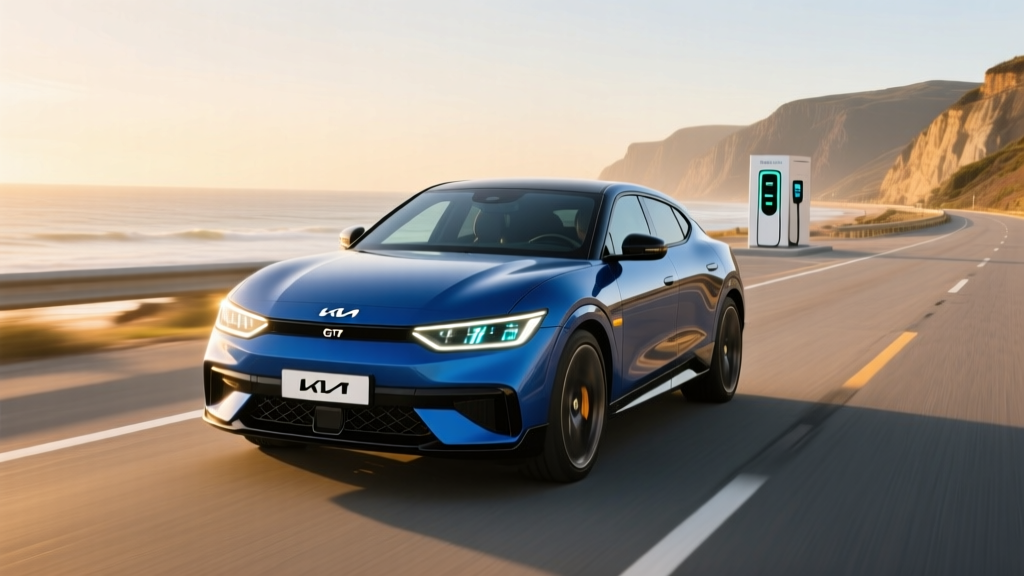
Quick Verdict: The Fastest Kia Ever Built
The 2023 Kia EV6 GT is a performance anomaly. With 576 horsepower and a dual-motor all-wheel-drive powertrain, it rockets to 60 mph in 3.4 seconds — making it the quickest production vehicle Kia has ever sold. But beyond the launch-control theatrics, the EV6 GT is also a practical daily driver built on Hyundai Motor Group's E-GMP platform with 800V architecture, meaning DC fast charging that rivals anything from Porsche or Tesla. The trade-off? A 206-mile EPA range that falls well short of the standard EV6 lineup, and a $61,600 starting price that puts it in direct competition with the Tesla Model Y Performance and Ford Mustang Mach-E GT.
Now that the 2023 model year is well established on dealer lots and the used-EV market, buyers can evaluate this car on real-world data rather than press-release promises. Here's every number that matters.
Full Specifications at a Glance
| Attribute | Value |
|---|---|
| EPA Range | 206 miles |
| Battery (usable) | 77.4 kWh, NMC lithium-ion |
| Drivetrain | Dual-motor AWD |
| Horsepower | 576 hp (combined) |
| Torque | 545 lb-ft |
| 0-60 mph | 3.4 seconds |
| Top Speed | 161 mph |
| Max DC Fast Charge | ~240 kW (peak) |
| 10–80% DC Charge Time | ~18 minutes (ideal conditions) |
| Level 2 Charge Rate | 10.9 kW (onboard charger) |
| EPA Efficiency | 85 MPGe combined (2.52 kWh/mi) |
| Cargo (rear seats up) | 24.4 cu ft |
| Cargo (rear seats folded) | 50.2 cu ft |
| Rear Legroom | 39.0 inches |
| Base MSRP | $61,600 |
| Battery Warranty | 10 years / 100,000 miles |
| Basic Warranty | 5 years / 60,000 miles |
Real-World Range: What 206 EPA Miles Actually Means
Real-World Highway (70 mph, moderate temps): ~175–185 miles
Real-World City / Mixed: ~190–200 miles
Cold Weather (below 32°F, highway): ~140–160 miles
The EV6 GT's 206-mile EPA rating is the lowest in the EV6 lineup, a direct consequence of its performance-tuned dual motors, stickier summer tires, and the energy cost of carrying 576 hp. According to fueleconomy.gov, the GT achieves 85 MPGe combined — compared to 134 MPGe for the long-range RWD model.
In practice, highway driving at sustained 70+ mph speeds pushes consumption closer to 2.8–3.0 kWh/mile, shaving roughly 20–30 miles off the EPA figure. Cold weather compounds this: lithium-ion cells lose efficiency below freezing, and cabin heating draws significant energy without a heat pump (the GT uses a resistance heater in some markets, though Kia added a heat pump for later builds — verify your VIN's build sheet).
For a daily commuter with a 40-mile round trip, 206 miles is more than adequate with nightly Level 2 charging. For road trips, you'll be stopping every 150–170 miles to maintain a comfort buffer — but as we'll see, the charging speed partially offsets the shorter range.
Charging Performance: 800V Architecture Pays Off
The EV6 GT's E-GMP platform supports 800V DC fast charging natively, meaning it can accept peak rates that most 400V competitors cannot match. Here's the full charging breakdown:
| Charging Level | Power | Speed / Time |
|---|---|---|
| Level 1 (120V household) | ~1.4 kW | ~3–4 miles per hour |
| Level 2 (240V, 48A) | 10.9 kW | ~28–32 miles per hour; full charge ~7.5 hours |
| DC Fast Charge (350 kW station) | Peak ~240 kW | 10–80% in ~18 min; 80–100% adds ~20+ min |
| DC Fast Charge (150 kW station) | ~150 kW sustained | 10–80% in ~25 min |
Charging curve reality: The "~240 kW" figure is a peak, not a sustained rate. In real-world testing at 350 kW Electrify America or Tesla Supercharger (with NACS adapter, available for 2023 models via Kia's adapter program), the EV6 GT pulls close to peak rate between roughly 10–55% State of Charge, then tapers progressively. The 10–80% time of approximately 18 minutes is achievable on a warm battery at a high-power station — but expect 22–28 minutes in colder conditions or at lower-power chargers.
One practical advantage: the EV6 GT's standard NACS port compatibility (via adapter) now opens access to Tesla's Supercharger network, dramatically expanding road-trip charging options compared to the CCS-only landscape of 2023. The vehicle also supports V2L (vehicle-to-load), letting you power devices or appliances at up to 3.6 kW through an interior or exterior outlet — handy for camping or emergency backup.
For home charging, a 48-amp Level 2 station on a 240V/60A circuit delivers roughly 30 miles of range per hour of charging. A full overnight session easily replenishes the 77.4 kWh battery. Budget $500–$1,200 for a quality Level 2 home charger and $800–$2,500 for professional electrical installation depending on your panel capacity and run distance.
Performance Deep Dive: The 2023 Kia EV6 GT 0-60 and Beyond
The headline number — 3.4 seconds to 60 mph — is legitimate and repeatable with launch control engaged. This places the EV6 GT in elite company:
- Tesla Model Y Performance: 3.5 seconds (slightly slower)
- Ford Mustang Mach-E GT Performance Edition: 3.5 seconds
- Porsche Taycan 4S: 3.8 seconds (but starts at $100K+)
- BMW i4 M50: 3.7 seconds
Beyond straight-line acceleration, the EV6 GT features an electronically controlled limited-slip differential (e-LSD), drift mode (for closed-course use), and adaptive dampers with GT-specific tuning. The steering is weighted appropriately for a performance EV, though it lacks the feedback of a dedicated sports sedan. At 4,796 pounds, the GT is heavy — you feel that mass during direction changes — but the low center of gravity keeps body roll well-controlled.
The dual-motor AWD system can vector torque front-to-rear, and the GT's electronic stability control allows more slip angle than the standard EV6 before intervening. Braking is handled by regenerative deceleration (up to four levels adjustable via paddle shifters, including one-pedal "i-Pedal" mode) supplemented by conventional friction brakes. The blended brake feel is one of the better implementations in the EV space — transitions between regen and friction braking are mostly seamless.
Pricing, Tax Credits, and Total Cost
| Item | Amount |
|---|---|
| Base MSRP (GT AWD) | $61,600 |
| Destination charge | $1,295 |
| GT Technology Package (HUD, remote parking, etc.) | $1,500 |
| As-tested price (typical) | ~$64,395 |
| Federal §30D Tax Credit (if eligible) | Up to $7,500 |
| Effective price after max credit | ~$56,895 |
Federal tax credit eligibility (§30D): The 2023 Kia EV6 GT is built on Hyundai Motor Group's E-GMP platform, and battery sourcing has been a moving target under IRS rules. Under current IRS §30D guidelines, eligibility for the full $7,500 credit depends on three factors:
- MSRP cap: The EV6 GT at $61,600 falls under the $80,000 SUV/truck cap (the GT is classified as a small SUV for credit purposes — verify with your dealer).
- Buyer income limits: AGI must not exceed $150,000 (single), $225,000 (head of household), or $300,000 (joint).
- Battery sourcing / critical minerals: The battery cell supplier and mineral sourcing must meet escalating annual thresholds. Kia has confirmed some EV6 builds qualify for the full credit, while others may qualify for $3,750 (half credit) depending on the battery batch. Always confirm with the dealer and cross-reference the IRS's qualifying vehicle list before purchase.
For buyers who purchased in 2023, the point-of-sale transfer option was not yet available (it took effect January 1, 2024). If you're buying a used 2023 EV6 GT now, the used-EV credit (§25E) may apply: up to $4,000 or 30% of the sale price (whichever is lower) on vehicles under $25,000 — though the GT's residual values currently sit above that threshold. Check current pricing on used listings.
Interior, Tech, and Daily Livability
The EV6 GT shares its cabin architecture with the standard EV6 but adds GT-specific sport seats with suede and vegan leather bolsters, a GT steering wheel with drive-mode buttons, and unique digital cluster graphics. The dual 12.3-inch panoramic display curves toward the driver, running Kia's latest infotainment with wireless Apple CarPlay and Android Auto.
Cargo and passenger space:
- Rear cargo (seats up): 24.4 cu ft — competitive with a compact crossover
- Rear cargo (seats folded): 50.2 cu ft — enough for weekend gear for four
- Front trunk (frunk): 0.7 cu ft — essentially a cable storage cubby, not useful for luggage
- Rear legroom: 39.0 inches — generous for adults on long trips
- Headroom (front/rear): 39.0 / 37.8 inches — the sloping roofline slightly compromises rear headroom for taller passengers
Driver assistance (SAE Level 2): The EV6 GT comes with Kia's Highway Driving Assist 2 (HDA2), which includes adaptive cruise control with stop-and-go, lane-centering steering, and automatic lane-change assist when the turn signal is activated. This is a Level 2 driver-assist system — the driver must remain engaged with hands on the wheel and eyes on the road at all times. It is not autonomous driving.
Additional tech highlights include an augmented-reality head-up display (with GT Technology Package), a digital key (NFC-based smartphone unlock), remote smart parking assist (the car can pull itself in and out of tight spaces while you stand outside), and over-the-air software updates for powertrain and infotainment calibration.
Pros, Cons, and Who Should Buy
Pros
- 3.4-second 0-60 — supercar territory at a mainstream price
- 800V architecture: 10–80% in ~18 min on 350 kW chargers
- Class-leading 10-year/100,000-mile battery warranty
- Standard AWD with torque vectoring and e-LSD
- V2L capability for camping or emergency power
- Comfortable, spacious rear seat for a performance crossover
Cons
- 206-mile EPA range — shortest in the EV6 family
- Frunk is nearly useless (0.7 cu ft)
- Heavy at 4,796 lbs — felt during cornering
- Summer tires reduce cold-weather grip and range
- Tax credit eligibility varies by battery batch — not guaranteed
- Rear visibility compromised by thick C-pillars and sloping roof
Who should look elsewhere: High-mileage road trippers who hate frequent charging stops (consider the EV6 Wind RWD at 310 miles EPA), buyers on a strict budget (the EV6 Light starts much lower), or anyone who prioritizes cargo volume over performance (the Hyundai Ioniq 5 offers more utility).
How It Compares: EV6 GT vs. the Competition
| Spec | 2023 Kia EV6 GT | Tesla Model Y Perf. | Ford Mach-E GT | BMW i4 M50 |
|---|---|---|---|---|
| 0-60 mph | 3.4 sec | 3.5 sec | 3.5 sec | 3.7 sec |
| Horsepower | 576 hp | 456 hp | 480 hp | 536 hp |
| EPA Range | 206 mi | 285 mi | 260 mi | 227 mi |
| Battery | 77.4 kWh NMC | ~75 kWh | 91 kWh usable | 81.5 kWh |
| Max DC Charge | ~240 kW | ~250 kW | ~150 kW | ~200 kW |
| 10–80% DC | ~18 min | ~15 min | ~38 min | ~31 min |
| Base MSRP | $61,600 | $52,490 | $59,995 | $67,795 |
| Battery Warranty | 10 yr / 100K mi | 8 yr / 120K mi | 8 yr / 100K mi | 8 yr / 80K mi |
The EV6 GT's closest rival is the Tesla Model Y Performance, which offers more range (285 vs. 206 miles), a lower starting price, and access to the Supercharger network natively. However, the Kia counters with a longer battery warranty, more engaging chassis dynamics, and a more conventional (and to some, more comfortable) interior layout with physical climate controls. The Mach-E GT offers more range but charges significantly slower. The BMW i4 M50 is more refined but costs $6,000+ more and offers less range.
Frequently Asked Questions
What is the real-world range of the 2023 Kia EV6 GT?
Expect approximately 175–185 miles on the highway at 70 mph in moderate temperatures, and 190–200 miles in mixed city/suburban driving. In freezing weather with highway speeds, range can drop to 140–160 miles. These figures assume no aggressive driving — repeated full-throttle launches will reduce range further.
How fast does the EV6 GT charge at home and on the road?
On a Level 2 home charger (240V, 48A), the EV6 GT adds roughly 30 miles of range per hour, with a full 0–100% charge taking about 7.5 hours. On a 350 kW DC fast charger, it peaks at approximately 240 kW and charges from 10–80% in about 18 minutes under ideal conditions. On a 150 kW station, expect 10–80% in roughly 25 minutes.
Does the 2023 Kia EV6 GT qualify for the federal EV tax credit?
It may qualify for the full $7,500, a partial $3,750, or nothing — depending on the specific battery's critical-mineral and component sourcing, your income, and the vehicle's MSRP classification. The MSRP of $61,600 is within the $80,000 cap for SUVs. Income limits apply ($150K single / $300K joint). Always verify eligibility through the IRS §30D page and your dealer before relying on the credit.
Is the EV6 GT worth buying over a Tesla Model Y Performance?
If you value chassis engagement, a longer battery warranty (10 vs. 8 years), and a more traditional crossover interior, the EV6 GT is the stronger driver's car. If maximum range (285 vs. 206 miles), the lowest price, and native Supercharger access are your priorities, the Model Y Performance wins on practicality. Both are legitimately fast — the 0.1-second 0-60 difference is negligible in real-world driving.
What's the biggest drawback of the EV6 GT?
Range. At 206 miles EPA, the GT requires more frequent charging stops on road trips than most competitors. For buyers who regularly drive 200+ miles between stops, this is a meaningful limitation. The trade-off for 576 hp and 3.4-second sprints is a smaller effective operating radius per charge.
How long will the EV6 GT's battery last?
Kia covers the battery with a 10-year/100,000-mile warranty guaranteeing at least 70% capacity retention. NMC chemistry in the E-GMP platform has shown degradation rates of roughly 2–3% per year in real-world fleet data, suggesting 85–90% State of Health after 5 years of typical use. The GT's performance tuning means more frequent high-current discharge events, which can accelerate degradation slightly compared to a lower-output EV6 trim — but the thermal management system is robust.