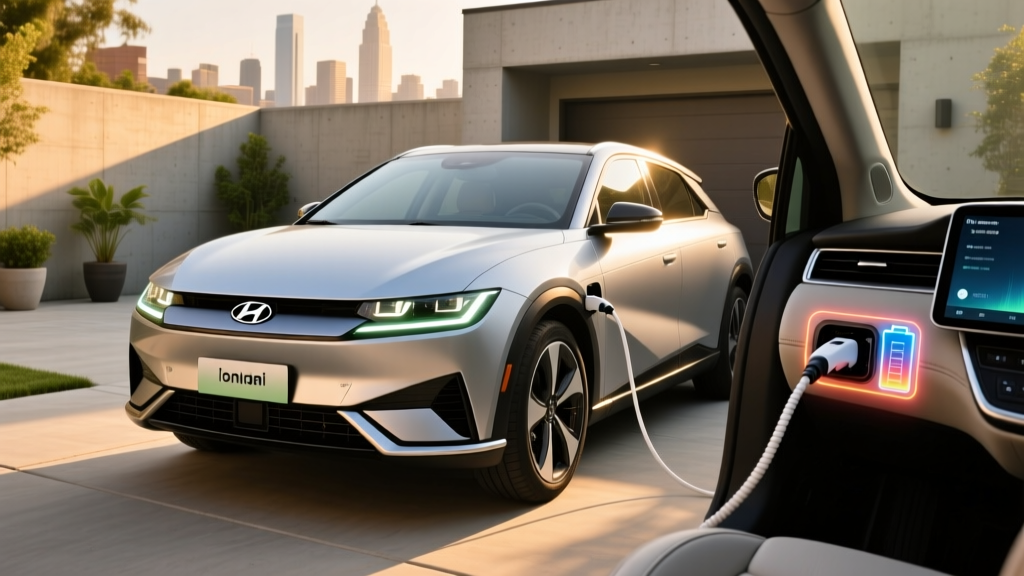
The 2023 Hyundai Ioniq 5 remains one of the most compelling electric crossovers on the used EV market in 2026. Built on Hyundai's E-GMP platform with an 800V electrical architecture, it delivers class-leading DC fast-charging speeds, a spacious retro-futuristic cabin, and enough range to handle most road trips without drama. If you're shopping the pre-owned market or evaluating a leftover 2023 model, here's the complete data-driven breakdown you need.
2023 Ioniq 5 Specs at a Glance
| Specification | SE/SEL RWD | SE/SEL/Limited AWD |
|---|---|---|
| EPA Range | 303 mi | 256 mi (Limited: 260 mi) |
| Battery (usable) | 77.4 kWh, NMC lithium-ion | |
| Peak DC Fast Charge | ~240 kW (800V architecture) | |
| 10–80% DC Charge Time | ~18 minutes (optimal conditions) | |
| Level 2 Home Charging | 10.9 kW onboard charger | |
| 0–60 mph | 7.4 sec | 5.0 sec |
| Horsepower | 168 hp (225 lb-ft) | 320 hp (446 lb-ft) |
| Drivetrain | Rear-wheel drive | Dual-motor AWD |
| MPGe (combined) | 132 MPGe | 110 MPGe |
| Efficiency (kWh/100mi) | 25 kWh/100 mi | 30 kWh/100 mi |
| Cargo (rear seats up) | 27.2 cu ft | |
| Cargo (rear seats folded) | 59.3 cu ft | |
| Original Base MSRP | $41,450 | $45,200 |
Sources: EPA Fuel Economy, Hyundai Motor America.
Real-World Range: What the EPA Sticker Doesn't Tell You
Real-World Expectation: ~240–270 miles highway (RWD); ~200–230 miles highway (AWD). In freezing temperatures (below 32°F), expect a 20–30% reduction — potentially dropping the AWD model to 175–200 miles on a full charge.
The 2023 Ioniq 5's EPA figures are solid for the segment, but real-world highway driving at 70–80 mph typically yields 20–25% less range than the sticker suggests. This is physics, not a defect: higher speeds increase aerodynamic drag significantly, and EVs lack a multi-speed transmission to optimize efficiency at speed.
The 77.4 kWh NMC (nickel manganese cobalt) battery pack provides good energy density, but NMC chemistry is more temperature-sensitive than LFP. During winter, the Ioniq 5's heat pump (standard on AWD trims, optional on some RWD configurations) helps preserve range by efficiently warming the cabin without draining the traction battery as aggressively as resistive heating. Even so, plan for meaningful range loss in sub-freezing commutes.
For city driving with frequent regenerative braking opportunities, the RWD model can actually meet or slightly exceed its EPA estimate. The AWD model's dual-motor setup adds weight and parasitic drag from the front motor, which is why its efficiency drops to 30 kWh/100 miles versus the RWD's excellent 25 kWh/100 miles.
Charging Speed: The 800V Advantage in Practice
This is where the 2023 Ioniq 5 separates itself from nearly every competitor in its price range. The E-GMP platform's 800V electrical architecture allows peak DC fast-charging rates around 240 kW when connected to a capable 350 kW charger — and critically, the charge curve sustains high power well into the session.
| Charging Level | Power | Speed (approx.) | Notes |
|---|---|---|---|
| Level 1 (120V) | ~1.4 kW | ~4–5 mi/hr | Emergency/trickle only |
| Level 2 (240V, 48A) | 10.9 kW | ~36–40 mi/hr | Full charge in ~7.5 hours |
| DC Fast (350 kW station) | Peak ~240 kW | 10–80% in ~18 min | Requires battery preconditioning |
| DC Fast (150 kW station) | ~135 kW | 10–80% in ~28 min | More common station type |
| DC Fast (50 kW CHAdeMO adapter) | ~50 kW | 10–80% in ~65 min | Legacy stations only |
Preconditioning matters. To hit that 18-minute 10–80% figure, you must enter the charging station as your navigation destination so the battery thermal management system can warm or cool the pack to optimal temperature. Without preconditioning — especially in cold weather — peak charge rates can drop to 100–130 kW, stretching your stop to 30+ minutes.
The charge curve tapers noticeably above 80% State of Charge (SoC). Charging from 80–100% can take as long as the 10–80% session. This is standard behavior for NMC batteries to protect longevity, but it means road-trip strategy should target 80% charges, not full fills.
At home, the 10.9 kW onboard charger is among the fastest in the segment. On a 48-amp Level 2 circuit (requiring a 60-amp breaker), you'll add roughly 36–40 miles of range per hour — enough to fully replenish the battery overnight. Installation costs for a home Level 2 setup typically run $500–$2,000 depending on whether your electrical panel needs an upgrade.
Performance and Driving Dynamics
The dual-motor AWD Ioniq 5 delivers 320 horsepower and 446 lb-ft of instant torque, launching to 60 mph in approximately 5.0 seconds. That's genuinely quick for a family crossover and makes highway merging and passing effortless. The RWD model, at 168 hp and 7.4 seconds to 60, is adequate for commuting but won't thrill you at stoplights.
Ride quality is a highlight. The Ioniq 5's long 118.1-inch wheelbase and low center of gravity (thanks to the floor-mounted battery pack) produce stable, composed handling. The suspension tuning leans comfort-oriented — it absorbs road imperfections well but doesn't pretend to be a sport sedan in corners. Steering is light and precise, ideal for urban driving but somewhat numb on twisty back roads.
Regenerative braking offers four levels adjustable via steering-wheel paddles, including a full one-pedal driving mode (i-Pedal) that can bring the car to a complete stop without touching the brake pedal. Most owners quickly adapt to one-pedal driving and rarely use the friction brakes in daily commuting.
Interior, Cargo, and Daily Practicality
The Ioniq 5's cabin is genuinely distinctive — a minimalist, retro-modern design with a flat floor (no transmission tunnel), a sliding center console that moves up to 5.5 inches, and dual 12.3-inch displays spanning the dashboard. The "parametric pixel" LED lighting and sustainable material choices (recycled PET bottles, eco-processed leather) give it character beyond the typical crossover interior.
Passenger space:
- Front headroom: 39.6 inches
- Front legroom: 41.7 inches
- Rear headroom: 38.7 inches
- Rear legroom: 39.4 inches
Rear-seat legroom is exceptional — rivaling midsize sedans — and the flat floor means a comfortable middle-seat position for a fifth passenger on shorter trips.
Cargo capacity: 27.2 cu ft behind the rear seats, expanding to 59.3 cu ft with the 60/40 split rear seats folded. The AWD model includes a small front trunk (frunk) at 0.85 cu ft — enough for a charging cable bag or a few grocery items. The RWD model's frunk is larger at 2.0 cu ft, since there's no front motor.
One practical drawback: the 2023 Ioniq 5 lacks a rear wiper, which is a real annoyance in rain and snow. Hyundai added one starting with the 2024 model year.
Technology, Safety, and Driver Assistance
The 2023 Ioniq 5 comes equipped with Hyundai's SmartSense suite of driver-assistance features, which includes:
- Adaptive cruise control with stop-and-go
- Lane-keeping assist and lane-centering
- Forward collision-avoidance assist with pedestrian detection
- Blind-spot collision-avoidance assist
- Rear cross-traffic collision-avoidance assist
- Highway Driving Assist (HDA) on Limited trim — combines adaptive cruise with lane-centering and speed-limit adjustment
The infotainment system runs on a 12.3-inch touchscreen with wireless Apple CarPlay and Android Auto, built-in navigation (on SEL and above), and over-the-air (OTA) update capability. The digital key feature (on Limited trim) allows you to unlock and start the car using a compatible smartphone.
A standout feature is the Vehicle-to-Load (V2L) capability, available with an adapter. The Ioniq 5 can output up to 3.6 kW of AC power from its traction battery — enough to run a laptop, power tools at a job site, or even keep essential appliances running during a brief home outage. This is a genuinely useful differentiator.
Safety ratings are strong: the 2023 Ioniq 5 earned a 5-Star Overall Safety Rating from NHTSA and was an IIHS Top Safety Pick+ when equipped with specific headlights.
Pricing, Tax Credits, and Ownership Cost
Original MSRP for the 2023 Ioniq 5 ranged from $41,450 (SE RWD Standard Range) to approximately $52,600 (Limited AWD with options). On the used market in 2026, expect to find well-equipped 2023 models in the $28,000–$38,000 range depending on mileage and condition.
| Scenario | Amount | Key Rules |
|---|---|---|
| Original MSRP (SE RWD) | $41,450 | — |
| Used EV Tax Credit (§25E) | Up to $4,000 | 30% of sale price, max $4,000; vehicle must be >2 model years old, sold for <$25,000 by a dealer; buyer income caps apply ($75K single / $150K joint) |
| Estimated Used Price (2026) | $28,000–$38,000 | Varies by mileage, trim, condition |
| Net Cost After Credit (if eligible) | As low as ~$24,000 | Requires dealer sale under $25K for credit eligibility |
Critical tax credit note: The original §30D new-vehicle credit of up to $7,500 is no longer available for 2023 models purchased new. However, as a used vehicle in 2026, the Ioniq 5 may qualify for the §25E Previously-Owned Clean Vehicle Credit — up to $4,000 or 30% of the sale price (whichever is less), provided the dealer sale price is $25,000 or under and the buyer meets income thresholds. Always verify current rules at IRS.gov and consult a tax professional, as eligibility depends on battery sourcing, sale price, and individual tax situation.
Warranty coverage for the 2023 model is excellent and largely transfers to second owners:
- Battery: 8 years / 100,000 miles (capacity retention above 70%)
- Electric powertrain: 8 years / 100,000 miles
- New vehicle: 5 years / 60,000 miles
Hyundai's battery warranty is one of the best in the industry, and the 70% capacity retention threshold is competitive. Real-world degradation data for the E-GMP platform's NMC pack suggests roughly 5–8% capacity loss over the first 100,000 miles under normal use — well within warranty coverage.
Pros
- Class-leading 800V DC fast charging (10–80% in ~18 min)
- Spacious, flat-floor cabin with excellent rear legroom
- V2L power output for tools, camping, or backup power
- Strong 8-year/100,000-mile battery warranty
- Comfortable ride quality and refined road manners
- Potential used-EV tax credit savings up to $4,000
Cons
- No rear wiper on 2023 model
- AWD range drops significantly (256 mi EPA)
- Cold-weather range loss can be 20–30%
- Infotainment can feel laggy compared to Tesla/Rivian
- Small frunk, especially on AWD models
- No native NACS port (CCS1 standard; adapter required for Tesla Superchargers)
Who Should Buy the 2023 Ioniq 5?
Compared to its platform sibling, the Kia EV6, the Ioniq 5 offers a more comfort-oriented ride and a roomier rear seat, while the EV6 leans slightly sportier. Against the Tesla Model Y, the Ioniq 5 charges faster on non-Tesla networks and offers a more conventional (and to some, more intuitive) cabin layout, though the Model Y edges ahead in cargo space and Supercharger network access. The Ford Mustang Mach-E is more engaging to drive but can't match the Ioniq 5's charging speed or rear-seat comfort.
Frequently Asked Questions
What is the real-world range of the 2023 Hyundai Ioniq 5?
The EPA rates the RWD at 303 miles and AWD at 256 miles. In real-world highway driving at 70+ mph, expect roughly 240–270 miles (RWD) or 200–230 miles (AWD). In freezing temperatures, subtract another 20–30%. City driving with regenerative braking can meet or slightly exceed EPA estimates.
How fast does the Ioniq 5 charge at home and on the road?
At home on a 240V Level 2 charger (48A), the 10.9 kW onboard charger adds roughly 36–40 miles per hour, fully charging overnight in about 7.5 hours. On a 350 kW DC fast charger with battery preconditioning, it peaks at ~240 kW and charges 10–80% in approximately 18 minutes. On more common 150 kW stations, expect 10–80% in about 28 minutes.
Does the 2023 Ioniq 5 qualify for any federal EV tax credit in 2026?
As a used vehicle, it may qualify for the §25E Previously-Owned Clean Vehicle Credit: up to $4,000 or 30% of sale price (whichever is less), provided the dealer sale price is $25,000 or under and buyer income is below $75,000 (single) or $150,000 (joint). The original new-vehicle §30D credit is no longer available. Always verify with a tax professional and check current rules at IRS.gov.
Is the Ioniq 5 worth buying over the Tesla Model Y or Kia EV6?
The Ioniq 5 wins on DC charging speed, rear-seat comfort, and V2L capability. The Model Y wins on Supercharger network access and cargo volume. The EV6 shares the E-GMP platform but offers a sportier driving feel with slightly less rear headroom. Your best choice depends on whether charging speed, cabin space, or driving dynamics matter most to you.
What connector does the 2023 Ioniq 5 use?
The 2023 model uses the CCS1 (Combined Charging System) connector for DC fast charging and J1772 for Level 1/2 AC charging. It does not have the NACS (Tesla) port native to newer models. However, Hyundai has partnered with Tesla to provide a NACS adapter, allowing access to Tesla Supercharger stations — though charging speeds on Superchargers are typically limited to 150 kW (V3 stalls), below the Ioniq 5's peak capability.
How long will the Ioniq 5 battery last?
Hyundai warranties the 77.4 kWh NMC battery for 8 years or 100,000 miles against degradation below 70% of original capacity. Real-world data from early E-GMP owners suggests approximately 5–8% degradation over the first 100,000 miles. With proper care — avoiding frequent 100% charges, minimizing DC fast charging in extreme heat, and using preconditioning — the pack should comfortably last 150,000–200,000+ miles before approaching the warranty threshold.