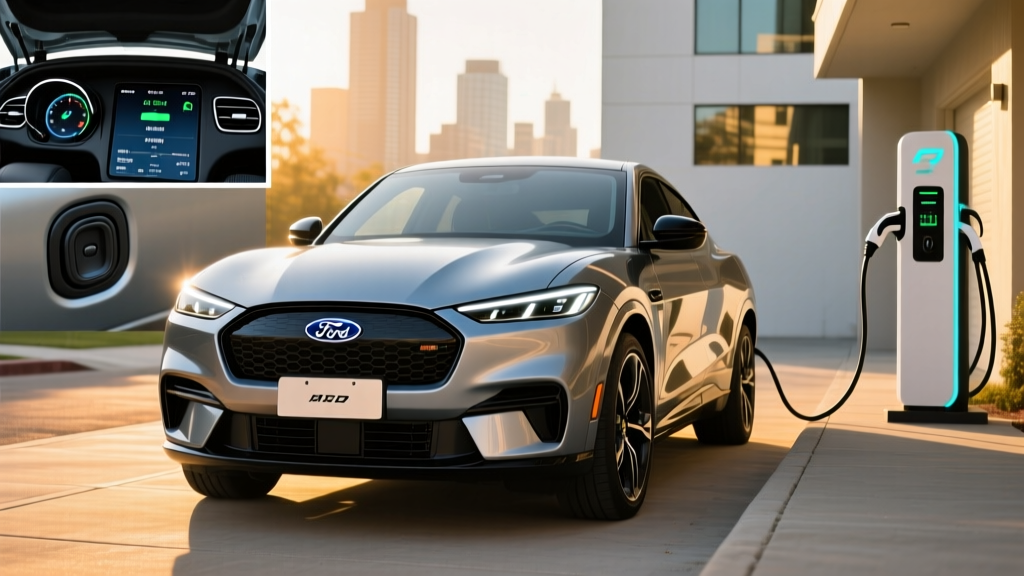
The 2023 Ford Mustang Mach-E Select at a Glance
The 2023 Ford Mustang Mach-E Select serves as the entry point into Ford's electric crossover lineup, pairing a usable 70 kWh battery with a single rear-mounted motor and a starting MSRP that undercuts many rivals. For buyers researching the 2023 Ford Mustang Mach-E Select as a daily commuter or light road-tripper, the numbers tell a specific story: 250 miles of EPA-estimated range, 266 horsepower, and DC fast-charging that peaks at 150 kW. It is not the longest-range or fastest-charging EV in its class, but its price-to-feature ratio, Ford Co-Pilot360 suite, and broad dealer network make it a pragmatic choice for first-time EV buyers.
Below, we break down every spec that matters for ownership — from real-world range expectations and the actual charging curve to IRS §30D tax credit eligibility and total cost of ownership versus the Hyundai Ioniq 5 and Tesla Model Y.
| Spec | Value |
|---|---|
| EPA Range (SR RWD) | 250 miles |
| Battery (Usable / Gross) | 70 kWh / 75.7 kWh, NMC (nickel manganese cobalt) |
| Drivetrain | Rear-wheel drive, single motor |
| Horsepower / Torque | 266 hp / 317 lb-ft |
| 0–60 mph | ~6.1 seconds |
| Max DC Fast Charge | 150 kW (peak) |
| 10–80% DCFC Time | ~38 minutes |
| Level 2 Home Charge Rate | 10.5 kW (32A) — approx. 28 mi/hr |
| EPA Efficiency | 101 MPGe combined (33 kWh/100 mi) |
| Cargo (behind rear seats / max) | 29.7 cu ft / 59.7 cu ft |
| Front Trunk (Frunk) | 4.7 cu ft (drainable, Mega Power Frunk) |
| Base MSRP (Select SR RWD) | $42,995 |
| Battery/Powertrain Warranty | 8 years / 100,000 miles |
Range and Efficiency: EPA vs. the Real World
The Select trim with the Standard Range (SR) battery and rear-wheel drive carries an EPA-estimated 250 miles of range. That figure is derived from a mix of city and highway driving cycles, but real-world results diverge based on speed, temperature, and terrain.
- City / mixed commuter driving (65°F): 240–260 miles — regenerative braking recaptures energy in stop-and-go traffic, often matching or slightly exceeding the EPA sticker.
- Highway cruising (70–75 mph, 65°F): 210–230 miles — sustained high speeds increase aerodynamic drag; expect a 10–15% reduction.
- Cold weather (20–30°F, highway mix): 170–195 miles — NMC chemistry loses efficiency in the cold, and cabin heating draws from the pack. The Mach-E uses a resistive PTC heater on this trim, not a heat pump, which amplifies winter range loss to roughly 25–30%.
At 33 kWh per 100 miles (combined), the Mach-E Select's efficiency is competitive with the Volkswagen ID.4 (31–34 kWh/100mi depending on trim) but trails the Hyundai Ioniq 5 RWD (30 kWh/100mi) and the Tesla Model Y RWD (28 kWh/100mi). Over 15,000 annual miles, that efficiency gap translates to roughly $40–$70 per year in additional electricity cost at the national average of $0.16/kWh — noticeable but not deal-breaking.
Charging Speeds: DC Fast, Level 2, and the Curve Reality
Charging capability is where the 2023 Mach-E Select shows its age relative to 800-volt rivals. The SR battery accepts a peak of 150 kW on a DC fast charger using its CCS1 port. However, peak rate is not sustained rate — understanding the charge curve is critical for trip planning.
| Charging Level | Power / Voltage | Miles Added per Hour | Notes |
|---|---|---|---|
| Level 1 (120V household) | ~1.4 kW | ~3–4 miles/hr | Emergency/trickle only; a full 0–100% takes 50+ hours |
| Level 2 (240V, 32A) | 10.5 kW | ~28 miles/hr | Ford Mobile Charger or wallbox; 0–100% in ~7 hours |
| Level 2 (240V, 48A) | 11.5 kW (vehicle-limited) | ~31 miles/hr | The onboard charger caps at ~11.5 kW even on a 48A circuit |
| DC Fast Charge (CCS1) | Peak 150 kW | ~59 miles in 10 min (avg) | 10–80% in ~38 min; tapers sharply above 80% |
Charge curve reality: The Mach-E Select holds near 150 kW only between roughly 15% and 40% State of Charge (SoC). From 40–60%, power drops to approximately 110–120 kW; from 60–80%, it falls to around 70–85 kW. Charging from 80–100% on DCFC is painfully slow — often sub-20 kW — so plan to unplug at 80% on road trips and charge more frequently rather than waiting for a full pack.
Compared to the Hyundai Ioniq 5, which can accept 235 kW on 800V architecture and complete a 10–80% session in roughly 18 minutes, the Mach-E Select adds about 20 minutes to a typical road-trip stop. For daily commuters who charge at home overnight, this difference is largely academic.
Performance and Driving Impressions
The single rear-mounted motor produces 266 horsepower and 317 lb-ft of torque, delivered to the rear wheels. Ford quotes a 0–60 mph time of approximately 6.1 seconds for the RWD Select, which is quick enough for confident highway merging and passing but noticeably a step behind the dual-motor AWD variants (which hit 60 in the low 5-second range).
Driving dynamics benefit from the rear-biased weight distribution and low center of gravity. Steering is precise if slightly numb, and the suspension tuning favors comfort over sportiness — appropriate for the Select's commuter-oriented buyer. One-pedal driving is available and well-calibrated, allowing most city driving without touching the brake pedal.
The Mach-E Select does not offer a tow package on the SR battery. If towing is a priority (up to 2,300 lbs for SR, 2,700 lbs for ER), you will need to look at the Extended Range trims or a competitor.
Interior, Tech, and Daily Livability
Inside, the Mach-E Select features Ford's SYNC 4A infotainment system displayed on a large 15.5-inch portrait-oriented touchscreen. The interface is responsive, supports wireless Apple CarPlay and Android Auto, and includes built-in navigation with EV route planning that accounts for charging stops. Over-the-air (OTA) updates have added features and improved performance since launch.
The driver-assist suite, Ford Co-Pilot360 2.0, includes:
- Adaptive cruise control with stop-and-go
- Lane centering assist
- Automatic emergency braking with pedestrian detection
- Blind-spot monitoring with cross-traffic alert
- Rear parking sensors and backup camera
Note: Ford's BlueCruise hands-free highway driving system is not available on the Select trim — it requires the Premium or GT trims (or a standalone package on certain configurations). This is a Level 2 SAE driver-assist system; the driver must remain attentive at all times.
Passenger space is generous for the segment: 43.3 inches of front legroom and 38.9 inches in the rear, enough for two adults on longer trips. The 29.7 cubic feet of cargo space behind the rear seats expands to 59.7 with the 60/40 split folded. The 4.7-cubic-foot front trunk (frunk) is drainable and includes a built-in cupholder shelf — useful for tailgating or stowing muddy gear.
Pricing, Trims, and Federal Tax Credit Eligibility
The 2023 Mustang Mach-E Select SR RWD launched at an MSRP of $42,995 (including destination). Adding AWD (dual-motor, 210-mile range on SR) pushed the price to approximately $45,995. The Select was the most affordable entry in the Mach-E lineup, sitting below the Premium ($46,995+), California Route 1 ($54,995+), and GT ($59,995+) trims.
As a 2023 model, the Mach-E is available on the used market at significant discounts — typically $28,000–$36,000 depending on mileage and condition.
When purchased new, the 2023 Mach-E was eligible for up to $3,750 under the IRS §30D credit. It did not qualify for the full $7,500 because its battery did not meet the full critical-minerals sourcing threshold introduced in April 2023. Key eligibility rules (per IRS guidance):
- MSRP cap: SUVs/vans/pickups ≤ $80,000; other vehicles ≤ $55,000. The Mach-E qualifies as an SUV (≤ $80,000 cap) — all trims pass.
- Buyer income cap: AGI ≤ $150,000 (single), $225,000 (head of household), $300,000 (joint).
- Battery sourcing: Must meet critical-minerals and battery-component thresholds that tighten annually. The 2023 Mach-E met component requirements ($3,750) but not the full critical-minerals requirement.
- Point-of-sale transfer: Beginning in 2024, buyers can transfer the credit to the dealer for an immediate price reduction. This applies to qualifying new purchases only.
Tax credit rules are subject to change. Consult a tax professional and verify current eligibility at irs.gov before purchasing.
Used EV credit (§25E): Buyers purchasing a used 2023 Mach-E Select from a dealer may qualify for up to $4,000 (30% of the sale price, capped at $4,000) if the sale price is $25,000 or less and income limits apply ($75,000 single / $150,000 joint). This makes a pre-owned Mach-E Select an especially compelling value in 2026.
Ownership Costs and Warranty
Ford covers the Mach-E's high-voltage battery and electric powertrain components for 8 years or 100,000 miles, whichever comes first. The battery warranty guarantees that capacity will not fall below 70% of its original state during that period — consistent with industry norms (Hyundai, Kia, and Tesla offer similar terms, though Hyundai's is 10yr/100,000mi).
The bumper-to-bumper limited warranty is 3 years / 36,000 miles.
Estimated 5-year ownership costs for a Mach-E Select driven 15,000 miles/year:
- Electricity (home charging at $0.16/kWh): ~$2,475 total ($495/year)
- Maintenance: ~$500–$800 over 5 years (cabin air filter, brake fluid check, tire rotation — no oil changes, no transmission fluid)
- Insurance: ~$1,800–$2,400/year depending on location and profile (EV premiums run 10–20% above comparable gas vehicles)
- Tires: EV-specific tires wear faster due to instant torque and heavier weight; budget ~$800–$1,200 for a replacement set around year 3–4
How the Mach-E Select Compares to Key Rivals
| Spec | Ford Mach-E Select SR | Hyundai Ioniq 5 SE | Tesla Model Y RWD | VW ID.4 Pro S |
|---|---|---|---|---|
| EPA Range | 250 mi | 220 mi (SR) / 303 mi (LR) | 260 mi | 275 mi |
| Battery (Usable) | 70 kWh (NMC) | 58 kWh (SR) / 77.4 kWh (LR) | ~60 kWh (LFP) | 82 kWh (NMC) |
| Peak DCFC | 150 kW | 175 kW (SR) / 235 kW (LR, 800V) | ~170 kW | 170 kW |
| 10–80% DCFC | ~38 min | ~25 min (LR) / ~35 min (SR) | ~30 min | ~34 min |
| 0–60 mph | 6.1 sec | 7.4 sec (SR RWD) | 6.6 sec | 7.7 sec |
| Cargo (rear/max) | 29.7 / 59.7 cu ft | 27.2 / 59.3 cu ft | 30.2 / 76.2 cu ft | 30.3 / 64.2 cu ft |
| Base MSRP (2023) | $42,995 | $41,450 | $47,740 | $45,290 |
Key takeaways: The Mach-E Select sits in the middle of this pack. It does not lead in any single category — the Ioniq 5 LR charges far faster, the Model Y offers more cargo space and efficiency, and the ID.4 delivers more range at a similar price. Where the Mach-E wins is driving engagement (the best steering feel in the segment), the intuitive SYNC 4A interface, and Ford's extensive dealer network for service.
Pros and Cons
- Engaging RWD driving dynamics uncommon in the EV crossover segment
- Intuitive 15.5" SYNC 4A with wireless CarPlay/Android Auto
- Drainable frunk with practical tailgate-friendly design
- Competitive base MSRP with strong used-market value
- Broad Ford dealer network for service and warranty work
- OTA updates have improved the vehicle post-launch
- No heat pump on Select trim — significant cold-weather range loss
- 150 kW peak DCFC is outpaced by 800V rivals (Ioniq 5 at 235 kW)
- BlueCruise hands-free driving unavailable on Select
- Only $3,750 in federal tax credit when new (not the full $7,500)
- SR battery range (250 mi) may feel limiting on road trips
- Some early-build 2023 models had 12V battery drain issues (check service history)
Who Should Buy the 2023 Mach-E Select?
Choose the Mach-E Select if: You want a well-built, engaging-driving EV crossover for commuting and moderate road trips, value a strong dealer service network, and primarily charge at home. It is especially attractive on the used market where the §25E credit can bring the effective price below $24,000.
Look elsewhere if: You need 300+ miles of range for frequent road trips (consider the Ioniq 5 Long Range or Mach-E Extended Range), you regularly drive in sub-freezing climates and want a heat pump (Ioniq 5, VW ID.4), or you want hands-free highway driving (Ford BlueCruise requires the Premium trim or above, or consider GM's Super Cruise on the Cadillac Lyriq).
Frequently Asked Questions
What is the real-world range of the 2023 Mach-E Select?
The EPA rates it at 250 miles, but expect 210–230 miles at highway speeds in mild weather, and as low as 170–195 miles in freezing temperatures. City commuters using regenerative braking may see 240–260 miles.
How fast does it charge at home and on the road?
On a Level 2 home charger (240V, 32A), it adds about 28 miles of range per hour — a full charge takes roughly 7 hours. On a DC fast charger, it peaks at 150 kW and completes a 10–80% session in approximately 38 minutes, though the rate tapers significantly above 60% SoC.
Does the 2023 Mach-E Select qualify for the federal EV tax credit?
When purchased new, it qualified for $3,750 (not the full $7,500) under §30D due to partial battery-sourcing compliance. On the used market, buyers meeting income limits ($75,000 single / $150,000 joint) may qualify for up to $4,000 under the §25E used-EV credit if the sale price is $25,000 or less. Always verify current rules at irs.gov.
Is the Mach-E Select worth buying over the Tesla Model Y or Ioniq 5?
It depends on your priorities. The Model Y offers more cargo space and Supercharger access. The Ioniq 5 Long Range charges dramatically faster (235 kW, 10–80% in ~18 min) and includes a heat pump. The Mach-E Select wins on driving feel, infotainment usability, and used-market pricing. Cross-shop all three and prioritize what matters most to your daily routine.
What is the battery warranty?
Ford covers the high-voltage battery for 8 years or 100,000 miles against defects and capacity loss below 70% of original state. The powertrain warranty matches this term.
Does it have a heat pump?
No. The 2023 Mach-E Select uses a resistive PTC heater, which draws more energy from the battery in cold weather. This contributes to the 25–30% range loss observed in freezing conditions. If cold-climate efficiency is critical, consider the Ioniq 5 or the Mach-E Premium (which may include a heat pump on certain model years — verify with the window sticker).