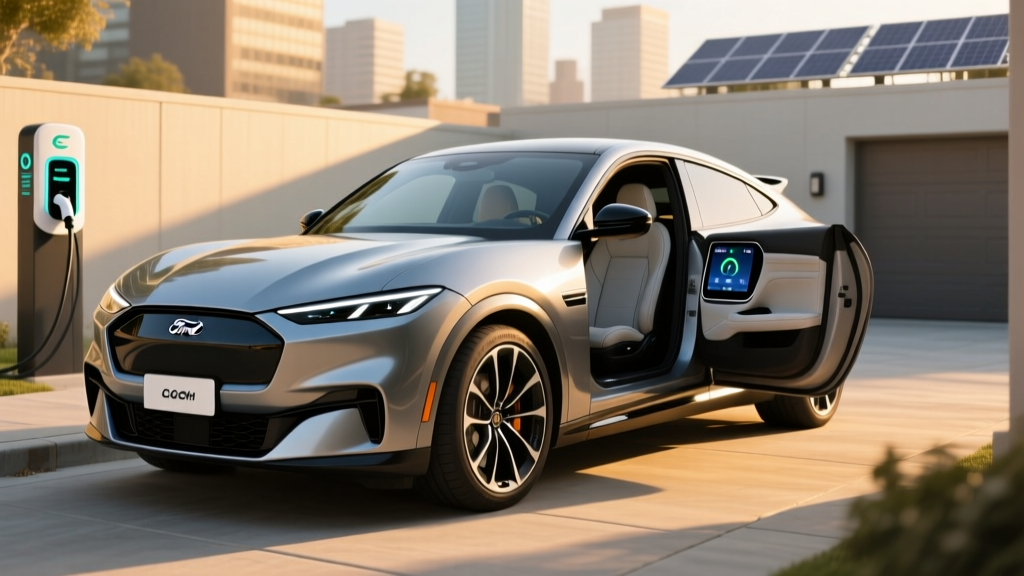
Quick Verdict: A Practical Electric Crossover With Mustang Attitude
The 2023 Ford Mustang Mach-E remains one of the most well-rounded electric crossovers in its class, balancing usable range, competent DC fast-charging speeds, and a genuinely engaging driving experience that justifies the Mustang badge — at least in GT trim. With the extended-range battery, it pushes past 300 miles of EPA-estimated range, and its pricing undercuts the Tesla Model Y on several trims. For buyers shopping the used or certified-pre-owned market in 2026, the 2023 Mach-E represents strong value, particularly given Ford's battery warranty coverage and the vehicle's access to the Tesla Supercharger network via adapter.
But the Mach-E isn't without compromises. Rear-seat legroom trails some competitors, the charge curve tapers noticeably above 80% state of charge (SoC), and real-world highway range in cold weather drops meaningfully below the EPA sticker. Here's everything you need to know before buying.
Spec Table: 2023 Mustang Mach-E at a Glance
| Specification | Select / Premium (Std Range) | Premium (Ext Range) | GT | GT Perf. Edition |
|---|---|---|---|---|
| EPA Range | 230 mi | 312 mi (RWD) / 290 mi (AWD) | 270 mi | 260 mi |
| Usable Battery | 68 kWh (LFP) | 88 kWh (NMC) | 88 kWh (NMC) | 88 kWh (NMC) |
| Horsepower | 266 hp | 290 hp (RWD) / 346 hp (AWD) | 480 hp | 480 hp |
| 0–60 mph | ~6.3 sec | ~6.1 sec (RWD) / 5.1 sec (AWD) | ~3.8 sec | ~3.5 sec |
| Drivetrain | RWD or eAWD | RWD or eAWD | eAWD | eAWD |
| Max DC Fast Charge | 115 kW | 150 kW | 150 kW | 150 kW |
| 10–80% DCFC Time | ~38 min | ~45 min | ~45 min | ~45 min |
| Level 2 Home Charging | 10.5 kW (~30 mi/hr) | 10.5 kW (~30 mi/hr) | 10.5 kW (~30 mi/hr) | 10.5 kW (~30 mi/hr) |
| MPGe (Combined) | 101 MPGe | 104 MPGe (RWD) / 98 MPGe (AWD) | 84 MPGe | 82 MPGe |
| Base MSRP (2023) | $42,995 | $48,995 | $59,995 | $65,995 |
Sources: EPA Fueleconomy.gov, Ford Motor Company
Range & Efficiency: EPA Sticker vs. Real-World Miles
EPA Estimated: 290 miles
Real-World Highway (70 mph, 75°F): ~255–270 miles
Cold-Weather Highway (30°F, heater on): ~200–230 miles
City/Commuter Driving (with regen): ~280–300 miles
The 2023 Mach-E's range story splits into two battery narratives. The standard-range models use a 68 kWh usable LFP (lithium iron phosphate) pack — the same chemistry Tesla uses in base Model 3 and Model Y variants. LFP offers excellent cycle life and can be charged to 100% daily without degradation concerns, but it's heavier and less energy-dense, which limits the standard-range Mach-E to 230 miles EPA.
The extended-range models step up to an 88 kWh usable NMC (nickel manganese cobalt) battery, unlocking up to 312 miles in the Premium RWD configuration. This is the sweet spot for most buyers. The 312-mile figure holds up reasonably well in mild-weather city and suburban driving, where regenerative braking recaptures energy and speeds stay moderate.
However, highway driving at sustained 70–75 mph increases aerodynamic drag significantly, and EV efficiency drops. Expect roughly 255–270 miles from the extended-range AWD on a warm-weather road trip. In winter conditions — especially below freezing where battery internal resistance rises and cabin heating draws substantial power — that number can fall to 200–230 miles. The Mach-E does include a heat pump on extended-range models (standard-range models use resistive heating), which mitigates cold-weather losses somewhat compared to EVs without one.
Efficiency, measured in MPGe, peaks at 104 MPGe combined for the Premium RWD extended-range trim, which translates to roughly 32 kWh per 100 miles. The GT variants sacrifice efficiency for performance, landing around 82–84 MPGe (roughly 40 kWh/100 mi).
Charging Speeds: DC Fast Charging and Home Level 2
| Charging Level | Power (kW) | Miles Added per Hour | Notes |
|---|---|---|---|
| Level 1 (120V household) | ~1.4 kW | ~3–4 mi/hr | Emergency/top-up only; ~80+ hours for full charge |
| Level 2 (240V home/work) | 10.5 kW | ~26–30 mi/hr | Overnight full charge in ~8–10 hours (ext. range) |
| DC Fast Charge (Std Range) | Peak 115 kW | ~150–180 mi/hr (at peak) | 10–80% in ~38 min; taper above 80% |
| DC Fast Charge (Ext Range / GT) | Peak 150 kW | ~190–220 mi/hr (at peak) | 10–80% in ~45 min; taper above 80% |
The 2023 Mach-E uses the CCS1 (Combined Charging System) connector for DC fast charging, though Ford has provided a NACS adapter to Mach-E owners for access to Tesla's Supercharger network — a significant practical advantage given Supercharger reliability and coverage. Ford was among the first legacy automakers to secure Supercharger access, and by 2026 this adapter ecosystem is well established.
On a 150 kW DC fast charger, the extended-range and GT models peak at 150 kW, but — as with all EVs — that peak is not sustained across the entire session. The charge curve is strongest between roughly 10–50% SoC, where the battery management system can accept maximum current. Above 60%, the rate tapers; above 80%, it slows dramatically to protect cell longevity. A typical 10–80% session takes approximately 45 minutes, which is adequate for road-trip stops but trails the Hyundai Ioniq 5's 18-minute 10–80% time on its 800V architecture.
At home on a Level 2 charger (240V, 48A circuit recommended), the onboard charger accepts up to 10.5 kW, adding roughly 26–30 miles of range per hour. A full overnight charge of the 88 kWh pack from 10% takes about 8–10 hours, which suits most commuters who plug in upon arriving home.
Preconditioning tip: The Mach-E allows you to set a departure time or manually precondition the battery via the FordPass app. When navigating to a DC fast charger, the vehicle will begin warming the battery to optimize charge acceptance. Skipping preconditioning in cold weather can add 10–15 minutes to your fast-charging session.
Performance & Driving Dynamics
The Mach-E lineup spans from sensible commuter to legitimate performance machine. The base Select trim with RWD delivers 266 hp and a 6.3-second 0–60 mph time — perfectly adequate for merging and passing. Step up to the Premium AWD extended-range and you get 346 hp with a 5.1-second sprint, which feels genuinely quick in daily driving.
The GT trim is where the Mustang name earns its keep: 480 hp, standard eAWD, and a 3.8-second 0–60 time. The GT Performance Edition drops that to approximately 3.5 seconds with its MagneRide adaptive suspension and summer performance tires. Torque vectoring via the dual-motor setup provides confident corner exit grip, and the steering — while electric and somewhat numb — is well-weighted for a crossover.
Ride quality varies by trim. The Select and Premium models offer a compliant, comfortable ride suitable for daily commuting and family use. The GT is firmer, and the Performance Edition's stiffened suspension transmits more road imperfections into the cabin. All trims feature one-pedal driving capability through aggressive regenerative braking, though the regen feel is less progressive than Tesla's implementation.
Interior, Tech & Cargo Space
The Mach-E's cabin represents a clean break from Ford's traditional interior design language. A vertically oriented 15.5-inch touchscreen dominates the center stack, running Ford's SYNC 4A infotainment system with wireless Apple CarPlay and Android Auto. The interface is responsive, though some users report that the lack of physical HVAC controls (everything routes through the screen) requires a learning curve.
A 10.2-inch digital instrument cluster sits behind the steering wheel, and available features include a panoramic fixed-glass roof, a B&O premium audio system, and Ford's BlueCruise hands-free driving system on compatible highway sections. BlueCruise is a SAE Level 2 driver-assistance system — it does not make the Mach-E self-driving, and the driver must remain attentive at all times. A driver-facing camera monitors eye direction to enforce this.
Cargo and passenger dimensions:
- Cargo behind rear seats: 29.7 cu ft
- Cargo with rear seats folded: 59.7 cu ft
- Front trunk (frunk): 4.7 cu ft (drainable — useful for wet gear or tailgating)
- Rear legroom: 38.9 inches
- Front headroom: 40.4 inches
The rear legroom is adequate for adults under 6 feet but trails the Tesla Model Y (41.6 in) and Hyundai Ioniq 5 (41.7 in). The frunk is modest in size but includes a drain plug — a thoughtful touch for hauling ice or muddy equipment.
Pricing, Trims & Federal Tax Credit Eligibility
| Trim | 2023 Base MSRP | §30D Credit Potential | Effective Price (if eligible) |
|---|---|---|---|
| Select (Std Range RWD) | $42,995 | Up to $7,500 | ~$35,495 |
| Premium (Ext Range RWD) | $48,995 | Up to $7,500 | ~$41,495 |
| Premium (Ext Range AWD) | $51,995 | Up to $7,500 | ~$44,495 |
| GT | $59,995 | Up to $7,500 | ~$52,495 |
| GT Performance Edition | $65,995 | Up to $7,500 | ~$58,495 |
All MSRP figures reflect original 2023 pricing. Used/CPO prices in 2026 vary by market, mileage, and condition.
The 2023 Mach-E was eligible for the IRS §30D federal EV tax credit at the time of original sale, with the full $7,500 available for qualifying buyers. However, eligibility is not automatic. The credit has multiple requirements:
- MSRP cap: SUVs/crossovers must be under $80,000 — all Mach-E trims qualify.
- Buyer income cap: Modified AGI must not exceed $150,000 (single), $225,000 (head of household), or $300,000 (joint filing).
- Battery sourcing: Critical minerals and battery components must meet phased-in domestic/FPA-sourcing thresholds. The 2023 Mach-E's battery sourcing was partially compliant; the exact credit amount ($3,750 or $7,500) depended on the build date and battery lot.
- Point-of-sale transfer: Beginning in 2024, buyers can transfer the credit to the dealer for an upfront price reduction. For 2023 purchases, the credit was claimed on the buyer's tax return.
For 2026 buyers purchasing a used 2023 Mach-E, the §25E used EV credit may apply: up to $4,000 or 30% of the sale price (whichever is lower), with income caps of $75,000 (single) / $112,500 (head of household) / $150,000 (joint), and the vehicle must be purchased from a dealer for under $25,000. Check current IRS guidance for the latest rules, as they are subject to legislative change.
Warranty Coverage & Battery Longevity
Ford backs the 2023 Mach-E with the following warranty structure:
- Bumper-to-bumper: 3 years / 36,000 miles
- Powertrain: 5 years / 60,000 miles
- EV battery pack: 8 years / 100,000 miles (retains ≥70% capacity)
- Corrosion perforation: 5 years / unlimited miles
The battery warranty guarantees that the high-voltage pack will retain at least 70% of its original capacity over the 8-year/100,000-mile period. If capacity drops below that threshold, Ford will repair or replace the battery at no cost. In practice, NMC batteries in liquid-cooled packs like the Mach-E's have shown degradation rates of roughly 1–2% per year under normal use, meaning most owners will see 85–90% capacity retention at the 100,000-mile mark. The LFP standard-range pack may degrade even more slowly, given LFP's superior cycle-life characteristics.
A full battery replacement outside of warranty, should it ever be needed, is estimated at $12,000–$18,000 depending on the pack size and labor, based on current Ford parts pricing and third-party estimates. However, catastrophic battery failure is rare in modern liquid-cooled EVs.
Pros & Cons
Pros
- Up to 312 mi EPA range (ext. range RWD)
- Tesla Supercharger access via NACS adapter
- Strong performance in GT trim (3.5-sec 0–60)
- LFP option for daily 100% charging without degradation worry
- Drainable frunk for practical utility
- BlueCruise hands-free highway driving available
- Competitive pricing vs. Model Y and Ioniq 5
Cons
- Rear legroom (38.9 in) trails key competitors
- DC fast-charging speed (150 kW peak) slower than 800V rivals
- 10–80% charge time (~45 min) lags Ioniq 5 (~18 min)
- No physical HVAC controls — screen-only interface
- Cold-weather range loss significant without preconditioning
- Standard-range LFP limited to 230 mi EPA
- BlueCruise requires subscription after trial period
Who Should Buy the 2023 Mach-E?
- Choose the Mach-E Premium Ext Range if: You need 280+ real-world miles for commuting and occasional road trips, want Supercharger access, and value a comfortable ride with strong tech. This is the volume trim and the best all-around value.
- Choose the Mach-E GT if: Performance is a priority and you want sub-4-second acceleration without sacrificing daily usability. Accept the range trade-off (~250 real-world highway miles).
- Choose the Select Std Range if: You have reliable home charging, commute under 100 miles round-trip, and want the lowest entry price. The LFP battery is ideal for daily 100% charging.
- Look elsewhere if: You regularly carry tall rear-seat passengers (consider the Ioniq 5 or Model Y), need the fastest possible DC charging (Ioniq 5's 800V architecture), or require 3-row seating (Kia EV9).
The 2023 Mach-E excels as a daily commuter and family crossover with the occasional road trip. Its Supercharger access eliminates much of the public-charging anxiety that plagues non-Tesla EVs, and its range is sufficient for most American driving patterns. It is not ideal as a heavy-duty towing vehicle (maximum towing capacity is 2,200 lb with the optional tow package — light-duty only), and it doesn't offer the cargo volume of a larger SUV.
Frequently Asked Questions
What is the real-world range of the 2023 Ford Mustang Mach-E?
The EPA rates the extended-range RWD at 312 miles, but real-world highway driving at 70–75 mph yields approximately 255–270 miles in warm weather and 200–230 miles in freezing conditions. The standard-range LFP model delivers about 190–210 miles in real-world mixed driving against its 230-mile EPA sticker.
How fast does the Mach-E charge at home and on the road?
At home on a Level 2 charger (240V), the Mach-E accepts up to 10.5 kW, adding roughly 26–30 miles per hour and fully charging overnight. On DC fast chargers, extended-range models peak at 150 kW and charge from 10–80% in about 45 minutes. Standard-range models peak at 115 kW.
Does the 2023 Mach-E qualify for the federal EV tax credit?
When new, the 2023 Mach-E qualified for up to $7,500 under IRS §30D, subject to buyer income limits ($150K single / $300K joint), MSRP caps (all trims under $80K), and battery-sourcing requirements. For used purchases in 2026, the §25E used-EV credit of up to $4,000 may apply if the sale price is under $25,000 and buyer income qualifies. Consult a tax professional or IRS.gov for current eligibility.
Is the 2023 Mach-E worth buying vs. the Tesla Model Y or Hyundai Ioniq 5?
The Mach-E offers a compelling middle ground: more traditional styling and build quality than the Model Y, with Supercharger access via adapter. The Ioniq 5 charges significantly faster (18 min 10–80% on 800V) and has more rear-seat room, but lacks Supercharger compatibility. The Mach-E is the right pick for buyers who value driving dynamics, Ford dealer service access, and proven Supercharger access without buying a Tesla.
What is the battery warranty on the 2023 Mach-E?
Ford covers the high-voltage battery for 8 years or 100,000 miles, whichever comes first, guaranteeing at least 70% capacity retention over that period. This warranty transfers to subsequent owners, which benefits used-EV buyers in 2026.
Can the Mach-E use Tesla Superchargers?
Yes. Ford provides a NACS (North American Charging Standard) adapter that allows the Mach-E's CCS1 port to connect to Tesla Supercharger stalls. The FordPass app or the vehicle's navigation system can route you to compatible Supercharger locations, and payment is handled through your linked Ford account.