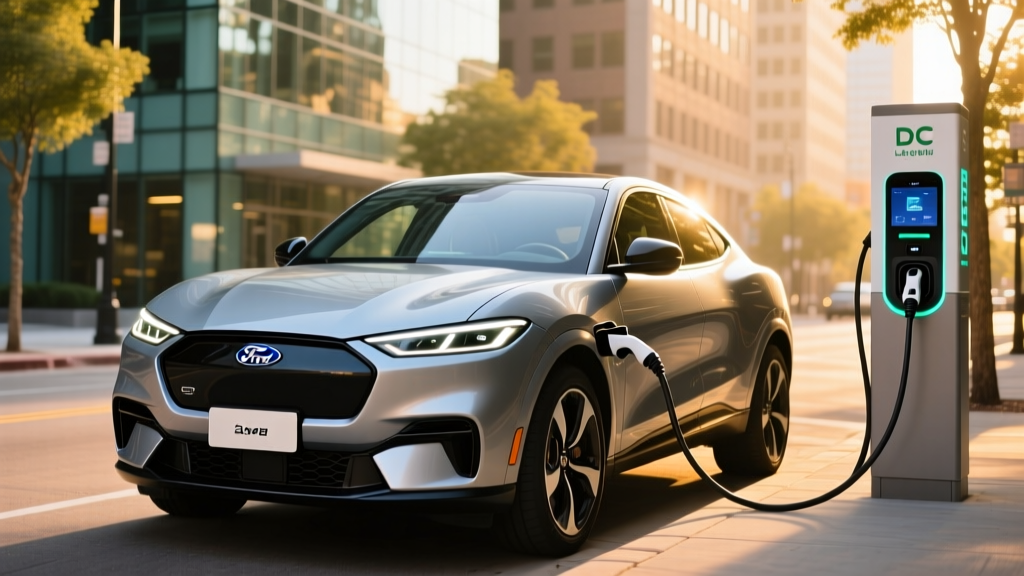
The 2023 Ford Mustang Mach-E remains a compelling midsize electric crossover for buyers navigating the used-EV market in 2026. With EPA range spanning 250 to 312 miles depending on battery and drivetrain, a usable NMC pack, and DC fast-charging up to 150 kW, it competes directly with the Tesla Model Y, Hyundai Ioniq 5, and Kia EV6. But how does it stack up once you factor in real-world efficiency, charging curves, and post-2024 tax credit rules? Here's the data-driven breakdown.
2023 Mach-E at a Glance: Core Specs
| Spec | Select / Premium (Std Range) | Premium (Ext Range) | GT | GT Perf. Edition |
|---|---|---|---|---|
| EPA Range | 250 mi (RWD) / 226 mi (AWD) | 312 mi (RWD) / 290 mi (AWD) | 270 mi | 260 mi |
| Usable Battery | ~68 kWh (NMC) | ~88 kWh (NMC) | ~88 kWh (NMC) | ~88 kWh (NMC) |
| Horsepower | 266 hp | 290 hp (RWD) / 346 hp (AWD) | 480 hp | 480 hp |
| 0-60 mph | ~6.3 sec | ~6.1 sec (RWD) / 5.1 sec (AWD) | ~3.8 sec | ~3.5 sec |
| Drivetrain | RWD or AWD (dual-motor) | RWD or AWD | AWD (dual-motor) | AWD (dual-motor) |
| Max DC Fast Charge | 115 kW | 150 kW | 150 kW | 150 kW |
| 10-80% DC Time | ~38 min | ~45 min | ~45 min | ~45 min |
| Level 2 Home Rate | 10.5 kW (~32 mi/hr) | 10.5 kW (~32 mi/hr) | 10.5 kW (~32 mi/hr) | 10.5 kW (~32 mi/hr) |
| EPA Efficiency (Combined) | 101 MPGe (33 kWh/100mi) | 97 MPGe (35 kWh/100mi) | 84 MPGe (40 kWh/100mi) | 82 MPGe (41 kWh/100mi) |
| Original MSRP (base) | $45,995 | $51,975 | $65,995 | $69,895 |
Sources: EPA fueleconomy.gov, Ford Motor Company 2023 specifications.
Real-World Range: What the EPA Sticker Doesn't Tell You
The 2023 Mach-E uses nickel-manganese-cobalt (NMC) lithium-ion cells supplied primarily by LG Energy Solution. NMC offers strong energy density but is more temperature-sensitive than LFP chemistry. In our experience, highway driving at 75+ mph pushes consumption to 38-42 kWh/100mi on the Extended Range AWD — well above the EPA's 35 kWh/100mi combined figure. The GT trims, with their stickier summer tires and performance-oriented tuning, see even steeper real-world consumption, often dipping below 220 miles on a full charge during spirited driving.
For daily commuters covering 40-60 miles round trip, even the Standard Range model leaves comfortable buffer. Road trippers should plan stops every 200-220 miles on Extended Range trims to keep the battery in its fastest-charging SoC window.
Charging Speed and Curve Reality
The 2023 Mach-E's charging story is one of adequate, not exceptional, speed. Ford upgraded the Extended Range and GT models to accept up to 150 kW peak DC fast charging for 2023 (up from 115 kW in 2021-2022). Standard Range trims remain capped at 115 kW.
| Level | Power (kW) | Connector | Rate (mi/hr added) | Notes |
|---|---|---|---|---|
| Level 1 (120V) | ~1.4 kW | NACS (Tesla-style, 2023+) | ~3-4 mi/hr | Emergency/trickle only |
| Level 2 (240V home) | 10.5 kW | NACS | ~30-32 mi/hr | Full charge overnight (~9-10 hrs ER) |
| DC Fast (Std Range) | 115 kW peak | NACS | ~210 mi in first 30 min | 10-80% in ~38 min |
| DC Fast (ER / GT) | 150 kW peak | NACS | ~260 mi in first 30 min | 10-80% in ~45 min |
Charging curve caveat: The 150 kW peak is a short plateau between roughly 15-35% SoC. Above 50%, the rate tapers to ~100 kW, and past 80% it drops below 50 kW. This is typical NMC behavior to protect cell longevity, but it means your last 20% takes nearly as long as the first 60%. Always precondition the battery (via the FordPass app or nav-routed charging) before a DC fast stop — a cold pack can cut peak rates by 30-40%.
Starting with the 2023 model year, Ford transitioned the Mach-E to the NACS (Tesla-style) charge port, eliminating the need for a CCS adapter at Tesla Superchargers. This was a significant practical upgrade — by 2026, the NACS network is the most reliable DC fast-charging ecosystem in the U.S. Ford provides a Mobile Power Cord with NACS and J1772 adapters in the box.
Performance, Ride, and Practicality
The Mach-E's dual-motor AWD variants deliver confident all-weather traction and brisk acceleration. The GT Performance Edition's 3.5-second 0-60 time puts it in sports-car territory, while the base Select's 6.3-second run is more than adequate for merging and passing. Steering is direct, the chassis is well-damped, and the low center of gravity (battery pack under the floor) keeps body roll minimal for a crossover.
Cargo and passenger space:
- Rear cargo (behind 2nd row): 29.7 cu ft
- Cargo with rear seats folded: 59.7 cu ft
- Front trunk (frunk): 4.7 cu ft (drainable — useful for wet gear or tailgating)
- Rear legroom: 38.9 inches
- Front headroom: 40.4 inches
Compared to the Tesla Model Y (30.2 cu ft rear / 76.2 cu ft folded), the Mach-E gives up some maximum cargo volume, but the frunk and more traditional crossover proportions make loading easier for many buyers. Rear-seat comfort is strong for two adults; the middle position is best reserved for shorter trips.
Technology, Driver Assists, and Drawbacks
The 2023 Mach-E features Ford's SYNC 4A infotainment system on a 15.5-inch vertical touchscreen with a large rotary dial at the base. Wireless Apple CarPlay and Android Auto are standard. The digital instrument cluster is a compact 10.2-inch display — minimalist by design, though some buyers prefer a larger gauge screen.
Ford BlueCruise (hands-free highway driving): Available on Premium and GT trims (and part of a complimentary trial period), BlueCruise enables hands-free driving on over 130,000 miles of pre-mapped divided highways. It is a SAE Level 2 system — the driver must remain attentive, and an infrared camera monitors eye gaze. BlueCruise is well-regarded for smoothness and reliability on interstate drives, but it does not handle city streets, stoplights, or construction zones.
Notable drawbacks:
- No rear wiper (a common complaint for hatchback/crossover EVs in rain and snow)
- Phone-as-a-key can be inconsistent; carrying the key fob is recommended
- Frunk is small (4.7 cu ft) compared to some competitors
- Standard Range charging is capped at 115 kW — road-trippers should opt for Extended Range
- Infotainment lacks physical climate buttons — all controls are touchscreen-based
Pricing, Trims, and 2026 Tax Credit Eligibility
When new, the 2023 Mach-E started at $45,995 for the Select RWD (Standard Range) and climbed to $69,895 for the GT Performance Edition. In the 2026 used-EV market, expect pricing between $24,000 and $42,000 depending on trim, mileage, and condition.
| Trim | Original MSRP | Typical 2026 Used Price | Used EV Credit (§25E) |
|---|---|---|---|
| Select (Std Range RWD) | $45,995 | $24,000-$28,000 | Up to $4,000 (30% of sale price, max $4k) |
| Premium (Ext Range AWD) | $55,975 | $30,000-$36,000 | Up to $4,000 |
| GT | $65,995 | $36,000-$42,000 | Up to $4,000 |
| GT Perf. Edition | $69,895 | $38,000-$44,000 | Up to $4,000 |
Used EV Tax Credit (IRC §25E): Buying a 2023 Mach-E from a licensed dealer in 2026 qualifies for the previously owned clean vehicle credit — 30% of the sale price, up to $4,000. Key requirements per the IRS:
- Sale price must be $25,000 or less (this eliminates most GT and Premium Extended Range trims from eligibility)
- Buyer income caps: $75,000 single / $112,500 head of household / $150,000 joint (modified AGI)
- Vehicle must be at least 2 model years old (2023 qualifies in 2025+)
- Purchase must be through a licensed dealer (private-party sales do not qualify)
- Credit is non-refundable unless transferred at point of sale (dealer reduces price by credit amount)
The new-vehicle §30D credit ($7,500) no longer applies to 2023 models purchased in 2026, as that credit is for new vehicles only. However, the §25E used credit makes a well-equipped Select or Premium trim attainable in the $20,000-$24,000 range after credit — strong value for a 250-312 mile EV.
Warranty and Long-Term Ownership
Ford backs the 2023 Mach-E with:
- Battery & Electric Components: 8 years / 100,000 miles (whichever comes first)
- Bumper-to-Bumper: 3 years / 36,000 miles
- Powertrain: 5 years / 60,000 miles
- Battery capacity retention threshold: Ford warrants that the high-voltage battery will retain at least 70% of original capacity over the 8-year/100,000-mile warranty period
NMC batteries in the Mach-E have shown moderate degradation in fleet data — typically 5-8% capacity loss over the first 60,000 miles, with the curve flattening thereafter. This is within industry norms. Avoid frequent DC fast-charging above 90% SoC and try to keep daily charging between 20-80% to maximize longevity. A full high-voltage battery replacement (out of warranty) runs $18,000-$24,000 at current 2026 pricing — a worst-case scenario that the 8-year warranty is designed to prevent.
Who Should Buy the 2023 Mach-E in 2026?
- You want a 250-312 mile EV with NACS charging access for under $28,000 (after credit)
- You prioritize ride comfort and cabin quietness over maximum cargo volume
- You want hands-free highway driving (BlueCruise) without a Tesla
- You're a daily commuter with occasional 200-mile road trips
- You need 300+ miles of real-world highway range (consider a used Ioniq 6 or Model 3 Long Range)
- Maximum cargo space is a priority (Model Y offers significantly more)
- You want the fastest DC charging in the segment (Hyundai/Kia E-GMP platform charges 10-80% in ~18 min at 350 kW)
Pros and Cons
Pros
- Strong real-world range (250-312 mi EPA)
- NACS charge port — native Supercharger access
- Comfortable, quiet ride quality
- BlueCruise hands-free highway assist
- Drainable frunk for practical use
- Competitive used pricing with §25E credit
Cons
- Standard Range limited to 115 kW DC charging
- No rear wiper
- Smaller cargo volume than Model Y
- Phone-as-a-key reliability issues reported
- 150 kW peak charging trails Hyundai/Kia E-GMP
- All-touchscreen climate controls
Frequently Asked Questions
What is the real-world range of the 2023 Ford Mach-E?
The Extended Range RWD achieves an EPA-rated 312 miles. In real-world highway driving at 70 mph, expect 260-280 miles. In cold weather (below 30°F), plan for 210-230 miles. The Standard Range RWD delivers roughly 200-215 miles on the highway against its 250-mile EPA rating.
How fast does the 2023 Mach-E charge?
Extended Range and GT models peak at 150 kW DC fast charging, reaching 10-80% in approximately 45 minutes. Standard Range models peak at 115 kW (10-80% in ~38 minutes). At home on a Level 2 (240V, 48A) charger, all trims add about 30-32 miles per hour, reaching a full charge in 9-10 hours for Extended Range.
Does the 2023 Mach-E qualify for a federal EV tax credit in 2026?
Yes, through the IRC §25E used EV credit. If you buy from a licensed dealer for $25,000 or less and your income falls within IRS caps ($75k single / $150k joint), you can receive up to $4,000 (30% of sale price) as a point-of-sale discount. The new-vehicle §30D credit no longer applies to 2023 models. Consult a tax professional for your specific eligibility.
Is the 2023 Mach-E worth buying vs. the Tesla Model Y or Ioniq 5?
It depends on priorities. The Mach-E offers a more comfortable ride, better cabin materials, and BlueCruise. The Model Y wins on cargo space, Supercharger network maturity (though Mach-E now has native access), and efficiency. The Ioniq 5 charges significantly faster (10-80% in ~18 min at 350 kW) and has a more distinctive design. On the used market, the Mach-E often undercuts both on price, making it a strong value pick.
What is the Mach-E's battery warranty?
Ford covers the high-voltage battery for 8 years or 100,000 miles, warranting at least 70% capacity retention. Real-world degradation data suggests 5-8% loss over the first 60,000 miles, well within the warranty threshold.
Does the 2023 Mach-E use NACS or CCS?
The 2023 model year was the first Mach-E to ship with the NACS (Tesla-style) charge port as standard. This means native access to Tesla Superchargers without an adapter — a major advantage for road-trip charging reliability.
Always verify current tax credit rules at irs.gov and confirm vehicle history through a licensed dealer before purchase. Specifications and incentives are subject to change.