Quick Verdict: The Electric Truck That Plays by Real-World Rules
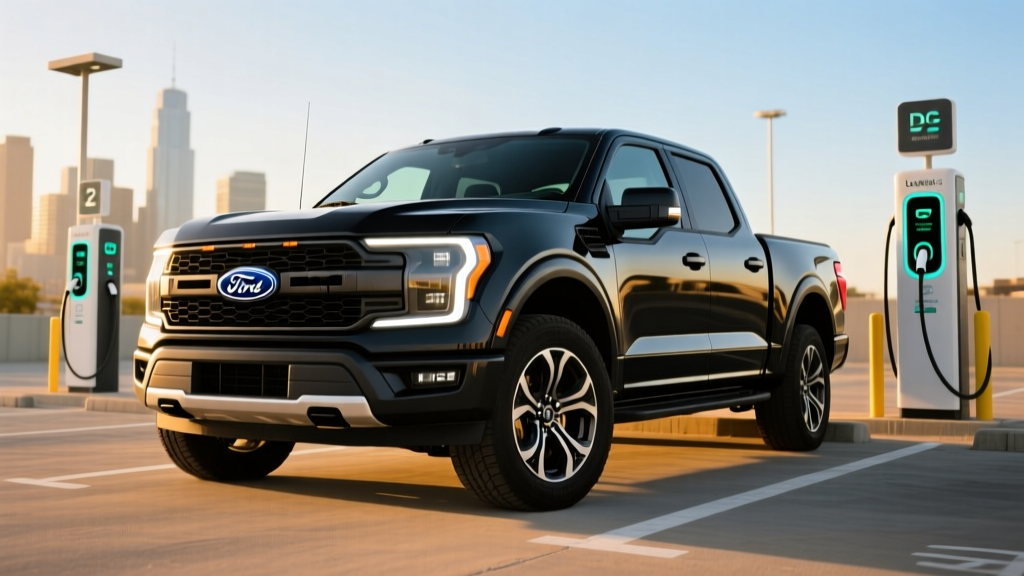
The 2023 Ford F-150 Lightning was the first mainstream full-size electric pickup to reach driveways at scale, and it did so without asking buyers to learn a new vehicle language. It looks like an F-150, works like an F-150, and in extended-range form, delivers EPA-estimated range that makes daily driving and moderate road trips genuinely practical. As a used-EV prospect in 2026, the Lightning represents one of the most capable and comfortable electric trucks on the secondary market — provided you understand its real-world range behavior, charging curve realities, and the specific battery pack you're getting.
This review covers every trim from the entry-level Pro to the Platinum, with exact figures on range, charging speed, performance, cargo capacity, and federal tax credit eligibility under current IRS §30D rules. Whether you're evaluating a certified pre-owned Lightning or comparing it to the Rivian R1T or Chevrolet Silverado EV, the data below gives you the full picture.
Range, Battery & Real-World Efficiency
The 2023 Lightning offers two battery packs across its trim lineup, both using NMC (nickel manganese cobalt) lithium-ion chemistry. Ford does not use LFP in the Lightning — the energy density requirements of a full-size truck demand the higher specific energy that NMC provides.
| Spec | Standard Range | Extended Range |
|---|---|---|
| Usable Battery Capacity | 98 kWh | 131 kWh |
| Chemistry | NMC | NMC |
| EPA Range (XLT/Lariat) | 240 mi | 320 mi |
| EPA Range (Platinum) | N/A | 300 mi |
| EPA Efficiency (Combined) | ~68 MPGe | ~70 MPGe |
| kWh per 100 Miles | ~49 kWh | ~48 kWh |
The EPA sticker tells part of the story. In mixed driving with the Extended Range pack, expect 270–295 miles in moderate temperatures on a combination of suburban and highway routes. Sustained 75+ mph highway driving drops that to roughly 240–260 miles due to the brick-like aerodynamics of a full-size pickup. In cold weather (below 30°F), plan for a 20–30% reduction — meaning an Extended Range Lightning may deliver 200–230 miles of practical range in winter conditions. The Standard Range pack, with its 240-mile EPA figure, realistically serves as a 170–200-mile vehicle in cold or highway-heavy use.
The Lightning's efficiency of roughly 48–49 kWh per 100 miles is typical for the full-size electric truck segment. For context, the Rivian R1T with its large pack returns similar figures, while the GMC Hummer EV is notably less efficient due to its extreme weight. According to fueleconomy.gov, the Extended Range Lightning's combined MPGe of 70 puts it in the middle of the electric truck pack.
Charging Speed: DC Fast, Level 2 & Home Setup
Charging is where Lightning owners need to set expectations carefully. The truck's peak DC fast-charge rate and its sustained charging curve differ meaningfully from smaller EVs.
| Charging Method | Standard Range (98 kWh) | Extended Range (131 kWh) |
|---|---|---|
| Max DC Fast Charge Rate | 120 kW peak | 150 kW peak |
| DC 10–80% Time | ~44 minutes | ~41 minutes |
| Level 2 (240V, 48A) | 11.5 kW / ~23 mi/hr | 11.5 kW / ~25 mi/hr |
| Level 2 (240V, 80A w/ Ford Charge Station Pro) | 19.2 kW / ~38 mi/hr | 19.2 kW / ~40 mi/hr |
| Level 1 (120V, 12A) | ~1.4 kW / ~3 mi/hr | ~1.4 kW / ~3 mi/hr |
| Connector | CCS1 | CCS1 |
Charging curve reality: The Extended Range pack peaks near 150 kW only at low states of charge (roughly 10–25% SoC). From 40% onward, the rate tapers to roughly 100–110 kW, and above 70% it drops further to around 60–70 kW. This is normal behavior for a large NMC pack managing thermal load, but it means your average charging speed over a 10–80% session is closer to 95–100 kW, not 150 kW. Plan road-trip stops accordingly — a 10–80% session takes about 41 minutes at a capable 150+ kW CCS station.
Home charging note: The optional Ford Charge Station Pro delivers up to 19.2 kW on a 100-amp circuit, which is among the fastest residential Level 2 options available. However, this requires a dedicated 100A breaker and likely a 200A or larger electrical panel. Budget $1,500–$3,500 for professional installation depending on your panel capacity and conduit run. The standard Mobile Power Cord on a 240V/32A outlet (NEMA 14-50) delivers about 7.7 kW — adequate for overnight replenishment of 150+ miles. Always consult a licensed electrician for your specific installation.
Performance, Drivetrain & Towing
Every 2023 Lightning comes with dual electric motors and all-wheel drive as standard. There is no rear-wheel-drive variant. The instant torque delivery from the dual-motor setup gives the Lightning a fundamentally different character from its gas-powered F-150 sibling.
| Spec | Standard Range | Extended Range |
|---|---|---|
| Horsepower | 452 hp | 580 hp |
| Torque | 775 lb-ft | 775 lb-ft |
| 0–60 mph | ~5.0 sec | ~3.8 sec |
| Drivetrain | Dual-motor AWD | Dual-motor AWD |
| Max Towing Capacity | 7,700 lbs | 10,000 lbs |
| Max Payload | ~2,235 lbs | ~1,952 lbs |
The Extended Range's 3.8-second 0–60 time is sports-sedan quick in a truck that weighs over 6,500 pounds. More practically, the 775 lb-ft of torque from zero RPM makes merging, passing, and low-speed trail maneuvering effortless.
Towing and range — the hard truth: If you plan to tow frequently, understand that range drops dramatically under load. Towing a 7,000–8,000 lb trailer at highway speeds can reduce range by 40–55%. An Extended Range Lightning that normally delivers 280 real-world miles may only manage 130–160 miles while towing heavy. This isn't a flaw unique to the Lightning — it's physics — but it demands trip planning around DC fast-charger availability on your tow routes.
Pricing, Trims & Federal Tax Credit Eligibility
The 2023 Lightning launched with aggressive pricing that has since been adjusted upward on subsequent model years. On the used market in 2026, 2023 models represent strong value, but federal tax credit rules for used EVs differ from new-vehicle purchases.
| Trim | Battery | Original Base MSRP | Typical As-Tested |
|---|---|---|---|
| Pro | Standard Range (98 kWh) | $59,974 | $60,000–$65,000 |
| XLT | Standard Range (98 kWh) | $65,974 | $68,000–$78,000 |
| XLT | Extended Range (131 kWh) | $75,974 | $78,000–$88,000 |
| Lariat | Extended Range (131 kWh) | $85,974 | $88,000–$98,000 |
| Platinum | Extended Range (131 kWh) | $96,874 | $98,000–$105,000 |
Federal tax credit for used EVs (§25E): If you're purchasing a 2023 Lightning as a used vehicle in 2026, you may qualify for the Used Clean Vehicle Credit (§25E), which provides up to $4,000 or 30% of the sale price (whichever is less). Key requirements per IRS guidelines:
- Sale price cap: The used vehicle must sell for $25,000 or less to qualify
- Income limits: Modified AGI cannot exceed $75,000 (single), $112,500 (head of household), or $150,000 (joint)
- Vehicle age: Must be at least 2 model years old (2023 models qualify in 2026)
- Dealer requirement: Must be purchased from a licensed dealer
- First-time transfer: The credit applies only to the first qualified sale since August 16, 2022
Important caveat: Given original MSRPs of $60,000+, most 2023 Lightnings on the used market in 2026 will still sell above the $25,000 used-credit cap. This means the majority of buyers will not qualify for the $4,000 used credit. Always verify current pricing and consult a tax professional for your specific situation. The original §30D new-vehicle credit (up to $7,500) is no longer available for 2023 models purchased in 2026.
Interior, Cargo, Technology & Driver Assistance
The Lightning's cabin mirrors the 14th-generation F-150, which means excellent space, solid materials in upper trims, and Ford's latest infotainment architecture. Where it diverges from the gas truck is the massive front trunk (frunk) made possible by the absence of an engine.
| Measurement | SuperCrew (all trims) |
|---|---|
| Front Legroom | 43.9 in |
| Rear Legroom | 43.6 in |
| Frunk Volume | 14.1 cu ft |
| Bed Length (5.5 ft box) | 67.1 in |
| Bed Volume | 52.8 cu ft |
| Seating Capacity | 5 passengers |
Standout technology features:
- SYNC 4 / SYNC 4A: 12-inch touchscreen standard (15.5-inch portrait screen on Lariat and Platinum), wireless Apple CarPlay and Android Auto
- Ford BlueCruise: SAE Level 2 hands-free highway driving on pre-mapped divided highways — requires driver attention monitoring; this is not autonomous driving
- Pro Power Onboard: Up to 9.6 kW of exportable AC power (2.4 kW standard on Pro), enabling job-site tool use, tailgating, or emergency home backup via the available Ford Intelligent Backup Power system
- Onboard Scales & Smart Hitch: Available payload and tongue-weight estimation via suspension sensors
- 14.1 cu ft Mega Power Frunk: Lockable, drainable, with four 120V outlets and two USB ports — essentially a second cargo area
Notable drawbacks:
- Extended Range models are heavy (6,700+ lbs), which increases tire wear and reduces efficiency at speed
- The 5.5-foot bed is shorter than the gas F-150's available 6.5- and 8-foot options
- DC fast-charging speed (150 kW peak) trails competitors like the Hyundai Ioniq 5 or Tesla Cybertruck
- Ford's public charging network experience via the FordPass app can be inconsistent depending on the third-party network
- Platinum trim pricing pushed past $100,000 as-tested, undercutting its value proposition versus luxury alternatives
Warranty, Battery Longevity & Ownership Costs
Ford backs the Lightning with a competitive warranty package, and the high-voltage battery coverage is critical for used buyers evaluating remaining coverage.
| Component | Coverage |
|---|---|
| Basic (Bumper-to-Bumper) | 3 years / 36,000 miles |
| Powertrain | 5 years / 60,000 miles |
| High-Voltage Battery | 8 years / 100,000 miles |
| Battery Capacity Retention | Minimum 70% SoH over warranty period |
| Corrosion Perforation | 5 years / unlimited miles |
The 8-year/100,000-mile battery warranty with a 70% state-of-health floor is standard for the segment and aligns with Ford's published specifications. For a 2023 model purchased in 2026, you'll have roughly 5 years and 70,000+ miles of battery warranty remaining, assuming average mileage. NMC chemistry in the Lightning has shown modest degradation in early owner reports — typically 3–6% loss over the first 30,000 miles — but long-term data beyond 100,000 miles is still accumulating.
Ownership cost considerations: Electricity costs for the Lightning are roughly $0.04–$0.06 per mile at residential rates ($0.13–$0.16/kWh), versus $0.15–$0.20 per mile for a comparable gas F-150 at $3.50/gallon. Insurance premiums for the Lightning tend to run 15–25% higher than the gas F-150 due to repair costs and vehicle value. Factor in reduced maintenance (no oil changes, fewer brake replacements due to regenerative braking) for a more complete picture.
Who Should Buy the 2023 Ford F-150 Lightning?
- Need a full-size truck for daily driving with home Level 2 charging access
- Value the frunk and Pro Power Onboard for job-site or outdoor use
- Want quick acceleration and smooth, quiet highway cruising
- Tow occasionally but not as your primary use case
- Prefer a traditional truck experience without a learning curve
- Tow heavy trailers long distances regularly (range loss is severe)
- Need DC fast-charging speeds above 200 kW for frequent road trips
- Want a longer bed (6.5 ft+) — the Lightning only offers a 5.5 ft box
- Require true off-road capability (Rivian R1T's quad-motor system or the gas F-150 Raptor may serve better)
Pros & Cons at a Glance
- Massive 14.1 cu ft frunk with power outlets
- Pro Power Onboard up to 9.6 kW for tools and backup
- Extended Range delivers 320 mi EPA — among the best for electric trucks
- Comfortable, spacious SuperCrew cabin with excellent rear legroom
- BlueCruise hands-free highway driving is well-executed
- Dual-motor AWD standard on every trim
- Familiar F-150 controls and ergonomics
- 150 kW peak DC charging trails newer competitors
- Heavy vehicle weight hurts efficiency and tire wear
- Range drops 40–55% when towing near max capacity
- Only a 5.5-foot bed available
- Platinum trim pushes past $100K
- Cold-weather range loss is significant (20–30%)
- Used tax credit unlikely to apply due to $25K price cap
Frequently Asked Questions
What is the real-world range of the 2023 Ford F-150 Lightning?
The Extended Range model is EPA-rated at 320 miles (300 for Platinum). In real-world mixed driving at moderate temperatures, expect 270–295 miles. Highway-only driving at 75+ mph drops that to roughly 240–260 miles, and cold weather below 30°F can reduce range to 200–230 miles. The Standard Range model's 240-mile EPA rating translates to about 170–200 miles in cold or highway-heavy conditions.
How fast does the Lightning charge at home and on the road?
On a DC fast charger, the Extended Range pack peaks at 150 kW and charges from 10–80% in approximately 41 minutes. At home with the optional 80A Ford Charge Station Pro (19.2 kW), you'll add about 40 miles of range per hour. With a standard 240V/32A outlet (7.7 kW), expect about 15–16 miles per hour — sufficient for overnight replenishment of daily driving.
Does the 2023 Lightning qualify for a federal tax credit in 2026?
As a used vehicle purchased in 2026, the 2023 Lightning may qualify for the §25E Used Clean Vehicle Credit of up to $4,000, but only if the sale price is $25,000 or less and buyer income falls within IRS limits. Most 2023 Lightnings on the used market still exceed the $25,000 price cap, making this credit difficult to claim. The original §30D new-vehicle credit is no longer available. Always consult a tax professional and verify current IRS rules.
Is the Lightning worth buying versus the Rivian R1T or Chevy Silverado EV?
The Lightning wins on familiarity, interior space, frunk utility, and Pro Power Onboard capability. The Rivian R1T offers a more innovative platform with available quad motors, better off-road capability, and a more compact footprint, but with less rear-seat room. The Chevy Silverado EV (4WT and RST trims) offers up to 400+ miles of EPA range and 200+ kW DC charging but was less widely available for 2023. If you prioritize traditional truck comfort and job-site power, the Lightning is the strongest pick.
How long will the Lightning's battery last?
Ford warrants the high-voltage battery for 8 years or 100,000 miles with a minimum 70% state-of-health retention. Early owner data suggests 3–6% degradation in the first 30,000 miles, which is typical for NMC chemistry with active thermal management. With proper care (avoiding frequent 100% charges and DC fast-charging exclusively), the battery should deliver well over 150,000 miles before approaching the warranty threshold.
Can the Lightning power my home during an outage?
Yes, with the available Ford Intelligent Backup Power system and the 80A Charge Station Pro, the Extended Range Lightning can supply up to 9.6 kW to your home through a transfer switch (installed by a licensed electrician). Ford estimates this can power an average home for up to 3 days, depending on consumption. This requires a compatible home electrical panel and professional installation.