Quick Verdict: The Electric Truck That Normalized EVs
The 2023 Ford F-150 Lightning did something no other electric vehicle had managed before it: it made electrification feel unremarkable to mainstream American buyers. Built on the bones of the best-selling vehicle in the United States, the Lightning swapped the V8 for a dual-motor powertrain without asking owners to relearn how to drive a truck. From a 2026 vantage point, the 2023 model year remains a strong used-EV prospect and a benchmark for what a full-size electric pickup can deliver — and where it still falls short.
Ford offered the 2023 Lightning in four trims: Pro, XLT, Lariat, and Platinum. The Standard Range battery paired with the Pro and XLT trims, while the Extended Range battery was available on XLT and standard on Lariat and Platinum. Production constraints and supply-chain issues defined much of the 2023 model year, pushing wait times out and inflating dealer markups. Today, those dynamics have settled, making the 2023 Lightning a compelling option on the used market — especially with the §25E used-EV tax credit potentially knocking $4,000 off the price for eligible buyers.
Range, Efficiency, and the Real-World Reality Check
The EPA's range estimates tell only part of the story for a 6,500-pound electric truck. Here is how the two battery options stack up on paper:
| Spec | Standard Range (98 kWh) | Extended Range (131 kWh) |
|---|---|---|
| Usable Battery Capacity | 98 kWh (NMC) | 131 kWh (NMC) |
| EPA Estimated Range | 240 miles | 320 miles (Platinum: 300 mi) |
| EPA Combined MPGe | 68 MPGe | 66 MPGe |
| Efficiency (kWh/100 mi) | ~49 kWh/100 mi | ~51 kWh/100 mi |
| Drivetrain | Dual-Motor AWD | Dual-Motor AWD |
On the EPA sticker, the Extended Range Lightning promises 320 miles. In practice, expect roughly 260–285 miles during mixed driving at highway speeds (65–75 mph). In cold weather (below 32°F), that figure can drop to 200–230 miles due to cabin heating demands and reduced battery chemistry efficiency. The Standard Range model's 240-mile EPA figure translates to approximately 190–210 miles on the highway and 155–175 miles in freezing temperatures. Towing a 5,000-pound trailer cuts range roughly in half regardless of battery size.
The Lightning's efficiency of roughly 2.0–2.1 kWh per mile is unremarkable by EV standards but expected for a full-size truck with the aerodynamic profile of a brick. For comparison, the Rivian R1T with its dual-motor configuration achieves around 2.0 kWh/mi, while the smaller Chevrolet Silverado EV (on the Ultium platform) pushes closer to 1.7 kWh/mi thanks to a more aero-optimized design.
According to fueleconomy.gov, the 2023 Lightning Extended Range posts a combined 66 MPGe — a number that sounds low until you remember this vehicle weighs over three tons and can tow 10,000 pounds.
Charging Speeds: DC Fast, Level 2, and the Home Setup
Charging an electric truck is where the rubber meets the road — literally and figuratively. The 2023 Lightning supports the CCS1 connector for DC fast charging and accepts up to 150 kW at a public station. Here is the complete charging breakdown:
| Charging Level | Power / Rate | Standard Range | Extended Range |
|---|---|---|---|
| Level 1 (120V household) | ~1.4 kW | ~3 mi/hr | ~3 mi/hr |
| Level 2 (240V, 32A mobile) | 7.7 kW | ~20 mi/hr | ~20 mi/hr |
| Level 2 (240V, 48A Wall Connector) | 11.5 kW | ~30 mi/hr | ~30 mi/hr |
| Level 2 (240V, 80A — Lariat/Platinum dual onboard) | 19.2 kW | ~48 mi/hr | ~48 mi/hr |
| DC Fast Charge (CCS1) | Peak 150 kW | 15–80% in ~44 min | 15–80% in ~41 min |
A critical detail many buyers miss: the Lariat and Platinum trims come equipped with dual onboard chargers, enabling 19.2 kW Level 2 charging when paired with a Ford Charge Station Pro or an equivalent 80-amp hardwired unit. The Pro and XLT trims are limited to 11.5 kW on Level 2 unless you option the dual-charger upgrade. That difference means a full overnight charge for the 131 kWh Extended Range battery takes about 7 hours at 19.2 kW versus nearly 12 hours at 11.5 kW.
On DC fast charging, the Lightning peaks at 150 kW but does not sustain it. The charge curve tapers noticeably above 60% state of charge, dropping to roughly 80–90 kW through the 60–80% window. This is why the 15–80% time of around 41–44 minutes is slower than rivals like the Hyundai Ioniq 5 or the Rivian R1T (which can peak at 200+ kW on newer models). For road trips, plan on 30–40 minute stops every 200 miles or so — not ideal, but manageable with route planning on networks like Electrify America or EVgo.
Home charging installation for the 80A Ford Charge Station Pro typically requires a 100-amp dedicated circuit. Expect to pay $1,200–$2,500 for a licensed electrician to install it, depending on your panel capacity and run distance. If your home has a 200-amp panel that is already heavily loaded, a panel upgrade to 300–400 amps can add $2,000–$5,000 to the project. Always get a site assessment from a licensed electrician before purchasing equipment.
Performance, Towing, and Payload
The 2023 Lightning is no slouch despite its heft. Dual electric motors power all four wheels with instant torque, delivering a satisfying shove off the line that no gas-powered F-150 can match without a high-output EcoBoost or V8.
| Performance Spec | Standard Range | Extended Range |
|---|---|---|
| Horsepower | 452 hp | 580 hp |
| Torque | 775 lb-ft | 775 lb-ft |
| 0–60 mph | ~3.8 seconds | |
| Max Towing Capacity | 7,700 lbs | 10,000 lbs (w/ Max Trailer Tow) |
| Max Payload | 2,235 lbs | 1,952 lbs |
| Top Speed | 110 mph | 110 mph |
The Extended Range model's 3.8-second 0–60 time is sports-car territory in a vehicle with an 8-foot bed. But the real party trick is the torque: 775 lb-ft available from zero RPM means towing a boat up a grade feels effortless compared to waiting for a gas engine to build boost.
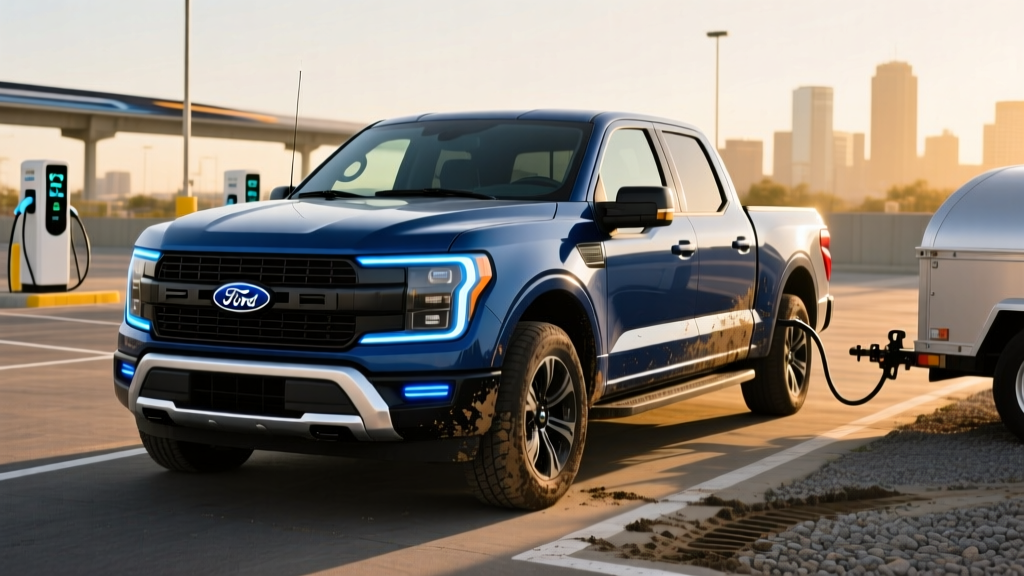
Towing impact on range is severe — plan for it. Ford's own testing and independent reviews confirm that towing a 6,000–8,000-pound trailer at highway speeds can cut range by 45–55%. An Extended Range Lightning rated for 320 miles may deliver only 150–170 miles with a heavy trailer in tow. Ford's onboard range calculator adjusts estimates based on trailer weight and driving conditions, which helps, but it does not eliminate the fundamental physics problem. If you tow frequently over long distances, the Lightning requires careful route planning around DC fast chargers — and not all charging stations are designed to accommodate trucks with trailers attached.
Cargo, Interior Space, and the Mega Power Frunk
The Lightning retains the full-size cabin of the SuperCrew F-150, meaning genuine five-passenger comfort with ample rear legroom.
- Front legroom: 43.9 inches
- Rear legroom: 43.6 inches
- Bed length: 5.5 feet (standard for SuperCrew)
- Bed payload volume: 52.8 cu ft
- Front trunk (frunk): 14.1 cu ft — lockable, drainable, with 400 lbs payload capacity
- Interior cabin storage: Multiple bins, fold-flat work surface available on Lariat/Platinum
The Mega Power Frunk is the Lightning's most distinctive feature. Where a gas F-150 has an engine, the Lightning has a weather-sealed, lockable storage compartment large enough for four carry-on bags or a full set of power tools. It includes a 120V outlet (and a 240V outlet on higher trims), making it a mobile workstation. The drain plug lets you fill it with ice for tailgating — a detail that resonates with truck buyers.
Inside, the Lariat and Platinum trims feature a 15.5-inch vertical touchscreen running Ford's SYNC 4A system with wireless Apple CarPlay and Android Auto. The Pro and XLT get a smaller 12-inch screen. The Platinum adds a 12-inch digital instrument cluster, leather-trimmed seats, and a B&O 18-speaker audio system. The XLT sits in the value sweet spot with available features like the 15.5-inch screen, power-adjustable pedals, and the Pro Power Onboard 2.0 kW generator.
Pricing, Trims, and Tax Credit Eligibility
When the 2023 Lightning launched, Ford's MSRP structure was aggressively competitive. Prices rose through the model year due to supply pressures, but the original MSRP targets remain relevant for used-market negotiations:
| Trim | Battery | Original MSRP | Est. Used Price (2026) |
|---|---|---|---|
| Pro | Standard Range (98 kWh) | $59,974 | $38,000–$44,000 |
| XLT | Standard Range (98 kWh) | $67,474 | $42,000–$50,000 |
| XLT | Extended Range (131 kWh) | $77,474 | $48,000–$56,000 |
| Lariat | Extended Range (131 kWh) | $84,474 | $55,000–$64,000 |
| Platinum | Extended Range (131 kWh) | $96,874 | $62,000–$74,000 |
Federal tax credit note: The 2023 F-150 Lightning qualified for the full $7,500 §30D new clean vehicle credit when purchased new, as it was assembled in the U.S. (Claycomo, Missouri — later Dearborn, Michigan) and met battery-sourcing requirements. However, eligibility depended on the buyer's adjusted gross income (AGI caps: $150,000 single / $300,000 joint) and the truck's MSRP falling under the $80,000 cap for pickups and SUVs. Several 2023 trims — particularly the Lariat Extended Range and Platinum — exceeded the $80,000 MSRP cap, disqualifying them from the new-vehicle credit at original purchase.
For 2026 used-EV buyers, the §25E used clean vehicle credit offers up to $4,000 (or 30% of the sale price, whichever is less) on a 2023 Lightning purchased from a dealer, provided the sale price is $25,000 or less, the buyer's AGI falls under income caps ($75,000 single / $150,000 joint), and the vehicle has not previously been claimed under §25E after August 16, 2022. Given current used prices, qualifying for the full $4,000 credit requires finding a well-equipped Standard Range Pro or XLT at the lower end of the market. Always verify eligibility with a tax professional and consult the latest IRS guidance.
Tech, Driver Assistance, and Ownership Experience
The 2023 Lightning comes equipped with Ford Co-Pilot360 2.0, which includes:
- Adaptive cruise control with stop-and-go
- Lane-keeping system with lane-centering
- Blind-spot information system (BLIS) with trailer coverage
- Automatic emergency braking with pedestrian detection
- Pro Trailer Backup Assist — a standout feature that simplifies trailer hitching and reversing
Ford Co-Pilot360 is a Level 2 driver-assistance system. It does not make the Lightning self-driving. The driver must keep hands on the wheel and eyes on the road at all times. Ford's hands-free BlueCruise system was available on select 2023 Lightning trims (Lariat and Platinum with the appropriate package) for use on pre-mapped divided highways, but it still requires driver monitoring via an infrared camera.
The Pro Power Onboard system deserves special mention. Available in 2.0 kW (XLT) or 9.6 kW (Lariat/Platinum) configurations, it turns the Lightning into a mobile generator. The 9.6 kW version can power a job site worth of tools, run a camper's appliances, or — with the available Ford Intelligent Backup Power system and a compatible home transfer switch — supply emergency power to your home during an outage for up to three days at moderate consumption. This vehicle-to-home (V2H) capability is a genuine differentiator that gas trucks cannot match without an external generator.
Over-the-air (OTA) updates via Ford Power-Up keep the software current, and the available 360-degree camera with trailer reverse guidance is among the best in the segment. On the downside, the 2023 Lightning's infotainment system can be sluggish compared to rivals, and the absence of a physical volume knob on the 15.5-inch screen is a persistent annoyance.
Warranty, Battery Longevity, and Maintenance
| Coverage | Term |
|---|---|
| Basic Bumper-to-Bumper | 3 years / 36,000 miles |
| Powertrain | 5 years / 60,000 miles |
| EV Components (battery, motors, inverters) | 8 years / 100,000 miles |
| Battery Capacity Retention Guarantee | ≥70% capacity over 8 yr / 100,000 mi |
| Corrosion Perforation | 5 years / unlimited miles |
The 8-year/100,000-mile EV component warranty is industry-standard and matches what Ford, GM, and most competitors offer. The battery capacity retention threshold of 70% is also standard — meaning Ford will repair or replace the battery if it degrades below 70% of original capacity within the warranty window. Real-world data from 2022–2023 Lightning owners (as of early 2026) suggests degradation is tracking well, with most vehicles reporting 92–96% state of health after 30,000–50,000 miles. The NMC chemistry in both battery packs has proven durable under Ford's active liquid thermal management system.
Maintenance costs are significantly lower than a gas F-150. There are no oil changes, spark plugs, or transmission fluid swaps. Brake pad life is extended substantially thanks to regenerative braking — many owners report minimal pad wear at 50,000 miles. The primary recurring costs are tire replacement (the Lightning's weight and instant torque wear tires faster than gas trucks), cabin air filter changes, and windshield washer fluid. Insurance premiums run 15–25% higher than an equivalent gas F-150, according to industry averages — a factor worth including in your total cost of ownership calculation.
Pros, Cons, and Who Should Buy
Pros
- Instant 775 lb-ft of torque — tows and accelerates effortlessly
- Mega Power Frunk (14.1 cu ft) is genuinely useful
- Pro Power Onboard turns the truck into a 9.6 kW mobile generator
- Quiet, smooth daily driving experience
- Strong SuperCrew cabin space (43.6" rear legroom)
- V2H home backup power capability (with transfer switch)
- Lower running costs vs. gas F-150 (fuel + maintenance)
Cons
- DC fast charging peaks at 150 kW — slower than Rivian R1T and Silverado EV
- Towing cuts range by ~50% — limits long-distance trailer hauling
- Heavy vehicle eats tires faster than gas counterparts
- Extended Range battery adds significant weight, reducing payload
- Infotainment can be sluggish; no physical volume knob on large screen
- Cold-weather range loss of 25–35% is substantial
- Higher insurance premiums vs. gas F-150
Who Is the 2023 Lightning For?
Buy it if: You want a daily-driver truck with low fuel and maintenance costs, you tow occasionally (not daily long-haul), you value the frunk and Pro Power Onboard for work or recreation, and you can charge at home with a Level 2 setup.
Skip it if: You regularly tow heavy trailers over 200+ miles, you live in a region with sparse DC fast-charging infrastructure, or you need maximum payload capacity (the Extended Range battery's weight cuts into payload by nearly 300 lbs vs. Standard Range).
Consider the Rivian R1T instead if: You prioritize faster DC charging (200+ kW on newer models), more advanced off-road capability, or a more car-like driving experience — though at a higher price point.
Consider the Chevy Silverado EV instead if: You need more range (up to 400+ miles on the 4WT trim) and GM's Ultium platform efficiency, though availability and trim configurations differ.
Frequently Asked Questions
What is the real-world range of the 2023 F-150 Lightning?
The Extended Range model's 320-mile EPA estimate translates to roughly 260–285 miles in real-world mixed driving, and 200–230 miles in cold weather. The Standard Range model delivers about 190–210 miles on the highway from its 240-mile EPA rating. Towing a trailer can cut these figures by 45–55%.
How fast does the 2023 Lightning charge?
At a DC fast charger, it peaks at 150 kW and charges from 15–80% in about 41–44 minutes depending on battery size. At home on a Level 2 charger, it adds 20–48 miles per hour depending on your amperage and whether your trim has the dual onboard charger (19.2 kW capability on Lariat/Platinum).
Does the 2023 F-150 Lightning qualify for the federal EV tax credit?
When new, many trims qualified for the $7,500 §30D credit — but trims with an MSRP above $80,000 (Lariat Extended Range, Platinum) were excluded. For 2026 used buyers, the §25E credit offers up to $4,000 on vehicles priced at $25,000 or less, subject to buyer income caps. Consult a tax professional and review current IRS guidance before purchasing.
Is the Lightning worth buying vs. the Rivian R1T or Silverado EV?
The Lightning wins on value, frunk utility, and V2H backup power. The Rivian R1T offers faster charging, better off-road chops, and a more premium interior — but at a higher price. The Silverado EV offers more range and a larger bed but was only available in limited fleet trims for 2023. For most truck buyers seeking an everyday EV with work capability, the Lightning remains the most well-rounded choice at its price point.
How much does it cost to charge a Lightning at home?
At the U.S. average residential electricity rate of ~$0.16/kWh, a full charge of the Extended Range 131 kWh battery costs roughly $21. For the Standard Range 98 kWh pack, it is about $16. That equates to roughly $0.07–$0.08 per mile — compared to $0.18–$0.22 per mile for a gas F-150 getting 18 MPG at $3.50/gallon.
Can the 2023 Lightning power my home during an outage?
Yes, with the available Ford Intelligent Backup Power system and a professionally installed home transfer switch. The 9.6 kW Pro Power Onboard system (Lariat/Platinum) can supply essential circuits in your home for up to approximately three days at moderate consumption levels. This requires the Ford Charge Station Pro and a compatible transfer switch installed by a licensed electrician.