Quick Answer: Is the 2023 Chevy Silverado 1500 EV Worth It?
The 2023 Chevy Silverado 1500 EV (specifically the 4WT fleet work truck and early RST First Edition trims) delivers an EPA-estimated 400 miles of range from a massive ~200 kWh Ultium battery pack. It starts around $74,800 (4WT) and reaches $105,000+ (RST First Edition). It's best suited for buyers who need serious towing (up to 10,000 lbs), have reliable Level 2 home charging, and drive highway-heavy routes where the range holds up. Compared to a gas Silverado 1500, you'll save roughly $1,500–$2,500/year on fuel (depending on local electricity rates), but pay significantly more upfront and face longer charging stops on road trips. The §30D federal tax credit of up to $7,500 may apply, but eligibility depends on current-year income caps, MSRP limits, and battery sourcing rules — always verify at IRS.gov.
Range, Battery, and Charging: The Numbers That Matter
The 2023 Silverado EV rides on GM's Ultium platform with a double-stacked battery module design. The headline spec — 400 miles EPA — applies to the RST First Edition trim. The fleet-oriented 4WT variant carries a smaller pack rated at roughly 240 miles EPA. Here's the full spec breakdown:
| Spec | 4WT (Fleet) | RST First Edition |
|---|---|---|
| EPA Range | ~240 miles | ~400 miles |
| Battery Capacity (usable) | ~100 kWh | ~200 kWh |
| Battery Chemistry | NMC (Ultium) | NMC (Ultium) |
| Peak DC Fast Charge Rate | ~200 kW | ~350 kW (capable) |
| 10–80% DC Fast Charge Time | ~35 min | ~40 min (on 350 kW station) |
| Level 2 Home Charging (kW) | 11.5 kW (standard) / 19.2 kW (optional) | 11.5 kW (standard) / 19.2 kW (optional) |
| Level 2 Full Charge Time | ~9 hrs (11.5 kW) | ~17 hrs (11.5 kW) / ~10 hrs (19.2 kW) |
| Horsepower | 510 hp | 664 hp |
| 0–60 mph | ~5.5 sec | ~4.5 sec |
| Max Towing Capacity | 8,000 lbs | 10,000 lbs |
| Base MSRP (2023) | $74,800 | $105,000 |
| Battery/Powertrain Warranty | 8 yr / 100,000 mi | 8 yr / 100,000 mi |
Real-World Range Reality Check
The 400-mile EPA figure is impressive, but real-world conditions change the math. Expect ~320–350 miles at sustained 70–75 mph highway speeds in mild weather. In cold weather (below 30°F), range can drop 20–30%, putting you closer to 280–320 miles on the RST. Towing a 7,000-lb trailer at highway speed can slash range to 150–200 miles depending on terrain and aerodynamics. These aren't defects — they're physics. The Silverado EV's large battery gives you a bigger buffer than most EVs, but it doesn't eliminate the variables.
On charging speed: the RST's 350 kW peak capability is class-leading, but sustained charge rate matters more than peak. On a 350 kW Electrify America or compatible station, the Silverado EV holds strong through ~60% SoC before tapering. On more common 150 kW DC chargers, expect 10–80% in roughly 55–65 minutes. Always precondition the battery by navigating to a charger in the infotainment system — this warms the pack for faster charging, especially in cold weather.
EV vs. Gas Silverado: Cost and Capability Comparison
How does the 2023 Silverado 1500 EV stack up against its gas counterpart? Let's compare the EV RST First Edition against a comparably equipped 2023 Silverado 1500 High Country (6.2L V8, 4WD):
| Factor | Silverado EV RST | Silverado Gas (High Country 6.2L) |
|---|---|---|
| Base MSRP | $105,000 | ~$68,000 |
| Fuel/Energy Cost per Mile | ~$0.05–$0.08 (home charging) | ~$0.20–$0.28 (gas at $3.50/gal, 16 MPG) |
| Annual Fuel/Energy Cost (15k mi/yr) | ~$750–$1,200 | ~$3,000–$4,200 |
| Annual Maintenance | ~$300–$500 | ~$800–$1,200 |
| EPA Efficiency | ~63 MPGe combined | ~16 MPG combined |
| Towing (max) | 10,000 lbs | ~12,500 lbs |
| Refuel/Recharge Time | 10–80% in ~40 min (DCFC) | ~5 min at gas station |
| Emissions (tailpipe) | Zero | ~400 g CO₂/mile |
The fuel savings are substantial — potentially $2,000–$3,000 per year — but the EV commands a $37,000+ premium at the sticker. At $2,500/year in fuel savings, the payback period stretches to roughly 15 years without factoring in a tax credit. With a $7,500 federal credit (if eligible), you're still looking at a 12-year payback on the price premium alone. The EV makes financial sense if you drive high annual miles, have cheap home electricity, and plan to keep the truck long-term.
Total Cost of Ownership: 5-Year Breakdown
Here's what owning a Silverado EV RST actually costs over five years and 75,000 miles, compared to the gas High Country:
| Cost Category | Silverado EV RST (5 yr) | Silverado Gas HC (5 yr) |
|---|---|---|
| Purchase Price (after est. credit) | $97,500 | $68,000 |
| Fuel/Energy | $5,000 | $17,500 |
| Maintenance | $2,000 | $5,000 |
| Insurance (est. avg) | $12,500 | $9,500 |
| Depreciation (est. 50%) | $48,750 | $30,000 |
| Home Charger Install (one-time) | $1,500–$3,000 | $0 |
| Total 5-Year Cost | ~$166,750–$168,250 | ~$130,000 |
The EV's higher purchase price, steeper depreciation (EV trucks have depreciated significantly in the 2024–2025 used market), and elevated insurance premiums (typically 20–35% higher than gas equivalents) offset much of the fuel and maintenance savings. This isn't an argument against the EV — it's an argument for running your own numbers based on your local electricity rate, annual mileage, and insurance quotes.
Home Charging and Real-World Ownership Considerations
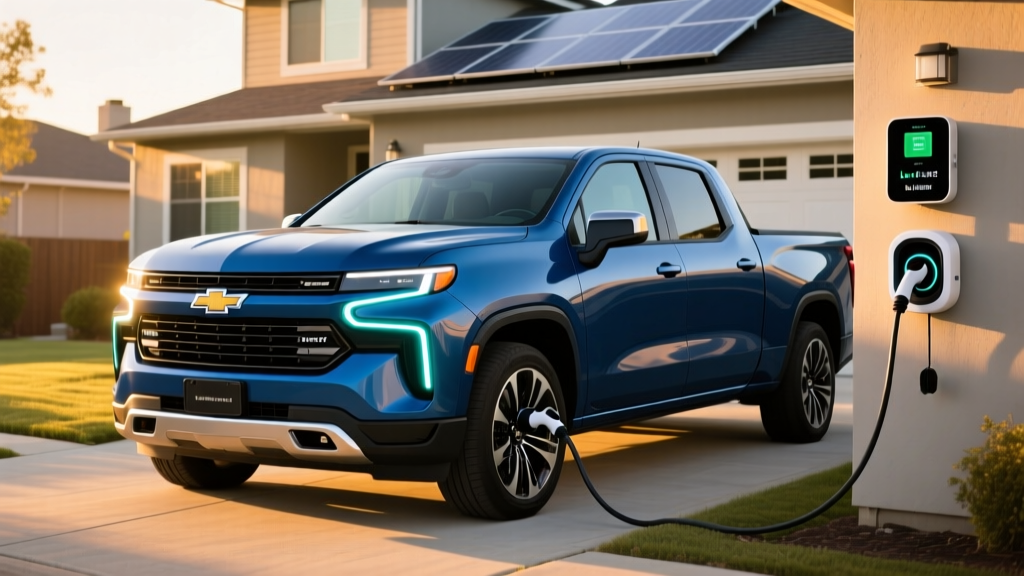
The Silverado EV's ~200 kWh battery is enormous, and that creates a specific home-charging challenge. On a standard 11.5 kW Level 2 home charger (requiring a 60-amp circuit), a full charge takes ~17 hours. In practice, you'll rarely charge from 0–100% — most owners arrive home at 30–50% and top up overnight. But if you use 200+ miles in a day, a single overnight session on 11.5 kW won't fully replenish the pack.
The optional 19.2 kW onboard charger cuts that to ~10 hours for a full charge, but it requires a 100-amp dedicated circuit. Many homes with 200-amp electrical panels cannot support this without a panel upgrade ($2,000–$5,000+). Before purchasing, get a quote from a licensed electrician to assess:
- Your panel's remaining capacity (amps available after existing loads)
- Wire run distance from panel to garage/driveway (longer runs = higher cost)
- Whether a panel upgrade to 400-amp service is needed
- Local permit requirements (typically $50–$300)
Typical Home Level 2 Installation Costs
| Item | 11.5 kW Setup | 19.2 kW Setup |
|---|---|---|
| Level 2 Charger (hardware) | $500–$800 | $800–$1,200 |
| Electrician Labor | $500–$1,500 | $1,000–$2,500 |
| Panel Upgrade (if needed) | $0–$3,000 | $2,000–$5,000 |
| Permit | $50–$200 | $100–$300 |
| Total Estimated | $1,050–$5,500 | $3,900–$9,000 |
If you cannot charge at home — say you live in an apartment, park on the street, or your HOA restricts charger installation — the Silverado EV becomes significantly harder to live with. Relying on public DC fast charging for a 200 kWh battery means 40–65 minute sessions every few days at $0.30–$0.50/kWh (that's $60–$100 per session at public rates). Home charging at $0.12–$0.18/kWh brings that same full charge to $24–$36. The economics of EV ownership tilt heavily in favor of home charging access.
Common Misconceptions: Myth vs. Fact
| Myth | Fact |
|---|---|
| "400 miles means I'll always get 400 miles." | EPA range is a lab estimate. Highway driving at 75 mph, cold weather, and towing reduce range 20–50%. Expect 280–350 miles in real-world mixed use. |
| "I can tow just as far on a charge as a gas truck can on a tank." | Towing 8,000+ lbs at highway speed can reduce EV range to 150–200 miles. Gas trucks lose efficiency towing too, but refueling takes 5 minutes vs. 40+ minutes for an EV. |
| "The battery will need replacing in 5 years." | GM warrants the Ultium battery for 8 years/100,000 miles against defects and excessive degradation (typically defined as dropping below 60–70% capacity). NMC batteries in liquid-cooled packs like the Ultium platform are lasting 200,000+ miles in real-world data from similar GM EVs. |
| "Everyone gets the $7,500 tax credit." | The §30D credit has strict requirements: buyer income caps ($150K single / $300K joint for new vehicles), MSRP caps ($80,000 for trucks/vans — note the RST at $105K may exceed this), and battery critical-mineral and component sourcing rules that change annually. Check IRS.gov and consult a tax professional. |
| "It charges at 350 kW everywhere." | 350 kW is the truck's peak capability, but very few public chargers deliver that speed. Most DCFC stations are 50–150 kW. Plan for 10–80% in 40–65 minutes depending on station output. |
A critical note on the tax credit: the Silverado EV RST First Edition's $105,000 MSRP exceeds the §30D MSRP cap of $80,000 for trucks. This means the RST First Edition likely does not qualify for the new-vehicle federal tax credit. The lower-priced 4WT at $74,800 falls under the cap and may qualify, but you must verify battery sourcing compliance for the specific model year. The 3WT and lower trims that GM announced at lower price points are more likely credit-eligible. Always verify current eligibility on fueleconomy.gov before purchasing.
Decision Framework: Should You Buy the 2023 Silverado 1500 EV?
Choose the Silverado EV If:
- You have home Level 2 charging — or can install it — and your daily driving is under 200 miles round-trip.
- You tow occasionally, not daily — the EV is excellent for boat/trailer trips under 150 miles each way, but long-distance towing requires careful charging planning.
- You value instant torque and quiet operation — 664 hp in the RST with zero turbo lag or transmission hunting is a genuinely different truck experience.
- You're buying the 4WT for fleet/commercial use — lower operating costs, no oil changes, and potential commercial EV credits (§45W) make the math work better for business use.
- You live in a state with additional EV incentives — states like California, Colorado, and others offer rebates that stack with federal credits on eligible trims.
Look Elsewhere If:
- You regularly tow over 200 miles one-way — the charging infrastructure for heavy-towing EV road trips isn't mature enough yet for stress-free travel.
- You can't charge at home — public charging a 200 kWh battery is expensive and time-consuming.
- Budget is a primary concern — the gas Silverado 1500 offers similar capability at $35,000–$40,000 less upfront.
- You want a proven long-term track record — the Silverado EV is a first-generation product on a new platform; early adopters accept some risk of software bugs and service-learning curves.
Consider a Hybrid Alternative If:
- You want fuel savings without range compromises — the Ford F-150 PowerBoost hybrid delivers ~22 MPG combined (vs. 16 MPG for the V8 gas Silverado) with no charging dependency and a lower sticker price.
Frequently Asked Questions
What's the real-world range of the 2023 Chevy Silverado 1500 EV?
The EPA rates the RST First Edition at 400 miles and the 4WT at ~240 miles. In real-world highway driving at 70 mph in mild conditions, expect roughly 320–350 miles from the RST. In cold weather (below freezing), plan for 280–320 miles. Towing heavy loads cuts range dramatically — to 150–200 miles depending on weight, speed, and terrain. Source: fueleconomy.gov.
How long does it take to charge the Silverado EV at home?
On an 11.5 kW Level 2 charger (60-amp circuit), the 200 kWh RST pack takes roughly 17 hours from empty to full. With the optional 19.2 kW charger (100-amp circuit), that drops to ~10 hours. Most owners charge from 20–80% overnight, which takes 9–10 hours on 11.5 kW or 5–6 hours on 19.2 kW — sufficient for daily use.
Does the 2023 Silverado EV qualify for the $7,500 federal tax credit?
It depends on the trim. The §30D credit caps eligible truck MSRPs at $80,000. The 4WT ($74,800) falls under this cap and may qualify if battery sourcing and buyer income requirements are met. The RST First Edition ($105,000) exceeds the MSRP cap and does not qualify. Always verify current eligibility at IRS.gov and consult a tax professional, as sourcing rules update annually.
Can the Silverado EV tow as well as the gas version?
The RST tows up to 10,000 lbs, which is competitive but less than the gas Silverado High Country's ~12,500-lb rating. The bigger difference is range while towing: expect 150–200 miles on a charge with a heavy trailer, versus 300+ miles on a tank of gas. For short tows (under 100 miles each way), the EV is excellent. For long-distance towing, the gas truck remains more practical.
What should a first-time EV buyer know before purchasing the Silverado EV?
Three things: (1) Home charging is nearly essential — budget $1,500–$5,000+ for a Level 2 installation and get an electrician quote before buying. (2) Plan road trips around charging stations using apps like PlugShare or A Better Routeplanner; the Silverado EV's CCS/NACS charging compatibility (depending on model year and adapter availability) determines which networks you can use. (3) Expect higher insurance premiums — get a quote before signing. The Silverado EV rewards prepared owners with dramatically lower fuel costs and a refined driving experience, but punishes unprepared ones with charging frustration and unexpected expenses.
How does the Silverado EV compare to the Ford F-150 Lightning and Rivian R1T?
The Ford F-150 Lightning (320 miles EPA, ~$55,000–$96,000) is the closest competitor — it's more affordable and widely available but offers less range. The Rivian R1T (up to 410 miles EPA with Max Pack, ~$73,000–$99,000) is more adventure-oriented with a smaller bed. The Silverado EV wins on maximum range and charging speed; the Lightning wins on value and dealer network; the R1T wins on off-road capability and build quality. All three require home charging for practical daily use.