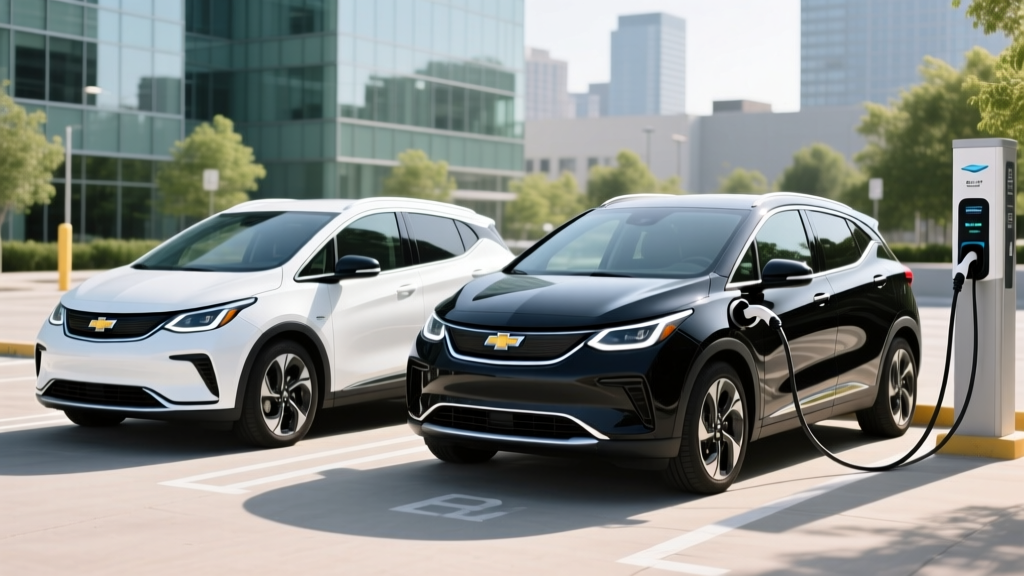
The 2023 Chevrolet Bolt EV and Bolt EUV occupy a unique space in the used-EV market of 2026. Originally priced from just $26,500 new — and eligible for the full $7,500 federal tax credit at point of sale — the Bolt became the most affordable long-range electric vehicle in America during its final model year. GM discontinued the Bolt platform after 2023 to retool for next-generation Ultium-based EVs, but the result is a thriving used market where savvy buyers can pick up a low-mileage Bolt EV or EUV for a fraction of its original sticker.
This review covers the 2023 Chevy Bolt lineup as you'll find it today: specs, real-world range, charging realities, ownership costs, and whether it still makes sense compared to newer budget EVs. If you're cross-shopping used Bolts against a new Nissan Leaf, Hyundai Kona Electric, or entry-level Tesla Model 3, the data below will clarify exactly what you're getting — and where the Bolt falls short.
2023 Chevy Bolt EV and EUV: Quick Spec Overview
| Spec | Bolt EV (2LT) | Bolt EUV (Premier) |
|---|---|---|
| EPA Range | 259 miles | 247 miles |
| Battery (usable) | 65 kWh, NMC (nickel-manganese-cobalt) | 65 kWh, NMC |
| Motor / Drivetrain | 200 hp / 266 lb-ft, FWD | 200 hp / 266 lb-ft, FWD |
| 0-60 mph | ~6.5 seconds | ~7.0 seconds |
| Max DC Fast Charge | 55 kW (CCS1) | 55 kW (CCS1) |
| 10-80% DC Charge Time | ~50 minutes | ~50 minutes |
| Level 2 Home Charging | 11.5 kW onboard charger (~39 mi/hr) | 11.5 kW (~37 mi/hr) |
| EPA Efficiency | 120 MPGe (28 kWh/100 mi) | 115 MPGe (29 kWh/100 mi) |
| Cargo Volume (rear seats up) | 16.3 cu ft | 16.3 cu ft |
| Rear Legroom | 36.0 in | 39.1 in |
| Battery Warranty (original) | 8 yr / 100,000 mi | 8 yr / 100,000 mi |
| Original Base MSRP | $26,500 | $28,200 |
Source: fueleconomy.gov and Chevrolet's archived 2023 spec sheets.
Range and Efficiency: EPA vs. Real World
Real-World Expectation: 220-240 miles in mixed driving; 180-200 miles sustained highway at 75 mph; 160-180 miles in sub-30°F winter conditions.
The 65 kWh NMC battery pack delivers genuinely usable range for most daily commutes and moderate road trips. In temperate, city-heavy driving — exactly the Bolt's ideal use case — owners regularly report matching or slightly exceeding the 259-mile EPA figure thanks to aggressive regenerative braking and low-speed efficiency.
However, the Bolt's aerodynamics (it's a tall hatchback, not a sleek sedan) hurt it on the highway. Sustained 70-75 mph cruising drops efficiency to roughly 3.2-3.5 miles per kWh, yielding around 200-215 miles of practical range before you'd want to find a charger. In freezing temperatures, expect a 25-35% reduction from EPA — the Bolt lacks a heat pump, relying instead on resistive cabin heating that draws heavily from the pack.
The Bolt EUV's slightly shorter range (247 miles EPA) comes from its longer wheelbase, additional weight, and marginally larger frontal area. In practice, the difference is negligible day-to-day — about 10-15 fewer miles per charge.
Efficiency in Context
At 120 MPGe combined (Bolt EV), the car is efficient by absolute standards but trails more modern platforms. The Hyundai Kona Electric (2024+) achieves 129 MPGe, and the Tesla Model 3 RWD hits 132 MPGe. The Bolt's efficiency is perfectly adequate — it just isn't class-leading.
Charging Speed: The Bolt's Most Significant Limitation
This is where the 2023 Chevy Bolt reveals its age. The vehicle's DC fast-charging architecture peaks at just 55 kW on a CCS1 connector. In an era where competitors routinely accept 150-250 kW, the Bolt's charging speed is its single biggest compromise for anyone planning regular road trips.
| Charging Level | Power (kW) | Speed (miles of range per hour) | Notes |
|---|---|---|---|
| Level 1 (120V household) | ~1.2 kW | ~4 mi/hr | Emergency/trickle only; full charge in ~54 hours |
| Level 2 (240V home/public) | 11.5 kW (max onboard) | ~37-39 mi/hr | Full charge in ~7 hours; excellent onboard charger |
| DC Fast Charge (CCS1) | 55 kW peak | ~180-200 mi/hr (at peak) | 10-80% in ~50 min; tapers heavily above 80% |
Home charging is a bright spot. The Bolt's 11.5 kW onboard AC charger is one of the best in its class. On a properly installed 48-amp Level 2 home station (like a ChargePoint Home Flex or Emporia Level 2), you'll add roughly 39 miles of range per hour, meaning a depleted battery fully replenishes overnight in about 7 hours. Many competing budget EVs cap at 7.2 kW onboard, making the Bolt's Level 2 performance genuinely excellent.
DC fast charging is the weak link. The 55 kW peak means a 10-80% session takes roughly 50 minutes — and that's under ideal battery-temperature conditions. On a cold pack without adequate preconditioning (the Bolt's preconditioning is rudimentary compared to Tesla or Hyundai's systems), expect that to stretch past 60 minutes. The charge curve also tapers steeply above 80% SoC, so charging to 100% on DC adds significant time.
For road trips, plan for roughly one 50-minute stop every 180-200 miles of highway driving. That's workable but noticeably slower than a Model 3 (15-20 min stops) or Ioniq 5 (18-25 min stops) on the same route. The Bolt uses the CCS1 connector, which is compatible with Electrify America, EVgo, and most non-Tesla networks. With GM's transition to NACS, CCS chargers remain widely available but are no longer the industry's growth focus.
Performance and Driving Dynamics
The 2023 Bolt is motivated by a single front-mounted permanent-magnet motor producing 200 horsepower and 266 lb-ft of torque. That torque is available instantly, as in all EVs, giving the Bolt surprisingly punchy acceleration from stops and confident city merging. The 0-60 mph time of approximately 6.5 seconds (Bolt EV) feels quicker than the number suggests because of the linear, lag-free electric power delivery.
Ride quality is composed, if not sporty. The battery pack sits low in the chassis, giving the Bolt a planted feel through corners that belies its economy-car roots. The steering is light and numb — this is a commuter, not a canyon carver — but body roll is well-controlled.
Regenerative braking is a standout feature. The Bolt offers two modes: standard regen (mild, coast-friendly) and one-pedal driving mode (activated via the "L" shifter position or steering-wheel paddle), which provides aggressive deceleration that can bring the car to a complete stop without touching the brake pedal. Once acclimated, most owners use one-pedal mode exclusively in city driving, reducing brake wear to near-zero.
What the Bolt doesn't do: There is no all-wheel-drive option, no performance variant, and towing is not recommended (no factory tow rating). Ground clearance is modest at 5.3 inches — adequate for pavement but not rough roads or snow berms.
Interior, Cargo, and Technology
Passenger and Cargo Space
The Bolt EV hatchback offers 16.3 cubic feet of cargo space behind the rear seats and 57.0 cubic feet with the 60/40 rear seats folded. That's competitive with a Honda Civic Hatchback and sufficient for weekly groceries, luggage for two, or a folded bicycle.
The Bolt EUV (Electric Utility Vehicle) is the more practical choice for families. Built on a stretched wheelbase, it adds 3.1 inches of rear legroom (39.1 inches total — genuinely roomy for adults) while maintaining the same 16.3 cu ft cargo figure. The EUV's rear doors also open wider, simplifying child-seat installation.
Neither variant offers a front trunk (frunk); the space under the hood houses the motor and power electronics.
Infotainment and Driver Assistance
The 2023 Bolt comes equipped with a 10.2-inch touchscreen running Chevrolet Infotainment 3 Plus, which supports wireless Apple CarPlay and Android Auto — a feature still not universal in 2026 budget EVs. The interface is straightforward if dated in its graphics, with physical shortcut buttons for volume and tuning that owners appreciate.
A 10.8-inch digital driver display replaces traditional gauges, showing range, energy flow, and navigation prompts clearly.
Standard driver-assistance features (Chevy Safety Assist) include:
- Automatic emergency braking with pedestrian detection
- Lane-keeping assist with lane-departure warning
- Following-distance indicator
- Intelligent speed assist
- Automatic high beams
Available on Premier trims: adaptive cruise control (stop-and-go capable), lane-change alert with blind-spot monitoring, and rear cross-traffic alert. Notably, GM's Super Cruise hands-free highway driving system was available as an option on the Bolt EUV Premier — a rare Level 2 feature at this price point when new. Super Cruise works only on pre-mapped divided highways (over 400,000 miles of compatible roads in North America as of 2025) and requires driver attention monitoring via an infrared camera on the steering column.
Pricing, Tax Credits, and Used Market Value in 2026
When new, the 2023 Bolt EV started at $26,500 (1LT) and the EUV at $28,200 (LT). A well-equipped EUV Premier with Super Cruise could reach $39,400 before incentives. These prices were before any federal, state, or utility incentives.
Federal Tax Credit (Original Purchase)
The 2023 Bolt EV and EUV qualified for the full $7,500 federal tax credit under IRS §30D when purchased new. This credit was available as a point-of-sale rebate (reducing the purchase price at the dealer) starting in 2024, but 2023 purchasers claimed it on their tax return. Eligibility required:
- Buyer AGI within limits: $150,000 single / $225,000 head of household / $300,000 joint
- MSRP cap: $55,000 for sedans/hatchbacks (Bolt EV) or $80,000 for SUVs/vans (Bolt EUV classified as SUV) — both Bolts cleared easily
- Battery component and critical-mineral sourcing thresholds (the Bolt's LG-sourced battery met 2023 requirements)
Source: IRS.gov — Clean Vehicle Credits
2026 Used Market Pricing
As a used vehicle in 2026, the Bolt is no longer eligible for the new-vehicle §30D credit. However, buyers purchasing from a dealer may qualify for the used clean vehicle credit (§25E) — up to $4,000 or 30% of the sale price (whichever is less) — subject to income caps ($75,000 single / $112,500 HOH / $150,000 joint) and a sale-price ceiling of $25,000.
| Trim | Typical Used Price Range | After §25E Credit (if eligible) |
|---|---|---|
| Bolt EV 1LT | $14,000 - $17,000 | $10,000 - $13,000 |
| Bolt EV 2LT | $16,000 - $19,500 | $12,000 - $15,500 |
| Bolt EUV LT | $16,500 - $20,000 | $12,500 - $16,000 |
| Bolt EUV Premier | $19,000 - $24,000 | $15,000 - $20,000 |
These prices vary significantly by mileage, condition, region, and battery state of health. Always request a battery SoH report (available through the myChevrolet app or an OBD-II reader with EV-capable software) before purchasing a used Bolt.
Battery Longevity, Degradation, and Warranty
The Bolt's 65 kWh NMC (nickel-manganese-cobalt) battery pack is manufactured by LG Energy Solution. NMC chemistry offers higher energy density than LFP (lithium iron phosphate), enabling the Bolt's 259-mile range in a compact package, but it trades some long-term cycle-life resilience compared to LFP.
GM's battery warranty covers 8 years or 100,000 miles (whichever comes first) against capacity loss below 60% of original — meaning the warranty replaces or repairs the pack if usable capacity drops below approximately 39 kWh. This threshold is less generous than Hyundai's 70% retention guarantee or Tesla's 70%, but in practice, Bolt batteries have shown moderate degradation of roughly 5-8% over the first 60,000 miles based on owner-reported data from fleet-tracking platforms.
For a 2023 model purchased used in 2026, roughly 5 years and unlimited miles of the original battery warranty remain. This is transferable to subsequent owners — a significant value proposition on the used market.
Battery care tips for Bolt owners:
- Avoid routinely charging to 100% for daily use; set a target of 80-85% for commuting and charge to 100% only before long trips
- Minimize DC fast-charging frequency; the Bolt's modest 55 kW rate actually helps here — it's less stressful on cells than 250 kW chargers
- In extreme cold, plug in when possible to allow the thermal management system to maintain pack temperature using grid power rather than battery energy
- Use the battery conditioning feature (available in the infotainment system) before planned fast-charging stops
Battery Replacement Cost
Out of warranty, a full Bolt battery pack replacement runs approximately $14,000-$16,000 at a Chevrolet dealer (parts plus labor), based on 2025-2026 service estimates. However, individual module replacement (the Bolt pack uses 288 cells across 10 modules) can address localized cell failure for $2,000-$4,000. Most Bolt owners will never need a full pack replacement within the vehicle's useful life.
Pros and Cons
Pros
- Excellent value on the used market (under $15K after credit)
- 259-mile EPA range is genuinely practical for daily use
- 11.5 kW onboard Level 2 charger — best in class
- Spacious interior, especially EUV rear legroom
- Wireless CarPlay/Android Auto standard
- One-pedal driving with strong regenerative braking
- Transferable 8-yr/100,000-mi battery warranty
- Low maintenance costs (no oil, minimal brake wear)
Cons
- 55 kW DC fast charging is painfully slow for road trips
- No heat pump — significant winter range loss
- CCS1 connector (NACS is the industry direction)
- FWD only; no AWD option for snow-belt buyers
- Modest ground clearance (5.3 in)
- Battery warranty threshold at 60% (below competitors' 70%)
- Infotainment graphics feel dated vs. 2025+ rivals
- No frunk for additional storage
Who Should Buy the 2023 Chevy Bolt in 2026?
Best Suited For:
- Daily commuters driving 30-80 miles round trip with home Level 2 charging — the Bolt's range and efficiency shine here
- Budget-conscious EV buyers who want a proven, long-range EV for under $15,000 after incentives
- Second-car households replacing a gas commuter car while keeping a gas vehicle for long road trips
- Urban and suburban drivers who rarely drive more than 200 miles in a single day
- Families needing rear-seat space on a budget (the EUV's 39.1-inch rear legroom is exceptional at this price)
Look Elsewhere If:
- You regularly drive 300+ miles between charging stops on road trips (the 55 kW charging speed will frustrate you)
- You live in a region with harsh winters and lack garage parking (the range loss without a heat pump is substantial)
- You need AWD for mountain passes or unplowed roads
- You want the latest in infotainment, ADAS, or charging technology
2023 Bolt vs. Key Competitors
| Attribute | 2023 Bolt EV | 2023 Hyundai Kona Electric | 2022-23 Tesla Model 3 RWD | 2023 Nissan Leaf SV Plus |
|---|---|---|---|---|
| Typical Used Price | $14K-$19K | $17K-$22K | $22K-$28K | $15K-$19K |
| EPA Range | 259 mi | 258 mi | 272 mi | 212 mi |
| DC Fast Charge Peak | 55 kW | ~75 kW | ~170 kW | ~100 kW (CHAdeMO) |
| Level 2 Onboard | 11.5 kW | 7.2 kW | 7.6-11.5 kW | 6.6 kW |
| Connector | CCS1 | CCS1 | NACS (Tesla) | CHAdeMO |
| Heat Pump | No | Yes | Yes | No |
| 0-60 mph | ~6.5 sec | ~6.5 sec | ~5.8 sec | ~6.9 sec |
The Bolt wins on price and Level 2 charging speed. The Tesla Model 3 dominates road-trip charging with Supercharger network access and 170 kW capability. The Kona Electric offers a heat pump and slightly faster DC charging. The Leaf is similarly priced but its CHAdeMO connector is a dead-end standard in North America and its range is noticeably shorter.
Frequently Asked Questions
What is the real-world range of the 2023 Chevy Bolt?
Expect 220-240 miles in mixed city/highway driving at moderate temperatures. Highway-only driving at 75 mph drops this to roughly 200-215 miles. In winter conditions below 30°F, plan for 160-180 miles. The Bolt's range is highly dependent on speed and temperature — city driving with regenerative braking maximizes it.
How fast does the Bolt charge at home and on the road?
On a 48-amp Level 2 home charger, the Bolt adds about 39 miles of range per hour (11.5 kW), fully recharging overnight in roughly 7 hours. On DC fast chargers, it peaks at 55 kW, achieving a 10-80% charge in approximately 50 minutes under ideal conditions. This is the Bolt's main weakness for road-trip use.
Does the 2023 Bolt qualify for any tax credit in 2026?
As a used vehicle, the 2023 Bolt may qualify for the federal used clean vehicle credit (§25E) — up to $4,000 or 30% of the sale price, whichever is less. Eligibility requires a sale price at or below $25,000, buyer income below $75,000 (single) or $150,000 (joint), and purchase from a licensed dealer. Private-party sales do not qualify. Check current rules at IRS.gov.
Is the Bolt EUV better than the Bolt EV?
The EUV offers 3.1 additional inches of rear legroom and slightly easier rear-seat access, making it the better family choice. The EV has marginally more range (259 vs. 247 miles EPA) and a lower starting price. Both share the same battery, motor, and charging hardware. Choose the EUV if rear-seat passengers are a priority; choose the EV for maximum range and value.
What happens if the battery degrades?
GM's battery warranty covers capacity loss below 60% for 8 years/100,000 miles (transferable). A 2023 Bolt purchased in 2026 has roughly 5 years of coverage remaining. Real-world data suggests 5-8% degradation over the first 60,000 miles — well within the warranty threshold. Full out-of-warranty replacement costs approximately $14,000-$16,000, but partial module repairs are far less expensive.
Can I use Tesla Superchargers with a 2023 Bolt?
Not natively — the Bolt uses a CCS1 connector, while Tesla Superchargers use NACS. As of 2026, GM has begun offering NACS adapters for certain models, but official Bolt compatibility with Tesla Superchargers via adapter has not been confirmed by GM. Third-party CCS-to-NACS adapters exist but carry compatibility and warranty risks. Plan your road-trip charging around CCS-compatible networks (Electrify America, EVgo, ChargePoint).
Is the 2023 Chevy Bolt worth buying in 2026?
For the right buyer — a daily commuter with home charging who rarely road-trips — the 2023 Bolt is one of the best values in the entire used-EV market. Under $15,000 (after the used credit) for a 259-mile-range EV with excellent home charging, a spacious cabin, and remaining battery warranty is difficult to beat. If road trips are regular, the 55 kW charging speed will test your patience, and a used Model 3 or Kona Electric may serve you better despite higher cost.