Quick Verdict: The Value King That Outgrew Its Price Tag
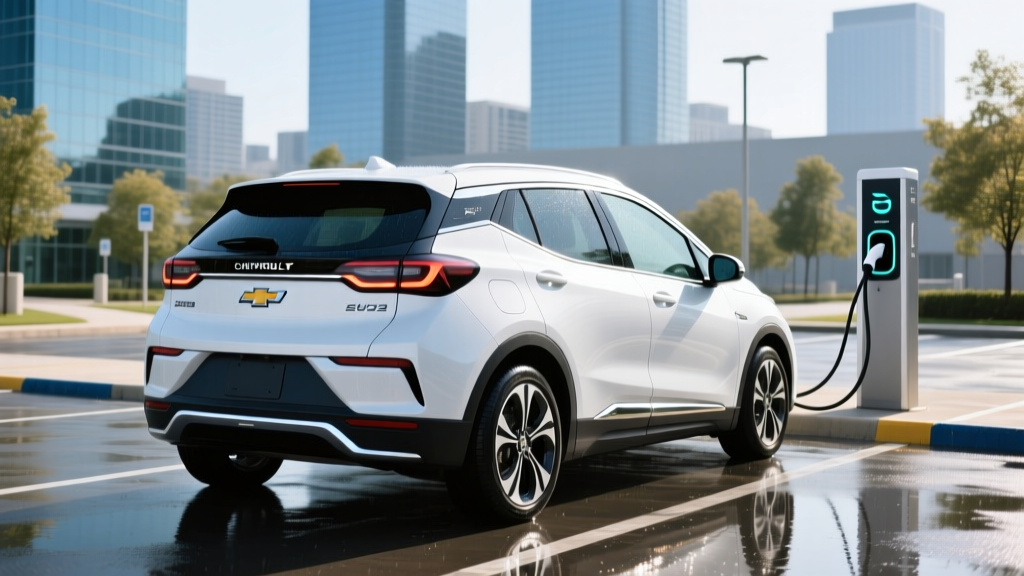
The 2023 Chevy Bolt EUV Premier occupies a strange place in the used-EV market. Originally launched as one of the most affordable electric crossovers in America — with a base MSRP that undercut nearly every rival — the Bolt EUV now lives exclusively on dealer lots as a pre-owned vehicle. Chevrolet discontinued the Bolt EUV after the 2023 model year to retool its Orion Assembly plant for next-generation Ultium-based EVs. But that discontinuation hasn't dimmed interest. If anything, the Bolt EUV Premier has become one of the most sought-after used EVs, especially since many 2023 models qualify for the up-to-$4,000 used-EV tax credit under IRS §25E.
This review covers the 2023 Bolt EUV Premier — the top-trim, fully loaded version — with a focus on what real ownership looks like in 2026: actual range on the highway, charging realities, battery health considerations, and whether it still makes financial sense against newer, faster-charging competitors.
Range, Battery & Efficiency: 247 EPA Miles in the Real World
| Spec | Value |
|---|---|
| EPA Range | 247 miles |
| Battery Capacity (usable) | 65 kWh (NMC lithium-ion) |
| Efficiency | 115 MPGe combined / 29 kWh/100 mi |
| Drivetrain | FWD, single-motor |
| Horsepower / Torque | 200 hp / 266 lb-ft |
| 0–60 mph | ~7.0 seconds |
| Max DC Fast Charge | 55 kW (CCS1) |
| Level 2 Charge Rate | 11.5 kW (48A) |
| Cargo Volume | 16.3 cu ft (rear seats up) / 56.9 cu ft (folded) |
| Base MSRP (2023) | $38,795 (Premier trim) |
| Battery Warranty | 8 years / 100,000 miles |
The 65 kWh NMC (nickel-manganese-cobalt) battery pack sits low in the chassis. It's a proven chemistry with good energy density, though NMC packs generally benefit from not being regularly charged to 100% for daily use — GM recommends setting a daily charge target of around 80–90% and saving full charges for longer trips. The battery management system includes a buffer (roughly 2–3 kWh below the gross capacity) to protect against deep discharge degradation.
According to fueleconomy.gov, the 2023 Bolt EUV achieves 115 MPGe combined (120 city / 108 highway). The city-biased efficiency advantage is typical of single-motor FWD EVs, where regenerative braking recovers significant energy in stop-and-go traffic.
Charging Speed: The Bolt EUV's Biggest Limitation
| Level | Power / Connector | Rate | 10–80% Time |
|---|---|---|---|
| Level 1 (120V) | ~1.4 kW / J1772 | ~4 mi/hr | ~55+ hours |
| Level 2 (240V) | 11.5 kW / J1772 | ~37 mi/hr | ~4.5 hours (full) |
| DC Fast Charge | 55 kW peak / CCS1 | ~155 mi/hr (peak) | ~50–55 minutes |
Here's where the Bolt EUV shows its age. The 55 kW peak DC fast-charge rate was acceptable when the Bolt platform debuted in 2017, but by 2023, competitors like the Hyundai Ioniq 5 (240 kW peak) and Kia EV6 (239 kW peak) made 55 kW look painfully slow. On a typical Electrify America or EVgo 150+ kW station, the Bolt EUV will peak near 55 kW and taper gradually, taking roughly 50 to 55 minutes to go from 10% to 80%. A full 10–100% session can stretch past 90 minutes.
The charge curve is relatively flat compared to newer platforms — the Bolt EUV sustains close to its peak rate through about 60% SoC before tapering — but the low ceiling means long road trips require patience. Plan for 30-minute meal breaks every 180–200 miles and you'll be fine. Expect anything faster, and you'll be frustrated.
At home, the story improves dramatically. The Bolt EUV's onboard charger supports 11.5 kW on Level 2 (48 amps on a 60-amp circuit), which is actually best-in-class for its price segment. That means a full overnight charge adds roughly 37 miles of range per hour of charging, easily replenishing a full day's driving in 2–3 hours. Most Bolt EUV owners report that home Level 2 charging makes the DC fast-charge limitation a non-issue for daily life.
Performance & Driving Impressions
The Bolt EUV Premier's single front-mounted motor produces 200 horsepower and 266 lb-ft of torque. That torque is available instantly from 0 RPM, which gives the EUV a punchy, responsive feel in city driving and merging situations. The 0–60 mph time of approximately 7.0 seconds is respectable — not thrilling, but quicker than many gas-powered compact SUVs in this class.
Ride quality is comfortable and compliant, tuned more for commuting comfort than sporty handling. The 2,900+ lb curb weight (heavier than the smaller Bolt EV hatchback due to the longer wheelbase and added content) gives it a planted feel at highway speeds. Steering is light and numb — typical of GM's electric power steering calibration — but perfectly adequate for its commuter-crossover mission.
Regenerative braking offers two modes: a lighter "Drive" mode that mimics conventional car coasting, and a stronger "Low" mode (selected via the shift lever) that provides more aggressive regen. There's also a steering-wheel paddle that activates one-pedal driving on demand, which many Bolt owners prefer for stop-and-go traffic. However, one-pedal driving in the Bolt EUV doesn't bring the vehicle to a complete hold — you'll still need the brake pedal at very low speeds, unlike some newer EVs with full stop-and-hold regen.
Interior, Tech & the Premier Trim Advantage
The Premier trim is where the Bolt EUV makes its strongest case as a daily driver. Key Premier-standard features include:
- Perforated leather-appointed seating with heated front seats and heated steering wheel
- 10.2-inch diagonal infotainment touchscreen with wireless Apple CarPlay and Android Auto
- 8-inch digital driver instrument cluster
- Bose premium 7-speaker audio system
- Wireless phone charging pad
- Adaptive cruise control (not available on base LT trim)
- HD Surround Vision 360-degree camera
- Super Cruise availability (optional on Premier; requires the $2,200 Technology Package)
Super Cruise deserves specific mention. When equipped, it provides hands-free driving on over 400,000 miles of compatible divided highways in the U.S. and Canada, using a combination of LiDAR-mapped HD data, real-time cameras, GPS, and a driver-attention monitoring camera on the steering column. This is an SAE Level 2 system — you must remain attentive and the system will not navigate interchanges, construction zones, or surface streets autonomously. But on long highway stretches, it's one of the most refined Level 2 systems available, rivaling Ford's BlueCruise in real-world reliability.
Cabin space is generous for a compact crossover. Rear legroom measures 39.1 inches — notably more than the standard Bolt EV hatchback (36.0 in) thanks to the EUV's 2.9-inch longer wheelbase. Front legroom is 40.9 inches. Headroom is adequate front and rear, though the panoramic sunroof (available on Premier via the Sun and Sound package) slightly reduces front headroom. The rear seats fold 60/40, expanding cargo from 16.3 to 56.9 cubic feet — competitive with the Hyundai Kona Electric and slightly behind the Volkswagen ID.4.
Pricing, Tax Credits & Used-EV Value in 2026
When new, the 2023 Bolt EUV Premier carried an MSRP of $38,795 (before destination). With the optional Technology Package (Super Cruise + enhanced ADAS), the Sun and Sound Package, and other add-ons, as-tested prices commonly reached $43,000–$45,000.
In 2023, new Bolt EUV buyers could claim the full $7,500 federal tax credit under IRS §30D, since the vehicle was assembled in Michigan, its battery components and critical minerals met sourcing thresholds, and it fell under the $80,000 SUV MSRP cap. That credit was available as a point-of-sale price reduction starting in 2024.
| Scenario | Credit | Key Rules |
|---|---|---|
| Bought new in 2023 | $7,500 (§30D) | Must meet income caps ($150K single / $300K joint), MSRP under $80K |
| Bought used in 2026 | Up to $4,000 (§25E) | 30% of sale price, max $4,000; income caps $75K single / $150K joint; vehicle must be ≥2 model years old; sale price ≤$25,000; purchased from a licensed dealer |
| Ineligible scenarios | $0 | Private-party purchases; sale price over $25K; buyer exceeds income caps; claiming credit for same VIN previously |
On the used market in early 2026, a well-maintained 2023 Bolt EUV Premier typically lists between $19,000 and $25,000 depending on mileage and condition. Models priced at or below $25,000 from a licensed dealer may qualify the buyer for the §25E used-EV credit — 30% of the sale price up to $4,000. A $22,000 purchase, for example, could yield a $4,000 credit (30% of $22,000 = $6,600, capped at $4,000). Always verify current eligibility through the IRS §25E guidelines and consult a tax professional before purchase.
Ownership Costs & Battery Longevity
GM backs the Bolt EUV's battery and powertrain with an 8-year / 100,000-mile warranty (whichever comes first), with a capacity retention threshold of 60% of original capacity. In practice, NMC batteries in the Bolt platform have shown strong longevity. Data aggregated from owner forums and fleet studies suggest typical degradation of approximately 8–12% over the first 100,000 miles, meaning a Bolt EUV with 50,000 miles might retain roughly 92–95% of its original 247-mile range. The thermal management system (liquid cooling and heating) plays a significant role in preserving battery health across climates.
Insurance costs for the Bolt EUV tend to be moderate — generally in line with compact crossovers, though slightly above comparable gas vehicles due to higher repair-cost estimates for EV-specific components. Expect annual premiums in the $1,400–$1,900 range depending on your state, driving record, and coverage level.
Maintenance is minimal: no oil changes, no spark plugs, no transmission fluid. The primary recurring costs are cabin air filter replacement (~$30–$50 annually), tire rotation, windshield washer fluid, and eventual tire replacement. The Bolt EUV's regenerative braking significantly extends brake pad life — many owners report original brake pads at 80,000+ miles.
Pros, Cons & Who Should Buy
Pros
- 247-mile EPA range — competitive with newer, pricier EVs
- 11.5 kW Level 2 onboard charger — among the fastest in its class
- Spacious rear seat (39.1" legroom) for a compact crossover
- Super Cruise availability (Premier w/ Tech Package)
- Strong value on the used market with §25E credit eligibility
- Low operating costs — minimal maintenance, cheap home charging
- Proven battery platform with strong real-world longevity data
Cons
- 55 kW DC fast charging — painfully slow for road trips
- No heat pump — significant cold-weather range loss
- Discontinued — no new models; parts/service dependent on existing dealer network
- CCS1 connector — not NACS (Tesla Supercharger network requires adapter, if available)
- Rear drum brakes (not discs) — unusual at this price point
- No frunk (front trunk) — all cargo is rear-mounted
- Infotainment can feel dated vs. 2025+ EV competitors
Not Ideal For: Frequent long-distance road trippers (the 55 kW DC charging is a dealbreaker), drivers in extreme cold climates without a garage (range loss is significant), or buyers who want the latest infotainment tech and NACS Supercharger access.
How It Compares: Bolt EUV Premier vs. Key Competitors
| Spec | 2023 Bolt EUV Premier | 2023 Hyundai Kona Electric | 2023 VW ID.4 Pro |
|---|---|---|---|
| EPA Range | 247 mi | 256 mi | 275 mi |
| Battery | 65 kWh NMC | 64 kWh NMC | 82 kWh NMC |
| DC Fast Charge Peak | 55 kW | ~75 kW | 135 kW |
| 10–80% DCFC Time | ~50 min | ~47 min | ~30 min |
| Level 2 Rate | 11.5 kW | 7.2 kW | 11 kW |
| 0–60 mph | ~7.0 sec | ~6.5 sec | ~7.7 sec |
| Cargo (rear seats up) | 16.3 cu ft | 19.2 cu ft | 30.3 cu ft |
| Typical Used Price (2026) | $19K–$25K | $20K–$26K | $22K–$29K |
The Bolt EUV's advantage is its Level 2 home charging speed (11.5 kW crushes the Kona's 7.2 kW) and its strong range relative to price. The Volkswagen ID.4 offers meaningfully faster DC charging and far more cargo space, but typically costs more on the used market — often above the §25E credit's $25,000 sale-price cap, which eliminates the $4,000 credit benefit.
Frequently Asked Questions
What is the real-world range of the 2023 Chevy Bolt EUV Premier?
EPA-rated at 247 miles, expect roughly 220–235 miles in real-world mixed driving, 200–215 miles on sustained highway trips, and as low as 170–195 miles in freezing temperatures. The lack of a heat pump makes cold-weather efficiency notably worse than competitors that include one.
How fast does the Bolt EUV charge at home and on DC fast chargers?
At home on a Level 2 (240V) charger, it charges at 11.5 kW — adding about 37 miles of range per hour and fully recharging overnight in roughly 6.5 hours. On DC fast chargers, it peaks at just 55 kW, requiring about 50–55 minutes for a 10–80% charge. This is the vehicle's most significant drawback for road-trip use.
Does the 2023 Bolt EUV qualify for a federal EV tax credit in 2026?
As a used vehicle, it may qualify for the IRS §25E used clean vehicle credit — up to $4,000 (30% of sale price) if purchased from a licensed dealer for $25,000 or less, and if the buyer meets income caps ($75,000 single / $150,000 joint). The original $7,500 §30D new-vehicle credit is no longer available since the model is discontinued. Verify eligibility on irs.gov and with a tax professional.
Is the Bolt EUV Premier worth buying vs. newer competitors?
If your driving is primarily commuting and daily errands with home charging, the Bolt EUV Premier offers outstanding range and value at $19,000–$25,000 used. However, if you road-trip frequently or need NACS/Tesla Supercharger access, consider a used Hyundai Ioniq 5, Kia EV6, or Ford Mustang Mach-E instead — all offer significantly faster DC charging at a moderate price premium.
What is the battery warranty and how long will the battery last?
GM covers the battery for 8 years / 100,000 miles with a 60% capacity retention guarantee. Real-world data from the Bolt platform suggests roughly 8–12% degradation over 100,000 miles with normal use. Many Bolt owners report excellent battery health well beyond 100,000 miles when following recommended charging practices (avoiding prolonged 100% SoC storage, using preconditioning).
Does the Bolt EUV have Super Cruise?
Super Cruise is available on the Premier trim only, as part of the optional Technology Package (~$2,200 when new). Not all Premier-trim vehicles were equipped with it — verify by checking for the light-bar on the steering wheel and the Super Cruise option code on the window sticker or vehicle build sheet. Super Cruise is an SAE Level 2 system requiring driver attention at all times.
Can the Bolt EUV use Tesla Superchargers?
The 2023 Bolt EUV uses a CCS1 connector. GM has announced NACS adapter availability for some models, but as of early 2026, Bolt owners should verify adapter compatibility and access with their local Chevrolet dealer. Even with an adapter, the 55 kW charge rate would remain the limiting factor on Supercharger stalls.